


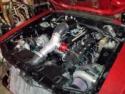




First Dyno Experience... :(

TECH Resident
Joined: Nov 2011
Posts: 812
Likes: 0
From: NJ

went to dyno day at the shop in town saturday and came out pretty dissappointed from my first dyno with my T/A. over all it ended up doing 256hp/314tq... and ITS A 2001 LS1..WTF it ran so lean that by the time it got to 6000rpm the ratio was at 18:1.. does it just need a good tune or is this something more serious?
and ITS A 2001 LS1..WTF it ran so lean that by the time it got to 6000rpm the ratio was at 18:1.. does it just need a good tune or is this something more serious?LEAN at high rpm can be many things. stick to basics first.....check your fuel filter, and pump. next would be be the fuel lines. often the stock fuel lines won't handle many modifications, and may need to be enlarged.
anything at all that restricts the fuel flow, can and will cause a lean condition at higher rpms. also, check your fuel pressure regulator.

TECH Fanatic
Joined: Feb 2006
Posts: 1,025
Likes: 1
From: CT/NJ
The car still has a catalytic converter on it, yes? Tailpipe wideband readings are worthless if so.
Go over the basics man. Fix your check engine light issues. Clean all of that excess oil out of the MAF and K&N. Give the car a tune up. Check for excessive backpressure in the exhaust. Check the clutch out etc.
Go over the basics man. Fix your check engine light issues. Clean all of that excess oil out of the MAF and K&N. Give the car a tune up. Check for excessive backpressure in the exhaust. Check the clutch out etc.
Catalytic Converter doesnt change air fuel by that much on the dyno....
both dynos locally that I use, I've verified that AFR is within .2 of being correct comapred to one in the pipe pre catalytic converter
and I've done this comparison multiple times....every time I do a car I get the customer an A/F reading from the dyno, but use my wideband in the front o2 bung to do the tuning
your Myth has been dispelled by hard cold facts and physically proof.

Catalytic Converter doesnt change air fuel by that much on the dyno....
both dynos locally that I use, I've verified that AFR is within .2 of being correct comapred to one in the pipe pre catalytic converter
and I've done this comparison multiple times....every time I do a car I get the customer an A/F reading from the dyno, but use my wideband in the front o2 bung to do the tuning
your Myth has been dispelled by hard cold facts and physically proof.
both dynos locally that I use, I've verified that AFR is within .2 of being correct comapred to one in the pipe pre catalytic converter
and I've done this comparison multiple times....every time I do a car I get the customer an A/F reading from the dyno, but use my wideband in the front o2 bung to do the tuning
your Myth has been dispelled by hard cold facts and physically proof.
 Yes, pre cat to aft cat was .02-.03, seen this over and over...
 TECH Fanatic
Joined: Feb 2006
Posts: 1,025
Likes: 1
From: CT/NJ
Catalytic Converter doesnt change air fuel by that much on the dyno....
both dynos locally that I use, I've verified that AFR is within .2 of being correct comapred to one in the pipe pre catalytic converter
and I've done this comparison multiple times....every time I do a car I get the customer an A/F reading from the dyno, but use my wideband in the front o2 bung to do the tuning
your Myth has been dispelled by hard cold facts and physically proof.
both dynos locally that I use, I've verified that AFR is within .2 of being correct comapred to one in the pipe pre catalytic converter
and I've done this comparison multiple times....every time I do a car I get the customer an A/F reading from the dyno, but use my wideband in the front o2 bung to do the tuning
your Myth has been dispelled by hard cold facts and physically proof.
LS1 Tech Stories
The Best V8 Stories One Small Block at Time

Topdon ONE vs. Artidiag 800 BT2: Which is the Diagnostic Tablet For You?
Pouria Savadkouei
Gas Monkey Built a 6-Wheel Ferrari Testarossa With a Corvette LT4 Engine
Verdad Gallardo
7 Most Reliable High-Performance Engines GM Has Ever Built
Verdad Gallardo
Amazing '71 Camaro Restomod Is Modern Muscle Car Under the Skin
Verdad Gallardo
6 Common C5 Corvette Failures and What's Involved In Repairing Them
Pouria Savadkouei
Retro Modern Bandit Pontiac Trans AM Comes With Burt Reynolds' Autograph
Verdad Gallardo
Top 10 Greatest Cadillac V Series Performance Models Ever, Ranked
Pouria Savadkouei
Top 10 Most Powerful Chevy Trucks Ever Made!

Hennessey's New Supercharged Silverado ZR2 Has 700 HP
Verdad Gallardo the narrow band O2 sensor does not actually measure oxygen concentration, but rather the difference between the amount of oxygen in the exhaust gas and the amount of oxygen in air. Rich mixture causes an oxygen demand which creates a voltage...
catalytic converters do not change the oxygen content in any way..... it converts the three main pollutants in automobile exhaust. It converts carbon monoxide (CO) and unburned hydrocarbons (HC), and a reduction reaction converts oxides of nitrogen (NOx) to produce carbon dioxide (CO2), nitrogen (N2), and water (H2O)
it doesn change the oxygen content...
it reduces the Demand for more oxygen to "balance the equation" so to speak
in your pre cat o2 it see's all the pollution gasses mixed in and the oxygen demand changes, creating a swing in voltage
at stoich, the pollution gasses are at a minimum..so the oxygen demand is "ideal" and you get a voltage in the 450mv range
when the Catalytic converter processes those pollution gasses...and converts them to other things, the oxygen demand is "ideal" again...creating a voltage in the 450mv range
when your cats fail and can no longer correct those pollution gasses, your rear o2's start to swing due to the new change in oxygen demand..when they go past a certain range a certain # of times, it sets an SES light to let you know
A wideband O2 is An electronic circuit containing a feedback loop controls the gas pump current to keep the output of the electrochemical cell constant, so that the pump current directly indicates the oxygen content of the exhaust gas
It will show the same oxygen content before and after the catalytic converter as it measures Actual Oxygen Content
typically you get just a few tenths of a point leaner at the tailpipe due to fresh air contamination from being so close to the exit point..
and I can repeat the example on any dyno in the country assuming their wideband is not old and out of calibration.
When you have done several hundred tunes...you tend to notice these things a little more than the end user who only knows what he has read on the internet where freedom of speech tends to let myths fly rampantly.
most people dont even know that their dual exhaust that comes from a Y pipe to a dual outlet, has tailpipes that will see different flows at different RPM's and one will read lean compared to the other.(next time you are on the dyno with your car... try a back to back pull in each pipe and notice the difference between the two)
From a Y-Pipe, a single outlet exhaust will typically do the exact same as a dual tip exhaust, and sometimes it will do better at higher rpm's... less turns inside the muffler = less restriction = more power..
Last edited by soundengineer; Feb 14, 2012 at 01:20 AM.
TECH Fanatic
Joined: Feb 2006
Posts: 1,025
Likes: 1
From: CT/NJ
I'm a little sorry I asked, didn't mean for you to go and type that much. This is what I wanted, really:
catalytic converters do not change the oxygen content in any way..... it converts the three main pollutants in automobile exhaust. It converts carbon monoxide (CO) and unburned hydrocarbons (HC), and a reduction reaction converts oxides of nitrogen (NOx) to produce carbon dioxide (CO2), nitrogen (N2), and water (H2O)
it doesn change the oxygen content...
it reduces the Demand for more oxygen to "balance the equation" so to speak
Now, I need to know, how do you make CO and HC into CO2 and H2O without using up O2? This is the most awesome chemical reaction I have ever heard of.
catalytic converters do not change the oxygen content in any way..... it converts the three main pollutants in automobile exhaust. It converts carbon monoxide (CO) and unburned hydrocarbons (HC), and a reduction reaction converts oxides of nitrogen (NOx) to produce carbon dioxide (CO2), nitrogen (N2), and water (H2O)
it doesn change the oxygen content...
it reduces the Demand for more oxygen to "balance the equation" so to speak
just because you have carbon dioxide, doesnt mean that the oxygen has dissappeared...its still there... cO2
it means that the catalytic converter has allowed bonding and break down of pollutants..when they bond to other chemicals, they are no longer toxic to our environment...
like an acid neutralizing a base...all the chemicals are still there...just re-arranged
the more HC and CO it makes, the more O2 your narrowband thinks it needs to balance the equation....
the wideband just says...oh... that much exists in this packet of gas
o2 demand vs actual O2
TECH Resident
Joined: Nov 2011
Posts: 812
Likes: 0
From: NJ
you realize it doesnt change the Oxygen content.. its still there, just bonded to other items...the amount of total O2 is still the same
just because you have carbon dioxide, doesnt mean that the oxygen has dissappeared...its still there... cO2
it means that the catalytic converter has allowed bonding and break down of pollutants..when they bond to other chemicals, they are no longer toxic to our environment...
like an acid neutralizing a base...all the chemicals are still there...just re-arranged
the more HC and CO it makes, the more O2 your narrowband thinks it needs to balance the equation....
the wideband just says...oh... that much exists in this packet of gas
o2 demand vs actual O2
just because you have carbon dioxide, doesnt mean that the oxygen has dissappeared...its still there... cO2
it means that the catalytic converter has allowed bonding and break down of pollutants..when they bond to other chemicals, they are no longer toxic to our environment...
like an acid neutralizing a base...all the chemicals are still there...just re-arranged
the more HC and CO it makes, the more O2 your narrowband thinks it needs to balance the equation....
the wideband just says...oh... that much exists in this packet of gas
o2 demand vs actual O2


Ok E=MC^2 and a^2 + b^2=C^2
Anyways, first order of business, a simple tune-up (plugs, wires, fuel filter, PCV, and air filter) Then clean your MAF with some electrical parts cleaner, or alcohol and cotton swab (just don't break the little wires) See how she does.
Then see what kind of fuel pressure you are getting at WOT like stated above to be positive you don't have a weak fuel pump.
Anyways, first order of business, a simple tune-up (plugs, wires, fuel filter, PCV, and air filter) Then clean your MAF with some electrical parts cleaner, or alcohol and cotton swab (just don't break the little wires) See how she does.
Then see what kind of fuel pressure you are getting at WOT like stated above to be positive you don't have a weak fuel pump.
I should have said actual molecules of oxygen instead of 02 for the wideband
while a narrow band looks for missing 02 to complete the equation
the wideband looks for actual total molecules of oxygen remaining
Co2 has two molecules of oxygen that were not consumed during combustion
I'm done with trying to teach you chemistry
while a narrow band looks for missing 02 to complete the equation
the wideband looks for actual total molecules of oxygen remaining
Co2 has two molecules of oxygen that were not consumed during combustion
I'm done with trying to teach you chemistry

TECH Fanatic
Joined: Feb 2006
Posts: 1,025
Likes: 1
From: CT/NJ
Why is that? Did you just realize that your argument is ridiculous? Never mind catalytic converters, O2 readings would never change at all no matter how rich or lean an engine was run if you were correct. The oxygen from the combustion process would still be there, just attached to Hydrogen, Carbon and Nitrogen molecules. Humans would be able to breathe under water too, lol. 
Yes!
Originally Posted by bjamick
Anyways, first order of business, a simple tune-up (plugs, wires, fuel filter, PCV, and air filter) Then clean your MAF with some electrical parts cleaner, or alcohol and cotton swab (just don't break the little wires) See how she does.

Clogged cats , oliy MAF , Bad fuel pump .
Sad to see that your 1st dyno experience is a bad one..
I dynoed 332rwhp 339rwtq with 98 Z28 A4 K&N Filter ,cutout and LS6 Intake stock tune.
13:4 A/F ratio.
Sad to see that your 1st dyno experience is a bad one..
I dynoed 332rwhp 339rwtq with 98 Z28 A4 K&N Filter ,cutout and LS6 Intake stock tune.
13:4 A/F ratio.

Why is that? Did you just realize that your argument is ridiculous? Never mind catalytic converters, O2 readings would never change at all no matter how rich or lean an engine was run if you were correct. The oxygen from the combustion process would still be there, just attached to Hydrogen, Carbon and Nitrogen molecules. Humans would be able to breathe under water too, lol.
Yes!
Yes!
our lungs dont have the ability to unbond oxygen from complex Molecules
the oxygen is still there... Fish(and some amphibians) have Gills that can filter our and breathe the dissolved o2 in the water...not the O2 in the H2O
In the case of hydrogen and oxygen gas, if you react them together one way you get liquid water (H2O). The reason we cannot breathe liquid water is because the oxygen used to make the water is bound to two hydrogen atoms, and we cannot breathe the resulting liquid. The oxygen is useless to our lungs in this form.
The oxygen that fish breathe is not the oxygen in H2O. Instead, the fish are breathing O2 (oxygen gas) that is dissolved in the water. Many different gases dissolve in liquids, and we see an example all the time in carbonated beverages. In these beverages, there is so much carbon dioxide gas dissolved in water that it rushes out in the form of bubbles.
Fish "breathe" the dissolved oxygen out of the water using their gills. It turns out that extracting the oxygen is not very easy -- air has something like 20 times more oxygen in it than the same volume of water. Plus water is a lot heavier and thicker than air, so it takes a lot more work to move it around. The main reason why gills work for fish is the fact that fish are cold-blooded, which reduces their oxygen demands. Warm-blooded animals like whales breath air like people do because it would be hard to extract enough oxygen using gills.
Humans cannot breathe underwater because our lungs do not have enough surface area to absorb enough oxygen from water, and the lining in our lungs is adapted to handle air rather than water. However, there have been experiments with humans breathing other liquids, like fluorocarbons. Fluorocarbons can dissolve enough oxygen and our lungs can draw the oxygen out
The oxygen that fish breathe is not the oxygen in H2O. Instead, the fish are breathing O2 (oxygen gas) that is dissolved in the water. Many different gases dissolve in liquids, and we see an example all the time in carbonated beverages. In these beverages, there is so much carbon dioxide gas dissolved in water that it rushes out in the form of bubbles.
Fish "breathe" the dissolved oxygen out of the water using their gills. It turns out that extracting the oxygen is not very easy -- air has something like 20 times more oxygen in it than the same volume of water. Plus water is a lot heavier and thicker than air, so it takes a lot more work to move it around. The main reason why gills work for fish is the fact that fish are cold-blooded, which reduces their oxygen demands. Warm-blooded animals like whales breath air like people do because it would be hard to extract enough oxygen using gills.
Humans cannot breathe underwater because our lungs do not have enough surface area to absorb enough oxygen from water, and the lining in our lungs is adapted to handle air rather than water. However, there have been experiments with humans breathing other liquids, like fluorocarbons. Fluorocarbons can dissolve enough oxygen and our lungs can draw the oxygen out
and ... there is actually a Fluid that has enough o2 dissolved in it for us to breathe it....
they use it in the medical field...it is especially useful for a very undeveloped premature baby who's lungs are not ready to breathe oxygen from the Air. the fluid carries enough Oxygen that it can be absobed thru an undeveloped lung until it can grow far enough to support life from air based breathing.(my mom worked in a hospital that did this treatment to extremely premature babies)
for the life of me I cant remember the name of it, but I remember its a tongue twister..LOL
I wish I had a good example is something you could understand for the difference of how a narrowband o2 works and how a wideband o2 works and why the catalytic converter doesnt change the amount of oxygen Atoms total......but until you take a Chemisty class...you will never understand how it works at a molecular level.
and hey...look...wikipedia can tell you exactly what I have already said..
http://en.wikipedia.org/wiki/Oxygen_sensor
im going to start by saying what ive been told then i need some feedback on what to do next. I was told that the cig/accy fuse also operated part of the ecm?
That fuse was blown at the time of the dyno.
I have since replaced the fuse with a higher 30 amp.
Now that i can plug in the obd reader it says SECONDARY AIR which is the air pump?
ive also been told the air pump is an emissions device, but does it effect the power?
OR will replacing that fuse that supposedly also runs the ecm fix my air/fuel problems and loss of power problem?
this is all in question form and im only stating what has been told to me.
That fuse was blown at the time of the dyno.
I have since replaced the fuse with a higher 30 amp.
Now that i can plug in the obd reader it says SECONDARY AIR which is the air pump?
ive also been told the air pump is an emissions device, but does it effect the power?
OR will replacing that fuse that supposedly also runs the ecm fix my air/fuel problems and loss of power problem?
this is all in question form and im only stating what has been told to me.