






Wheel weight robbing power?

Originally Posted by JakeFusion™
It definitely makes you slower.
Heavy wheels are the absolute worst thing to do to a performance car. Braking, handling, and acceleration are all significantly impacted.
Heavy wheels are the absolute worst thing to do to a performance car. Braking, handling, and acceleration are all significantly impacted.
yeah i could definately feel a very obvious difference, i just wasnt sure if it was phsycological or something.


Launching!
Joined: Nov 2005
Posts: 213
Likes: 0
the loss is a function of the angular acceleration of the wheel. if anyone wants to know the exact loss of their horsepower they can pm me. all ill need is the center of mass of the wheel, the weight of the wheel, the weight of the car, the horsepower at the wheels (and the weight of the wheels used when the hp was measured), and the gear you wish to calculate the loss at. as you shift into a higher gear, the parasitic loss becomes smaller and smaller. you might begin to realize that it is no small feat to accurately calculate the parasitic loss differences between wheels.
Originally Posted by Forced370GTO
the loss is a function of the angular acceleration of the wheel. if anyone wants to know the exact loss of their horsepower they can pm me. all ill need is the center of mass of the wheel, the weight of the wheel, the weight of the car, the horsepower at the wheels (and the weight of the wheels used when the hp was measured), and the gear you wish to calculate the loss at. as you shift into a higher gear, the parasitic loss becomes smaller and smaller. you might begin to realize that it is no small feat to accurately calculate the parasitic loss differences between wheels.
i PM'd you

You just need to take measurements of the wheel and tire combos.
First you need to know the weight and dimensions of the rim. Next, weigh the rim with the tire on it and however much air you usually keep in the tire.
Now for the equations:
I = 1/2 MR^2 (the "^2" denotes "to the second power" aka "squared")
This is the equation for a solid shere which you would use on the rim. Obviously, the rim isn't perfectly uniform, but this will give you a close enough estimation to be able to compare two different wheel/tire combos. M stands for the weight (do it in pounds) of just the rim and R (half the diameter of the rim) is the radius (do it in feet).
I = 1/2 M (R1^2 + R2^2)
This would be for the tire. You know the mass because it is the weight of the wheel and tire combo minus the weight of the wheel. R1 is the inner radius (which equals half the diameter of the rim) and R2 is half the diameter of the entire tire.
Add the two I's together and you get the moment of inertia (resistance to rotation) in pound feet. This is for one rim and tire which needs to be compared to the other type of rim and tire combination. Obviously, multiplying by 4 for each combo gives their total values.
First you need to know the weight and dimensions of the rim. Next, weigh the rim with the tire on it and however much air you usually keep in the tire.
Now for the equations:
I = 1/2 MR^2 (the "^2" denotes "to the second power" aka "squared")
This is the equation for a solid shere which you would use on the rim. Obviously, the rim isn't perfectly uniform, but this will give you a close enough estimation to be able to compare two different wheel/tire combos. M stands for the weight (do it in pounds) of just the rim and R (half the diameter of the rim) is the radius (do it in feet).
I = 1/2 M (R1^2 + R2^2)
This would be for the tire. You know the mass because it is the weight of the wheel and tire combo minus the weight of the wheel. R1 is the inner radius (which equals half the diameter of the rim) and R2 is half the diameter of the entire tire.
Add the two I's together and you get the moment of inertia (resistance to rotation) in pound feet. This is for one rim and tire which needs to be compared to the other type of rim and tire combination. Obviously, multiplying by 4 for each combo gives their total values.
I've done the math on this. I set up a 400rwhp car and guessed at a wheel wieght then added something like 15lbs to each rim in the worst possible spot (outer edge of rim). Turned out to be around a 4rwhp loss.
Its not something that is a rule of thumb. The hp loss would be greater in gears that spin up faster like 1st. I just did it in 4th with a data export from dynojet on a 400rwhp 6 speed f-body to get an idea on how it was affecting my dyno numbers. If anyone is interested I can email you the math as HTML or PDF as I did it with intentions of putting it on my website. email me at chipsATpcmforless.com and I'll reply back with it.
Its not something that is a rule of thumb. The hp loss would be greater in gears that spin up faster like 1st. I just did it in 4th with a data export from dynojet on a 400rwhp 6 speed f-body to get an idea on how it was affecting my dyno numbers. If anyone is interested I can email you the math as HTML or PDF as I did it with intentions of putting it on my website. email me at chipsATpcmforless.com and I'll reply back with it.
Originally Posted by LostCauseZ06
yeah i just find it somewhat hard to believe that 40 total pounds of rotational mass, and smaller diameter wheels, is only going to be about 5 RWHP difference??
ive seen guys post on here before about guys gaining 10-15 RWHP from just changing wheels but obviously that seems to be a load of bullshit now that the facts are out on the table.
these slicks weight freakin 2/3 the weight of the 19's... that is ALOT of rotational mass off the drivetrain. Oh well guess we will jsut have to stick it on the dyno and see.
ive seen guys post on here before about guys gaining 10-15 RWHP from just changing wheels but obviously that seems to be a load of bullshit now that the facts are out on the table.
these slicks weight freakin 2/3 the weight of the 19's... that is ALOT of rotational mass off the drivetrain. Oh well guess we will jsut have to stick it on the dyno and see.
LS1 Tech Stories
The Best V8 Stories One Small Block at Time

6 Common C5 Corvette Failures and What's Involved In Repairing Them
Pouria Savadkouei
Retro Modern Bandit Pontiac Trans AM Comes With Burt Reynolds' Autograph
Verdad Gallardo
Top 10 Greatest Cadillac V Series Performance Models Ever, Ranked
Pouria Savadkouei
Top 10 Most Powerful Chevy Trucks Ever Made!

Hennessey's New Supercharged Silverado ZR2 Has 700 HP
Verdad Gallardo
Coachbuilt N2A Anteros Is an LS2-Powered C6 Corvette In Italian Clothes
Verdad Gallardo
Awesome K5 Blazer Restomod Comes With C7 Corvette Power
Verdad Gallardo
10 Camaros You Should Never Buy

10 LS Engine Myths That Refuse to Die
Verdad Gallardo alvin.... i think your missing the main part of the formula and the proof.
its not the more weight that kill the power, its the bigger wheel diamerter. get a hammer and spin around in circles holding the handle, the weight is pretty crazy to get spinning. now hold it by the handle but move your hand up the handle considerably.
with a 19" wheel tire combo that weighs 20 lbs more than the new setup there is a HUGE difference in the amount of power to get it spinning. accelleration is jacked up hardcore. the power required to get the wheels themselves moving faster and faster robs HP's when on the dyno.
my setup is a little differnt than a most, i didnt just switch from heavy 16" wheels and tires to some lighter weight 16" wheels and tires..
i switched from 19" HEAVY chrome wheels with HEAVY tires, all of the weight of the tire is on the outside of the diameter of the wheel, then you have the outside lip/edge of the wheel, ALL of the weight on the wheel/tire combo it on the furthest outside edge of the diameter of the wheel. therefore is robs power pretty insanely.
the new setup is on 17's, the tires themselves are incredibly light and there isnt much mass outside of that 17" diameter.
somebody needs to go through and run a car on a dyno and then try every diameter of wheel but keep the overall weight about the same. i think the results would be pretty darn surprising. now go and also throw 20 lbs on the outside of the wheel on top of that and you will be in my situation.
my butt-o-meter registers quite a bit of an increase in power. i would honestly say it truly feels like a 10-15 RWHP increase. i was quite surprised. not to mention the amount of throttle to get the car going off lights and stuff from a stop seemed to be much less as well..
ill have to stick the car on the dyno and see what it truly is.
its not the more weight that kill the power, its the bigger wheel diamerter. get a hammer and spin around in circles holding the handle, the weight is pretty crazy to get spinning. now hold it by the handle but move your hand up the handle considerably.
with a 19" wheel tire combo that weighs 20 lbs more than the new setup there is a HUGE difference in the amount of power to get it spinning. accelleration is jacked up hardcore. the power required to get the wheels themselves moving faster and faster robs HP's when on the dyno.
my setup is a little differnt than a most, i didnt just switch from heavy 16" wheels and tires to some lighter weight 16" wheels and tires..
i switched from 19" HEAVY chrome wheels with HEAVY tires, all of the weight of the tire is on the outside of the diameter of the wheel, then you have the outside lip/edge of the wheel, ALL of the weight on the wheel/tire combo it on the furthest outside edge of the diameter of the wheel. therefore is robs power pretty insanely.
the new setup is on 17's, the tires themselves are incredibly light and there isnt much mass outside of that 17" diameter.
somebody needs to go through and run a car on a dyno and then try every diameter of wheel but keep the overall weight about the same. i think the results would be pretty darn surprising. now go and also throw 20 lbs on the outside of the wheel on top of that and you will be in my situation.
my butt-o-meter registers quite a bit of an increase in power. i would honestly say it truly feels like a 10-15 RWHP increase. i was quite surprised. not to mention the amount of throttle to get the car going off lights and stuff from a stop seemed to be much less as well..
ill have to stick the car on the dyno and see what it truly is.
Originally Posted by Louie83
You just need to take measurements of the wheel and tire combos.
First you need to know the weight and dimensions of the rim. Next, weigh the rim with the tire on it and however much air you usually keep in the tire.
Now for the equations:
I = 1/2 MR^2 (the "^2" denotes "to the second power" aka "squared")
This is the equation for a solid shere which you would use on the rim. Obviously, the rim isn't perfectly uniform, but this will give you a close enough estimation to be able to compare two different wheel/tire combos. M stands for the weight (do it in pounds) of just the rim and R (half the diameter of the rim) is the radius (do it in feet).
I = 1/2 M (R1^2 + R2^2)
This would be for the tire. You know the mass because it is the weight of the wheel and tire combo minus the weight of the wheel. R1 is the inner radius (which equals half the diameter of the rim) and R2 is half the diameter of the entire tire.
Add the two I's together and you get the moment of inertia (resistance to rotation) in pound feet. This is for one rim and tire which needs to be compared to the other type of rim and tire combination. Obviously, multiplying by 4 for each combo gives their total values.
First you need to know the weight and dimensions of the rim. Next, weigh the rim with the tire on it and however much air you usually keep in the tire.
Now for the equations:
I = 1/2 MR^2 (the "^2" denotes "to the second power" aka "squared")
This is the equation for a solid shere which you would use on the rim. Obviously, the rim isn't perfectly uniform, but this will give you a close enough estimation to be able to compare two different wheel/tire combos. M stands for the weight (do it in pounds) of just the rim and R (half the diameter of the rim) is the radius (do it in feet).
I = 1/2 M (R1^2 + R2^2)
This would be for the tire. You know the mass because it is the weight of the wheel and tire combo minus the weight of the wheel. R1 is the inner radius (which equals half the diameter of the rim) and R2 is half the diameter of the entire tire.
Add the two I's together and you get the moment of inertia (resistance to rotation) in pound feet. This is for one rim and tire which needs to be compared to the other type of rim and tire combination. Obviously, multiplying by 4 for each combo gives their total values.
If this is too much work and you guys want an example I can give you one.
Let's say we have a 16 inch rim that weighs 20 pounds with uniform weight distribution.
I = 17.78 pound feet
Let's say we have an 18 inch rim that weighs 30 pounds with uniform weight distribution.
I = 33.75 pound feet
Multiply that by 4 and you get about 71 pound feet to 135 pound feet. The difference is 64 pound feet which is huge. That is the resistance to rotation of the rims. This does not even include the tires, in which the larger radius of the 18" tire would make the results even more drastic.
Cliff notes: Wheel weight and diameter matters a crap load.
Originally Posted by LostCauseZ06
its not the more weight that kill the power, its the bigger wheel diamerter. get
the weight is because of the bigger diameter, still takes more power to move regardless of center mass..
the weight is nto necesarily because of the bigger diameter... the heavier /smaller diameter wheel SHOULD still perform better than a lighter/bigger diameter wheel.
Originally Posted by LostCauseZ06
the weight is nto necesarily because of the bigger diameter... the heavier /smaller diameter wheel SHOULD still perform better than a lighter/bigger diameter wheel.


TECH Regular
Joined: Mar 2006
Posts: 471
Likes: 0
From: Rolesville, NC
Good stuff Louis83. 
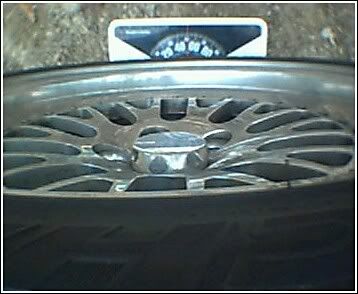
Here is my rear street wheel. CCW Classic street 18x12 with a Mich PS 18x335/30 at 51 lbs total. Tire is 33 lbs, rim is 18 lbs
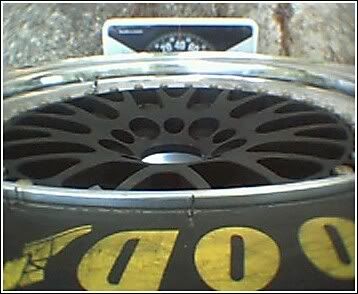
He is one of road race wheels. CCW Classic Track 18x13 with a GoodYear G19 18 x 11.5 x 25.5 at 39 lbs, tire 21 lbs rim 18 lbs
The difference to total weight is 12 lbs per rear wheel. about 11 lbs per front wheel. or 46 lbs total diffence between the street wheels and track wheels.
So if I understand these formula of the total wheel wt and diameter.
Street wheel: 51 lbs and 25.5" or 2.13 feet
I = 1/2M ( R1^2+R2^2)
R1^2 + R2^2 = 2.13 FEET ^2 = 4.54
1/2m = 51/2 = 25.5 LBS
I = 25.5 LBS * 4.54 FEET
I = 115.77 ft /lbs for ONE rear street wheel
Track wheel: 39 lbs and 25.5" or 2.13 feet
I = 1/2M ( R1^2+R2^2)
R1^2 + R2^2 = 2.13 FEET ^2 = 4.54
1/2m = 39 / 2 = 19.50 lbs
I = 19.50 * 4.54 feet
I = 88.53 lb ft for ONE rear track wheel
The difference is 115.77 - 88.53 = 27.24 pound ft for ONE rear wheel.
Rear wheels = 54.48 lb ft difference and lets just say 52 lb ft for the front wheels
or 106.48 lb ft diffence between my street and track wheels.
So could there be an estimate that every pound removed from rotational wt saves 2.5 lbs of static weight ?
Here is my rear street wheel. CCW Classic street 18x12 with a Mich PS 18x335/30 at 51 lbs total. Tire is 33 lbs, rim is 18 lbs
He is one of road race wheels. CCW Classic Track 18x13 with a GoodYear G19 18 x 11.5 x 25.5 at 39 lbs, tire 21 lbs rim 18 lbs
The difference to total weight is 12 lbs per rear wheel. about 11 lbs per front wheel. or 46 lbs total diffence between the street wheels and track wheels.
So if I understand these formula of the total wheel wt and diameter.
Street wheel: 51 lbs and 25.5" or 2.13 feet
I = 1/2M ( R1^2+R2^2)
R1^2 + R2^2 = 2.13 FEET ^2 = 4.54
1/2m = 51/2 = 25.5 LBS
I = 25.5 LBS * 4.54 FEET
I = 115.77 ft /lbs for ONE rear street wheel
Track wheel: 39 lbs and 25.5" or 2.13 feet
I = 1/2M ( R1^2+R2^2)
R1^2 + R2^2 = 2.13 FEET ^2 = 4.54
1/2m = 39 / 2 = 19.50 lbs
I = 19.50 * 4.54 feet
I = 88.53 lb ft for ONE rear track wheel
The difference is 115.77 - 88.53 = 27.24 pound ft for ONE rear wheel.
Rear wheels = 54.48 lb ft difference and lets just say 52 lb ft for the front wheels
or 106.48 lb ft diffence between my street and track wheels.
So could there be an estimate that every pound removed from rotational wt saves 2.5 lbs of static weight ?
Last edited by AU N EGL; Mar 4, 2007 at 08:35 AM.

I'm a full bolt-on LS1. I have 18" Y2K Corvette wheels with regular Goodyear tires. How much are these wheels gonna rob from me on the dyno?
Is it negligable or am I setting myself up for dissapointment on the dyno with these wheels?
Is it negligable or am I setting myself up for dissapointment on the dyno with these wheels?
Originally Posted by JKDZ28
I'm a full bolt-on LS1. I have 18" Y2K Corvette wheels with regular Goodyear tires. How much are these wheels gonna rob from me on the dyno?
Is it negligable or am I setting myself up for dissapointment on the dyno with these wheels?
Is it negligable or am I setting myself up for dissapointment on the dyno with these wheels?
if your going to be running around on those wheels/tires all the time and at the track then dont really worry about it. but like in my situation, if you are using slicks whenever your out racing then you will wanna know how much power your making with the wheels and tires you will be using.
at least thats the way i look at it.
are the Y2k's chrome ? go weigh them and then get back with us

TECH Regular
Joined: Mar 2006
Posts: 471
Likes: 0
From: Rolesville, NC
Rims:
18.08 lbs, front; 20.06 rear - 00 OEM standard, thin spoke, high polish
Tires:
23lbs, 265/40x17; 24.5 lbs, 275/40x18; 25.5 lbs, 295/35x18 - Goodyear F1 GS CS
27 lbs, 265/40R18; 28 lbs, 315/40R18 - Goodyear GS F1 SC
18.08 lbs, front; 20.06 rear - 00 OEM standard, thin spoke, high polish
Tires:
23lbs, 265/40x17; 24.5 lbs, 275/40x18; 25.5 lbs, 295/35x18 - Goodyear F1 GS CS
27 lbs, 265/40R18; 28 lbs, 315/40R18 - Goodyear GS F1 SC
Originally Posted by Louie83
If this is too much work and you guys want an example I can give you one.
Let's say we have a 16 inch rim that weighs 20 pounds with uniform weight distribution.
I = 17.78 pound feet
Let's say we have an 18 inch rim that weighs 30 pounds with uniform weight distribution.
I = 33.75 pound feet
Let's say we have a 16 inch rim that weighs 20 pounds with uniform weight distribution.
I = 17.78 pound feet
Let's say we have an 18 inch rim that weighs 30 pounds with uniform weight distribution.
I = 33.75 pound feet
M = 20lbs
R= 1/2 diameter = 8" = 0.67'
I = 1/2(20lbs)(0.67)² = 4.44 lbft
your calcs are off by a factor of 4 (2²).....