


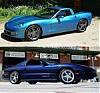



Wheel weight robbing power?

yep, you did 
lol
I figured out my 18" combo and I got considerably less than you did for the 16" rim and thought something was not right so I went back to yours and did my own calcs and then discovered you used the diameter.
lol
I figured out my 18" combo and I got considerably less than you did for the 16" rim and thought something was not right so I went back to yours and did my own calcs and then discovered you used the diameter.
Originally Posted by AU N EGL
Good stuff Louis83. 
Here is my rear street wheel. CCW Classic street 18x12 with a Mich PS 18x335/30 at 51 lbs total. Tire is 33 lbs, rim is 18 lbs
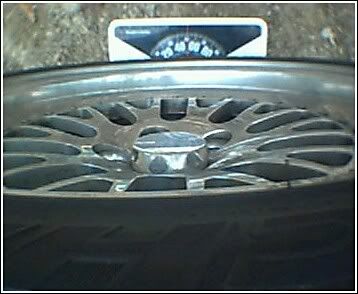
He is one of road race wheels. CCW Classic Track 18x13 with a GoodYear G19 18 x 11.5 x 25.5 at 39 lbs, tire 21 lbs rim 18 lbs
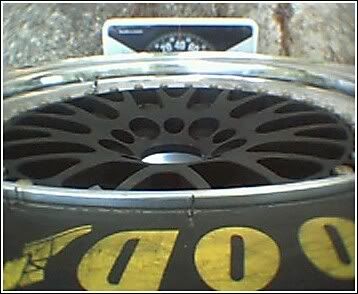
The difference to total weight is 12 lbs per rear wheel. about 11 lbs per front wheel. or 46 lbs total diffence between the street wheels and track wheels.
So if I understand these formula of the total wheel wt and diameter.
Street wheel: 51 lbs and 25.5" or 2.13 feet
I = 1/2M ( R1^2+R2^2)
R1^2 + R2^2 = 2.13 FEET ^2 = 4.54
1/2m = 51/2 = 25.5 LBS
I = 25.5 LBS * 4.54 FEET
I = 115.77 ft /lbs for ONE rear street wheel
Track wheel: 39 lbs and 25.5" or 2.13 feet
I = 1/2M ( R1^2+R2^2)
R1^2 + R2^2 = 2.13 FEET ^2 = 4.54
1/2m = 39 / 2 = 19.50 lbs
I = 19.50 * 4.54 feet
I = 88.53 lb ft for ONE rear track wheel
The difference is 115.77 - 88.53 = 27.24 pound ft for ONE rear wheel.
Rear wheels = 54.48 lb ft difference and lets just say 52 lb ft for the front wheels
or 106.48 lb ft diffence between my street and track wheels.
So could there be an estimate that every pound removed from rotational wt saves 2.5 lbs of static weight ?
Here is my rear street wheel. CCW Classic street 18x12 with a Mich PS 18x335/30 at 51 lbs total. Tire is 33 lbs, rim is 18 lbs
He is one of road race wheels. CCW Classic Track 18x13 with a GoodYear G19 18 x 11.5 x 25.5 at 39 lbs, tire 21 lbs rim 18 lbs
The difference to total weight is 12 lbs per rear wheel. about 11 lbs per front wheel. or 46 lbs total diffence between the street wheels and track wheels.
So if I understand these formula of the total wheel wt and diameter.
Street wheel: 51 lbs and 25.5" or 2.13 feet
I = 1/2M ( R1^2+R2^2)
R1^2 + R2^2 = 2.13 FEET ^2 = 4.54
1/2m = 51/2 = 25.5 LBS
I = 25.5 LBS * 4.54 FEET
I = 115.77 ft /lbs for ONE rear street wheel
Track wheel: 39 lbs and 25.5" or 2.13 feet
I = 1/2M ( R1^2+R2^2)
R1^2 + R2^2 = 2.13 FEET ^2 = 4.54
1/2m = 39 / 2 = 19.50 lbs
I = 19.50 * 4.54 feet
I = 88.53 lb ft for ONE rear track wheel
The difference is 115.77 - 88.53 = 27.24 pound ft for ONE rear wheel.
Rear wheels = 54.48 lb ft difference and lets just say 52 lb ft for the front wheels
or 106.48 lb ft diffence between my street and track wheels.
So could there be an estimate that every pound removed from rotational wt saves 2.5 lbs of static weight ?
for my rear 18x10.5 iForged rims and 295/30/18 PS2 tire....
rim:
M=23.5lbs
R=0.75'
I=6.61 lb ft
tire:
M=26lbs
R¹=0.75'
R²=1.04'
I=21.4 lb ft
for a total combo inertia of ~28 lb ft.....
I also think you would want to subtract the two radii of the tire and not add them........?? The tire is hollow and therefore you want to know the inertia of just tire and not part of the 'donut hole'. The way I see it, by adding them you are adding the inertia of an Xlb item with radius X to another with the same mass but different dia. I think you want to subtract the inertia of the tire 'hole' out of the equation.

Teching In
Joined: Dec 2005
Posts: 23
Likes: 0
From: Waveland, MS
Originally Posted by JR HAWK 9
I also think you would want to subtract the two radii of the tire and not add them........?? The tire is hollow and therefore you want to know the inertia of just tire and not part of the 'donut hole'. The way I see it, by adding them you are adding the inertia of an Xlb item with radius X to another with the same mass but different dia. I think you want to subtract the inertia of the tire 'hole' out of the equation.

6600 rpm clutch dump of death Administrator


Joined: Dec 2001
Posts: 4,983
Likes: 13
From: Texas
MOI is important. Slung or rotation mass is much more than static mass. Go read one of the mags where they pull the heavy 18-22" wheels off some ricer, and replace them with the stock 15" wheels. The car goes a second quicker in the quarter...
Now, with our cars, its isn't as drastic, but it does make a difference. Think about this. Go from a Factory 17-18" GM Truck/Suburban/Tahoe wheel to a factory 20" wheel and you loose at least 1MPG. More mass farther out eats up more energy.
Now, with our cars, its isn't as drastic, but it does make a difference. Think about this. Go from a Factory 17-18" GM Truck/Suburban/Tahoe wheel to a factory 20" wheel and you loose at least 1MPG. More mass farther out eats up more energy.

TECH Regular
Joined: Mar 2006
Posts: 471
Likes: 0
From: Rolesville, NC
Ok a Freind and I have been working on this one a bit more. Here is what we have caculated.
What effect does the lower weight of a race tire have on a car's
performance? This is a follow-up of some data that Tom and I were
kicking
around. The setup:
CCW + Michelin PS = 51 pounds
CCW + Hoosier slick = 39 pounds
The lighter combination will have less translational energy at speed,
and
less rotational energy as well. This impacts acceleration, braking,
and
cornering. How much?
The total wheel/tire energy is 1/2 mV^2 + 1/2 Iw^2 at speed.
I took some measurements of my own CCWs to roughly calculate the moment
of inertia I:
I (race setup) = 0.9168 lb*ft*s^2
I (street) = 1.1989 lb*ft*s^2
At 140mph (back straight at VIR), the energy stored in all 4 wheels/tires
is:
Street setup:
stored wheel energy = 133556 + 86140 foot-pounds
(translational+rotational
energy)
Track setup:
stored wheel energy = 102131 + 65871 foot-pounds (translational +
rotational
energy)
What does this all mean? Some fun facts:
The total energy stored in the wheels/tires is about 10% of the total
kinetic energy of the vehicle at 140mph (not counting
rotating/reciprocating drivetrain parts). This percentage drops as speed drops.
The energy difference between a street tire and a race tire gives the
race-tire equipped vehicle about an equivalent 5 rear-wheel horsepower
advantage on VIR's back straight. On slower straights, this advantage
decreases with speed.
The race setup is overall 48 pounds lighter than the street setup.
However, to the brakes on VIR's back straight, the race setup "feels" about 70 pounds lighter due to having to dissipate less rotational energy. This 70
pound number drops as speed drops. The effect will not be as great on a
100mph straight.
+ the race setup has less gyroscopic effet in corners. I didn't
calculate
that one Light tires do make a difference.
On longer high speed straights on road race ciruits there is a big difference. not to metion the effect of braking from high speeds,
What effect does the lower weight of a race tire have on a car's
performance? This is a follow-up of some data that Tom and I were
kicking
around. The setup:
CCW + Michelin PS = 51 pounds
CCW + Hoosier slick = 39 pounds
The lighter combination will have less translational energy at speed,
and
less rotational energy as well. This impacts acceleration, braking,
and
cornering. How much?
The total wheel/tire energy is 1/2 mV^2 + 1/2 Iw^2 at speed.
I took some measurements of my own CCWs to roughly calculate the moment
of inertia I:
I (race setup) = 0.9168 lb*ft*s^2
I (street) = 1.1989 lb*ft*s^2
At 140mph (back straight at VIR), the energy stored in all 4 wheels/tires
is:
Street setup:
stored wheel energy = 133556 + 86140 foot-pounds
(translational+rotational
energy)
Track setup:
stored wheel energy = 102131 + 65871 foot-pounds (translational +
rotational
energy)
What does this all mean? Some fun facts:
The total energy stored in the wheels/tires is about 10% of the total
kinetic energy of the vehicle at 140mph (not counting
rotating/reciprocating drivetrain parts). This percentage drops as speed drops.
The energy difference between a street tire and a race tire gives the
race-tire equipped vehicle about an equivalent 5 rear-wheel horsepower
advantage on VIR's back straight. On slower straights, this advantage
decreases with speed.
The race setup is overall 48 pounds lighter than the street setup.
However, to the brakes on VIR's back straight, the race setup "feels" about 70 pounds lighter due to having to dissipate less rotational energy. This 70
pound number drops as speed drops. The effect will not be as great on a
100mph straight.
+ the race setup has less gyroscopic effet in corners. I didn't
calculate
that one
Light tires do make a difference.On longer high speed straights on road race ciruits there is a big difference. not to metion the effect of braking from high speeds,
LS1 Tech Stories
The Best V8 Stories One Small Block at Time

6 Common C5 Corvette Failures and What's Involved In Repairing Them
Pouria Savadkouei
Retro Modern Bandit Pontiac Trans AM Comes With Burt Reynolds' Autograph
Verdad Gallardo
Top 10 Greatest Cadillac V Series Performance Models Ever, Ranked
Pouria Savadkouei
Top 10 Most Powerful Chevy Trucks Ever Made!

Hennessey's New Supercharged Silverado ZR2 Has 700 HP
Verdad Gallardo
Coachbuilt N2A Anteros Is an LS2-Powered C6 Corvette In Italian Clothes
Verdad Gallardo
Awesome K5 Blazer Restomod Comes With C7 Corvette Power
Verdad Gallardo
10 Camaros You Should Never Buy

10 LS Engine Myths That Refuse to Die
Verdad Gallardo
Originally Posted by AU N EGL
Ok a Freind and I have been working on this one a bit more. Here is what we have caculated.
What effect does the lower weight of a race tire have on a car's
performance? This is a follow-up of some data that Tom and I were
kicking
around. The setup:
CCW + Michelin PS = 51 pounds
CCW + Hoosier slick = 39 pounds
The lighter combination will have less translational energy at speed,
and
less rotational energy as well. This impacts acceleration, braking,
and
cornering. How much?
The total wheel/tire energy is 1/2 mV^2 + 1/2 Iw^2 at speed.
I took some measurements of my own CCWs to roughly calculate the moment
of inertia I:
I (race setup) = 0.9168 lb*ft*s^2
I (street) = 1.1989 lb*ft*s^2
At 140mph (back straight at VIR), the energy stored in all 4 wheels/tires
is:
Street setup:
stored wheel energy = 133556 + 86140 foot-pounds
(translational+rotational
energy)
Track setup:
stored wheel energy = 102131 + 65871 foot-pounds (translational +
rotational
energy)
What does this all mean? Some fun facts:
The total energy stored in the wheels/tires is about 10% of the total
kinetic energy of the vehicle at 140mph (not counting
rotating/reciprocating drivetrain parts). This percentage drops as speed drops.
The energy difference between a street tire and a race tire gives the
race-tire equipped vehicle about an equivalent 5 rear-wheel horsepower
advantage on VIR's back straight. On slower straights, this advantage
decreases with speed.
The race setup is overall 48 pounds lighter than the street setup.
However, to the brakes on VIR's back straight, the race setup "feels" about 70 pounds lighter due to having to dissipate less rotational energy. This 70
pound number drops as speed drops. The effect will not be as great on a
100mph straight.
+ the race setup has less gyroscopic effet in corners. I didn't
calculate
that one Light tires do make a difference.
On longer high speed straights on road race ciruits there is a big difference. not to metion the effect of braking from high speeds,
What effect does the lower weight of a race tire have on a car's
performance? This is a follow-up of some data that Tom and I were
kicking
around. The setup:
CCW + Michelin PS = 51 pounds
CCW + Hoosier slick = 39 pounds
The lighter combination will have less translational energy at speed,
and
less rotational energy as well. This impacts acceleration, braking,
and
cornering. How much?
The total wheel/tire energy is 1/2 mV^2 + 1/2 Iw^2 at speed.
I took some measurements of my own CCWs to roughly calculate the moment
of inertia I:
I (race setup) = 0.9168 lb*ft*s^2
I (street) = 1.1989 lb*ft*s^2
At 140mph (back straight at VIR), the energy stored in all 4 wheels/tires
is:
Street setup:
stored wheel energy = 133556 + 86140 foot-pounds
(translational+rotational
energy)
Track setup:
stored wheel energy = 102131 + 65871 foot-pounds (translational +
rotational
energy)
What does this all mean? Some fun facts:
The total energy stored in the wheels/tires is about 10% of the total
kinetic energy of the vehicle at 140mph (not counting
rotating/reciprocating drivetrain parts). This percentage drops as speed drops.
The energy difference between a street tire and a race tire gives the
race-tire equipped vehicle about an equivalent 5 rear-wheel horsepower
advantage on VIR's back straight. On slower straights, this advantage
decreases with speed.
The race setup is overall 48 pounds lighter than the street setup.
However, to the brakes on VIR's back straight, the race setup "feels" about 70 pounds lighter due to having to dissipate less rotational energy. This 70
pound number drops as speed drops. The effect will not be as great on a
100mph straight.
+ the race setup has less gyroscopic effet in corners. I didn't
calculate
that one
Light tires do make a difference.On longer high speed straights on road race ciruits there is a big difference. not to metion the effect of braking from high speeds,
I gave up as soon as I realized I used diameter instead of radius.

