


Will I notice a difference between 3" and 4" intercooler piping?


TECH Apprentice
Joined: Mar 2006
Posts: 361
Likes: 1
From: australia


Thanks for the link. I do it a little differently - the easier way.
Also, the way he does it isn't applicable if you have a turbo or supercharger on the car.
To figure out charge speed:
Engine Flow Naturally Aspirated = (((Cu In/1728) * RPM) / 2) * Volumetric Efficiency
so for my engine...
Engine Flow Naturally Aspirated = (((383 / 1728) * 6400) / 2) * 0.85
Engine Flow Naturally Aspirated = 602 CFM
Engine Flow Boosted = (Boost+14.67)/14.67 * Engine Flow Naturally Aspirated
so for my engine...
Engine Flow Boosted = (17 psi + 14.67 psi)/14.67 * 602 CFM
Engine Flow Boosted = 1299 CFM....about out of room with the D1
To figure pipe velocity:
Pipe Velocity = (Engine Flow Boosted / ((((Pipe Diameter^2)/4 * 3.14))/144))/60
so for my engine....
Pipe Velocity = (1299 CFM / ((((3in ^2)/4 * 3.14))/144)/60
Pipe Velocity = 441 fps
In an ideal world I would try and keep pipe velocities to no more than 100 fps. Above 100 fps you start to get out of the valley of the curve and head up the non-linear portion for pressure drop. However, I don't think this is very realistic in our world of 600+ HP.
I think going through the above math and adjusting your inlet piping accordingly makes sense for N/A application. I don't think it is realistic for most supercharger applications and I'm sure it is just splitting hairs with a turbo - so you spin your turbo a smidge faster....no biggie.
JMO.
Also, the way he does it isn't applicable if you have a turbo or supercharger on the car.
To figure out charge speed:
Engine Flow Naturally Aspirated = (((Cu In/1728) * RPM) / 2) * Volumetric Efficiency
so for my engine...
Engine Flow Naturally Aspirated = (((383 / 1728) * 6400) / 2) * 0.85
Engine Flow Naturally Aspirated = 602 CFM
Engine Flow Boosted = (Boost+14.67)/14.67 * Engine Flow Naturally Aspirated
so for my engine...
Engine Flow Boosted = (17 psi + 14.67 psi)/14.67 * 602 CFM
Engine Flow Boosted = 1299 CFM....about out of room with the D1
To figure pipe velocity:
Pipe Velocity = (Engine Flow Boosted / ((((Pipe Diameter^2)/4 * 3.14))/144))/60
so for my engine....
Pipe Velocity = (1299 CFM / ((((3in ^2)/4 * 3.14))/144)/60
Pipe Velocity = 441 fps
In an ideal world I would try and keep pipe velocities to no more than 100 fps. Above 100 fps you start to get out of the valley of the curve and head up the non-linear portion for pressure drop. However, I don't think this is very realistic in our world of 600+ HP.
I think going through the above math and adjusting your inlet piping accordingly makes sense for N/A application. I don't think it is realistic for most supercharger applications and I'm sure it is just splitting hairs with a turbo - so you spin your turbo a smidge faster....no biggie.
JMO.
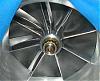
I would run the 3" and transition to 4" at the throttlebody. There is no need for 4" piping on a car that makes 700hp. You will not make more power, you will not make boost faster. On a turbo car, its all about air speed and efficiency. 4" is way to big on that combo. If it were my car, it would have 1 5/8" headers, 2 1/8" crossover, 4-4.5" downpipe, 3" IC pipes


So it would be 200ish fps not 400ish.

TECH Addict
Joined: Aug 2004
Posts: 2,866
Likes: 4

Small engine (say 2.0ltr 4 pot) and LOTS of boost the turbo might well flow enough air to meet those numbers, but on a 572 BBC they might strugle!
Chris.



Teching In
Joined: Jan 2021
Posts: 6
Likes: 2
From: Lakeport california
Intercooler piping size If a 75mm throttle body is used with 3" intercooler plumbing vs upping the throttle body size and piping. Would there be any advantage to this. My concern is a larger pipe increases overall volume between intercooler to tb and may take longer for turbo to compress that air space vs the smaller setup. Any thoughts!










