




real world data of air to air intercoolers. (flow)

Thread Starter
Staging Lane
Joined: Nov 2009
Posts: 85
Likes: 0
 real world data of air to air intercoolers. (flow)
 whos bought a ebay air to air intercoooler turned up the boost and then turned out the intercooler was a restriction?
i think that might be my problem, because i dont know what else is holding my power back.
80mm turbo. 3" charge pipe thew a ebay 31x12x4 intercooler (3" in/out) then 3" charge pipe to a stock throttle body and ls6 intake manifold. heads are trick flow cnc 225s.
im looking for 1100hp to the flywheel and thats about 900 wheel threw the auto. im a few hundred hp short.
thoughts?
i think that might be my problem, because i dont know what else is holding my power back.
80mm turbo. 3" charge pipe thew a ebay 31x12x4 intercooler (3" in/out) then 3" charge pipe to a stock throttle body and ls6 intake manifold. heads are trick flow cnc 225s.
im looking for 1100hp to the flywheel and thats about 900 wheel threw the auto. im a few hundred hp short.
thoughts?
Well I have the same size ebay intercooler and hp estimaters put me around 820 whp wtih my weight and ET that was with a PT88 and a 347.
We need more info on your set up to know if you think it is a problem. The only other thing you can do is get a presure reading from pre and post FMIC to know if it is causing your problems
We need more info on your set up to know if you think it is a problem. The only other thing you can do is get a presure reading from pre and post FMIC to know if it is causing your problems
What auto? How much boost? Ever had the motor dynoed N/A? I doubt the intercooler is the restriction.
Don't get too hung up on dyno numbers. I was disappointed with my dyno numbers and the car went low 9's consistantly.
Don't get too hung up on dyno numbers. I was disappointed with my dyno numbers and the car went low 9's consistantly.
Thread Starter
Staging Lane
Joined: Nov 2009
Posts: 85
Likes: 0
231/231 117+3
9 to 1
25psi
no dyno numbers yet going of mph at the track 3300lbs 150mph
my boost gauge gets it reading of the back of the manifold, i was thinking about adding another right off the turbo.
th400. 25psi. motor not dynoed n/a.
9 to 1
25psi
no dyno numbers yet going of mph at the track 3300lbs 150mph
Well I have the same size ebay intercooler and hp estimaters put me around 820 whp wtih my weight and ET that was with a PT88 and a 347.
We need more info on your set up to know if you think it is a problem. The only other thing you can do is get a presure reading from pre and post FMIC to know if it is causing your problems
We need more info on your set up to know if you think it is a problem. The only other thing you can do is get a presure reading from pre and post FMIC to know if it is causing your problems
th400. 25psi. motor not dynoed n/a.
Thread Starter
Staging Lane
Joined: Nov 2009
Posts: 85
Likes: 0
Trending Topics
LS1 Tech Stories
The Best V8 Stories One Small Block at Time

Retro Modern Bandit Pontiac Trans AM Comes With Burt Reynolds' Autograph
Verdad Gallardo
Top 10 Greatest Cadillac V Series Performance Models Ever, Ranked
Pouria Savadkouei
Top 10 Most Powerful Chevy Trucks Ever Made!

Hennessey's New Supercharged Silverado ZR2 Has 700 HP
Verdad Gallardo
Coachbuilt N2A Anteros Is an LS2-Powered C6 Corvette In Italian Clothes
Verdad Gallardo
Awesome K5 Blazer Restomod Comes With C7 Corvette Power
Verdad Gallardo
10 Camaros You Should Never Buy

10 LS Engine Myths That Refuse to Die
Verdad Gallardo
Five Reasons the Camaro Was the Most Pivotal Player in the Pony Car Wars 2.0
Brett Foote
The Ebay IC's with 3" in/outs realistically only have 2 5/8" in and outs. I could easily see them being a restriction above 800whp.
I actually cut mine off and welded on some 3.5" Vbands. My core is 24" x 12" x 4" thick (same as yours I think). My in/outs were the typical 2.625" I.D. dimensions. My power goals are eventually 1000whp. I did not feel comfortable with those small in and outs.
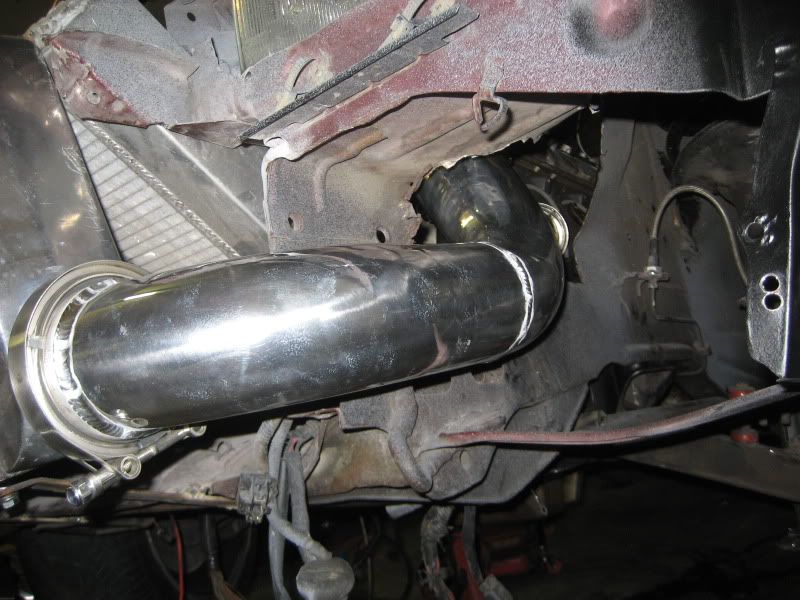
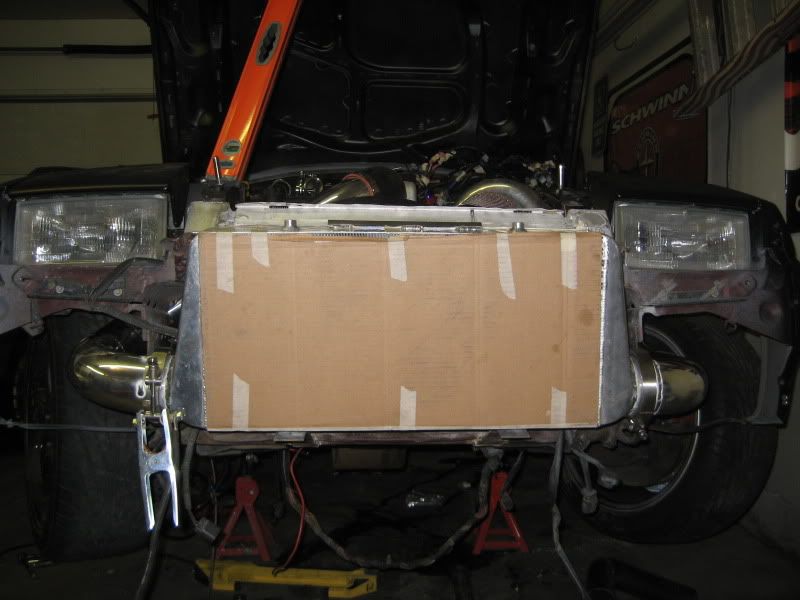
I actually cut mine off and welded on some 3.5" Vbands. My core is 24" x 12" x 4" thick (same as yours I think). My in/outs were the typical 2.625" I.D. dimensions. My power goals are eventually 1000whp. I did not feel comfortable with those small in and outs.


The Ebay IC's with 3" in/outs realistically only have 2 5/8" in and outs. I could easily see them being a restriction above 800whp.
I actually cut mine off and welded on some 3.5" Vbands. My core is 24" x 12" x 4" thick (same as yours I think). My in/outs were the typical 2.625" I.D. dimensions. My power goals are eventually 1000whp. I did not feel comfortable with those small in and outs.
I actually cut mine off and welded on some 3.5" Vbands. My core is 24" x 12" x 4" thick (same as yours I think). My in/outs were the typical 2.625" I.D. dimensions. My power goals are eventually 1000whp. I did not feel comfortable with those small in and outs.
Ive only had my car running a short time and made 2 decent runs before winter hit. My best was 141mph at race weight of 3700lbs, Weight/MPH calculate to 849hp. 370, E85, PT76GTS, glide, 18lbs of boost at 14 degrees timing. Still a little rich also was leaning it out, first pass went 137mph (10.5-7:1 A/F), then leaned it out and went 141mph (11.0:1), then leaned it more and started having traction issues off the line. I think the intercooler works great and its got a lot left in it.
Also I was only seeing 115 degree air intake going through the traps. It was a cool day, mid-low 60's out.
I was hesitant about this intercooler, I considered buying 2 of the 3" thick ones and welding them together and making custom end tanks. I left plenty of room where I mounted my intercooler in case i had to do this.. As of now this one seems to be doing fine.
A way you can check is get another boost gauge and see what the pressure is before the intercooler. If you dont have one... wherever your boost is referenced for the wastegate/controller (intake?) if it is, hook it up to before the intercooler.. since your now referencing boost there if your intercooler is restrictive make a pass and log it and see how much your car slows down.. Say referenced at the intake the intake sees 15psi, the turbo could be pumping out 20psi. so if you reference before the cooler at 15psi... your intake might only see 10psi. Your mph difference can help you tell how much power you are losing. Make sense?
The in/outs were cast into the end tanks (like most). The O.D. of the in and outs was 3", which allowed a 3" pipe to fit right up against it and a silicone coupler to slide over each very nicely. But the wall of that cast section was very thick, (3/16" to be exact) which left me only 2 5/8" I.D.
I ran mine on my 3.0 liter pushing 22psi making about 600whp. I didn't feel that the IC was a restriction at that point. However, I feel that trying to make over 800whp on 2 5/8" I.D. pipe is going to prove to be a restriction.
Also, if the 2 5/8" IS NOT a restriction at 800whp... Then I definitely won't have anything to worry about with my 3.5" piping at 1000whp. My 3.5" O.D. pipe actually measures 3.375" I.D.
What was the I.D. of your in and outs? You said you KNOW it wasn't that small, but do you remember what it was actually?

I have a buddy with one of those intercoolers on his SBF PT88 car, they pulled it just to see what it would do and went from 22ish psi to 27ish psi on his car but didn't run any faster, IAT's with the cooler were in the 140-160 degree range, and hot enough to max out and melt the IAT sensor without LOL, never hurt a thing though.. E85 FTW. The car traps 123+ @ 3300+ lbs in the 1/8.


You guys also have to take into account that as the intercooler cools the air temperature, the pressure will drop, it's Boyle's Law, P*V = nRT. So as the temperature drops on the right side of the equation, either the pressure or the volume of air has to drop as well.
So to really be accurate, you not only need to measure the pressure prior to the intercooler, you also need to measure the temperature on both sides of the intercooler.
Isn't a larger volume of air what we are all searching for, not so much more pressure, but a larger volume of air?
So to really be accurate, you not only need to measure the pressure prior to the intercooler, you also need to measure the temperature on both sides of the intercooler.
Isn't a larger volume of air what we are all searching for, not so much more pressure, but a larger volume of air?


You guys also have to take into account that as the intercooler cools the air temperature, the pressure will drop, it's Boyle's Law, P*V = nRT. So as the temperature drops on the right side of the equation, either the pressure or the volume of air has to drop as well.
So to really be accurate, you not only need to measure the pressure prior to the intercooler, you also need to measure the temperature on both sides of the intercooler.
Isn't a larger volume of air what we are all searching for, not so much more pressure, but a larger volume of air?
So to really be accurate, you not only need to measure the pressure prior to the intercooler, you also need to measure the temperature on both sides of the intercooler.
Isn't a larger volume of air what we are all searching for, not so much more pressure, but a larger volume of air?
Actually, I just thought about it, and you're right. The volume is a constant, and the pressure on the inlet side is a constant, so the issue then is flow rate, or how efficiently the intercooler can cool and allow air to move through the system.
I'm not familiar with specifically how an air to water intercooler is built, or it's inner workings, but I'm guessing that a lot what it works so well is the thermal capacity of water is far greater than just that of aluminum for an air to air intercooler. So you need less surface area or 'restriction' in order to get a larger thermal exchange.

I did a test about a year ago and half ago with a procharger intercooler and a 12x24x3.
I posted the results on here I m pretty sure. It was interesting, and not what I expected at all. The iats, changed, the overall boost pressure changed....several psi, but the power stayed almost exactly the SAME. It was a low boost 540 on a mustang dyno. It was controlled by a fast xfi also, same af ratio.
That test actually started my developement of an intercooler dyno....measured heated air, to get the temp drop, and the pressure drop. Its not easy. Turns out an engine is the best way...
I posted the results on here I m pretty sure. It was interesting, and not what I expected at all. The iats, changed, the overall boost pressure changed....several psi, but the power stayed almost exactly the SAME. It was a low boost 540 on a mustang dyno. It was controlled by a fast xfi also, same af ratio.
That test actually started my developement of an intercooler dyno....measured heated air, to get the temp drop, and the pressure drop. Its not easy. Turns out an engine is the best way...
The volume of the inside of the pressurized side is a constant. Think of it this way. As the pressure inside the intercooler drops, the compressor is then able to push more into the intercooler.
Actually, I just thought about it, and you're right. The volume is a constant, and the pressure on the inlet side is a constant, so the issue then is flow rate, or how efficiently the intercooler can cool and allow air to move through the system.
I'm not familiar with specifically how an air to water intercooler is built, or it's inner workings, but I'm guessing that a lot what it works so well is the thermal capacity of water is far greater than just that of aluminum for an air to air intercooler. So you need less surface area or 'restriction' in order to get a larger thermal exchange.
Actually, I just thought about it, and you're right. The volume is a constant, and the pressure on the inlet side is a constant, so the issue then is flow rate, or how efficiently the intercooler can cool and allow air to move through the system.
I'm not familiar with specifically how an air to water intercooler is built, or it's inner workings, but I'm guessing that a lot what it works so well is the thermal capacity of water is far greater than just that of aluminum for an air to air intercooler. So you need less surface area or 'restriction' in order to get a larger thermal exchange.

The pressure drop across the core will give you the answer. If you drop 10psi across that core, you've got problems and I'm not even going to argue about Boyle. If you have a big pressure drop, it's the intercooler.
If you have a huge pressure ratio pre and post turbine housing, that's a contributing factor too.
If you have a huge pressure ratio pre and post turbine housing, that's a contributing factor too.