





408 stroker with twins

9 Second Club
Joined: Nov 2003
Posts: 13,616
Likes: 185
From: Norn Iron

Obviously there are compromises with every build, and as said many times before, not all wheels of the same diameter offer equal performance.

TECH Fanatic
Joined: Nov 2001
Posts: 1,027
Likes: 2
From: KS
My comment was really meant for the overkill guys. I know you like to nitpick everyone's threads but guys will post the question "what twins for 1000 RWHP" and the response is usually a pair of 70 something's. I won't argue there are better wheel designs/packages vs. others. And a guys whole combination is really the key. The word here should be "pressure ratio!"
9 Second Club
Joined: Nov 2003
Posts: 13,616
Likes: 185
From: Norn Iron
My comment was really meant for the overkill guys. I know you like to nitpick everyone's threads but guys will post the question "what twins for 1000 RWHP" and the response is usually a pair of 70 something's. I won't argue there are better wheel designs/packages vs. others. And a guys whole combination is really the key. The word here should be "pressure ratio!"
More like "efficiency"
I'm sure some of the cheap chinese 76mm units might perform worse than say a quality branded 67mm unit
On the other hand a quality 76mm unit could make the power with less boost, less heat, and generally far more efficiently than much smaller units.
If it's a drag car that never sees low rpm, spool is never an issue. So it would make no sense to go for the smaller units.
On the other hand if it is a street car, you need good boost response, fast spool etc etc, then smaller units and being prepared to overwork them a little would make more sense.
I would never opt for the smallest unit that might work, but on the other hand I'd never opt for the biggest. It really does just depend on the overall goals. A single power number just isnt enough, as there might be dozens of turbos that will make that number, but be totally different to actually use and drive with.
Even across a brand like Turbonetics, they must have about 6 different types of 76mm wheel with a big difference in power claims from them.
TECH Fanatic
Joined: Nov 2001
Posts: 1,027
Likes: 2
From: KS
Agreed. I guess I still think this mainly is a street car group who goes to the track. But most of the advice given is geared towards a drag setup and your post points out there would be a different recommendation given for each purpose. No doubt about it so again, not arguing.
I went with Comp 7275s .84 A/R for twin turbo 408ci build with manual ZO6 hoping for 1400+rwhp on kill and close to 1000rwhp on pump low boost
But if you're looking for 800rwhp with auto GT35r .81A/R will easily will make those numbers.
But if you're looking for 800rwhp with auto GT35r .81A/R will easily will make those numbers.
FWIW, i have a 390ci, specd tick performance cam, RPM 4L80e, VIG 3600stall, ported 317 heads, and a pair of T-netics TC66's which are 66mm compressor/65mm turbine on .68 a/r, and Jose at Forced inductions assured me they would make 1000rwhp(which is the goal) easily. im only lookin to spin the the motor to 6500rpm. this is in a full weight street car, and will be ran on E85.

FormerVendor
Joined: Feb 2011
Posts: 547
Likes: 1
Here is a Typhoon that Speed Inc built with a 400+ inch LS motor with a pair of GT35's and a air to water intercooler. I think in runs in the high 9's. That AWD Typhoon is over 4000 lbs to boot! If this combo was in an F-Body it would run 9.50's with ease.

FormerVendor
Joined: Dec 2001
Posts: 2,444
Likes: 2
From: WWW.SPEEDINC.COM
Thanks Chris, Dans Typhoon does run nice. It has trapped as high as 149 I believe?
I had twin 35R's on an APS 07 Z06 that trapped 153.5.
Personally I would run close to the smallest turbo capable of the goal as I prefer faster response.
3582R or 6165 as mentioned would be on point for an easy 800rwhp and 1krw capability if pushed.
I had twin 35R's on an APS 07 Z06 that trapped 153.5.
Personally I would run close to the smallest turbo capable of the goal as I prefer faster response.
3582R or 6165 as mentioned would be on point for an easy 800rwhp and 1krw capability if pushed.
LS1 Tech Stories
The Best V8 Stories One Small Block at Time

Topdon ONE vs. Artidiag 800 BT2: Which is the Diagnostic Tablet For You?
Pouria Savadkouei
Gas Monkey Built a 6-Wheel Ferrari Testarossa With a Corvette LT4 Engine
Verdad Gallardo
7 Most Reliable High-Performance Engines GM Has Ever Built
Verdad Gallardo
Amazing '71 Camaro Restomod Is Modern Muscle Car Under the Skin
Verdad Gallardo
6 Common C5 Corvette Failures and What's Involved In Repairing Them
Pouria Savadkouei
Retro Modern Bandit Pontiac Trans AM Comes With Burt Reynolds' Autograph
Verdad Gallardo
Top 10 Greatest Cadillac V Series Performance Models Ever, Ranked
Pouria Savadkouei
Top 10 Most Powerful Chevy Trucks Ever Made!

Hennessey's New Supercharged Silverado ZR2 Has 700 HP
Verdad Gallardo


9 Second Club
Joined: Nov 2003
Posts: 13,616
Likes: 185
From: Norn Iron
But that is the other aspect too.
Using bigger blowers not only gives them an easier life, but you can also make more power whilst giving the engine less of a hard time.
as long as they can provide that power in the rpm band you need it
Using bigger blowers not only gives them an easier life, but you can also make more power whilst giving the engine less of a hard time.
as long as they can provide that power in the rpm band you need it

Here is a Typhoon that Speed Inc built with a 400+ inch LS motor with a pair of GT35's and a air to water intercooler. I think in runs in the high 9's. That AWD Typhoon is over 4000 lbs to boot! If this combo was in an F-Body it would run 9.50's with ease.
SPEED INC AWD TT LSX STREET CAR - YouTube
SPEED INC AWD TT LSX STREET CAR - YouTube
Chris,the Typhoon your speaking of is mine,it has already gone 149 like INTMD8 posted and has ET'd 9.50's.In my opinion it is the perfect compromise of HP and lag,the 2nd of which is almost non existent.At 10.5 psi it makes 799hp on 93 octane turned up,not maxed out just turned up to 18psi it made just shy of 1k hp,to me it I couldn't be happier.Although they are a relatively small impeller size they make very good power through out the RPM range and as proven have the ability to make great over-all numbers.I am in total agreement with you on the turbo sizing,there is no reason if your goals are near the 1k level to run anything larger,that is unless your goals are to have a laggy POS


I see your a blower guy, how many twin set ups have you done?
9 Second Club
Joined: Nov 2003
Posts: 13,616
Likes: 185
From: Norn Iron
Are you saying two small turbos will be safer and more efficient than two larger turbos for the same overall power output ?
Perhaps my use of the word "blowers" did confuse a little. But clearly the thread is about turbochargers, and is what I was referring to.
A "blower" can be any form of compressor or air mover really.
And who said I'm a "blower" guy ? I've been building my own turbocharged cars and others for some 20 years.
Last edited by stevieturbo; Jan 31, 2014 at 03:42 AM.
TECH Fanatic
Joined: Nov 2001
Posts: 1,027
Likes: 2
From: KS
Might be time to stop arguing because INTMD8 and Chris@CBR have been doing the same thing...building turbo cars since before they were so popular. Your arguing against these guys and me earlier that small twins are "over worked" to produced the larger power numbers. And you can't argue spool time, but ask yourself ... How hard are they really working when this Typhoon mentioned and my car make near 1000 RWHP at no more than 18 psi?
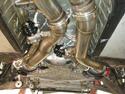


We just had a guy make over 800whp on a SINGLE PT 7275 .81 T4 in that rear mount stock 5.3 engine vette. Yea we need two of those on a street car for sure. I'm sure it will feel great in a stick car, no shift lag at all. Nothing better than watching a street car at the track take 10 seconds to spool up a poorly matched turbo to the combo. I understand how the low backpressure and cool boost of the larger turbos will be easier on the engine so to speak, but thats just total overkill. If your setup can do say 1000-1200whp maxed on on e85 or race gas and you run it a 800-900whp everything should still be quite happy for a long long time.
Last edited by slowride; Jan 31, 2014 at 02:07 PM.
9 Second Club
Joined: Nov 2003
Posts: 13,616
Likes: 185
From: Norn Iron
Might be time to stop arguing because INTMD8 and Chris@CBR have been doing the same thing...building turbo cars since before they were so popular. Your arguing against these guys and me earlier that small twins are "over worked" to produced the larger power numbers. And you can't argue spool time, but ask yourself ... How hard are they really working when this Typhoon mentioned and my car make near 1000 RWHP at no more than 18 psi?
Nobody is arguing, I'm just stating simple facts. Boost vs Boost, airflow vs airflow, power vs power etc the larger unit will move more air and it will do it more efficiently compared with an undersized compressor.
And as Ive said countless times before and maybe you've missed it, turbo choice will always be a compromise of some sort when aiming for big power, but wanting fast spool.
Of course smaller units will spool faster. Out of interest, how fast do they spool ? Are they making full boost by 2000, 3000, 4000rpm ?
What sort of rpm range does the engine make good power ? And what sort of rpm range is typically going to be used ?
As for how hard smaller units are working you just need to look at compressor maps and see how far off the right of the map these smaller units will be on bigger motors.
FormerVendor
Joined: Dec 2001
Posts: 2,444
Likes: 2
From: WWW.SPEEDINC.COM
Well fwiw a 3582r is a 61.4mm compressor wheel that can move 65lbs/min.
On 400-427 it will be over 800rwhp at 10psi on an M6 with peak boost around 4000rpm with a .82 housing and very fast part throttle response.
They will also do 1000 wheel and be very reliable. We've never failed a GT series Garrett, even units that were ran at their limits for years.
That being said it does come down to personal preference. I would rather run turbo's that don't have a ton of overhead so I have the best response possible for a given power level, resulting in the most average power.
Especially if running a factory block where you just aren't going to take advantage of 1600++++hp worth of turbos.
On 400-427 it will be over 800rwhp at 10psi on an M6 with peak boost around 4000rpm with a .82 housing and very fast part throttle response.
They will also do 1000 wheel and be very reliable. We've never failed a GT series Garrett, even units that were ran at their limits for years.
That being said it does come down to personal preference. I would rather run turbo's that don't have a ton of overhead so I have the best response possible for a given power level, resulting in the most average power.
Especially if running a factory block where you just aren't going to take advantage of 1600++++hp worth of turbos.
9 Second Club
Joined: Nov 2003
Posts: 13,616
Likes: 185
From: Norn Iron
A While back a car i was working on we did an almost back to back test from an old 6262 vs 6266CEA turbo on a 4cyl turbo, both running up to 35psi boost.
Performance wise the difference between the two turbos was night and day. Spool was identical though, and backpressure on the 6266CEA was almost 1:1 with boost, whereas the 6262 was around 1.5:1 vs boost.
The 6266CEA was superior in every way, and clearly more efficient too.. Same T4 A/R housing etc.
You dont need a ton of overhead, but it does make sense to try and use the most efficient unit you can.. But again it does come back to the problem of there being so much choice these days, with literally dozens of turbo sizes etc.
A friend here in the UK has a pair of GT35's on his 427, although he is making full boost by 3000rpm with the larger 1.06 housings. His dyno'd somewhere around the 1k mark on a Dynojet
FormerVendor
Joined: Dec 2001
Posts: 2,444
Likes: 2
From: WWW.SPEEDINC.COM
Sure the technology is a huge part of it and as you saw, compressor to turbine ratio which is pretty much ideal on a 3582R and very nice on the 6266 as well.
A lot of this stuff doesn't have enough turbine wheel which is why I hate the TC series. TC76 has slower response than the same turbo with a 75mm turbine as it just doesn't have enough torque to drive the compressor.
And again, a lot of this just comes down to preference. Some guys like huge choppy cams and the huge hit of a laggy turbo. I personally like super fast low rpm response and a smooth idle.
I think it's hard for many to make these decisions because they may have never even driven a turbo LSX car and some of the characteristics are hard to explain unless you have driven many different combos.
A lot of this stuff doesn't have enough turbine wheel which is why I hate the TC series. TC76 has slower response than the same turbo with a 75mm turbine as it just doesn't have enough torque to drive the compressor.
And again, a lot of this just comes down to preference. Some guys like huge choppy cams and the huge hit of a laggy turbo. I personally like super fast low rpm response and a smooth idle.
I think it's hard for many to make these decisions because they may have never even driven a turbo LSX car and some of the characteristics are hard to explain unless you have driven many different combos.