







LS 6.0 compound turbos?
Thread Starter
Teching In
Joined: Aug 2014
Posts: 25
Likes: 0
From: Minnesota
 LS 6.0 compound turbos?
 so i come from the diesel world where anything over a large single, you get into compounds.
so i am curious if doing compounds on an LS would work well, or be more trouble that its worth. has anyone done this? im looking for the best daily driven street/strip combo that would get me in the 9's and maintain stock bottom end. new to this turbo ls stuff, so talk slow please
so i am curious if doing compounds on an LS would work well, or be more trouble that its worth. has anyone done this? im looking for the best daily driven street/strip combo that would get me in the 9's and maintain stock bottom end. new to this turbo ls stuff, so talk slow please
depending on the car specs (wieght, suspension, traction) a decent size single turbo on a 6.0 should push you into the 9s pretty easy if you can call running 9s easy. a compound set up would be gross over kill for your goals and doesnt really belong in the same build as a stock bottom end.
Thread Starter
Teching In
Joined: Aug 2014
Posts: 25
Likes: 0
From: Minnesota
alright cool, all i needed to know. next question, what would work the best for a street strip car, a larger single, or twins? i wouldnt really want to sacrifice much on the top end, but would like the car to spool rather quick. well again, im used to my diesel that needs the charger to more it basically, so i guess i dont really know how big of an issue lag would be on an LS.
ok I know why you are thinking this way as I have twins on my truck but you have to remember diesels are way more limited in the rpm range. Basically only around 3k of useable rpm starting at like 1500.. so using a small charger to get spooled and to make a bigger charger think its on a bigger motor for the volume..
ok gasser world.. You wont or don't loose much pre boost.. so your 6.0 will still basically run like a n/a 6.0 until it sees boost.. then its like a whole different animal..
so a 475 will get you into the 9's I would think very easy and will be spooled in a good turbo cammed 6.0 by 3k.. just make sure you do the rest of the combination that all works together (like a 3200 stall and 3.42 gears)and you will be good..
I have a 475/87/110 on my 4.8 with a 3600 stall and 3.25 gears and 3400lbs, driven daily and ran 9.54@142 last time at the track.. on low 14psi(for a 4.8 that's low boost) boost.. and im still getting it dialed in suspension wise or trying to get it to leave harder..
ok gasser world.. You wont or don't loose much pre boost.. so your 6.0 will still basically run like a n/a 6.0 until it sees boost.. then its like a whole different animal..
so a 475 will get you into the 9's I would think very easy and will be spooled in a good turbo cammed 6.0 by 3k.. just make sure you do the rest of the combination that all works together (like a 3200 stall and 3.42 gears)and you will be good..
I have a 475/87/110 on my 4.8 with a 3600 stall and 3.25 gears and 3400lbs, driven daily and ran 9.54@142 last time at the track.. on low 14psi(for a 4.8 that's low boost) boost.. and im still getting it dialed in suspension wise or trying to get it to leave harder..
Thread Starter
Teching In
Joined: Aug 2014
Posts: 25
Likes: 0
From: Minnesota
Great explanation, thanks. Would an s478 or s480 change much of that equation? And would that still be fine for stock short block? S475 is more than likely what I will go with, but just curious.
Trending Topics
just really depends on you hp goals.. the exhaust side is going to determine the spoolup rpm, and how big of waist gates you will want to run.. likely you will end up with a standard(ie cheapest but also highest flowing) 96 ex wheel with a standard 1.32 housing.. the smaller the wheel the easier it is to spin, the smaller the housing the faster it will start spinning it.. its like tire size and gearing vs motor size..
the compressor side is all about how much power you want to make, to be generic each jump is worth 100 to 200 maxed out hp.. starting with "around" 800rwhp with a 475.. also worth noting that billet wheels add to this also and start around 100+hp higher maxed out.. and are lighter so they spool quicker.. but the downside lol, is they are also quieter because they are stronger..
the compressor side is all about how much power you want to make, to be generic each jump is worth 100 to 200 maxed out hp.. starting with "around" 800rwhp with a 475.. also worth noting that billet wheels add to this also and start around 100+hp higher maxed out.. and are lighter so they spool quicker.. but the downside lol, is they are also quieter because they are stronger..
LS1 Tech Stories
The Best V8 Stories One Small Block at Time

6 Common C5 Corvette Failures and What's Involved In Repairing Them
Pouria Savadkouei
Retro Modern Bandit Pontiac Trans AM Comes With Burt Reynolds' Autograph
Verdad Gallardo
Top 10 Greatest Cadillac V Series Performance Models Ever, Ranked
Pouria Savadkouei
Top 10 Most Powerful Chevy Trucks Ever Made!

Hennessey's New Supercharged Silverado ZR2 Has 700 HP
Verdad Gallardo
Coachbuilt N2A Anteros Is an LS2-Powered C6 Corvette In Italian Clothes
Verdad Gallardo
Awesome K5 Blazer Restomod Comes With C7 Corvette Power
Verdad Gallardo
10 Camaros You Should Never Buy

10 LS Engine Myths That Refuse to Die
Verdad Gallardo


Depends how you want the motor to act and what your budget/fab skills are. Twins are always going to have the edge IMO. They will produce less back pressure and will spool up more quickly that a single capable of the same flow. That being said they take up twice the space and are twice the work/cost.
Before asking if bigger is better turbo wise, we would need to know what your ET/power goals/weight/trans are and what your using the car for. Generally a mild cam 6.0 will produce 400+ hp NA. In a light to moderate weight chassis, that alone is enough to cut a decent 60 and be “snappy” on the street IMO. If your not running aftermarket suspension and a monster tire, low lag LS setups are very traction limited. Even my 5.3 was worthless above 13sih psi on the street with a 29x12 slick (I run 25lbs at the track). From my experience you need to run some sort of progressive boost control if you plan on a decent amount of boost on the street.
Personally I wouldn't sweat the comp wheel size as much as the exh wheel. 75-76mm comp is more than enough for most. I’d look at the 92mm turbine s400 line Jose sells at forced inductions. The billet 76/92 is a proven monster on a 6.0.
Not trying to be a ******, but from what I’ve read/seen….
Weight between a cast and billet wheel usually has nothing to do with spool speeds. Actually billet is heavier (its more dense) than its twin in a cast compressor. This is also why it is stronger...
The the reason billet wheels perform so much better is because it’s a bigger wheel! While the blade may have the same OD, the billet units usually have a smaller hub and the blades are actually longer. This moves much more air. Also noise depends more on blade angle and overall blade count. The fact that it’s billet has nothing to do with it. This is why the 6 blade billet “race” 75mm compressors will scream where as a 75mm 11 blade billet will be very quiet in comparison.
Here is an example of 2 "60mm" wheels side by side. Billet VS Cast. As you can see the billet units have longer blades. Making billet turbo users "cheaters" in class racing IMO.

Before asking if bigger is better turbo wise, we would need to know what your ET/power goals/weight/trans are and what your using the car for. Generally a mild cam 6.0 will produce 400+ hp NA. In a light to moderate weight chassis, that alone is enough to cut a decent 60 and be “snappy” on the street IMO. If your not running aftermarket suspension and a monster tire, low lag LS setups are very traction limited. Even my 5.3 was worthless above 13sih psi on the street with a 29x12 slick (I run 25lbs at the track). From my experience you need to run some sort of progressive boost control if you plan on a decent amount of boost on the street.
Personally I wouldn't sweat the comp wheel size as much as the exh wheel. 75-76mm comp is more than enough for most. I’d look at the 92mm turbine s400 line Jose sells at forced inductions. The billet 76/92 is a proven monster on a 6.0.
Weight between a cast and billet wheel usually has nothing to do with spool speeds. Actually billet is heavier (its more dense) than its twin in a cast compressor. This is also why it is stronger...
The the reason billet wheels perform so much better is because it’s a bigger wheel! While the blade may have the same OD, the billet units usually have a smaller hub and the blades are actually longer. This moves much more air. Also noise depends more on blade angle and overall blade count. The fact that it’s billet has nothing to do with it. This is why the 6 blade billet “race” 75mm compressors will scream where as a 75mm 11 blade billet will be very quiet in comparison.
Here is an example of 2 "60mm" wheels side by side. Billet VS Cast. As you can see the billet units have longer blades. Making billet turbo users "cheaters" in class racing IMO.
Last edited by Forcefed86; Aug 7, 2014 at 10:06 AM.
Thread Starter
Teching In
Joined: Aug 2014
Posts: 25
Likes: 0
From: Minnesota
alrighty, as far as goals for this car i would like to see a low 9 second 1/4 mile and eventually maybe a high 8 if thats reasonable. weight of the car depends on what i end up with, if its a big car, say impala, i would shoot for 3200# if its a smaller car, I would shoot for under 3000#. i would probably want to do a 4 link in the rear and run some pro shock single adjustable coilovers that i have for now. i would like to fit a 12" slick, so will probably have to do a mini tub.
as far as comfortability with the fab work, i think i would feel comfortable trying twins, but thats more money. if the twins really have an advantage then i will do twins right off the bat, if not then i might just do a single. but i also like symmetrical things, so twins would be more pleasing to my eye if thats a valid reason.
what would be a good charger for twins? what about twin fmw71's?
as far as comfortability with the fab work, i think i would feel comfortable trying twins, but thats more money. if the twins really have an advantage then i will do twins right off the bat, if not then i might just do a single. but i also like symmetrical things, so twins would be more pleasing to my eye if thats a valid reason.
what would be a good charger for twins? what about twin fmw71's?

If this is still a question...
For a low 9 second pass, a stock bottom end 6.0 will get you there... granted it's machined correctly and you don't have a cylinder go lean... but as far as the rotating assembly, it should be fine. It's been done literally hundreds, if not thousands, of times on here...
What you'll want to consider is the year you buy for the 6.0...
later year 6.0's have floating wrist pins and a couple other bells and whistles which should give you a little more longevity... something to consider.
For a low 9 second pass, a stock bottom end 6.0 will get you there... granted it's machined correctly and you don't have a cylinder go lean... but as far as the rotating assembly, it should be fine. It's been done literally hundreds, if not thousands, of times on here...
What you'll want to consider is the year you buy for the 6.0...
later year 6.0's have floating wrist pins and a couple other bells and whistles which should give you a little more longevity... something to consider.
here is my 75 wheel..
cast
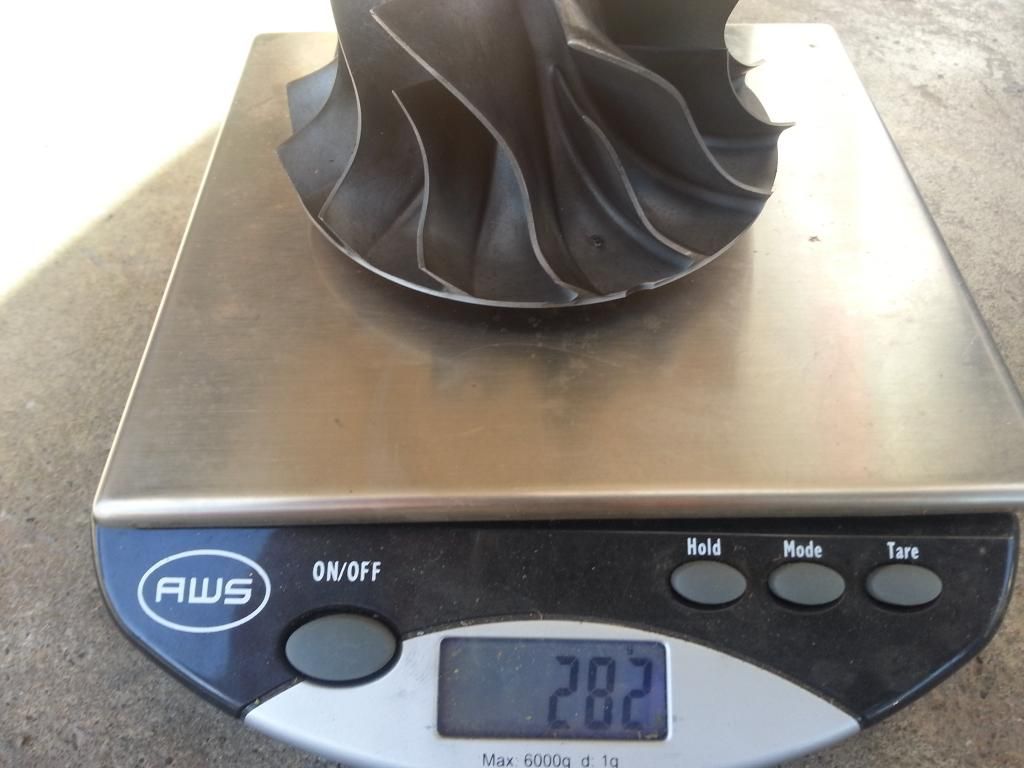
billet
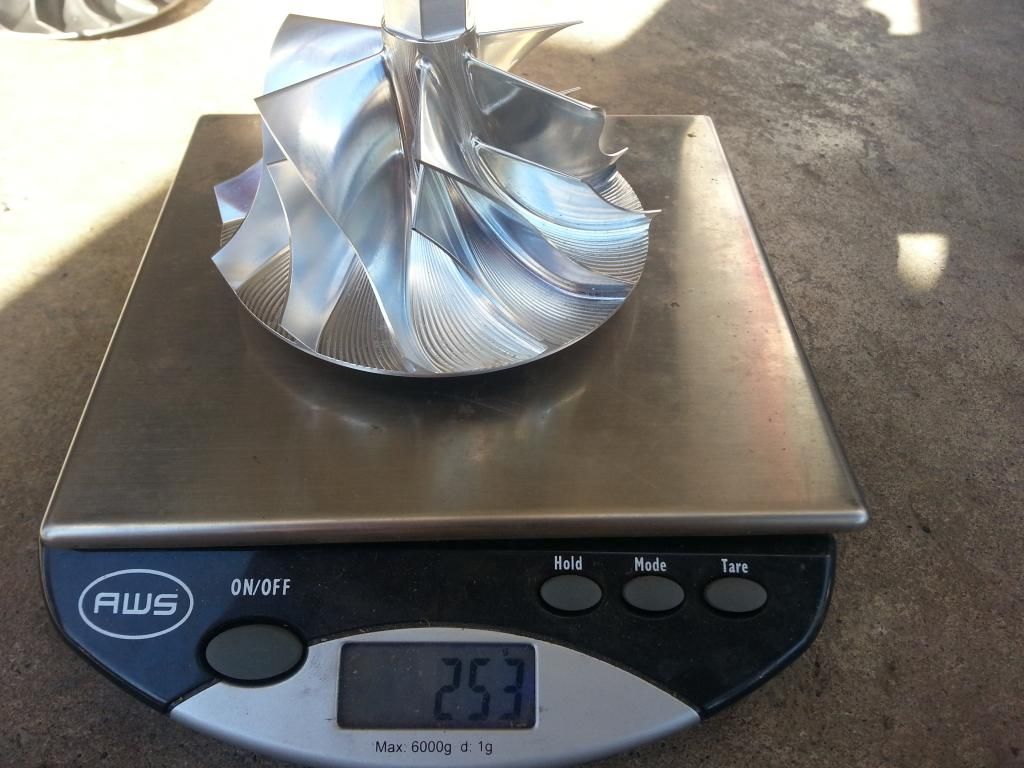
side by side
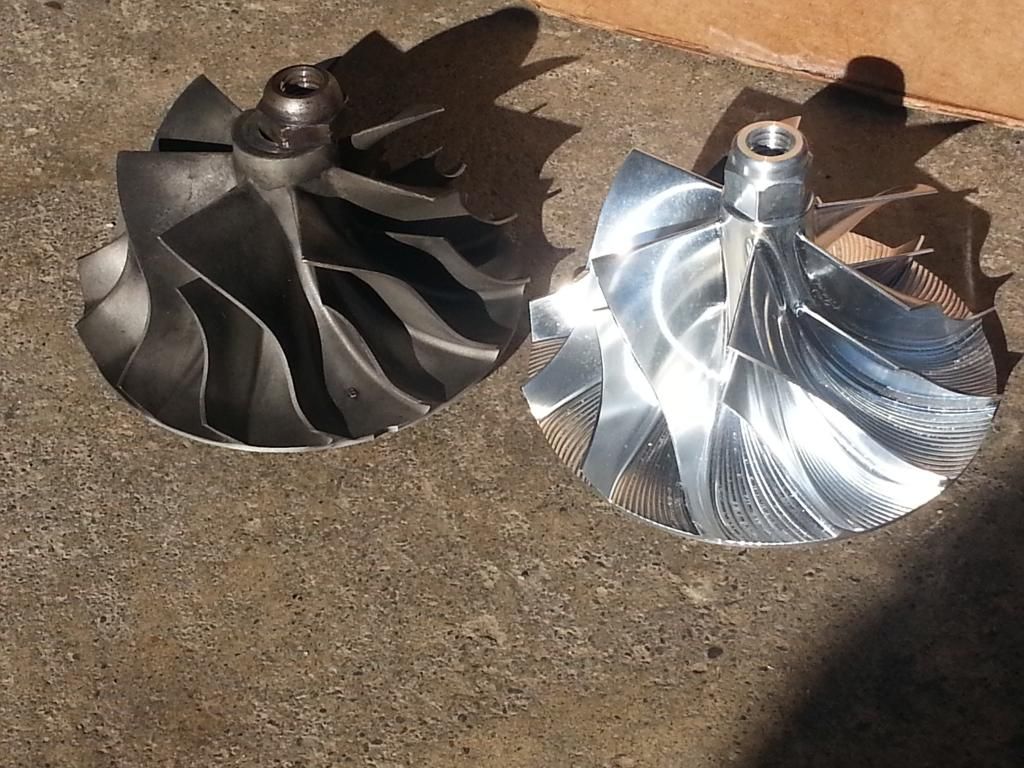
coming from the diesel world and having been taught some lessons from some very smart turbo guys I know that the "turbo whistle" is actually vibrations from the comp wheel.. so the billet being stronger and having more integrity vibrates less and therefore makes less noise.. and will also go higher p/r.. This wheel made 42 more hp over the cast wheel in a test of all 7 of the billet wheels made for a s475 back to back on the same truck, the same day.. they found a direct correlation between weight vs power.
ok sorry to get a bit off topic and no disrespect intended at all with my response. I hope you guys don't take it that way..
as far as twins, two 62/62's will get you past where you are wanting but 66/65's would get you that much farther..
stock48 ran 8.3x at 164 with a s476 and a stock bottom end 6.0 in his 3200lb nova.. fyi.
cast

billet

side by side

coming from the diesel world and having been taught some lessons from some very smart turbo guys I know that the "turbo whistle" is actually vibrations from the comp wheel.. so the billet being stronger and having more integrity vibrates less and therefore makes less noise.. and will also go higher p/r.. This wheel made 42 more hp over the cast wheel in a test of all 7 of the billet wheels made for a s475 back to back on the same truck, the same day.. they found a direct correlation between weight vs power.
ok sorry to get a bit off topic and no disrespect intended at all with my response. I hope you guys don't take it that way..
as far as twins, two 62/62's will get you past where you are wanting but 66/65's would get you that much farther..
stock48 ran 8.3x at 164 with a s476 and a stock bottom end 6.0 in his 3200lb nova.. fyi.
If this is still a question...
For a low 9 second pass, a stock bottom end 6.0 will get you there... granted it's machined correctly and you don't have a cylinder go lean... but as far as the rotating assembly, it should be fine. It's been done literally hundreds, if not thousands, of times on here...
What you'll want to consider is the year you buy for the 6.0...
later year 6.0's have floating wrist pins and a couple other bells and whistles which should give you a little more longevity... something to consider.
For a low 9 second pass, a stock bottom end 6.0 will get you there... granted it's machined correctly and you don't have a cylinder go lean... but as far as the rotating assembly, it should be fine. It's been done literally hundreds, if not thousands, of times on here...
What you'll want to consider is the year you buy for the 6.0...
later year 6.0's have floating wrist pins and a couple other bells and whistles which should give you a little more longevity... something to consider.
Also need to figure out what fuel your running, type of intercooler (if any), cam, intake, and redline. All that will come into play when picking a turbo. Honestly it’s one of the last things to buy.
I’d look at smaller T4 .8x-.9x housings.
Something like this I’d guess.
http://www.ebay.com/itm/BorgWarner-Airwerks-S300SX3-66-S366-S300-88-A-R-Open-Scroll-Turbo-66-73-88-/121270703773?pt=Motors_Car_Truck_Parts_Accessories&hash=item1c3c4c169d&vxp=mtr
Last edited by Forcefed86; Aug 7, 2014 at 01:53 PM.
coming from the diesel world and having been taught some lessons from some very smart turbo guys I know that the "turbo whistle" is actually vibrations from the comp wheel.. so the billet being stronger and having more integrity vibrates less and therefore makes less noise.. and will also go higher p/r.. This wheel made 42 more hp over the cast wheel in a test of all 7 of the billet wheels made for a s475 back to back on the same truck, the same day.. they found a direct correlation between weight vs power.
o.
o.
You see better back to back testing when comparing Holsets factory replacement comp. wheels to the cast counterpart. They have the exact same dimensions. This rules out design differences. When testing these two wheels, the cast wheel slightly out performed the billet wheel. Total time to full boost was very similar despite the heavier billet wheel.
Billet wheels were designed in the diesel world for longevity. 500k-1mill miles at a sustained 30+lbs takes it's toll on a cast wheels hub. The billet wheel was designed for longer service life, period. Not for performance.
I'ts just not economical for small companies to cast a compressor wheel. So they use billet wheels so alter the design for performance. If you were to make a clone of some of these "performance" billet wheels in cast, they would perform just as well.
All according to one of BW's turbo engineers anyway. (I'll shoot U the article)
I haven't heard about vibration being the sole cause of a turbos "whistle". Sounds believable, I'll have to read up on it. The angle and number of blades would play a large roll in the amount of vibration as well, just like an aircraft prop. This is why a billet 6 blade 475 is still a noisy bastard compared to a cast 7 blade 475.
my 6 blade is quiet in comparison to the 7 blade cast.. its really kind of the only thing that bums me out about it lol.. no worres..
And Adam is totally right on turbos being the last thing to worry about..
And Adam is totally right on turbos being the last thing to worry about..
Thread Starter
Teching In
Joined: Aug 2014
Posts: 25
Likes: 0
From: Minnesota
i get that turbos would be the last part. what im trying to do is gather all the info i can and try to start a parts list now, so that i can get the car, and get going on it and have it done (for the most part) over winter.
