




Backpressure measurement

9 Second Club
Joined: Nov 2003
Posts: 13,616
Likes: 185
From: Norn Iron

Some do run with no reference, some deliberately remove the reference.
And if you had say a 2psi spring....just what would "all the boost" be ?
It would be determined from exhaust pressure acting on the face of the valve in the gate, which would take minimal effort to open. So "all the boost" would still be quite low especially if EGBP was high relative to intake pressure.
To be fair, there is a lot of arguing and bickering in this thread that really isnt called for and it should be cleaned up and simplified for the original question.
Bottom line is simple.
Apply pressure to bottom chamber against spring, and the valve will open at a pressure very close to rated spring pressure.
Apply pressure to top chamber and this will try and blow it closed again basically assisting spring pressure.
Of course when the valve in the gate is closed and sealing, you also have the exhaust pressure acting on the valve trying to push it open against any of the above pressures trying to keep it closed. Larger valve, more force applied to the valve from that pressure.
However once it is open, that dynamic will change.
Some will use a very light spring and rely more so on exhaust pressure in the manifold to blow the valve open with no control on the chamber...some then add pressure to the top chamber to blow it shut again to increase boost.
Where the pressure for the chamber comes from to control is entirely up to you. Some use boost, some use exhaust pressure and some use a totally independent high pressure air source. Really doesnt matter.
And as said before, there are multiple ways to configure the system based on all of the above.
So until the OP outlines exactly how they intend to configure their setup there is no simple answer other than one, either, or all of the above control options.
Area of the WG valve plays a roll too. Assuming the same WG spring is used, a 2:1 BP ratio acting on a 60mm valve face will have a different cracking pressure than on a 38mm valve face.
Same deal with back pressure. Assuming the same dia. WG is used, a 10lb spring on a 2.5:1 BP ratio setup will have a different cracking pressure than on a 1:1 BP ratio setup.
Alot more to factor in than just spring pressure.
Same deal with back pressure. Assuming the same dia. WG is used, a 10lb spring on a 2.5:1 BP ratio setup will have a different cracking pressure than on a 1:1 BP ratio setup.
Alot more to factor in than just spring pressure.
Thread Starter
Joined: Nov 2009
Posts: 1,621
Likes: 31
From: THORNTON, PA (NEAR PHILLY)
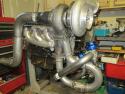
Bringing this back up. I was considering doing some changes like a cam and maybe intake, but wondering if backpressure is creating a bottleneck that would make any other mods worthless. On an 18 psi pull at only about 5800 rpms, I'm showing 46 psi of backpressure. Which calculates to about a 2.5:1 ratio My question is would a cam change still be worthwhile or worthless? Currently running the LS6 cam, thinking of something a little bigger like the Triple 12 etc. Or, perhaps a larger turbine. But I'm in love with the response of this turbo. Hard to pass up some of the gains that some of these cams are giving.
"Dome Pressure" = backpressure

"Dome Pressure" = backpressure

I'd see as high as 63-64psi and was still making more power on my 1.10 T4 S475 at 25lbs on a 5.3. I wouldn't sweat the back pressure with the baby overlap cams. I'm sure the trip 12 would pick up over the LS6 with your back pressure.
If you went with a large wheel T6 S475 you could install a more aggressive cam (LJMS stage2 or something) and it would pick up a ton I bet. The NA power would be bumped way up so you wouldn't notice the lag as much. Also if you keep the compressor smallish (75-76mm) it helps spool times alot.
For comparison I still see a little over 2:1 with the big 87/96 exh wheel and 1.25 T4 S476 around the same boost as you. (370" motor 224/224 @ 113 cam .600 lift)
If you went with a large wheel T6 S475 you could install a more aggressive cam (LJMS stage2 or something) and it would pick up a ton I bet. The NA power would be bumped way up so you wouldn't notice the lag as much. Also if you keep the compressor smallish (75-76mm) it helps spool times alot.
For comparison I still see a little over 2:1 with the big 87/96 exh wheel and 1.25 T4 S476 around the same boost as you. (370" motor 224/224 @ 113 cam .600 lift)
Seems like with it oscillating like that on the graph you really have to take the average, really probably only around 35psi back pressure. I had those S200 turbos on my 6.0 with tiny .48 housings and saw around 30psi back pressure at 16psi boost I think, that setup had to be the same or worse on the exhaust side.
Its possible a slightly bigger cam might lower your back pressure even, kind of like how a bigger cam can lower your DCR. Ask Jarrett about it too, he had that same exact turbo on his truck right?!
Its possible a slightly bigger cam might lower your back pressure even, kind of like how a bigger cam can lower your DCR. Ask Jarrett about it too, he had that same exact turbo on his truck right?!
LS1 Tech Stories
The Best V8 Stories One Small Block at Time

Topdon ONE vs. Artidiag 800 BT2: Which is the Diagnostic Tablet For You?
Pouria Savadkouei
Gas Monkey Built a 6-Wheel Ferrari Testarossa With a Corvette LT4 Engine
Verdad Gallardo
7 Most Reliable High-Performance Engines GM Has Ever Built
Verdad Gallardo
Amazing '71 Camaro Restomod Is Modern Muscle Car Under the Skin
Verdad Gallardo
6 Common C5 Corvette Failures and What's Involved In Repairing Them
Pouria Savadkouei
Retro Modern Bandit Pontiac Trans AM Comes With Burt Reynolds' Autograph
Verdad Gallardo
Top 10 Greatest Cadillac V Series Performance Models Ever, Ranked
Pouria Savadkouei
Top 10 Most Powerful Chevy Trucks Ever Made!

Hennessey's New Supercharged Silverado ZR2 Has 700 HP
Verdad Gallardo Thread Starter
Joined: Nov 2009
Posts: 1,621
Likes: 31
From: THORNTON, PA (NEAR PHILLY)
I think its 1/8" copper tapped into the drivers exh manifold as it was easy to get there.
Thread Starter
Joined: Nov 2009
Posts: 1,621
Likes: 31
From: THORNTON, PA (NEAR PHILLY)

9 Second Club
Joined: Nov 2003
Posts: 13,616
Likes: 185
From: Norn Iron
2.5:1 is huge, even 2:1 is a lot, unless it really is a fast spooling responsive setup.
Although it does seem singles suffer a lot more than twins with high back pressure.
Even an undamped MAP signal will have fluctuations and the exhaust side is a more extreme environment to take a reading from.
Although it does seem singles suffer a lot more than twins with high back pressure.
Even an undamped MAP signal will have fluctuations and the exhaust side is a more extreme environment to take a reading from.

TECH Enthusiast
Joined: Apr 2009
Posts: 723
Likes: 4
What is the sample rate on the system & sensor?
I would expect to see a visual extrapolation of the the exhaust pulse pressure waves that would correlate to cylinder firing if the sensor & sampling rate are fast enough to keep up.
I would expect to see a visual extrapolation of the the exhaust pulse pressure waves that would correlate to cylinder firing if the sensor & sampling rate are fast enough to keep up.

most drive pressure sensor set ups i've seen have several coiled loops. i'm not sure if thats to keep the heat off the sensor or the dampen the exhaust pulses.
anyone care to enlighten me?
anyone care to enlighten me?

TECH Enthusiast
Joined: Oct 2007
Posts: 530
Likes: 2
From: South Lyon, Michigan
More than anything its a vibration loop. Lets the line flex and not crack as easily.

Thread Starter
Joined: Nov 2009
Posts: 1,621
Likes: 31
From: THORNTON, PA (NEAR PHILLY)

TECH Fanatic


Joined: Jun 2013
Posts: 1,163
Likes: 16
From: Avon, Ohio
As mentioned, I have always seen the cleanest readings in the turbine scroll. I actually like to tap in the scroll directly across form the first exposure point of the turbine wheel.
You may never see a clean log where you have it tapped even dampened currently as you are likely seeing some mixture of exhaust pulsing as well.
You may never see a clean log where you have it tapped even dampened currently as you are likely seeing some mixture of exhaust pulsing as well.