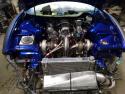



Making the switch to e85, do I still want to run meth?

I think too many people believe meth/water injection's only benefit is cooling charge temps. When the typical kits actually do very little of that. Water/meth provides benefits in combustion that an intercooler can't provide, so I run both.
Last edited by Forcefed86; Dec 29, 2015 at 06:49 PM.

Restricted User
Joined: Mar 2014
Posts: 7,192
Likes: 109
From: Ohio
I would still run it. The benefits are just too great.
Water pulls an immense amount of heat from the cc. More than the switch from gas to E85 and an intercooler combined are capable of.
Methanol provides a decent octane boost, although not as big after the E85 switch, but it also cools intake air without reducing efficiency or causing pressure loss. Even if I ran E85, I would run water/meth because the water will keep the cast pistons cool and the ring-lands intact, and the methanol will reduce the amount of CFM being forced through my un-ported heads giving a free power increase, octane aside.
A small pre-intercooler nozzle spraying meth also increases intercooler efficiency. If you already have the kit, there is no reason not to. E85 + Water/Meth has the knock resistance of running pure methanol.
Water pulls an immense amount of heat from the cc. More than the switch from gas to E85 and an intercooler combined are capable of.
Methanol provides a decent octane boost, although not as big after the E85 switch, but it also cools intake air without reducing efficiency or causing pressure loss. Even if I ran E85, I would run water/meth because the water will keep the cast pistons cool and the ring-lands intact, and the methanol will reduce the amount of CFM being forced through my un-ported heads giving a free power increase, octane aside.
A small pre-intercooler nozzle spraying meth also increases intercooler efficiency. If you already have the kit, there is no reason not to. E85 + Water/Meth has the knock resistance of running pure methanol.
I wouldn’t say it offers anywhere near the same knock suppression/octane as straight methanol. The typical meth inj kits don’t inject diddly volume wise.
At 200 psi the most the alky kit pumps are capable of is .5gpm. (30gph) and they pump less at the commonly used higher pressures. (Mine is sold as a “300 psi” pump)
Using my engine setup with rough math as an example:
900 crank = 1350 CFM = 10,100 gallons of air per min.
Even if I injected the pumps max 30gph, that’s roughly 20200:1 ratio of air vs fluid in the charge pipes. This changes the charge temps very little as a whole IMO. Also it has nowhere near the impact a methanol fueled engine has in the CC burned at the 4:1-5:1 air fuel ratios.
It’s true water absorbs much more heat than methanol, but it isn’t flammable. I always had ignition problems injecting any decent amount of water. Even at 50/50 ratios the truck LS square coils couldn’t fire off 16gph worth of 50/50 without dropping a lot of power (lost 3mph at track). Turning off the meth inj gained my 3mph back. Since I’ve upgraded the coils to the D585 I can turn the meth/water back on without losing any mph…
On the other hand, you can inject about any amount of straight methanol you want with zero ignition issues, though distribution gets to be an issue at higher volumes.
We were just talking about his in detail on YB. I don’t claim anything said above is a fact… just my opinion. Pretty interesting stuff.
http://www.yellowbullet.com/forum/sh....php?t=1603034
At 200 psi the most the alky kit pumps are capable of is .5gpm. (30gph) and they pump less at the commonly used higher pressures. (Mine is sold as a “300 psi” pump)
Using my engine setup with rough math as an example:
900 crank = 1350 CFM = 10,100 gallons of air per min.
Even if I injected the pumps max 30gph, that’s roughly 20200:1 ratio of air vs fluid in the charge pipes. This changes the charge temps very little as a whole IMO. Also it has nowhere near the impact a methanol fueled engine has in the CC burned at the 4:1-5:1 air fuel ratios.
It’s true water absorbs much more heat than methanol, but it isn’t flammable. I always had ignition problems injecting any decent amount of water. Even at 50/50 ratios the truck LS square coils couldn’t fire off 16gph worth of 50/50 without dropping a lot of power (lost 3mph at track). Turning off the meth inj gained my 3mph back. Since I’ve upgraded the coils to the D585 I can turn the meth/water back on without losing any mph…
On the other hand, you can inject about any amount of straight methanol you want with zero ignition issues, though distribution gets to be an issue at higher volumes.
We were just talking about his in detail on YB. I don’t claim anything said above is a fact… just my opinion. Pretty interesting stuff.
http://www.yellowbullet.com/forum/sh....php?t=1603034
Restricted User
Joined: Mar 2014
Posts: 7,192
Likes: 109
From: Ohio
Water begins pulling heat from the cc as soon as it enters it, not doing combustion only. As soon as compression starts, the water quickly evaporates and pulls a huge amount of heat out. It has basically all evaporated before ignition happens, greatly reducing the chances of detonation. Most people think that most of the detonation resistance comes from the methanol, which isn't true.
Don't forget, your 20200:1 ratio is volume, not weight. Air/fuel ratio is by weight so go by the 14.7:1 ratio to put that into perspective.
Since air is .08637 lbs per cubic feet and water is roughly 62.42 lbs per cubic feet (both at 0 degrees Celcius), you are looking at a 1744.674:62.42 ratio by weight, or a 27.95:1 air to water ratio.
Further math compounds the problem, because the weight of air changes more by temperature than liquids do.
100 degree IATs gives air a weight of 0.07094 lbs per cubic feet. Lets say 80 degree water is being injected, water is 62.00 lbs per cubic feet at 80 degrees. So your 20200:1 ratio becomes 1433:62 or a 23:1 ratio.
I can do the math to show you how much air temps change when you have 400 degree compressed air and 80 degree water. Water isn't really the charge cooler, its the methanol. Even though it only absorbs half the energy per mass to change temps as water, its evap temp is so low that it will continue pulling temps down far beyond what water is able to do in the charge pipes. Water has trouble pulling air temps below ambient, methanol can drive temperatures much lower, and absorbs almost as much energy as water when changing from a liquid to a vapor.
Don't forget, your 20200:1 ratio is volume, not weight. Air/fuel ratio is by weight so go by the 14.7:1 ratio to put that into perspective.
Since air is .08637 lbs per cubic feet and water is roughly 62.42 lbs per cubic feet (both at 0 degrees Celcius), you are looking at a 1744.674:62.42 ratio by weight, or a 27.95:1 air to water ratio.
Further math compounds the problem, because the weight of air changes more by temperature than liquids do.
100 degree IATs gives air a weight of 0.07094 lbs per cubic feet. Lets say 80 degree water is being injected, water is 62.00 lbs per cubic feet at 80 degrees. So your 20200:1 ratio becomes 1433:62 or a 23:1 ratio.
I can do the math to show you how much air temps change when you have 400 degree compressed air and 80 degree water. Water isn't really the charge cooler, its the methanol. Even though it only absorbs half the energy per mass to change temps as water, its evap temp is so low that it will continue pulling temps down far beyond what water is able to do in the charge pipes. Water has trouble pulling air temps below ambient, methanol can drive temperatures much lower, and absorbs almost as much energy as water when changing from a liquid to a vapor.
Last edited by JoeNova; Dec 30, 2015 at 01:14 PM.
Mass and weight are very different in physical sciences. I believe air/fuel ratio calculated by mass. Which is easier calculated via volume and converted to mass based on temperature and density. Meaning if we are talking straight ”gas”… For every cubic foot of gasoline that enters the CC approximately 14.7 cubic feet of air is needed to obtain a “stoich” mixture. My point being the amount of meth or water most of these kits inject does little to charge temps as a whole. It’s like pissing into the wind and expecting a large temperature shift. Regardless of how heavy that **** is… there’s too much air to make a large difference in overall temperature.
Regardless of weight, you still need a molecule of water to come in contact with a molecule of air. Then you need time for the water to pull heat from the air. With air rushing by at say 300FPS, there is very little time from the injection point to the CC. For water to be effective at removing heat from the charge temps you’d also need well over 212* to flash the water into vapor. If you take pressure into account (just like a radiator) Water in a 240KPA (20lbs of “boost”) charge pipe won’t boil/flash until 260*+. So it’s safe to say water sprayed post IC won’t “flash” until it hits the CC… Again, I believe it will have little effect on the charge temps as a whole.
Much like race gas, methanol adds octane. The more methanol in the CC the slower your flame front will be. Unlike water, methanol is flammable. So there is no real limit to the amount you can spray. Meaning you can up the volume considerably without ignition issues. This is why (IMO) methanol is considered more effective. You simply can’t spray the volumes of water needed without ignition issues to match straight methanol. Assuming we had ignition systems up to snuff, it’s been proven you can run stoich air fuel ratios without detonation under heavy load/boost with “low octane” fuels.
Regardless of weight, you still need a molecule of water to come in contact with a molecule of air. Then you need time for the water to pull heat from the air. With air rushing by at say 300FPS, there is very little time from the injection point to the CC. For water to be effective at removing heat from the charge temps you’d also need well over 212* to flash the water into vapor. If you take pressure into account (just like a radiator) Water in a 240KPA (20lbs of “boost”) charge pipe won’t boil/flash until 260*+. So it’s safe to say water sprayed post IC won’t “flash” until it hits the CC… Again, I believe it will have little effect on the charge temps as a whole.
Much like race gas, methanol adds octane. The more methanol in the CC the slower your flame front will be. Unlike water, methanol is flammable. So there is no real limit to the amount you can spray. Meaning you can up the volume considerably without ignition issues. This is why (IMO) methanol is considered more effective. You simply can’t spray the volumes of water needed without ignition issues to match straight methanol. Assuming we had ignition systems up to snuff, it’s been proven you can run stoich air fuel ratios without detonation under heavy load/boost with “low octane” fuels.
Wow, you guys don't mess around! Should I continue running straight meth? My big question is should I tune without the meth and get the afr at a safe range then add the meth in and run it rich or do I tune with the meth? I just worry about a failure in the system and going lean
LS1 Tech Stories
The Best V8 Stories One Small Block at Time

6 Common C5 Corvette Failures and What's Involved In Repairing Them
Pouria Savadkouei
Retro Modern Bandit Pontiac Trans AM Comes With Burt Reynolds' Autograph
Verdad Gallardo
Top 10 Greatest Cadillac V Series Performance Models Ever, Ranked
Pouria Savadkouei
Top 10 Most Powerful Chevy Trucks Ever Made!

Hennessey's New Supercharged Silverado ZR2 Has 700 HP
Verdad Gallardo
Coachbuilt N2A Anteros Is an LS2-Powered C6 Corvette In Italian Clothes
Verdad Gallardo
Awesome K5 Blazer Restomod Comes With C7 Corvette Power
Verdad Gallardo
10 Camaros You Should Never Buy

10 LS Engine Myths That Refuse to Die
Verdad Gallardo
TECH Enthusiast


Joined: Mar 2013
Posts: 503
Likes: 38
Mass and weight are very different in physical sciences. I believe air/fuel ratio calculated by mass. Which is easier calculated via volume and converted to mass based on temperature and density. Meaning if we are talking straight ”gas”… For every cubic foot of gasoline that enters the CC approximately 14.7 cubic feet of air is needed to obtain a “stoich” mixture. My point being the amount of meth or water most of these kits inject does little to charge temps as a whole. It’s like pissing into the wind and expecting a large temperature shift. Regardless of how heavy that **** is… there’s too much air to make a large difference in overall temperature.
Regardless of weight, you still need a molecule of water to come in contact with a molecule of air. Then you need time for the water to pull heat from the air. With air rushing by at say 300FPS, there is very little time from the injection point to the CC. For water to be effective at removing heat from the charge temps you’d also need well over 212* to flash the water into vapor. If you take pressure into account (just like a radiator) Water in a 240KPA (20lbs of “boost”) charge pipe won’t boil/flash until 260*+. So it’s safe to say water sprayed post IC won’t “flash” until it hits the CC… Again, I believe it will have little effect on the charge temps as a whole.
Much like race gas, methanol adds octane. The more methanol in the CC the slower your flame front will be. Unlike water, methanol is flammable. So there is no real limit to the amount you can spray. Meaning you can up the volume considerably without ignition issues. This is why (IMO) methanol is considered more effective. You simply can’t spray the volumes of water needed without ignition issues to match straight methanol. Assuming we had ignition systems up to snuff, it’s been proven you can run stoich air fuel ratios without detonation under heavy load/boost with “low octane” fuels.
Regardless of weight, you still need a molecule of water to come in contact with a molecule of air. Then you need time for the water to pull heat from the air. With air rushing by at say 300FPS, there is very little time from the injection point to the CC. For water to be effective at removing heat from the charge temps you’d also need well over 212* to flash the water into vapor. If you take pressure into account (just like a radiator) Water in a 240KPA (20lbs of “boost”) charge pipe won’t boil/flash until 260*+. So it’s safe to say water sprayed post IC won’t “flash” until it hits the CC… Again, I believe it will have little effect on the charge temps as a whole.
Much like race gas, methanol adds octane. The more methanol in the CC the slower your flame front will be. Unlike water, methanol is flammable. So there is no real limit to the amount you can spray. Meaning you can up the volume considerably without ignition issues. This is why (IMO) methanol is considered more effective. You simply can’t spray the volumes of water needed without ignition issues to match straight methanol. Assuming we had ignition systems up to snuff, it’s been proven you can run stoich air fuel ratios without detonation under heavy load/boost with “low octane” fuels.

TECH Enthusiast
Joined: Apr 2009
Posts: 723
Likes: 4
At the O2 level it is worth noting that the extrapolated A/F is calculated off a unit of percentage error anyways as the gas mix ratio is never exactly what stoich says it should be because the combustion process never yields an actual stoich burn.
OP, you can run either straight meth, water or a mix of both. What ratio is entirely dependent on what your testing shows as most beneficial.
It will also change what the actual O2 reading value is in terms of lambda calculation. That means for those guys calculating an extrapolated A/F from a gasoline scale, or Lambda, will be skewed by the addition of another combustant with a different A/F ratio. How much you add, as a percentage of mass of your fuel mass, determines what the actual resultant value is.
Does it really matter in the grand scheme of things? No. It will run best in an A/F ratio range. That is all you really need concern yourself with. Look at it like this, you go to the track, find a command A/F & timing along with a given mass of what ever mix works best & it runs the best time: Does it matter really what your A/F ratio monitor says? Not really. It only matters in the world of comparative data. This means for you later & other guys trying t compare your data to their own.
Last edited by gtfoxy; Dec 30, 2015 at 09:09 PM.
The mass of air compared to the mass of the water is very different at like weights. The injected fluid mass is tiny compared to the air mass. In order to change the charge temp on a large scale, the fluid needs to physically come into contact with the air to pull heat from it.
I'm at 50,000:1 ratios with the amount of fluid I spray. IMO, The water/meth molecules can't physically touch a large enough percentage of air molecules flying by to pull a significant amount of heat from the aircharge as a whole.
this conversation is way out of my league! how should I tune this thing on the dyno with meth to be safe? running it pig rich doesent sound like a good idea but i dont want a pump failure to cause me to burn the motor down either
TECH Enthusiast
Joined: Apr 2009
Posts: 723
Likes: 4
Back to back runs on a dyno is the only way to get the data you seek, or better yet take it to th struck for real world numbers. Run it at an acceptable tune then run it again with the water/meth activated to see where it lands, in comparison. Then you know the difference between the use or non-use.
You can change the command A/F or timing but then you are dealing with an artificial safety margin at this point. How far you are willing to fudge this is up to you. At the end of the day it is your car & your money. Run it where you are comfortable with.
You can change the command A/F or timing but then you are dealing with an artificial safety margin at this point. How far you are willing to fudge this is up to you. At the end of the day it is your car & your money. Run it where you are comfortable with.
Anyway…
I don’t think meth injection is any less reliable than a standard fuel system if setup properly. What happens if a fuel injector clogs partially? Or fuel pump flow drops off at WOT? Those will take out a motor as well if you don’t have safeguards in place. Most new ECU’s have some sort of AFR vs Load safety system. I believe the AEM wideband also have something similar. Meth injection or not, you should have something like that setup IMO. I have my target AFR setup at 10.8 above 20 psi. If it leans out past 11.2 the ECU drops the ignition and boost.
If you’re not using the meth/water in massive amounts for octane/detonation prevention, you’d most likely be fine if it failed. I spray a 7gph nozzle at the TB and a 2gph nozzle pre-turbo @ 200psi (about 12gph). This is 50/50 with E85 and an A2A IC. I can make a pass with or without the meth inj. I like my plug readings better with it on. Near as I can tell I’m making the same (if not a little more) power with less heat in the CC. That’s always a good thing in my book.
The max power rich to max power lean window for e85 is huge. About 10.5-12.75 (on a gas scale WB02). Which theoretically means any mixture in this range should be within a few % of max HP. Race/pump gas window is tiny by comparison at 12.5-13.25. So running “pig rich” hurts performance much more.
No reason to be on the lean side of peak power IMO. Start at 10.5 AFR and a silly low timing number (like 8-10* above 5psi). Then dial up the boost to where you want it. Next lean the AFR slowly until you stop picking up power. Stay within the E85 peak power “window”. Personally I’d run it rich to allow for some cylinders being leaner than others. At this point you should pull the plugs and install a fresh set. Make a pull and see if you have any excessively lean looking cylinders. If not, bump timing up slowly and monitor your gains. Gains should be pretty linear. As soon as the usual gains start to taper off , stop adding timing. Install a new set of plugs and get another plug read. Fine tune form there.
Restricted User
Joined: Mar 2014
Posts: 7,192
Likes: 109
From: Ohio
Mass and weight are very different in physical sciences. I believe air/fuel ratio calculated by mass. Which is easier calculated via volume and converted to mass based on temperature and density. Meaning if we are talking straight ”gas”… For every cubic foot of gasoline that enters the CC approximately 14.7 cubic feet of air is needed to obtain a “stoich” mixture. My point being the amount of meth or water most of these kits inject does little to charge temps as a whole. It’s like pissing into the wind and expecting a large temperature shift. Regardless of how heavy that **** is… there’s too much air to make a large difference in overall temperature.
Regardless of weight, you still need a molecule of water to come in contact with a molecule of air. Then you need time for the water to pull heat from the air. With air rushing by at say 300FPS, there is very little time from the injection point to the CC. For water to be effective at removing heat from the charge temps you’d also need well over 212* to flash the water into vapor. If you take pressure into account (just like a radiator) Water in a 240KPA (20lbs of “boost”) charge pipe won’t boil/flash until 260*+. So it’s safe to say water sprayed post IC won’t “flash” until it hits the CC… Again, I believe it will have little effect on the charge temps as a whole.
Much like race gas, methanol adds octane. The more methanol in the CC the slower your flame front will be. Unlike water, methanol is flammable. So there is no real limit to the amount you can spray. Meaning you can up the volume considerably without ignition issues. This is why (IMO) methanol is considered more effective. You simply can’t spray the volumes of water needed without ignition issues to match straight methanol. Assuming we had ignition systems up to snuff, it’s been proven you can run stoich air fuel ratios without detonation under heavy load/boost with “low octane” fuels.
Regardless of weight, you still need a molecule of water to come in contact with a molecule of air. Then you need time for the water to pull heat from the air. With air rushing by at say 300FPS, there is very little time from the injection point to the CC. For water to be effective at removing heat from the charge temps you’d also need well over 212* to flash the water into vapor. If you take pressure into account (just like a radiator) Water in a 240KPA (20lbs of “boost”) charge pipe won’t boil/flash until 260*+. So it’s safe to say water sprayed post IC won’t “flash” until it hits the CC… Again, I believe it will have little effect on the charge temps as a whole.
Much like race gas, methanol adds octane. The more methanol in the CC the slower your flame front will be. Unlike water, methanol is flammable. So there is no real limit to the amount you can spray. Meaning you can up the volume considerably without ignition issues. This is why (IMO) methanol is considered more effective. You simply can’t spray the volumes of water needed without ignition issues to match straight methanol. Assuming we had ignition systems up to snuff, it’s been proven you can run stoich air fuel ratios without detonation under heavy load/boost with “low octane” fuels.
Your second bold statement is volume, not mass. That conversion isn't even close. Your AFR ratio would be way below 1:1.
And you're right, water won't flash or boil until it gets into the CC, which is why I said methanol is the better charge cooler. Methanol will flash below most ambient temps, meaning that when it evaporates it can cool to far below ambient temps.

My point being the amount of meth or water most of these kits inject does little to charge temps as a whole.
It does work very well
And water will flash under 212 deg. Lol our atmosphere has water grains in it and its between 40-90 deg f typically on earth. Lol it dries up after it rains dont it
In this specific case, mass and weight are interchangeable, so you might as well say that the conversions are by mass.
Your second bold statement is volume, not mass. That conversion isn't even close. Your AFR ratio would be way below 1:1.
And you're right, water won't flash or boil until it gets into the CC, which is why I said methanol is the better charge cooler. Methanol will flash below most ambient temps, meaning that when it evaporates it can cool to far below ambient temps.
Your second bold statement is volume, not mass. That conversion isn't even close. Your AFR ratio would be way below 1:1.
And you're right, water won't flash or boil until it gets into the CC, which is why I said methanol is the better charge cooler. Methanol will flash below most ambient temps, meaning that when it evaporates it can cool to far below ambient temps.
Air–fuel ratio (AFR) is the mass ratio of air to fuel present in a combustion process such as in an internal combustion engine or industrial furnace. The AFR is an important measure for anti-pollution and performance-tuning reasons.
Weight and mass are not interchangeable. Especially when we are trying measuring the ability of a fluid to draw temperature from an air charge.
For example:
Say we have a 10X10X10 room full of air. (1000cu ft) Going by weight, this would amount to 80lbs of air at standard temp/pressure.
If I were to dump an 80lb bucket (10 gallons) of water into the top of this room. What do you think it will do to the temperature as a whole?
Now if I were to fog 80lbs (10g) of water into the room what do you think it would do the temperature as a whole?
Could do the same test with straight methanol…
Going by your Mass and Weight are the same theory they would both have the same effect. (Since they both weigh the same) Which we know isn’t true.
Using the same example now with a 50,000:1 ratio of fluid to air (like my water/meth kit sprays) It’s like taking that same 10x10x10 room and misting .15 gallons of fluid into it and expecting a massive change in temperature. I don’t see how it’s possible.
Last edited by Forcefed86; Dec 31, 2015 at 10:35 AM.
What/who are you disagreeing with? Works very well compared to what? How would you measure the charge temps?
I never said “it doesn’t work”. I’m saying at the typical volumes used it doesn’t cool the charge anywhere near as good as properly spec’d intercooler would. That’s a fact.
How much time does it take water to evaporate at 40-90*? What your saying isn’t relevant. We are talking about water flying by at 200-300+ FPS in a sealed pressure system. It’s not going to magically evaporate/flash between the injection point and the CC at those speeds IMO.
Last edited by Forcefed86; Dec 31, 2015 at 10:44 AM.