











How long do your plugs last?

If they are fouling, and failing due to carbon buildup, black soot, then this is an indicator that the engine needs tuning for cruise and idle situations. The idle/cruise needs to stay leaner than 14.5:1, perhaps as lean as 15:1 or even 15.2:1 is fine for a highway cruise at reasonable speeds (65-75 mph in most cars). That will help keep them plugs clean. Try an ignition amplifier and replacing OEM maintenance components of the ignition system before doing anything drastic, and perform a tune up. You can also spray water (100% distilled water is fine) which is nearly free, and tends to help clean things up.
Always run as much gap as you can afford to (without it blowing out). Larger gaps are associated with better economy and performance, as long as you get a fire started.
Always run as much gap as you can afford to (without it blowing out). Larger gaps are associated with better economy and performance, as long as you get a fire started.
If they are fouling, and failing due to carbon buildup, black soot, then this is an indicator that the engine needs tuning for cruise and idle situations. The idle/cruise needs to stay leaner than 14.5:1, perhaps as lean as 15:1 or even 15.2:1 is fine for a highway cruise at reasonable speeds (65-75 mph in most cars). That will help keep them plugs clean. Try an ignition amplifier and replacing OEM maintenance components of the ignition system before doing anything drastic, and perform a tune up. You can also spray water (100% distilled water is fine) which is nearly free, and tends to help clean things up.
Always run as much gap as you can afford to (without it blowing out). Larger gaps are associated with better economy and performance, as long as you get a fire started.
Always run as much gap as you can afford to (without it blowing out). Larger gaps are associated with better economy and performance, as long as you get a fire started.
Your other point about AFR at idle/cruise is entirely dependent on the engine combo as the more overlap the cam has the leaner the wideband will show when the tune is in the sweet spot. Some cams will want 17:1 at idle.
Who makes an LS based ignition amplifier knowing that the PCM feeds the 8 individual coil packs directly since its coil on plug? Or is that a general statement that doesn't apply to an LS based EFI system?
Your other point about AFR at idle/cruise is entirely dependent on the engine combo as the more overlap the cam has the leaner the wideband will show when the tune is in the sweet spot. Some cams will want 17:1 at idle.
Your other point about AFR at idle/cruise is entirely dependent on the engine combo as the more overlap the cam has the leaner the wideband will show when the tune is in the sweet spot. Some cams will want 17:1 at idle.
As to 17:1, there may be a durability issue with long term lean idle in some applications. I do not usually shoot for such a lean ratio, although I have experimented with a great number of engines at those ratios, I tend to avoid using them for extended periods. When explaining to people new to tuning I try to emphasize the range from 14.8 to 15.2 is a safe range to idle and cruise at, a desirable number range to see consistently as you drive gently. There is not much fuel savings moving from 15:1 to 17:1 or from 14.7 to 15.2, at least not with a 1998 year of fuel injection system tech, so really the main point is just so we dont carbon everything in there up.
he said "Spraying a bit of 50/50 too, which I think I'm going to take off." So the equipment is all in place, spend $5 on some water to chase out the carbon, I am sure the chamber needs it if you've been idling at 13:1 for extended periods.
Last edited by kingtal0n; Feb 12, 2016 at 12:42 AM.
It is general, and an obsessed enough individual could design a box to amplify their coil on plug power, I did think there must be at least one option available even to the non-obsessed. Are you saying there is not a single ignition amplifier in the world for the LS series engines? That just sounds crazy.
As to 17:1, there may be a durability issue with long term lean idle in some applications. I do not usually shoot for such a lean ratio, although I have experimented with a great number of engines at those ratios, I tend to avoid using them for extended periods. When explaining to people new to tuning I try to emphasize the range from 14.8 to 15.2 is a safe range to idle and cruise at, a desirable number range to see consistently as you drive gently. There is not much fuel savings moving from 15:1 to 17:1 or from 14.7 to 15.2, at least not with a 1998 year of fuel injection system tech, so really the main point is just so we dont carbon everything in there up.
he said "Spraying a bit of 50/50 too, which I think I'm going to take off." So the equipment is all in place, spend $5 on some water to chase out the carbon, I am sure the chamber needs it if you've been idling at 13:1 for extended periods.
As to 17:1, there may be a durability issue with long term lean idle in some applications. I do not usually shoot for such a lean ratio, although I have experimented with a great number of engines at those ratios, I tend to avoid using them for extended periods. When explaining to people new to tuning I try to emphasize the range from 14.8 to 15.2 is a safe range to idle and cruise at, a desirable number range to see consistently as you drive gently. There is not much fuel savings moving from 15:1 to 17:1 or from 14.7 to 15.2, at least not with a 1998 year of fuel injection system tech, so really the main point is just so we dont carbon everything in there up.
he said "Spraying a bit of 50/50 too, which I think I'm going to take off." So the equipment is all in place, spend $5 on some water to chase out the carbon, I am sure the chamber needs it if you've been idling at 13:1 for extended periods.
As for your 17:1 durability issue....are you familiar with the term reversion? If so, you would be aware that there are no durability issues running at 17:1 if thats what the engine wants. The wideband value is just a number on a large overlap motor at idle, it has nothing to do with what the engine wants. 14.63:1 may be fine for an engine with no overlap but will run like crap on a large overlap cam, it has nothing to do with durability.
LS1 Tech Stories
The Best V8 Stories One Small Block at Time

6 Common C5 Corvette Failures and What's Involved In Repairing Them
Pouria Savadkouei
Retro Modern Bandit Pontiac Trans AM Comes With Burt Reynolds' Autograph
Verdad Gallardo
Top 10 Greatest Cadillac V Series Performance Models Ever, Ranked
Pouria Savadkouei
Top 10 Most Powerful Chevy Trucks Ever Made!

Hennessey's New Supercharged Silverado ZR2 Has 700 HP
Verdad Gallardo
Coachbuilt N2A Anteros Is an LS2-Powered C6 Corvette In Italian Clothes
Verdad Gallardo
Awesome K5 Blazer Restomod Comes With C7 Corvette Power
Verdad Gallardo
10 Camaros You Should Never Buy

10 LS Engine Myths That Refuse to Die
Verdad Gallardo
Truck coils, stock ecu, br7ef (.022), sees 93 and c16 at the track, red gm performance wires.
It is on Holley now so I am anxious to see if i need to change coils like some have.
The holley may not like the non resistor just FYI. Mine ran fine on them for awhile then all of sudden wouldn't. Starts idles then randomly shuts down.
I run a non resistor plug still. Just use a resistor terminal on the plug wires
Seems the holley is prone to blowout issues even when everything is correct compared to the stock ECU driving the coils. It shouldn't as its a simple circuit, but it does seem to be the case
Tighter won't hurt you. I run .015 all the time now
I run a non resistor plug still. Just use a resistor terminal on the plug wires
Seems the holley is prone to blowout issues even when everything is correct compared to the stock ECU driving the coils. It shouldn't as its a simple circuit, but it does seem to be the case
Tighter won't hurt you. I run .015 all the time now
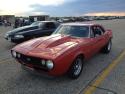
Ive been running ngk R5671-A8 in mine with 100K mile GM D585 coils using Holley efi, no issues so far. gap is .018", 91 on street @ 10psi, 100LL at track with ~18psi. I am also spraying 14gph water nozzles, no issues.
change plugs once a year
change plugs once a year
Thread Starter
Joined: Nov 2009
Posts: 1,621
Likes: 31
From: THORNTON, PA (NEAR PHILLY)
ES is gasketed I believe, EFS is still tapered. There is a difference with the electrode though, some are regular and some are the "V" groove. I went with EFS this time around with the regular electrode. Seems the V grove makes the gap larger that what it really is.
https://www.ngk.de/uploads/tx_templa...kerbung_04.jpg


V-groove doesn't affect the gap.
Same Holley unit from the beginning?
Perhaps yours has an issue?
Might be worth finding a shop that has an old Sun machine that will read the spark output like was done in the old days.
Same Holley unit from the beginning?
Perhaps yours has an issue?
Might be worth finding a shop that has an old Sun machine that will read the spark output like was done in the old days.

TECH Resident


Joined: Sep 2013
Posts: 994
Likes: 120
From: Mechanicsburg, PA
I have a handheld inductive voltage reader to check output voltage to the plugs. But I prefer the ST-125 type tester for a more accurate output test. It looks like a spark plug with the electrode missing and an alligator clip welded to it for a ground. Some of the tool guys sell ones that you can change the gap on to get an idea what the maximum output is from your system. The ST-125 type is more for O.E. ignition systems, 25k volts to light it.

Straighten out your tune and you should be in good shape. When a plugs gets carbon deposits they actually melt to the porcelin when you are romping on the car and form a glaze. The glaze is conductive and results in misfires when the spark takes the path of least resistance across the glaze to the size of the plug. As other have noted, on E85 plugs last a long time, on gas I change my plugs every 6000 miles even with a lean cruise/idle.
The holley may not like the non resistor just FYI. Mine ran fine on them for awhile then all of sudden wouldn't. Starts idles then randomly shuts down.
I run a non resistor plug still. Just use a resistor terminal on the plug wires
Seems the holley is prone to blowout issues even when everything is correct compared to the stock ECU driving the coils. It shouldn't as its a simple circuit, but it does seem to be the case
Tighter won't hurt you. I run .015 all the time now
I run a non resistor plug still. Just use a resistor terminal on the plug wires
Seems the holley is prone to blowout issues even when everything is correct compared to the stock ECU driving the coils. It shouldn't as its a simple circuit, but it does seem to be the case
Tighter won't hurt you. I run .015 all the time now
Thread Starter
Joined: Nov 2009
Posts: 1,621
Likes: 31
From: THORNTON, PA (NEAR PHILLY)
I have the new GM wires and BR7EFS here. Lets see how this works.
Here a pic of the current plug. Does this look real bad? Looks a little rich but I've seen alot worse. Interesting how the electrode looks pitted or fuzzy. Could the water/meth be doing that?

