When you click on links to various merchants on this site and make a purchase, this can result in this site earning a commission. Affiliate programs and affiliations include, but are not limited to, the eBay Partner Network.
I agree with that article, there are no gross misstatements in it IMO. However it is written to keep it simple, so you don't need a PhD to understand it, which honestly some of this does get into very complex reaction kinetics, especially when you get such complex fuels combusting. Believe it or not, gasoline is common, but is a far more complex fuel than any of these pure substances like methanol or ethanol.
Yes, I noticed that about the gasoline formulas... Seems all of the chemical combustion examples on-line use Octane as a stand in Chemical Formula. Couldn't find a single example of modern gasoline composition.
Originally Posted by ScottyBG
Here is what I think it fails to help people understand:
Normally in an internal combustion engine the limiting factor is air, not fuel. So the article looked at it from a fuel stand point and having too much of it. Think of it the other way around, you only have so much air and want to consume as much of it as possible. That is why being richer than stoic actually makes more power than stoic. If you looked at it purely from the point of view of wanting to have the exact correct amount of fuel to get all of the carbon available in it, through the first and second stage, the max power mixture would be 14.7ish. That way you wouldn't be wasting oxygen on the first step, that could be used in the second step if you had just the correct amount of fuel. But we know stoic is not best power mixture. Unless you go to the rich side you can not consume all the air with fuel.
I've been searching, studying, and posting in physics forums... trying to understand why rich makes more power. Thank you Scotty! Finally something that makes sense!
Originally Posted by ScottyBG
The second thing they fail to mention is that a significant portion of the energy comes from forming the water, not just the carbon monoxide, and carbon dioxide. They fail to mention this portion in their discussion. I'm sitting at the bar in a Texas Roadhouse swilling a Bud light right now, and don't have access, or care to look at any thermodynamic tables right now, but IIRC the formation of the water creates more of the energy, than the formation of the CO2. I could be wrong on this, but I know it is a significant portion. Thus the interest in using hydrogen for fuel, in fuel cells.
Deductively, the article leaves 1/3 of the thermal energy to be released in the first stage when water is formed. Still a considerable amount of energy.
However, if you don't mind, I'm curious if the thermodynamics tables you refer to are more specific, or maybe indicate something different.
Originally Posted by ScottyBG
And the function of the water in the conversion of CO to CO2 it is just a catalyst, it can happen at high temperature without water present as long as there is free oxygen present. This however would be a much slower reaction, and there is always some water present during combustion to promote this, so it is kind of a moot point. It doesn't take much water to catalyze this reaction, just the moisture normally found in the air would be enough.
That's kinda what I figured. Moot, but interesting just the same.
Originally Posted by ScottyBG
I hope this helps more, I kind of feel like we hijacked this thread talking about combustion, more than we did methanol injection. I actually did my thesis on this type of stuff working with a professor that was jointly employed by the university and Shell, back in '91 and '92. Believe it or not we were looking at adding ethanol to gasoline back then, and all its effects on combustion, engines and the environmental impact. In 2006 that became the reality.
We did stray from the original question. However, water/meth injection is directly related to the combustion process. There are a few gaps to fill in before we get there.
If instead of the richer mixture about 10% (by mass) of water would be injected in the intake charge (0.008 kg Water/kg air), the high latent heat of the water would cool the charge by 18 degrees, about 4 times the cooling effect of the richer mixture. The added fuel for the rich mixture can't burn because there is just not enough oxygen available. So it does not matter if fuel or water is added.
Before we get into that, I'm curious if you know how the Max Power Ratios for different fuels are contrived. Are they based on observation or calculated? If they're calculated, what's the non-PHd layman's explanation of the calculation process, or the factors involved?
Side thoughts and questions I've had. Not specific to Scotty, just food for thought and conversation.
Ignoring meth for the moment, a given mass of water at a given temperature is only capable of soaking up a specific amount of thermal energy as it evaporates, and then it absorbs thermal energy at a reduced rate as a gas in the combustion process.
It seems to me, that whether it evaporates in the intake tract or in the cylinder, that portion of thermal absorption wouldn't make a difference in combustion temps. It either pulls xyz in the intake tract, xyz in the cylinder, or x&y in the intake tract and the final z in the cylinder. All add up to the same... Or do they?
Counter thoughts:
Under pressure of the compression stroke and combustion process, the boiling point of water is increased. But evaporation isn't boiling, it's evaporation. Does increased pressure also decrease the rate of evaporation and effect the amount of thermal energy absorbed in the process???
If the water evaporates in the intake tract, the air charge cools and contracts, becoming more dense, effectively pulling more air in, and more air in the cylinder... Which skews a direct comparison.
And... This is a big one for me. Water vapor is lighter than air at the same temperature. For any given IAT, the charge would be more dense with oxygen if it had zero humidity. I'm curious what the actual density of oxygen in the charge pipe is, per given water evaporation and resultant temperature decrease.
Also, what differences in performance might occur if identical amounts of water are injected, but the ambient relative humidity is vastly different? 80ºF day in FL 75%RH vs, 80ºF day in AZ at 35%RH?
What is the dew point under a specified pressure and temperature (under boost conditions)? How much water injected can even evaporate in the charge pipe? If you inject pre turbo, how much might condense in the intercooler? (that would be a good thing I think)
Sorry I've actually been wrenching in the garage. I'm actually painting the whole underside of my '98 Z28. Got it up on the lift, with the tranny and rearend out, switching out the converter and the rear to an S60. Thought it would be a good time to wire brush the rust off it, and put a fresh coat of undercoating on it.
Side thoughts and questions I've had. Not specific to Scotty, just food for thought and conversation.
Ignoring meth for the moment, a given mass of water at a given temperature is only capable of soaking up a specific amount of thermal energy as it evaporates, and then it absorbs thermal energy at a reduced rate as a gas in the combustion process.
It seems to me, that whether it evaporates in the intake tract or in the cylinder, that portion of thermal absorption wouldn't make a difference in combustion temps. It either pulls xyz in the intake tract, xyz in the cylinder, or x&y in the intake tract and the final z in the cylinder. All add up to the same... Or do they?
I think chemically and thermodynamically it doesn't matter whither the phase change from liquid to gas happens in the intake or the cylinder the result is the same. I agree with you it all equals XYZ. The only problem that can happen is if you have too much liquid in the intake, cylinder distribution becomes a problem. From a distribution standpoint, it is better to have it happen in the intake tract. That's why we have 1 injector per intake runner on our EFI systems, to allow a large amount of the composition of the material in the intake manifold, to still be in the liquid phase, and not throw off distribution to the cylinders.
Counter thoughts:
Under pressure of the compression stroke and combustion process, the boiling point of water is increased. But evaporation isn't boiling, it's evaporation. Does increased pressure also decrease the rate of evaporation and effect the amount of thermal energy absorbed in the process???
If the water evaporates in the intake tract, the air charge cools and contracts, becoming more dense, effectively pulling more air in, and more air in the cylinder... Which skews a direct comparison.
There is really only one thing occurring, a phase change from liquid to gas, the terms evaporation or boiling are just common terms to describe this phase change, based upon the temperature it is happening at. The amount of energy absorbed for the phase change is about the same regardless of the temperature it occurs at, within reason. It does vary with temperature, but it is often close enough to consider it constant, over the temperature range we are considering here. It is just like for all practical purposes we can consider liquids incompressible, like in our brake system. It does actually compress with pressure, but it is so little it is almost impossible to measure unless you go from like 10 psi to like 40 million psi then it will be measureable.
The increased pressure in the cylinder from compressing the mixture, heats the mixture significantly. This is how detonation, or dieseling occurs. The mixture gets hot enough from being compressed that it ignites itself. This temperature rise from the compression, intern offsets the increased temperature requirement for the phase change from liquid to gas, so this more or less washes that out to some degree.
If the liquids in the track evaporate, they cool the rest of the charge, which decreases the volume of the rest of the charge, but by their nature the evaporated materials are less dense, and take up more volume in the gas phase than they did as liquid. These 2 transitions offset one another, from a pressure standpoint, so it doesn't pull more air in, actually there is a net positive pressure increase, so in fact it would be pushing gasses out of the intake. Some this is good though, because it is also pushing it down into the cylinder, as well as back against the incoming charge of air coming from the turbo.
That's as far as I'm going with this one today. I'll work on some thoughts for the rest of this later in the week. It is not so clear cut.
And... This is a big one for me. Water vapor is lighter than air at the same temperature. For any given IAT, the charge would be more dense with oxygen if it had zero humidity. I'm curious what the actual density of oxygen in the charge pipe is, per given water evaporation and resultant temperature decrease.
Also, what differences in performance might occur if identical amounts of water are injected, but the ambient relative humidity is vastly different? 80ºF day in FL 75%RH vs, 80ºF day in AZ at 35%RH?
What is the dew point under a specified pressure and temperature (under boost conditions)? How much water injected can even evaporate in the charge pipe? If you inject pre turbo, how much might condense in the intercooler? (that would be a good thing I think)
Sorry I've actually been wrenching in the garage. ...
I'm curious if you know how the Max Power Ratios for different fuels are contrived. Are they based on observation or calculated? If they're calculated, what's the non-PHd layman's explanation of the calculation process, or the factors involved?
Max power ratios are determined by testing. In fact they do vary s little from engine to engine. For example an engine that struggles with cooling may make max power s little richer than one that doesn't. That is why we don't say max power is exactly a number like 12.5645 AFR. It is normally about 12.5 but could be anywhere between about 12 and 13, for a specific engine.
Max power ratios are determined by testing. In fact they do vary s little from engine to engine. For example an engine that struggles with cooling may make max power s little richer than one that doesn't. That is why we don't say max power is exactly a number like 12.5645 AFR. It is normally about 12.5 but could be anywhere between about 12 and 13, for a specific engine.
Hmm.
I have seen AFR's stated out to the ten-thousanth before. http://ethanolpro.tripod.com/id213.html
Possibly just the calculated product of the fuels base blend constituent properties... I'd guess.
It makes sense that, in practice, every engine would be a little different.
Are you sure there isn't a calculation that would indicate the theoretical max power ratio for a given fuel?
If it exists, it's something I'd like to take a look at and understand.
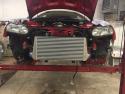
OK, I jumped into this post to read about nozzle location and now my brain hurts. LOL. So I am building a new setup for the first time. I just finished the cold side last weekend. I placed the nozzle just after the BOV, maybe 2 plus inches and the IAT is on the 90 degree bend. I haven't measured this distance between the 2 but does anyone here see there being an issue in design? I was worried about the spray having to make the turn. Again, I went off what I was reading other people doing with success. I am not to the point of tuning yet and figuring out what exactly I will be running in the Meth system.
OK, I jumped into this post to read about nozzle location and now my brain hurts. LOL. So I am building a new setup for the first time. I just finished the cold side last weekend. I placed the nozzle just after the BOV, maybe 2 plus inches and the IAT is on the 90 degree bend. I haven't measured this distance between the 2 but does anyone here see there being an issue in design? I was worried about the spray having to make the turn. Again, I went off what I was reading other people doing with success. I am not to the point of tuning yet and figuring out what exactly I will be running in the Meth system.
Sounds like you are in the same boat as me. I cant see your picture..its just a square??? My adblocker makes it so I cant see pics????
Actually I'm a Chem Eng with specialization in combustion engineering, and I understand what is goin on from a chemistry standpoint. To be honest I've learned more from practical experience with cars, than what I theoretically have been educated with. Sorry for the long read here.
If it were me I'd only run pure methanol, not a mix. 3 Window is correct in that the water does pull out more heat than methanol, for a given mass. However there is a limit to how much water you can spray before you start putting the fire out so to speak. The 2 ways the water work, and the 2 ways the methanol work are the same. The first way is they both lower the intake charge temperature, and secondly they both have the effect of stabilizing the combustion of the mixture, like increasing octane of the fuel does. They both make the mixture harder to ignite, and burn slower. The water does this by displacing air and fuel, it doesn't really participate, it is just along for the ride. It also absorbs some of the energy, and reduces EGT. The concentration of reacting components is one of the factors in controlling reaction rate, by adding water we reduce the concentration of the fuel and air in the cylinder. This is just like more concentrated acid will dissolve something faster than less concentrated acid will. This slower reaction rate does also result in lower cylinder pressure, which helps prevent knock but can also reduce power output. The reason you can make more power with this water/meth injection is because you can run more timing and boost because of this stabilization to make some of the lost power back. To be honest though spraying pure water is not normally done because there is very little gain in the combustion process, you loose as much to the water as you gain from increased boost. There is still a benefit from lowering the intake charge temp, but nothing is gained in the combustion within the cylinder.
In the case of methanol, there is almost no limit to how much you can spray, it just gets burned and contributes to fueling. The more you spray, the higher the octane you make your total fuel blend, which is gasoline, ethanol (the 10% from the gas) and methanol. The practical limiting factor is cylinder distribution. Since it is not a multiport system, you do have to be concerned with distribution, and if you spray a boat load, you get far more in the front cylinders than the rear, because it isn't fully evaporated. The amount of methanol you can spray, can actually cool the intake charge more than water, because you can spray more of it. I know 3 Window used the wet shower analogy, but if you ever get alcohol on your skin it gives a similar feeling. That is because both methanol and water are both very polar molecules, and the hydrogen bonding takes more energy to overcome to push these liquids into the gas phase. Not trying to take anything away from 3 window here, I actually like a lot of his posts, and appreciate his input often.
The only reason I wouldn't spray 100% methanol is if my components were not up to it. It is more corrosive, and I'm not sure the Snow kit is rated to 100%. There are systems like the Alky Control system that are.
I received most of my methanol training from the Buick guys. I used to race them often, and I usually go to the Buick Nationals here in Bowling Green every year. A friend of mine is a competitive racer in the GN community. Back when there way no E85, all of the GN's were running boat loads of methanol, often a couple 15 GPH nozzles. The guys I dealt with thought if you put water in it you were an idiot, that was based upon ETs, not chemistry. It is also more forgiving to spray higher levels of methanol, the window the engine will accept is much wider. The bottom end of this window is defined by the minimum amount you need to control knock, and the top of the window is defined by where you start to loose power( from putting the fire out with water), or where your fueling from cylinder to cylinder is inconsistent because it isn't carrying all the way to the back of the intake manifold, because too much of the injected material is still in the liquid phase.
Just my 2 cents.
This is interesting timing, but it looks like the Tuning School, agrees on the 100% methanol for injection. This is what I learned from the Buick guys about 10 years ago.
OK, I jumped into this post to read about nozzle location and now my brain hurts. LOL. So I am building a new setup for the first time. I just finished the cold side last weekend. I placed the nozzle just after the BOV, maybe 2 plus inches and the IAT is on the 90 degree bend. I haven't measured this distance between the 2 but does anyone here see there being an issue in design? I was worried about the spray having to make the turn. Again, I went off what I was reading other people doing with success. I am not to the point of tuning yet and figuring out what exactly I will be running in the Meth system.
Unfortunately I did. I bought a spool gun for my Miller Mig welder. But you have to preheat and it goes super fast at times. I do preheat and it helped. But the part also has to be laying flat, so you weld on top of the part. Once the weld gets going down or uphill it doesnt want to lay down, it starts to hang so to speak. Also even with preheating the start of the weld is too cold and it takes a second to burn in which makes it pool again. Also the heat setting was supposed to be max, at 10. I had to run it at just over 5 or it would just melt through. I could only weld about 1 inch at a time before it got too hot and just melted the pipe. Sucks really. But it worked. Saved me from buying a Tig which I really needed. And saved me 1500+ to have it done. In the end its not a show truck. Its a street strip no prep grudge truck that needs to go fast. Pretty doesnt win the money. Also it may be temporary. Once the engine is built with forged bottom end its may be changed to make more power.
Yea, it sucked for sure. I have 100% argon, prep with a separate steel brush only used on aluminum. Acetone ect. Tip angle was trial and error. The standard degrees and pushing didn't seem to work the best. Also with the speed on 10, maxed out, it seemed to not be fast enough really. I could watch the wire melt, pool up a small bead and then drop onto the pipe and burn in. So maybe 2 to 3 drops or droplets per second. It rarely ran like a standard Mig.
The spool gun came as a kit with the switch to swap over between AC and DC. Yea it was switched. Its just a super fine line between not enough heat and then a blow through. So make enough heat to lay the weld pretty flat but blow through every 1/2 inch, or make less heat so it takes a second to start laying " almost" flat and be able to get about 1 inch before blow through. I really think my issue is wire speed. Its not spooling fast enough so I can run fast enough. Its basically trying to Tig weld. Build heat, add the weld, build heat, add the weld, repeat. I will buy a Tig before doing this again.
Gas Monkey Built a 6-Wheel Ferrari Testarossa With a Corvette LT4 Engine
Slideshow: The controversial Ferrari F6 swaps its original flat-12 for a Corvette Z06-derived LT4 V8 and sends power to four rear wheels through a custom-built drivetrain.
7 Most Reliable High-Performance Engines GM Has Ever Built
Slideshow:These GM engines didn't just make huge power, they survived abuse, boost, track days, and six-digit mileage with a reputation for refusing to quit.
6 Common C5 Corvette Failures and What's Involved In Repairing Them
Slideshow: From wobbling harmonic balancers to failed EBCMs, these are the issues that define long-term C5 ownership and what repairs typically involve.
Retro Modern Bandit Pontiac Trans AM Comes With Burt Reynolds' Autograph
Slideshow: A modern Camaro transformed into a retro icon, this limited-run "Bandit" build blends nostalgia with brute force in a way few revivals manage.
Top 10 Greatest Cadillac V Series Performance Models Ever, Ranked
Slideshow: Cadillac didn't just crash the high-performance luxury vehicle party, it showed up loud, supercharged, and occasionally a little unhinged...