When you click on links to various merchants on this site and make a purchase, this can result in this site earning a commission. Affiliate programs and affiliations include, but are not limited to, the eBay Partner Network.
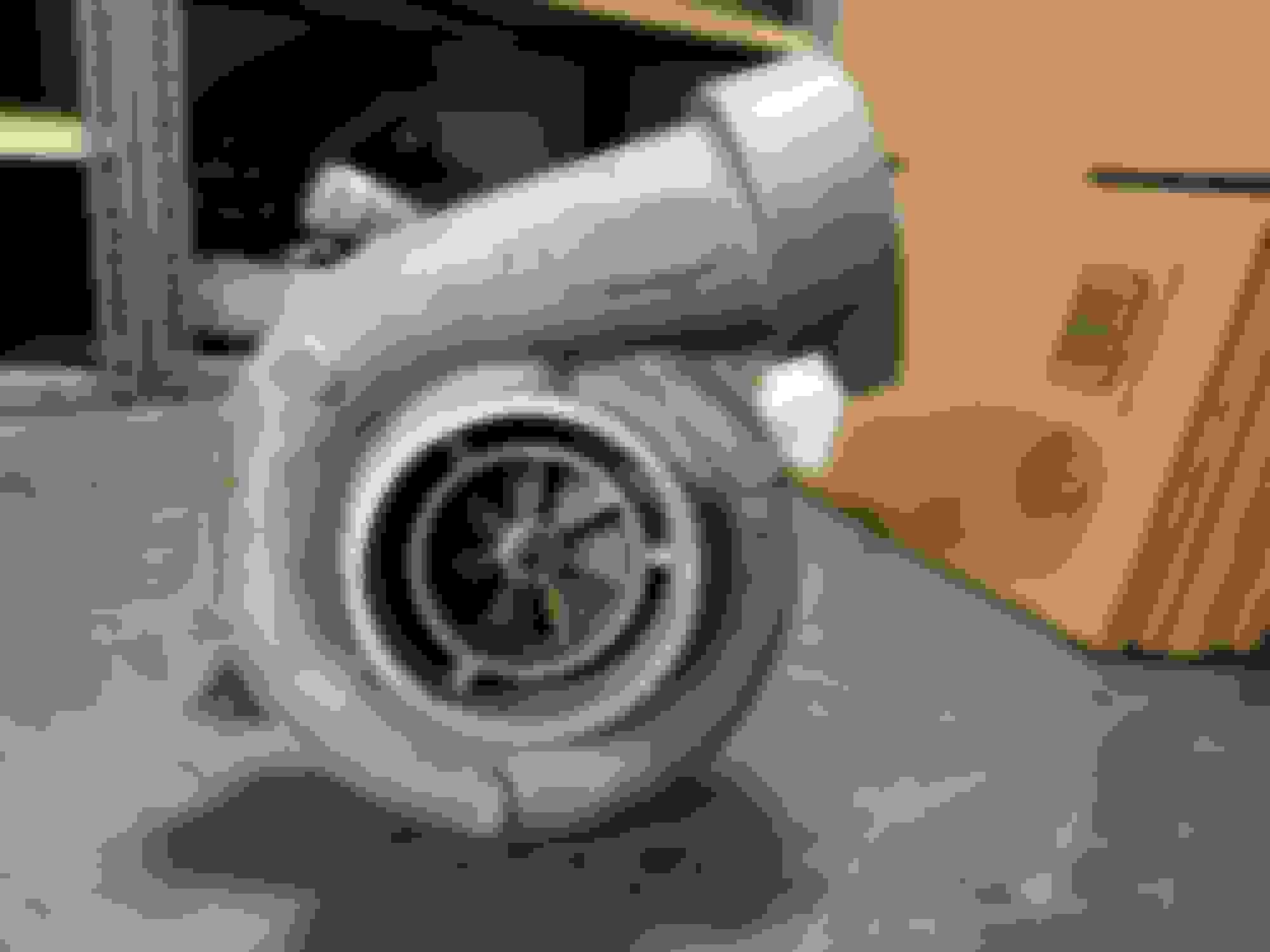
S366 vs S372 SXE
sxe on the left
tial 1.30 vband turbine housing on left and borg twin scroll on right
I am debating on which turbos to go with on stock bottom end 5.3. I am looking for only top end 5000-7200rpm, good response in that range is also important. Flat out in top gear is pretty common.
I have a manual 6 speed, 2,900 lbs and AWD. The car doesn't get launched, its not setup for drag racing.
I would like to use the s257 twins (with agp .83 housings) but I think the turbine wheel might be too small for that rpm range. Anybody tried this setup and dyno'd it or measured backpressure?
I saw really good results from cars with twin s366 make a lot of power on 93 octane and E85 and I think they would be a better choice.
The engine bay doesn't have space to mount a big single, I tried mocking it up and didn't like the exhaust routing. The only reason I haven't already put in twin s366 turbos is because they are much harder to fit than s200s and I am debating on the required effort.
Last edited by Sway Tale; Sep 16, 2021 at 02:01 PM.
5th gen camaro guys seem to do well with the 257SX-E. They seem to max out somewhere in the 900-1000whp range on a 6.2.
Torque may come on a little soon if it's a gen3 bottom end. If all you care about is 5000+ rpm the s366 will obviously flow more through the turbine at the expense of spool and transient response.
5th gen camaro guys seem to do well with the 257SX-E. They seem to max out somewhere in the 900-1000whp range on a 6.2.
Torque may come on a little soon if it's a gen3 bottom end. If all you care about is 5000+ rpm the s366 will obviously flow more through the turbine at the expense of spool and transient response.
I saw the agp twin turbo kit was very popular on camaros and they make big numbers but most of the dynos fall off at 6000-6500rpm and most use e85. I couldn't find anyone who was using s257sxe.
Originally Posted by stevieturbo
you could probably have a dozen other turbo options in there too.
But cam and intake will equally play a part, often more so than turbine side alone
But the 257's should work well
That's what I am thinking, what can I get away with.
Garrett G series and borg EFR would be better choices but that's double my budget even if I get internal wastegate versions.
That and the results for cast wheels, huge turbine wheels, moderate cams, and small diameter hot side piping are impressive. The only 2 dynos I found for twin s257 was an LS3 with a botched run with the throttle not wide open, and a Subaru with an LS that was using a stock cam.
I already know what the LS can do on twin s366 or even a single 96mm s400. If it was an automatic or a t56 geared car I wouldn't even debate but the short gearing has me wondering what others think.
VS Racing 6262 may be a better choice? Smaller package than the s366 and should light up faster and work well up top? My s366 setup was lazy, but could have just been my setup. Similar car weight, manual ,but RWD. Swapped to Precision 6766 and they spool ~1000rpms faster.
VS Racing 6262 may be a better choice? Smaller package than the s366 and should light up faster and work well up top? My s366 setup was lazy, but could have just been my setup. Similar car weight, manual ,but RWD. Swapped to Precision 6766 and they spool ~1000rpms faster.
I recently though about 6265E from AGP as another choice but I didn't think of VS racing or Precision. I am not going to say they are unreliable but.......I have used Borg Warner, Holset, Garrett, MHI, and IHI turbos for a long time and they are predictable in reliability.
I don't really have any experience with non-OEM turbo manufacturers so I wouldn't know how they perform. I did buy a few ebay IHI/MHI knockoffs and they did work but had slower spool. For $125-$250 they were great but not for $600+. A good external wastegate is a must. (ie: TiAL). If they were overspun or surging they would fail really quick.
Borg warner turbine housings are usually based off diesel applications (A lot of exhaust flow) and sometimes don't work well with gasoline engines.
Originally Posted by stevieturbo
If you went for a cheap S360, you' build around that larger platform and it'd be easy to grow if needed, and have the larger turbine wheel.
But I don't see how you'd go wrong with the 257 or 261.
I'd have more concern about 3rd and 4th gear longevity.
3rd/4th gear longevity? I am using a subaru transmission, I run out of 6th gear before 170mph
Here is a few examples of why I want some firsthand feedback from others:
S463 or S467 on a Detroit Diesel Series 60 12.7 Liter spools very quick and needs a wastegate in that application to prevent over boost due to a small turbine wheel. I like to install S475 T6 96mm (171702) on this engine and it gives you a broader powerband on the 12.7.
The famed S475/96mm T6 is actually a factory turbo on the Series 60 14 Liter (pre-2004) You do give up torque in a lower rev range but you gain everywhere else. Less wear on the engine.
Here is a Series 60 12.7 (1997-2003) factory turbo, I don't remember is its a 63mm or a 68mm but this one is a garrett. The garrett fails more often than the borg version and the garrett is twice the price. The compressor maps are different but the inducer/exducer is the same. Usually the shaft starts binding and doesn't spin as freely and the engine works harder to spin the turbo....leads to lower shaft speeds and noticeable loss of power and boost. Interestingly, the Garrett GTA42 on the 14L (2004-2007) has the same problem.
By comparison here is a modern turbo designed to control backpressure. Large exhaust housing and the compressor is too small, but it is VGT. The VGT mechanism seizes very often from heat and the whole turbo needs to be replaced. Cartridge failures are very rare. They are designed to control (restrict) exhaust flow and help with emissions management (EGR, DPF, etc.). These are terrible turbos for high performance and the turbine housing is one reason for that. This one is a HE400VG on a 15 Liter. The old HE500VG (larger compressor) is much better but the new engines stopped coming with them since 2011.
This is a HOLSET HT60 (reverse rotation HX60), its huge. The turbine wheel is well over 100mm. This engine has great power and spool and its 14 Liter.
Another example would be the 2008+ Mitsubishi EVO X. The stock turbo is tiny and twin scroll. Peak power is too early and the car revs all the way to 7,500 rpm. Easy to break rods like this, especially if running on E85 because you are not detonating.
Depending on fuel: Using a GTX3076 causes later spool near 4,000rpm but gets you to 350-450whp. Swapping to a GTX3576 get you all the way to 500+whp without a noticeable change in spool.
Swapping to a Borg EFR 7670 spool is a lot closer to 3,500 but it only gets you to 450-500whp.
Any of the BW's mentioned will work very well, if you choose them correctly.
And 6th gear and gearing are totally irrelevant to what I stated....which is the likelihood of breaking 3rd or 4th gear with the torque
Oh, I misunderstood the breaking a gear part. I am more worried about axles, STI transmissions usually break them.
Drag racing causes the output shaft to twist. Gear breakage is extremely rare even at 600+ torque but then again we are talking 4 cylinder power bands.
I am going to use a carbon fiber driveshaft to help soften the load. I have had good success with that before.
Last edited by Sway Tale; Sep 24, 2020 at 05:06 PM.
Completely off topic but I picked up a what it seems like is a S463 from a CAT dozer, it was cheap enough $120 took the thing apart and cleaned it up ,looks like everything is in good shape. The compressor wheel is 63 and borg t4 83mm exhaust wheel . The only thing I'm unsure of is the exhaust housing it's a divided t4 and 110 stamped on the inside, I'm guessing that means it's a 1.10 a/r . It's going on a 2jz and hope it's not going to be super lazy have it spool up around 4000-4500 rpm. AGP makes a billet wheel for it might upgrade to that later , but if it gets me to 600 whp with the cast wheel I'll be more than happy .
I was told by AGP that the SXE257's on my 6L with the .68 (T4) housings are good to 900whp and the .81 (T4) would be good to 1100whp through an 80E. We shall see, unfortunately not til spring.
I also saw someone's dyno sheet on Camaro5 for kind of a reference:
Forged TMS 376 short block (compression unknown)
S256's
227/239 @116 cam
Jakes 4L80
889/887 @ 18psi
So slightly bigger turbo's than the above would be inline with AGP's statement.
The numbers the small turbos seem to make on their kits do seem unrealistically high. But there seem to be a few so who knows
No idea what sort of performances the cars making those numbers are actually putting in though. Haven't seen any hit say 200mph in a mile, although AGP say it takes only 700hp to do so.
There are actually only a very small handful with actual good performance results, despite lots with big dyno numbers.
I think most twin turbo camaros on that forum are street tires, stock suspension, stock curb weight, maybe stock gearing, even stock cam.
What if the high dyno numbers are because of the LS3? It is 6.2, it has square port cylinder heads and high compression. It is not common to see twin turbo cars with a stock LS3, besides the corvette and camaro.
I have three engines that I can use at the moment. 4.8 LR4, 5.3 LM4, and a 6.0 LS2. I could try twins on all three displacements.Edit: I don't have a running engine at the moment. There was actually a Nova on this forum that ran twin S257 turbos on a 6.0 but I can't find it now.
Last edited by Sway Tale; Mar 4, 2021 at 07:58 AM.
Forced inductions bought a company called tdi and are producing several versions of budget s300 and s400 billet turbos. You may give them a call. Jose makes some of the baddest turbos out there. John Bewley is also a tdi dealer he could help you out as well.
Most of them on that forum are manual trans so #’s are obviously higher compared to auto. But I see many that are low 10sec et’s and upper 120’s to low 130mph so that would back up a 700-800whp dyno number at full weight. Which is on their base turbo’s which I think are smaller compared to sxe257. Either way I’m giving them a shot myself and then if it’s result I’m after maybe sxe 372’s or just go to 366’s and be done with it. Will be more than enough for my intentions with the truck.
Ive run twin s360s and s257s on a 6.0 and if the response matters at all the s360s are terrible compared to the 257s. They arent super terrible but the 257s are like a roots blower, the s360s would never be mistaken for a roots blower. The 257s will make peak at 7000+ on a 5.3 but probably not 6.0 or 6.2. Youve got good intakes for 7000+ peak but for the spring pressures that much boost requires you will have better chances with non stock pushrods, lifters and Yella Terras or better. I dont recall ever seeing big peak numbers at 7000+ with stock lifters or rockers, definitely not pushrods. Twenty people will say theyve seen it but I havent seen a dyno sheet.
The only "results" I have of the s257s on an LS3 other than dyno numbers are the best of three botched runs at the mile. It over boosted and passed the half mile mark at 95mph in top gear with no throttle, I got back in it around 5/8 mile with about 20-25% throttle from there on and it got to 172mph averaging 12-13psi, not super definitive or impressive, but it was making some decent steam to get there in top gear only.
Gas Monkey Built a 6-Wheel Ferrari Testarossa With a Corvette LT4 Engine
Slideshow: The controversial Ferrari F6 swaps its original flat-12 for a Corvette Z06-derived LT4 V8 and sends power to four rear wheels through a custom-built drivetrain.
7 Most Reliable High-Performance Engines GM Has Ever Built
Slideshow:These GM engines didn't just make huge power, they survived abuse, boost, track days, and six-digit mileage with a reputation for refusing to quit.
6 Common C5 Corvette Failures and What's Involved In Repairing Them
Slideshow: From wobbling harmonic balancers to failed EBCMs, these are the issues that define long-term C5 ownership and what repairs typically involve.
Retro Modern Bandit Pontiac Trans AM Comes With Burt Reynolds' Autograph
Slideshow: A modern Camaro transformed into a retro icon, this limited-run "Bandit" build blends nostalgia with brute force in a way few revivals manage.
Top 10 Greatest Cadillac V Series Performance Models Ever, Ranked
Slideshow: Cadillac didn't just crash the high-performance luxury vehicle party, it showed up loud, supercharged, and occasionally a little unhinged...
Coachbuilt N2A Anteros Is an LS2-Powered C6 Corvette In Italian Clothes
Slideshow: A one-off sports car that looks like a vintage Italian exotic-but hides a C6 Corvette underneath-just sold for the price of a new mid-engine Corvette.



 Twin S366 vs S257 SXE