When you click on links to various merchants on this site and make a purchase, this can result in this site earning a commission. Affiliate programs and affiliations include, but are not limited to, the eBay Partner Network.
I'm looking to upgrade my fuel lines from factory lines to a -8AN feed line and a -6AN return line. Are there any adapters to hook these hoses up to the factory plastic nipples at the tank. How is the best way to connect this size hose to the plastic fuel pump carrier?
Remember the stock fittings are only 3/8. That would be a restriction going through that and into a -8AN feed. Unless you want over 600whp, a -6AN feed will work just fine. But here are adapters from the GM push lock style ends to -6AN
Feed inlet on the stock LS1 rail is 3/8 in and outlet is 5/16. If you want to run a -8AN feed, you really should have aftermarket rails and a different outlet on the pump bucket to get the full benefit....otherwise -6AN line is what stock is.
This is part of the thing I find odd(at least for "in-tank fuel pumps like the 255's and 340lph). We all upgrade our lines to -8AN feeds and -6AN returns, and some even increase the feed tube size, yet the pumps themselves still have that tiny orifice that exits the pump. I have twin pumps on my setup(255Walbro and 340Aeromotive) with FAST rails -8AN feed and -6AN PFE stainless lines but I suppose I/we are counting on the extra volume in the fuel lines themselves to assure plenty of fuel is available because looking at that tiny hole in the pump exit remains the most restrictive point in the delivery.
Yes you are correct and I agree.... However a smaller diameter line will have more losses (pressure drop) over the same distance as a larger one. The regulator blocks off the flow until the pressure is achieved so the pump has to work even harder to maintain that pressure at the regulator.
An additional benefit of a larger line is there is a larger fluid capacity available which allows the fuel system to satisfy transient demands, like throttle fluctuations and shifting, ect. Target pressure could be more stable if there was an issue with the smaller line.
Most is a myth.....to promote a healthy economy.
Copied:
Given a big enough pump a 3/8” steel line could support 1000 HP.
. If the pressure falls as the engine RPM’s go up you need more pump head. More pump head can be achieved with a bigger pump, higher pump voltage and/or increasing the line size. But before you do check out the following (and remember a dirty fuel filter is often the culprit of falling fuel pressures!).
The reason most people do not understand why is because “back in the day” when carburetors ruled and everybody ran a Holly electric fuel pump running at 14 psig then into a rail mounted PRV set to 6 psig the “pump head” was insufficient to overcome the pressure drop thru the 3/8” line: particularly if the pump was at the front of the vehicle.
Let’s see why today this is what I call a “wives’ tale”. For this example I will use gasoline. If we use alcohol we need about double the flow or with E85 we need to increase the flow numbers by around 30 % .
At WOT (Wide Open Throttle) a BSFC (Brake Specific Fuel Consumption) of ½ pound of fuel per horsepower is quite safe: resulting in A/F ratios of 11:1 or richer. Remember that maximum HP occurs at an A/F ratio of 13:1. We won’t go into why one chooses such rich air fuel ratios; suffice to say that using a BSFC of .5 is generous. Since gasoline has a weight of 5.994 lbs/gallon (@ a SG of .7201 typical) then in round numbers we need 1 gallon of gasoline per 12 HP (5.994/.5). The reason I am making all these conversions for you is because typical fuel pump measurements are made in volume versus mass although mass is more accurate.
OK stay with me now as we calculate how much gasoline fuel we need to support say 1000 HP. 1000 divided by 12 = 83.3 Gallons Per Hour or 315 Liters Per Hour.
Now we are going to calculate the pressure drop thru a 3/8” steel line for a typical vehicle at a flow of 83.3 gph or 1000 HP. Most of you know that the pressure drop thru a straight pipe is less than an elbow or a 45 (same principle as your air ducting from your blower thru the piping and on into the engine). Lets assume we have about 10 feet of 3/8” fuel line. Let’s double that to say 20 feet to take care of the bends in the steel pipe from the gasoline tank up to the engine fuel rail. Ingersoll-Rand publishes an engineers’ handbook called “Cameron Hydraulic Data”. In there they list the “Friction Of Water” thru various types of pipe. Using the pressure drop thru a new steel pipe of .364” id at 1.388 gpm (83.3 gph) we get a head loss of 35 feet per 100 feet of pipe with water as the medium. 2.31 feet of water = 1 psi therefore 35/2.31 = 15 psi per 100 feet. If I use 20 feet of steel pipe then that is 1/5 of 15 or 3 psi using water (gasoline is less viscous and flows more freely). A Fuelab Model 41401 can deliver 90 gph @ 70 psig. Can I tolerate a 3 psig drop if I need the fuel delivered at 60 psig? Yes. Will increasing the line size to ½” help? Yes the pressure drop thru a ½” line is a nominal 5 feet versus 35 feet for the 3/8” id fuel line. The ½” line will result in a ½ pound drop versus the 3 pound drop for the 3/8” line at the stated flow of 83.3 gph (enough to support 1000 HP at a BSFC of .5). The pressure drop at 1320 HP thru a 3/8” steel line might be around 5 psi.
The key to sufficient fuel supply is pumping power. As another example let’s look at a flow of 1 gallon per minute at a required fuel rail pressure of 70 psig. That is enough fuel to support 720 HP. The pressure drop thru a 3/8”id line at 60 GPH is less than 1 psig! Switching to a ½” id line would result in a pressure of about 1/10 of the 3/8” line. However, given sufficient pumping power, a one (1) pound drop versus a tenth (1/10) pound drop is insignificant. At 500 HP the pressure drop is even less.
VISCOSITY SG plays no role in friction loss. The key factors are viscosity and surface tension of the liquid being pumped. Gasoline has lower viscosity and much lower surface tension than water, which is why it flows more easily thru a pipe. Consider that most greases have a lower SG than water but much higher viscosity. Which do you think flows more easily thru a pipe? SG becomes a factor if there is vertical lift of the liquid involved or very long pipe runs (which represent a large physical mass of liquid.) SG simply determines the weight of the liquid per unit volume and it boils down to more weight requires more power (HP) to move it. Friction loss is the mechanical resistance exercised by the pipe wall on the liquid. Low surface tension and/or low viscosity liquids overcome that resistance more easily. Here is a little experiment you can try. Water has relatively high surface tension. Alcohol greatly reduces that tension.
I agree totally. I was running almost 800rwhp through the stock lines which I believe are 5/16. A -8 feed is overkill on a street car. I would rather use that -6 as the feed and the -8 as the return. My understanding is a larger return will keep things a bit cooler in the tank.
I agree totally. I was running almost 800rwhp through the stock lines which I believe are 5/16. A -8 feed is overkill on a street car. I would rather use that -6 as the feed and the -8 as the return. My understanding is a larger return will keep things a bit cooler in the tank.
OK now I am totally confused. Why/how would a larger return line help with fuel temperature? Are you trying to lower the pressure on the backside of the regulator. IF so I would think you would need to drop it a ton to make much difference. Please educate me as I plan on transitioning to a return style fuel system over the holidays.
Most is a myth.....to promote a healthy economy.
Copied:
Given a big enough pump a 3/8” steel line could support 1000 HP.
. If the pressure falls as the engine RPM’s go up you need more pump head. More pump head can be achieved with a bigger pump, higher pump voltage and/or increasing the line size. But before you do check out the following (and remember a dirty fuel filter is often the culprit of falling fuel pressures!).
The reason most people do not understand why is because “back in the day” when carburetors ruled and everybody ran a Holly electric fuel pump running at 14 psig then into a rail mounted PRV set to 6 psig the “pump head” was insufficient to overcome the pressure drop thru the 3/8” line: particularly if the pump was at the front of the vehicle.
Let’s see why today this is what I call a “wives’ tale”. For this example I will use gasoline. If we use alcohol we need about double the flow or with E85 we need to increase the flow numbers by around 30 % .
At WOT (Wide Open Throttle) a BSFC (Brake Specific Fuel Consumption) of ½ pound of fuel per horsepower is quite safe: resulting in A/F ratios of 11:1 or richer. Remember that maximum HP occurs at an A/F ratio of 13:1. We won’t go into why one chooses such rich air fuel ratios; suffice to say that using a BSFC of .5 is generous. Since gasoline has a weight of 5.994 lbs/gallon (@ a SG of .7201 typical) then in round numbers we need 1 gallon of gasoline per 12 HP (5.994/.5). The reason I am making all these conversions for you is because typical fuel pump measurements are made in volume versus mass although mass is more accurate.
OK stay with me now as we calculate how much gasoline fuel we need to support say 1000 HP. 1000 divided by 12 = 83.3 Gallons Per Hour or 315 Liters Per Hour.
Now we are going to calculate the pressure drop thru a 3/8” steel line for a typical vehicle at a flow of 83.3 gph or 1000 HP. Most of you know that the pressure drop thru a straight pipe is less than an elbow or a 45 (same principle as your air ducting from your blower thru the piping and on into the engine). Lets assume we have about 10 feet of 3/8” fuel line. Let’s double that to say 20 feet to take care of the bends in the steel pipe from the gasoline tank up to the engine fuel rail. Ingersoll-Rand publishes an engineers’ handbook called “Cameron Hydraulic Data”. In there they list the “Friction Of Water” thru various types of pipe. Using the pressure drop thru a new steel pipe of .364” id at 1.388 gpm (83.3 gph) we get a head loss of 35 feet per 100 feet of pipe with water as the medium. 2.31 feet of water = 1 psi therefore 35/2.31 = 15 psi per 100 feet. If I use 20 feet of steel pipe then that is 1/5 of 15 or 3 psi using water (gasoline is less viscous and flows more freely). A Fuelab Model 41401 can deliver 90 gph @ 70 psig. Can I tolerate a 3 psig drop if I need the fuel delivered at 60 psig? Yes. Will increasing the line size to ½” help? Yes the pressure drop thru a ½” line is a nominal 5 feet versus 35 feet for the 3/8” id fuel line. The ½” line will result in a ½ pound drop versus the 3 pound drop for the 3/8” line at the stated flow of 83.3 gph (enough to support 1000 HP at a BSFC of .5). The pressure drop at 1320 HP thru a 3/8” steel line might be around 5 psi.
The key to sufficient fuel supply is pumping power. As another example let’s look at a flow of 1 gallon per minute at a required fuel rail pressure of 70 psig. That is enough fuel to support 720 HP. The pressure drop thru a 3/8”id line at 60 GPH is less than 1 psig! Switching to a ½” id line would result in a pressure of about 1/10 of the 3/8” line. However, given sufficient pumping power, a one (1) pound drop versus a tenth (1/10) pound drop is insignificant. At 500 HP the pressure drop is even less.
VISCOSITY SG plays no role in friction loss. The key factors are viscosity and surface tension of the liquid being pumped. Gasoline has lower viscosity and much lower surface tension than water, which is why it flows more easily thru a pipe. Consider that most greases have a lower SG than water but much higher viscosity. Which do you think flows more easily thru a pipe? SG becomes a factor if there is vertical lift of the liquid involved or very long pipe runs (which represent a large physical mass of liquid.) SG simply determines the weight of the liquid per unit volume and it boils down to more weight requires more power (HP) to move it. Friction loss is the mechanical resistance exercised by the pipe wall on the liquid. Low surface tension and/or low viscosity liquids overcome that resistance more easily. Here is a little experiment you can try. Water has relatively high surface tension. Alcohol greatly reduces that tension.
Damn dude, thats good info to say the least and I think I actually follow you on the subject. Thanks.
The best explanation I've ever had about why to upgrade to a larger feed line is this. A quick & easy test than can be done at home.
Try blowing through a straw, start with a 1" piece as an example.
Now take the same diameter straw and blow through a longer piece of it.
The longer the straw, the larger the restiction. The fact that the orifice in the fuel pump is quite small doesn't necessarily mean it's the biggest restriction in the system.
The best explanation I've ever had about why to upgrade to a larger feed line is this. A quick & easy test than can be done at home.
Try blowing through a straw, start with a 1" piece as an example.
Now take the same diameter straw and blow through a longer piece of it.
The longer the straw, the larger the restiction. The fact that the orifice in the fuel pump is quite small doesn't necessarily mean it's the biggest restriction in the system.
Never thought of it that way but I can see your point.
Sorry, to whom is this directed? If it's me,
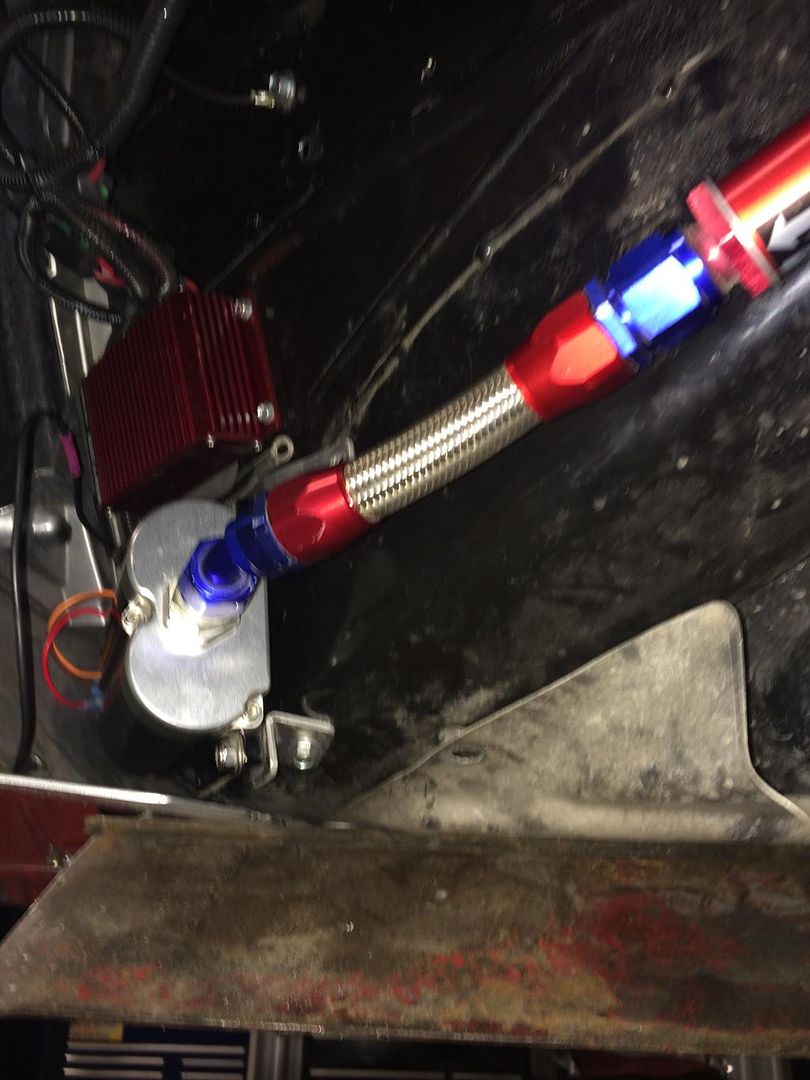
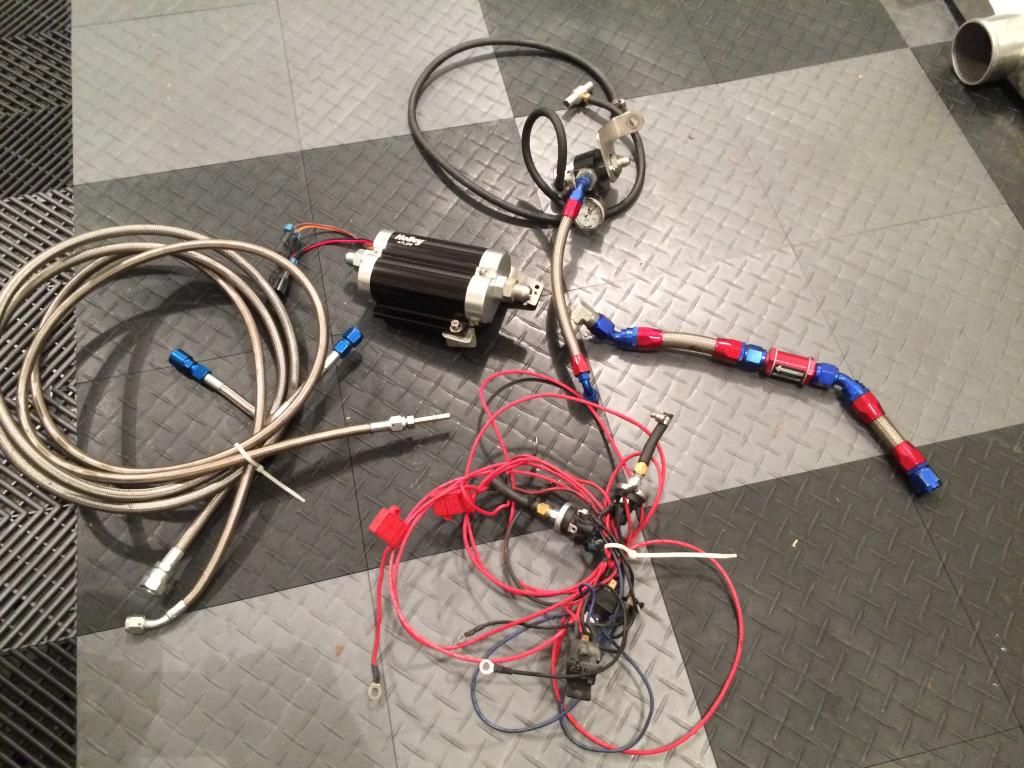
Bought the lines from anfittingsdirect dot com.
Attachment to the stock sender is via the OEM 5/16 to -6AN male locking adapter and the OEM 3/8 to -8AN male locking adapter.
Backside so you can see the locking mechanism. It screws into the body of the fitting, trapping the retaining ring.
Side view of the OEM 3/8 to -8AN male
Thanks,
Dave
Originally Posted by glocklimited9
Where did you get the Teflon fuel lines? and how are you hooking up to the stock sender?
Sorry, to whom is this directed? If it's me,
Bought the lines from anfittingsdirect dot com.
Attachment to the stock sender is via the OEM 5/16 to -6AN male locking adapter and the OEM 3/8 to -8AN male locking adapter.
Backside so you can see the locking mechanism. It screws into the body of the fitting, trapping the retaining ring.
Side view of the OEM 3/8 to -8AN male
Thanks,
Dave
Arent the Teflon lines supposed to not have a fuel? I have heard some of the braided lines do but I unsure what lines do or don't.
From the anfittingsdirect site where I bought the lines... Our stainless steel lines utilize a smooth bore PTFE tube inside a braided stainless steel sleeve. This combination gives you extreme pressure, heat, and chemical resistance along with a shiny and professional appearance. If you're building oil lines, fuel lines, doing an ethanol / E85 conversion, or any other fluid transfer system, www . anfittingsdirect . com is your magic bullet.
Originally Posted by JRENIGAR
Arent the Teflon lines supposed to not have a fuel? I have heard some of the braided lines do but I unsure what lines do or don't.
There are many guys making 800 plus hp through stock fuel lines. I think everyone goes a bit overboard on the size of the lines. I guess it cant hurt anything but it definitely isn't necessary.
I am in the process of redoing my fuel system currently. I am using a Holley 12-1800 pump which has -10 inlet and outlets. My system uses only a -6 feed line and a -6 return as it was built to hook up to the stock rails. I could change the lines for bigger now but I see no need and its a waste of money in my opinion.
This is the pump mounted with -10 from the tank to pump. After that its -6 all the way through.
From the anfittingsdirect site where I bought the lines... Our stainless steel lines utilize a smooth bore PTFE tube inside a braided stainless steel sleeve. This combination gives you extreme pressure, heat, and chemical resistance along with a shiny and professional appearance. If you're building oil lines, fuel lines, doing an ethanol / E85 conversion, or any other fluid transfer system, www . anfittingsdirect . com is your magic bullet.
I meant fuel smell. I couldn't think of the PTFE abbreviation. I now realize that's what you have. I definitely wouldn't want a fuel smell coming from my car due to cheap/inferior fuel lines.
Mighty, i was asking you and thats exactly what im looking for, thank you for the reply
I havent heard of that company so im hoping quality is good, wonder if they make their own fitting or use others?
realcanuk, My car is getting a big turbo Lsx, the stock lines are good to around 550whp, -6 to about 700, and im hoping to exceed that with my build. I defiantly dont want to run out of fuel and have to start over
6 Common C5 Corvette Failures and What's Involved In Repairing Them
Slideshow: From wobbling harmonic balancers to failed EBCMs, these are the issues that define long-term C5 ownership and what repairs typically involve.
Retro Modern Bandit Pontiac Trans AM Comes With Burt Reynolds' Autograph
Slideshow: A modern Camaro transformed into a retro icon, this limited-run "Bandit" build blends nostalgia with brute force in a way few revivals manage.
Top 10 Greatest Cadillac V Series Performance Models Ever, Ranked
Slideshow: Cadillac didn't just crash the high-performance luxury vehicle party, it showed up loud, supercharged, and occasionally a little unhinged...
Coachbuilt N2A Anteros Is an LS2-Powered C6 Corvette In Italian Clothes
Slideshow: A one-off sports car that looks like a vintage Italian exotic-but hides a C6 Corvette underneath-just sold for the price of a new mid-engine Corvette.






 Larger fuel lines
















 Thanks.







 I couldn't think of the PTFE abbreviation. I now realize that's what you have. I definitely wouldn't want a fuel smell coming from my car due to cheap/inferior fuel lines.