





ethanol

Super Cliff: Ethanol = poop
A gallon of ethanol should cost less than $1.00 but we will be paying full gasoline price for each gallon we buy. Now keep in mind that as the % ethanol mix in your gas goes up, your miles per gallon will be going down.
Ethanol is not nearly as efficient as gasoline. This will be most pronounced during the low-speed low-load driving where we spend 99% of our time. Unless cylinder pressure is increased greatly by compression or some other means, the efficiency with ethanol will go down exponentially in relation to % ethanol mix.
For at least 90% of your driving, lowering the intake air temp and slowing the burn rate with an oxygenated fuel is the last thing you want to be doing for fuel efficiency. I have no clue how people get so misinformed on this.
The 10% ethanol mix has been around for years and is notorious for bringing with it problems ranging from harder starting, vapor-lock, water absorbtion, and fuel system corrossion. The corrossion is most obvious with the carburetor guys and especially those who run aluminum carburetors (Carters) and aluminum fuel lines or fittings. As the % ethanol goes up, obviously the problems will become more pronounced.
A gallon of ethanol should cost less than $1.00 but we will be paying full gasoline price for each gallon we buy. Now keep in mind that as the % ethanol mix in your gas goes up, your miles per gallon will be going down.
Ethanol is not nearly as efficient as gasoline. This will be most pronounced during the low-speed low-load driving where we spend 99% of our time. Unless cylinder pressure is increased greatly by compression or some other means, the efficiency with ethanol will go down exponentially in relation to % ethanol mix.
For at least 90% of your driving, lowering the intake air temp and slowing the burn rate with an oxygenated fuel is the last thing you want to be doing for fuel efficiency. I have no clue how people get so misinformed on this.
The 10% ethanol mix has been around for years and is notorious for bringing with it problems ranging from harder starting, vapor-lock, water absorbtion, and fuel system corrossion. The corrossion is most obvious with the carburetor guys and especially those who run aluminum carburetors (Carters) and aluminum fuel lines or fittings. As the % ethanol goes up, obviously the problems will become more pronounced.

TECH Resident
Joined: Dec 2004
Posts: 841
Likes: 0
From: Baltimore, MD.
I agree that we need to be putting the heartland to work.
I think we should be phasing out some of the ag subsidies and encouraging our farmers to grow crops that we need. Corn, sugar beets, swamp grass, whatever is the most economical for producing ethanol (or methanol for that matter) is fine by me.
BUT, We do need to be careful not to cut our own throats by making fuel and food compete. Most of the corn in the US these days is not intended for human consumption OR for ethanol production. Most of it is grown for feed for livestock (cattle, chickens, etc). I certainly don't want to still have $3 a gallon gas and end up with $12 a pound chicken, which if we're not careful might happen.
'JustDreamin'
I think we should be phasing out some of the ag subsidies and encouraging our farmers to grow crops that we need. Corn, sugar beets, swamp grass, whatever is the most economical for producing ethanol (or methanol for that matter) is fine by me.
BUT, We do need to be careful not to cut our own throats by making fuel and food compete. Most of the corn in the US these days is not intended for human consumption OR for ethanol production. Most of it is grown for feed for livestock (cattle, chickens, etc). I certainly don't want to still have $3 a gallon gas and end up with $12 a pound chicken, which if we're not careful might happen.
'JustDreamin'
Last edited by 'JustDreamin'; May 4, 2006 at 09:34 AM.

6600 rpm clutch dump of death Administrator


Joined: Dec 2001
Posts: 4,983
Likes: 13
From: Texas
white2001s10 - Ethanol being "poop" I guess is a matter of opinion. There are whole countries who are energy independant as a result of the switch to alcohol fuel. You can look at anything ina negative light. You can certainly look at gasoline as being bad based on its benzene content, etc... Its all a matter of perspective.
As I said, I'm familiar with how alcohol works based on racing with it for quite some time. But, it isn't rocket science.
Also, you made some good points about using a motor exclusively for alochol or gas. Alcohol give you the ability to crank up compression, or in a boosted app, allow you to turn up the boost. In a boosted app the power gains are DRAMATIC.
As for the heartland. Commodity prices have been in a stready decline for almost 30 years. Right now, some of them at near their lowest point. What this means is we're driving farmers out of business based on costs.
Everything Ag related is based on the cost of oil. Fuel costs have doubled in the last year. Fertilizer costs basically double. Then comes the cost of spraying. Again fuel costs increase that.
Think about 1 tractor. Last year it cost $500/day to run a good sized tractor (just for fuel). Now, when you adjust that for the cost of labor and the tractor you're looking at close to $1100/day.
Now, look at just a cost of fuel increase its now $1000/day just for fuel.
Two things which have been the bulwarks of a strong America have been our production facilities which we are giving away to places like China, and our domestic Ag. We are driving farmers out of businesss in record numbers.
It may suck to have to cut back on your driving as fuel costs climb. But think about having to cut back on your eating too. What I'm talking about helps both directions.
Fuel costs can only go so far. Americans only have X ammount of disposable income. When fuel costs exceed that, folks spend less elsewhere. So, the economy slows, fuel demand drops, and fuel costs drop. its a vicious circle. The only cure for fuel costs are fuel costs. They will drive themselves down. The problem is what happens to the economy in the meantime.
As I said, I'm familiar with how alcohol works based on racing with it for quite some time. But, it isn't rocket science.
Also, you made some good points about using a motor exclusively for alochol or gas. Alcohol give you the ability to crank up compression, or in a boosted app, allow you to turn up the boost. In a boosted app the power gains are DRAMATIC.
As for the heartland. Commodity prices have been in a stready decline for almost 30 years. Right now, some of them at near their lowest point. What this means is we're driving farmers out of business based on costs.
Everything Ag related is based on the cost of oil. Fuel costs have doubled in the last year. Fertilizer costs basically double. Then comes the cost of spraying. Again fuel costs increase that.
Think about 1 tractor. Last year it cost $500/day to run a good sized tractor (just for fuel). Now, when you adjust that for the cost of labor and the tractor you're looking at close to $1100/day.
Now, look at just a cost of fuel increase its now $1000/day just for fuel.
Two things which have been the bulwarks of a strong America have been our production facilities which we are giving away to places like China, and our domestic Ag. We are driving farmers out of businesss in record numbers.
It may suck to have to cut back on your driving as fuel costs climb. But think about having to cut back on your eating too. What I'm talking about helps both directions.
Fuel costs can only go so far. Americans only have X ammount of disposable income. When fuel costs exceed that, folks spend less elsewhere. So, the economy slows, fuel demand drops, and fuel costs drop. its a vicious circle. The only cure for fuel costs are fuel costs. They will drive themselves down. The problem is what happens to the economy in the meantime.
so much BS I dont even know where to start.
Ethanol has a higher octane than gas, so no, you dont need another additive. Because of the higher octane, pinging and detonation are reduced.
Ethanol does make less energy per gallon, but because it has its own oxygen so you can burn much more...(richer AFR, compared to gasonline)
Ethanol does mix with water which is GOOD because in your gas tank, water will seperate from your pure gasoline, but with ethanol in it, it will mixup completely and burn the water without causing any problems.
yes growing ethanol from corn is not very efficient, but don't blame ethanol, blame the huge farming industry wanting to grow their favorite product.
AND if given a choice between buying gas from some rag-head shiek whos gonna take my money and fund a terrorist organization, versus giving my money to some greedy huge corn co-op in the USA, not a hard choice to make.
Ethanol has a higher octane than gas, so no, you dont need another additive. Because of the higher octane, pinging and detonation are reduced.
Ethanol does make less energy per gallon, but because it has its own oxygen so you can burn much more...(richer AFR, compared to gasonline)
Ethanol does mix with water which is GOOD because in your gas tank, water will seperate from your pure gasoline, but with ethanol in it, it will mixup completely and burn the water without causing any problems.
yes growing ethanol from corn is not very efficient, but don't blame ethanol, blame the huge farming industry wanting to grow their favorite product.
AND if given a choice between buying gas from some rag-head shiek whos gonna take my money and fund a terrorist organization, versus giving my money to some greedy huge corn co-op in the USA, not a hard choice to make.
TECH Resident
Joined: Dec 2004
Posts: 841
Likes: 0
From: Baltimore, MD.
Originally Posted by J-Rod
The problem is what happens to the economy in the meantime.
'JustDreamin'
Originally Posted by Steel Chicken
so much BS I dont even know where to start.
Ethanol has a higher octane than gas, so no, you dont need another additive. Because of the higher octane, pinging and detonation are reduced.
Ethanol does make less energy per gallon, but because it has its own oxygen so you can burn much more...(richer AFR, compared to gasonline)
Ethanol does mix with water which is GOOD because in your gas tank, water will seperate from your pure gasoline, but with ethanol in it, it will mixup completely and burn the water without causing any problems.
Ethanol has a higher octane than gas, so no, you dont need another additive. Because of the higher octane, pinging and detonation are reduced.
Ethanol does make less energy per gallon, but because it has its own oxygen so you can burn much more...(richer AFR, compared to gasonline)
Ethanol does mix with water which is GOOD because in your gas tank, water will seperate from your pure gasoline, but with ethanol in it, it will mixup completely and burn the water without causing any problems.
Technically ethanol has no octane in it at all. It only acts like a certain octane when a certain AFR is reached. The only advantage then would come under power enrichment, and is very minimal. Most cars are running too high an octane as-is and do not gain any power or advantage with ethanol.
Ethanol is hydroscopic, as in it will pull moisture out of the air and retain it. This isn't the advantage you make it out to sound like. It doesn't solve a problem for you, but creates one as fuel contamination can happen quickly. Once retaining water, the characteristics of the primary fuel will change.
The oxygenated fuel came into the picture for street vehicles due to the EPA, and not chosen by efficiency engineers as the best fuel for the job.
Here's a quote from Chevron about oxygenated fuel:
"Oxygenated Gasolines and Fuel Economy
The U.S. government requires the use of oxygenated gasoline in some areas in the wintertime to reduce the amount of carbon monoxide in the air. The oxygenates raise the cost of making gasoline and lower the miles you can drive per gallon. This Bulletin explains how oxygenated gasoline will affect your car's fuel economy and identifies other factors which could make the effect seem larger than it is.
Summary
Oxygenated gasoline will lower your car's fuel economy 2% to 3% because oxygenates contain less energy than conventional gasoline. If you experience a larger decrease, there are probably other contributing factors: change to winter weather, change from summer to winter gasoline, and/or changes in the car's driving cycle or mechanical condition. When they act in concert, these changes can decrease fuel economy more than oxygenated gasoline does."
6600 rpm clutch dump of death Administrator
Joined: Dec 2001
Posts: 4,983
Likes: 13
From: Texas
Originally Posted by white2001s10
Yes exactly.
Technically ethanol has no octane in it at all. It only acts like a certain octane when a certain AFR is reached. The only advantage then would come under power enrichment, and is very minimal. Most cars are running too high an octane as-is and do not gain any power or advantage with ethanol.
Technically ethanol has no octane in it at all. It only acts like a certain octane when a certain AFR is reached. The only advantage then would come under power enrichment, and is very minimal. Most cars are running too high an octane as-is and do not gain any power or advantage with ethanol.
Ethanol by volume has 10% less Btu's per gallon than gasoline. But, the proper AFR for Ethanol vs gasoline is much greater (9:1 vs 14.7:1). Now, couple that with its cooling effect on intake charge and when you optimize you engine combination for that (ie higher boost pressure, or a MUCH high static CR) then you can offset any so called power loss. As I said in side by side comparison with Methanol vs gasoline (methonal is about half the Btu's/gal of gasoline) that ina N/A combo the power is up 5% or so. but ina F/I combo it goes up between 15 to almost 20% on power. Which is worth noting.
6600 rpm clutch dump of death Administrator
Joined: Dec 2001
Posts: 4,983
Likes: 13
From: Texas
Ethanol is hydroscopic, as in it will pull moisture out of the air and retain it. This isn't the advantage you make it out to sound like. It doesn't solve a problem for you, but creates one as fuel contamination can happen quickly. Once retaining water, the characteristics of the primary fuel will change.
Ethanol is hydroscopic, as in it will pull moisture out of the air and retain it. This isn't the advantage you make it out to sound like. It doesn't solve a problem for you, but creates one as fuel contamination can happen quickly. Once retaining water, the characteristics of the primary fuel will change.
Risks
E85 Ethanol is not all good, it can also do damage, like prolonged exposure to high concentrations of ethanol may corrode metal and rubber parts in older engines (pre-1988) designed primarily for gasoline. The hydroxyl group on the ethanol molecule is an extremely weak acid, but it can enhance corrosion for some natural materials. For post-1988 fuel-injected engines, all the components are already designed to accommodate E10 (10% ethanol) blends through the elimination of exposed magnesium and aluminum metals and natural rubber and cork gasketed parts. Hence, there is a greater degree of flexibility in just how much more ethanol may be added without causing ethanol-induced damage, varying by automobile manufacturer. Anhydrous ethanol in the absence of direct exposure to alkali metals and bases is non-corrosive; it is only when water is mixed with the ethanol that the mixture becomes corrosive to some metals. Hence, there is no appreciable difference in the corrosive properties between E10 and a 50:50 blend of E10 gasoline and E85 (47.5% ethanol), provided there is no water present, and the design was done to accommodate E10. Nonetheless, operation with more than 10% ethanol has never been recommended by car manufacturers in non-FFVs.
Operation on up to 20% ethanol is generally considered safe for all post 1988 cars and trucks. This equates to running a blend of 23.5% of E85. Starting in 2013[4], at least one US state (Minnesota) already has legislatively mandated and planned to force E20 (20% ethanol) into their general gasoline fuel-distribution network. Details of how this will work for individual vehicle owners while maintaining automobile manufacturer warranties, despite exceeding the manufacturer's maximum warranted operation percentage of 10% of ethanol in fuel, are still being worked as of late-2005. However, the choice of transitioning to a 20% ethanol blend of gasoline is not without precedent; Brazil, in its conversion to an ethanol-fueled economy, determined that operation with up to 22% ethanol in gasoline was safe for the cars and trucks then on the road in Brazil at the time, and the conversion to a 20% blend was accomplished with only minor issues arising for older vehicles. Recently, conversion to a 24% blend was accomplished in Brazil.
In addition to corrosion, there is also a risk of increased engine wear for non-FFV engines that are not specifically designed for operation on high levels (i.e., for greater than 10%) of ethanol. The risk primarily comes in the rare event that the E85 fuel ever becomes contaminated with water. For water levels below approximately 0.5% to 1.0% contained in the ethanol, no phase separation of gasoline and ethanol occurs. For contamination with 1% or more water in the ethanol, phase separation occurs, and the ethanol and water mixture will separate from the gasoline. This can be simply observed by pouring a mixture of suspected water-contaminated E85 fuel in a clear glass tube, waiting roughly 30 minutes for the separation to occur (if it does), and then inspecting the sample. If there is water contamination of above 1% water in the ethanol, a clear separation of alcohol (with water) and gasoline will be clearly visible, with the colored gasoline floating above the clear alcohol and water mixture.
For a badly-contaminated amount of water in the ethanol and water mixture that separates from the gasoline (i.e., approximately 11% water, 89% ethanol, equivalent to 178 proof alcohol), considerable engine wear will occur, especially during times while the engine is heating up to normal operating temperatures, as for example just after starting the engine, when low temperature partial combustion of the water-contaminated ethanol mixture is taking place. This wear, caused by water-contaminated E85, is the result of the combustion process of ethanol, water, and gasoline producing considerable amounts of formic acid (HCOOH, also known as methanoic acid, and sometimes written as CH2O2).
In addition to the production of formic acid occurring for water-contaminated E85, smaller amounts of acetaldehyde (CH3CHO) and acetic acid (C2H4O2) are also formed for water-contaminated ethanol combustion. Nonetheless, it is the formic acid that is responsible for the majority of the rapid increase in engine wear.
Engines specifically designed for FFVs employ soft nitride coatings on their internal metal parts to provide formic acid wear resistance in the event of water contamination of E85 fuel. Also, the use of lubricant oil (motor oil) containing an acid neutralizer is necessary to prevent the damage of oil-lubricated engine parts in the event of water contamination of fuel. Such lubricant oil is required by at least one manufacturer of FFVs even to this day (Chrysler).
For non-FFVs burning E85 in greater than 23.5% E85 mixtures (20% ethanol), the remedy for accidentally getting a tank of water-contaminated E85 (or gasoline) while preventing excessive engine wear is to change the motor oil as soon as possible after either burning the fuel and replacing it with non-contaminated fuel, or after immediately draining and replacing the water-contaminated fuel. The risk of burning slightly water-contaminated fuel with low percentages of water (less than 1%) on a long commute is minimal; after all, it is the low temperature combustion of water contaminated ethanol and gasoline that causes the bulk of the formic acid to form; burning a slightly-contaminated mix of water (less than 1%) and ethanol quickly, in one long commute, will not likely cause any appreciable engine wear past the first 15 miles of driving, especially once the engine warms up and high temperature combustion occurs exclusively.
For those making their own E85, the risk of introducing water unintentionally into their homemade fuel is relatively high unless adequate safety precautions and quality control procedures are taken. Ethanol and water form an azeotrope such that it is impossible to distill ethanol to higher than 95.6% ethanol purity by weight (roughly 190 proof), regardless of how many times distillation is repeated. Unfortunately, this proof ethanol contains too much water to prevent separation of a mixture of such proof ethanol with gasoline, or to prevent the formation of formic acid during low temperature combustion. Therefore, when making E85, it becomes necessary to remove this residual water. It is possible to break the ethanol and water azeotrope through adding benzene or another hydrocarbon prior to a final rectifying distillation. This takes another distillation (energy consuming) step. However, it is possible to remove the residual water more easily, using 3 angstrom (3A) synthetic zeolite pellets to absorb the water from the mix of ethanol and water, prior to mixing the now anhydrous ethanol with gasoline in an 85% to 15% by volume mixture to make E85. This absorption process is also known as a molecular sieve. The benefit of using synthetic zeolite pellets is that they are essentially comparable to using a catalyst, in being infinitely reusable and in not being consumed in the process, and the pellets require only re-heating (perhaps on a backyard grill, in a solar reflector furnace, or with heated carbon dioxide gas collected and saved from the fermentation process) to drive off the water molecules absorbed into the zeolite. Research has also been done at Purdue University on using corn grits as a desiccant. [5] Once the ground corn becomes water logged, the corn grits can be processed much as the zeolite pellets, at least for a number of drying cycles before the grits lose their effectiveness. Once this occurs, it is possible to run the now water-logged corn grits through the natural fermentation process and convert them into even more ethanol fuel.
Running a non-FFV with too high of a percentage of ethanol will also cause a lean air fuel mixture. A lean mixture, if allowed to persist over considerable periods of time, will cause overheating of pistons and will eventually cause engine damage. It will also cause premature catalytic converter failure. This is also why the check engine light will illuminate if you mix more than around 50% to 60% E85 by volume with your gasoline in a non-FFV. If this happens, just add more 87 octane regular grade gasoline as soon as possible to correct the problem. (Some premium blends contain up to 10% ethanol; to correct the problem as quickly as possible, always add regular grade gasoline, not premium grade gasoline.) These lean mixture problems will not happen in a properly-converted vehicle.
LS1 Tech Stories
The Best V8 Stories One Small Block at Time

Topdon ONE vs. Artidiag 800 BT2: Which is the Diagnostic Tablet For You?
Pouria Savadkouei
Gas Monkey Built a 6-Wheel Ferrari Testarossa With a Corvette LT4 Engine
Verdad Gallardo
7 Most Reliable High-Performance Engines GM Has Ever Built
Verdad Gallardo
Amazing '71 Camaro Restomod Is Modern Muscle Car Under the Skin
Verdad Gallardo
6 Common C5 Corvette Failures and What's Involved In Repairing Them
Pouria Savadkouei
Retro Modern Bandit Pontiac Trans AM Comes With Burt Reynolds' Autograph
Verdad Gallardo
Top 10 Greatest Cadillac V Series Performance Models Ever, Ranked
Pouria Savadkouei
Top 10 Most Powerful Chevy Trucks Ever Made!

Hennessey's New Supercharged Silverado ZR2 Has 700 HP
Verdad Gallardo OMG 2-3% less power? Id much rather send billions to the middle east totalitarian countries and their terrorist progeny then swap out a head gasket and get my lost power back with a high compression ratio that ethanol will support.
I dont see why people are so resistant to reducing our dependence on foriegn oil...
in Colorado at least, we've been running 10% ethanol for decades, no huge problems, no end of the world crap. In northern europe, E85 is VERY common and we dont see any weeping and gnashing of teeth there about OMG 2% less power and wowzers if I leave my gas can open in the air for 3 months it gets water in it!!!
1) oil will NOT last forever
2) where do you think your money really goes when you buy foriegn oil?
3) dont be so stubborn and thick headed about chemistry you don't really understand and want to blow out of porportion
I dont see why people are so resistant to reducing our dependence on foriegn oil...
in Colorado at least, we've been running 10% ethanol for decades, no huge problems, no end of the world crap. In northern europe, E85 is VERY common and we dont see any weeping and gnashing of teeth there about OMG 2% less power and wowzers if I leave my gas can open in the air for 3 months it gets water in it!!!
1) oil will NOT last forever
2) where do you think your money really goes when you buy foriegn oil?
3) dont be so stubborn and thick headed about chemistry you don't really understand and want to blow out of porportion
6600 rpm clutch dump of death Administrator
Joined: Dec 2001
Posts: 4,983
Likes: 13
From: Texas
Ok, I lost two pages of typed info. So, bear with me. My last point was going to be to point out that oxygenated fuels are not necessarily bad in and to themelves if you tune for them correctly.
Fuel AFRst FARst Equivalence Ratio Lambda
Gasoline stoich 14.7 0.068 1 1
Gasoline Max power rich 12.5 0.08 1.176 0.8503
Gasoline Max power lean 13.23 0.0755 1.111 0.900
E85 stoich 9.765 0.10235 1 1
E85 Max power rich 6.975 0.1434 1.40 0.7143
E85 Max power lean 8.4687 0.118 1.153 0.8673
E100 stoich 9.0078 0.111 1 1
E100 Max power rich 6.429 0.155 1.4 0.714
E100 Max power lean 7.8 0.128 1.15 0.870
The term AFRst refers to the Air Fuel Ratio under stoichiometric, or ideal air fuel ratio mixture conditions. (See stoichiometry.)
FARst refers to the Fuel Air Ratio under stoichiometric conditions, and is simply the reciprocal of AFRst.
Equivalence Ratio is the ratio of actual Fuel Air Ratio to Stoichiometric Fuel Air Ratio; it provides an intuitive way to express richer mixtures.
Lambda is the ratio of actual Air Fuel Ratio to Stoichiometric Air Fuel Ratio; it provides an intuitive way to express leanness conditions (i.e., less fuel, less rich) mixtures of fuel and air.
When you can run a mixture with more fuel and still be around stoich (and BTU/gal are similar) it means you can make more usable power.
This is sometimes referred to as specific energy
As an extreme example. The Specific Energy of nitromethane has at stoichiometric ( heat of combustion divided by air-fuel ratio ) is 6.6, compared to 2.9 for iso-octane (that we talked about above),indicates that the fuel energy delivered to the combustion chamber is 2.3 times that of iso-octane for the same mass of air. Coupled with the higher flame temperature ( 2400C ), and flame speed (0.5 m/s).
Power output and usage in Racing
In other words. If you are so inclined, Mill those heads, bump your static CR, and take advantage of poor mans race gas at the pump....
Fuel AFRst FARst Equivalence Ratio Lambda
Gasoline stoich 14.7 0.068 1 1
Gasoline Max power rich 12.5 0.08 1.176 0.8503
Gasoline Max power lean 13.23 0.0755 1.111 0.900
E85 stoich 9.765 0.10235 1 1
E85 Max power rich 6.975 0.1434 1.40 0.7143
E85 Max power lean 8.4687 0.118 1.153 0.8673
E100 stoich 9.0078 0.111 1 1
E100 Max power rich 6.429 0.155 1.4 0.714
E100 Max power lean 7.8 0.128 1.15 0.870
The term AFRst refers to the Air Fuel Ratio under stoichiometric, or ideal air fuel ratio mixture conditions. (See stoichiometry.)
FARst refers to the Fuel Air Ratio under stoichiometric conditions, and is simply the reciprocal of AFRst.
Equivalence Ratio is the ratio of actual Fuel Air Ratio to Stoichiometric Fuel Air Ratio; it provides an intuitive way to express richer mixtures.
Lambda is the ratio of actual Air Fuel Ratio to Stoichiometric Air Fuel Ratio; it provides an intuitive way to express leanness conditions (i.e., less fuel, less rich) mixtures of fuel and air.
When you can run a mixture with more fuel and still be around stoich (and BTU/gal are similar) it means you can make more usable power.
This is sometimes referred to as specific energy
As an extreme example. The Specific Energy of nitromethane has at stoichiometric ( heat of combustion divided by air-fuel ratio ) is 6.6, compared to 2.9 for iso-octane (that we talked about above),indicates that the fuel energy delivered to the combustion chamber is 2.3 times that of iso-octane for the same mass of air. Coupled with the higher flame temperature ( 2400C ), and flame speed (0.5 m/s).
Power output and usage in Racing
E85 has been repeatedly shown to produce more power than a comparable gasoline fuel. Especially in engines that need high octane fuels to avoid detonation.[7] Ford Motor Company found typically power increased approximately 5% with the switch to E85 [8]. Researchers working on the E85 equivalent fuel for general aviation aircraft AGE-85 have seen the same results with an aircraft engine jumping from 600 hp on conventional 100LL av gas to 650 hp on the AGE-85. Recorded power increases ranging from 5% - 9% depending on the engine. [9][10]
Due to pressure to remove leaded fuel even from racing environments, several racing organizations are looking at ethanol or E85 fuels as suitable alternative fuels for high performance race engines.
In 2006, the "National Street Car Association" is adopting E85 as an approved fuel for both their American Muscle Car and Street Machine eliminator racing classes.
NHRA (National Hot Rod Association) currently allows ethanol as an approved fuel in several of its racing classes. NHRA approved ethanol is allowed in their bracket classes, Hotrod, Modified, ProFWD, and ProRWD classes to name some of the more popular. At this time it has not announced any plans to include E85 as an approved fuel in the classes that are currently limited to "pump fuels".
The Indy Racing League is likewise moving to ethanol based fuels this year, with 10% ethanol 90% methanol fuel blend, and switching to a 100% ethanol fuel in the 2007 racing season.
There is much discussion of NASCAR also making the switch to an alcohol based fuel in the future.
Interest in E85 is high enough that there are now competitions for engine builders to develop winning combinations for both power and fuel economy on this fuel. One such competition is sponsored by the AERA Engine Builders Association.
Due to pressure to remove leaded fuel even from racing environments, several racing organizations are looking at ethanol or E85 fuels as suitable alternative fuels for high performance race engines.
In 2006, the "National Street Car Association" is adopting E85 as an approved fuel for both their American Muscle Car and Street Machine eliminator racing classes.
NHRA (National Hot Rod Association) currently allows ethanol as an approved fuel in several of its racing classes. NHRA approved ethanol is allowed in their bracket classes, Hotrod, Modified, ProFWD, and ProRWD classes to name some of the more popular. At this time it has not announced any plans to include E85 as an approved fuel in the classes that are currently limited to "pump fuels".
The Indy Racing League is likewise moving to ethanol based fuels this year, with 10% ethanol 90% methanol fuel blend, and switching to a 100% ethanol fuel in the 2007 racing season.
There is much discussion of NASCAR also making the switch to an alcohol based fuel in the future.
Interest in E85 is high enough that there are now competitions for engine builders to develop winning combinations for both power and fuel economy on this fuel. One such competition is sponsored by the AERA Engine Builders Association.
In other words. If you are so inclined, Mill those heads, bump your static CR, and take advantage of poor mans race gas at the pump....
6600 rpm clutch dump of death Administrator
Joined: Dec 2001
Posts: 4,983
Likes: 13
From: Texas
Originally Posted by Steel Chicken
OMG 2-3% less power? Id much rather send billions to the middle east totalitarian countries and their terrorist progeny then swap out a head gasket and get my lost power back with a high compression ratio that ethanol will support.
I dont see why people are so resistant to reducing our dependence on foriegn oil...
in Colorado at least, we've been running 10% ethanol for decades, no huge problems, no end of the world crap. In northern europe, E85 is VERY common and we dont see any weeping and gnashing of teeth there about OMG 2% less power and wowzers if I leave my gas can open in the air for 3 months it gets water in it!!!
1) oil will NOT last forever
2) where do you think your money really goes when you buy foriegn oil?
3) dont be so stubborn and thick headed about chemistry you don't really understand and want to blow out of porportion
I dont see why people are so resistant to reducing our dependence on foriegn oil...
in Colorado at least, we've been running 10% ethanol for decades, no huge problems, no end of the world crap. In northern europe, E85 is VERY common and we dont see any weeping and gnashing of teeth there about OMG 2% less power and wowzers if I leave my gas can open in the air for 3 months it gets water in it!!!
1) oil will NOT last forever
2) where do you think your money really goes when you buy foriegn oil?
3) dont be so stubborn and thick headed about chemistry you don't really understand and want to blow out of porportion
I suppose the word stubborn is appropriate here.
First of all the US is NOT dependant on oil from the middle east.
We only get 15% of our oil from the middle east and that's not because we have to, but because of an agreement we have with Saudia Arabia. Let that sink in for a minute.
Second, it doesn't take 3 months for alcohol to contaminate itself.
Third, I challenge anyone here competent enough to perform a controlled test on the dyno and put to rest all the B.S. about using ethanol in our engines for daily use.
(edit: if no dyno is available then track testing will do)
With a naturally aspirated LS1 powered car:
First dyno with 92 octane from the pump.
Then with no changes dyno with 87 octane from the pump.
Next change to either 85% or 100% ethanol and up your fuel to 9:1 AFR or whatever you think will work best and what ever spark advance you wish, and dyno again.
Post the unbiased/unchanged test results here.
6600 rpm clutch dump of death Administrator
Joined: Dec 2001
Posts: 4,983
Likes: 13
From: Texas
Originally Posted by white2001s10
I suppose the word stubborn is appropriate here.
First of all the US is NOT dependant on oil from the middle east.
We only get 15% of our oil from the middle east and that's not because we have to, but because of an agreement we have with Saudia Arabia. Let that sink in for a minute.
First of all the US is NOT dependant on oil from the middle east.
We only get 15% of our oil from the middle east and that's not because we have to, but because of an agreement we have with Saudia Arabia. Let that sink in for a minute.
But, America if you want to clarify it is soley dependant on imported oil from a variety of countires, both OPEC, and non-OPEC. In many cases, they are either non-friendly to the U.S. or they are unstable.
If you want to see where we get our oil from:
http://tonto.eia.doe.gov/dnav/pet/pe...im0_mbbl_m.htm
Total Imports Feb-06
372,963,000 Barrels
Saudi Arabia
40,630,000 Barrels
So from Saudi Arabia we get ~9%
Persian Gulf
57,945,000
From OPEC in that same time period we got:
152,530,000
That includes the above total, and included Nigeria, and Venezuela. Again, that goes back to my point on unstable countries...
Of the Non-OPEC countries we got:
220,433,000 Barrels
Of that:
Canada
63,326,000
Mexico
52,575,000
If you don't see imports as problematic, then simply look as far as the U.S. trade deficit. What is the largest contributor to our global trade imbalance (hint: foreign oil imports)...
US Treasury Secretary Snow recently said the US could not tackle “global imbalances” itself with regard to current trade and current account deficits. The US last year lost $805 billion through its current account deficit and has lost a total of $4 trillion over the last 10 years cumulatively. But according to Sec. Snow and the US government, the US is not to blame and bears no accountability for these losses.
These “global imbalances” have likewise resulted in the foreign acquisition of $8 trillion of strategic US assets and wealth producing industries over this period. Foreign toys, cars, Christmas lights, and other goods have been exchanged for our companies (8,200 acquired in last 10 years), natural resources, and government debt (47% now foreign owned). Hardly seems like “free” trade.
The $6 trillion of assets the US acquired of foreign interests over this period will not make up for the lost jobs and economic and national security due to this net imbalance.
But it still isn't a problem now is it...
Second, it doesn't take 3 months for alcohol to contaminate itself.
Third, I challenge anyone here competent enough to perform a controlled test on the dyno and put to rest all the B.S. about using ethanol in our engines for daily use.
(edit: if no dyno is available then track testing will do)
With a naturally aspirated LS1 powered car:
First dyno with 92 octane from the pump.
Then with no changes dyno with 87 octane from the pump.
Next change to either 85% or 100% ethanol and up your fuel to 9:1 AFR or whatever you think will work best and what ever spark advance you wish, and dyno again.
Post the unbiased/unchanged test results here.
(edit: if no dyno is available then track testing will do)
With a naturally aspirated LS1 powered car:
First dyno with 92 octane from the pump.
Then with no changes dyno with 87 octane from the pump.
Next change to either 85% or 100% ethanol and up your fuel to 9:1 AFR or whatever you think will work best and what ever spark advance you wish, and dyno again.
Post the unbiased/unchanged test results here.
I never said imported goods including oil and cars wasn't a problem. The point is that us switching to ethanol isn't going to hurt the middle east.
Switching to ethanol is also not going to solve the import & trade problems either.
Why did you not post a link to these results?
I realize that many other countries use alcohol as fuel for motor vehicles, and I'm at least partially familiar with the problems and inefficiencies associated with that use.
Are you suggesting that in this post of yours shows nonbiased test data for a normally designed gasoline powered vehicle comparing the performance and efficiency of gasoline against ethanol?
I would love to see this.
Switching to ethanol is also not going to solve the import & trade problems either.
Originally Posted by J-Rod
Ford has already done the testing and I posted the results. Also, as I pointed out. If you take advantage of the increase in octane rating and maximize your combination your gains can be considerable.
I realize that many other countries use alcohol as fuel for motor vehicles, and I'm at least partially familiar with the problems and inefficiencies associated with that use.
Are you suggesting that in this post of yours shows nonbiased test data for a normally designed gasoline powered vehicle comparing the performance and efficiency of gasoline against ethanol?
I would love to see this.
6600 rpm clutch dump of death Administrator
Joined: Dec 2001
Posts: 4,983
Likes: 13
From: Texas
Originally Posted by white2001s10
I never said imported goods including oil and cars wasn't a problem. The point is that us switching to ethanol isn't going to hurt the middle east.
Switching to ethanol is also not going to solve the import & trade problems either.
Switching to ethanol is also not going to solve the import & trade problems either.
I really don't care if a switch to ethanol hurts the middle east. Thats not the point. The key point is that money is going out faster than it comes in. That money is fueling other governments. in many cases they are not friendly to the U.S.. Simple question do you give your potential enemies money to attack you?
Another issue Commodity prices in the U.S. are at record lows. By investment inside the U.S. instead of that money going out of the system, it stays inside the system.
You say switching to ethanol won't help the economy. Its there in black and white and its really simple. If the money being spent by us on foreign oil is at some point, not spent on foreign oil. Then it stops being part of the U.S. trade imbalance.
Simple fact, if the entire country were switched to E85, we could cover our oil requirements with domestic production. In other words, freedom from our overseas "benefactors"...
Here is a simpistic ay to look at it. Would you like to see an America where when we could care less about Hugo Chavez? Would you like an America where you don't have to worry about what is happening in Nigeria, and whether its going to impact you fisical bottom line week to week. I know I certainly would.
From an environmental impact, how about keeping the carbon cycle static instead of pushing emission from hydro-carbons that have been locked up for millions of years.
Simple fact, until proven otherwise oil at this point is a non-renewable resource. Meaning when it is gone, its gone. Some have argued that oil will renew itself, but I have yet to see it happen in nature, or happen in the short-term. None the less. Comodities are a renewable resource . So, with proper respect for the land it grows on, we have a renewable energy source. In addition, demand for oil continues to rise based on the demands of the system as a whole based on the pressure from China and India. If you don't understand the impact Chaina is having on the global supply of raw materials, you need to look around. Look at the cost of steel, concrete, copper, etc... China is driving demand.
Look, as I said before at this point ethanol is not economically feasible unless gas stays above $30-40/barrel sustained. Another thing. The only cure for high gas prices, are high gas prices. The Saudi's love cheap gas as it means they sell a ton of it. But, demand is what is driving the short term. So, demand is either going to be curbed by a loss of demand. America only has X ammount of disposable income. if its being spent on fuel it doens't go into the economy, thus economic slowdown....
Why did you not post a link to these results?
I realize that many other countries use alcohol as fuel for motor vehicles, and I'm at least partially familiar with the problems and inefficiencies associated with that use.
Are you suggesting that in this post of yours shows nonbiased test data for a normally designed gasoline powered vehicle comparing the performance and efficiency of gasoline against ethanol?
I would love to see this.
Are you suggesting that in this post of yours shows nonbiased test data for a normally designed gasoline powered vehicle comparing the performance and efficiency of gasoline against ethanol?
I would love to see this.
As I said before. I've run gas and alcohol based race motors. The differences in power output between gas and alcohol are well know, and well documented.
ENGINE PERFORMANCE - STRAIGHT ALCOHOL
Having looked at a few of the basic factors which influence the performance of fuels in an engine, let us now examine some actual engine tests. Figure 2-4 is a plot of 198 proof (99%) ethyl alcohol as compared to gasoline. "Mean Effective Pressure" in the graph is a direct indication of the power produced. The increased mean effective pressure (M.E.P.) of alcohol at all mixture ratios is the most noticeable difference between the two fuels. This increase in M.E.P. is due mainly to the greater volumetric efficiency that results from the high latent heat of vaporization of ethanol and the resulting greater mass density of the fuel/air mixture.
Figure 2-4: ENGINE PERFORMANCE of ETHANOL vs GASOLINE
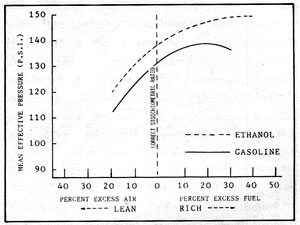
Note that the M.E.P. of ethanol increases with mixtures having up to 40% excess fuel, whereas for gasoline, the maximum pressure is reached at 20% excess fuel. It would seem that to achieve maximum power from an alcohol-burning engine there would be a temptation to burn very rich mixtures. Fuel economy aside, it should be noted that the rich mixtures necessary to obtain maximum M.E.P. are accompanied by incomplete burning of the fuel and the resultant lowering of overall thermal efficiency. The lean limits for alcohol and gasoline, therefore, are about the same, and both fuels develop maximum thermal efficiency at about 15% excess air. With mixtures leaner than 15% both fuels loose thermal efficiency.
Figure 2-5: HORSEPOWER COMPARISON of ETHANOL vs GASOLINE
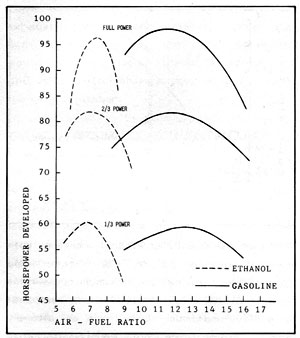
Figure 2-5 compares engine horsepower and air/fuel ratios for ethanol and gasoline in a six cylinder engine. The fuels in this case were 190 proof (95%) ethanol and "regular" gasoline having a specific gravity of 0.745. In the tests, air was supplied to the intake manifold at a constant 100 degrees Fahrenheit, and the carburetor needle valve was adjusted to provide the desired fuel/air ratios. The 2/3 and 1/3 loads were established by adjusting the throttle to give the same manifold pressure for both fuels.
The smaller air/fuel ratios for ethanol in comparison with gasoline are evident. In this test with the air supplied at the same temperature for both fuels, the correct fuel/air mixture should produce about 2% more power from gasoline than ethanol. However, alcohol, with its greater latent heat, requires more manifold heat to remain completely vaporized. In another test where this additional heat was supplied, the correct alcohol/air mixture gave 8.6% more power with ethanol! Note also that the test depicted in Figure 2-5 was run with alcohol that contained 5% water. This benefit of water injection probably inflated the alcohol power results to a certain degree. However, the main point illustrated is that the two fuels are remarkably similar in performance in a correctly adjusted engine.
ENGINE PERFORMANCE - ALCOHOL BLENDS
Although alcohol blends can be made from both ethanol and methanol, the primary interest seems to be in the direction of ethanol. Methanol and gasoline have a limited miscibility (mixability) while ethanol and gasoline can be mixed in all proportions. Economic reasons also dictate the interest in ethanol since it is more readily made from renewable resources. In addition, ethanol is a slightly superior motor fuel alternative under most conditions.
Economics aside, a major advantage of blends is that up to a certain concentration (somewhere between 10 and 20%) they can be used with absolutely no modification of the engine.
Many studies on how the various blends affect engine performance are contradictory. The recent "Two Million Mile" test in Nebraska, claims slightly higher fuel economy. Other tests claim a slight decrease. Some tests claim slightly better emissions, others claim no significant change. In relation to power output, the tests are equally ambiguous. However, when all the data is sifted, the overall conclusion is that in the areas of fuel economy, emissions, and performance there just isn't any real difference.
Figure 2-3, as discussed under Octane Ratings, illustrates another major advantage of alcohol blends, namely the ability of alcohol to raise the anti-knock quality of the gasoline with which it is mixed. This means, of course, that lower, cheaper grades of gasoline can be used to obtain a fuel with the desired octane rating, and the use of pollution producing additives can be eliminated. This is a significant advantage from the economic standpoint because the manufacture of high-octane blending stocks is expensive. Also, as previously mentioned, it is possible to raise the octane rating of unleaded gasoline so that it can be used in engines that previously required high-test leaded gasoline.
Alcohol blends do have one relatively minor drawback. The presence of even small amounts of water in the blend will cause a portion of the alcohol and gasoline to separate. At room temperature, less than 1% water can do the damage. As the temperature is lowered, amounts as small as 0.01% can cause separation. However, various substances such as benzene (benzol), acetone, and butyl alcohol can be added to the blend to increase water tolerance. Closed fuel systems, now in use, prevent moisture from forming inside the gas tank. Oil companies, given the proper incentive, could dry out their storage facilities and pipelines. Also, extensive use of alcohol blends over the past 50 years is ample evidence that the problem can be solved.
Having looked at a few of the basic factors which influence the performance of fuels in an engine, let us now examine some actual engine tests. Figure 2-4 is a plot of 198 proof (99%) ethyl alcohol as compared to gasoline. "Mean Effective Pressure" in the graph is a direct indication of the power produced. The increased mean effective pressure (M.E.P.) of alcohol at all mixture ratios is the most noticeable difference between the two fuels. This increase in M.E.P. is due mainly to the greater volumetric efficiency that results from the high latent heat of vaporization of ethanol and the resulting greater mass density of the fuel/air mixture.
Figure 2-4: ENGINE PERFORMANCE of ETHANOL vs GASOLINE
Note that the M.E.P. of ethanol increases with mixtures having up to 40% excess fuel, whereas for gasoline, the maximum pressure is reached at 20% excess fuel. It would seem that to achieve maximum power from an alcohol-burning engine there would be a temptation to burn very rich mixtures. Fuel economy aside, it should be noted that the rich mixtures necessary to obtain maximum M.E.P. are accompanied by incomplete burning of the fuel and the resultant lowering of overall thermal efficiency. The lean limits for alcohol and gasoline, therefore, are about the same, and both fuels develop maximum thermal efficiency at about 15% excess air. With mixtures leaner than 15% both fuels loose thermal efficiency.
Figure 2-5: HORSEPOWER COMPARISON of ETHANOL vs GASOLINE
Figure 2-5 compares engine horsepower and air/fuel ratios for ethanol and gasoline in a six cylinder engine. The fuels in this case were 190 proof (95%) ethanol and "regular" gasoline having a specific gravity of 0.745. In the tests, air was supplied to the intake manifold at a constant 100 degrees Fahrenheit, and the carburetor needle valve was adjusted to provide the desired fuel/air ratios. The 2/3 and 1/3 loads were established by adjusting the throttle to give the same manifold pressure for both fuels.
The smaller air/fuel ratios for ethanol in comparison with gasoline are evident. In this test with the air supplied at the same temperature for both fuels, the correct fuel/air mixture should produce about 2% more power from gasoline than ethanol. However, alcohol, with its greater latent heat, requires more manifold heat to remain completely vaporized. In another test where this additional heat was supplied, the correct alcohol/air mixture gave 8.6% more power with ethanol! Note also that the test depicted in Figure 2-5 was run with alcohol that contained 5% water. This benefit of water injection probably inflated the alcohol power results to a certain degree. However, the main point illustrated is that the two fuels are remarkably similar in performance in a correctly adjusted engine.
ENGINE PERFORMANCE - ALCOHOL BLENDS
Although alcohol blends can be made from both ethanol and methanol, the primary interest seems to be in the direction of ethanol. Methanol and gasoline have a limited miscibility (mixability) while ethanol and gasoline can be mixed in all proportions. Economic reasons also dictate the interest in ethanol since it is more readily made from renewable resources. In addition, ethanol is a slightly superior motor fuel alternative under most conditions.
Economics aside, a major advantage of blends is that up to a certain concentration (somewhere between 10 and 20%) they can be used with absolutely no modification of the engine.
Many studies on how the various blends affect engine performance are contradictory. The recent "Two Million Mile" test in Nebraska, claims slightly higher fuel economy. Other tests claim a slight decrease. Some tests claim slightly better emissions, others claim no significant change. In relation to power output, the tests are equally ambiguous. However, when all the data is sifted, the overall conclusion is that in the areas of fuel economy, emissions, and performance there just isn't any real difference.
Figure 2-3, as discussed under Octane Ratings, illustrates another major advantage of alcohol blends, namely the ability of alcohol to raise the anti-knock quality of the gasoline with which it is mixed. This means, of course, that lower, cheaper grades of gasoline can be used to obtain a fuel with the desired octane rating, and the use of pollution producing additives can be eliminated. This is a significant advantage from the economic standpoint because the manufacture of high-octane blending stocks is expensive. Also, as previously mentioned, it is possible to raise the octane rating of unleaded gasoline so that it can be used in engines that previously required high-test leaded gasoline.
Alcohol blends do have one relatively minor drawback. The presence of even small amounts of water in the blend will cause a portion of the alcohol and gasoline to separate. At room temperature, less than 1% water can do the damage. As the temperature is lowered, amounts as small as 0.01% can cause separation. However, various substances such as benzene (benzol), acetone, and butyl alcohol can be added to the blend to increase water tolerance. Closed fuel systems, now in use, prevent moisture from forming inside the gas tank. Oil companies, given the proper incentive, could dry out their storage facilities and pipelines. Also, extensive use of alcohol blends over the past 50 years is ample evidence that the problem can be solved.
My original post wasn't in answer to anything you had posted and yet you are on the defensive.
Posting that data copied from an internet site doesn't count in my book as a practical non-biased test under the conditions I stated. That's not even your test or data.
I've seen the information in your last post on more than one site and I'm already familiar with the results.
You're seriously sounding more and more like an internet expert with little if any practical knowledge of this.
As far as the economy and global trade goes and your plan to cut us off from the rest of the world because they're "unfriendly"... well whenever you become qualified to do executive briefings about economics and global strategies, you'll gain the credibility in my eyes, perhaps over what I've already heard from what I know are credible sources.
Who might be credible you ask? well Dr. Thomas Barnett for one.
Back to the ethanol B.S.
Instead of searching the web, why not fill your tank with ethanol and see what kind of results YOU get with the stuff.
Yeah you'll have to go into the tune and probably end up running open-loop mode to get anywhere at all, but that's really the easy part. A change in injector size is also likely... but hopefully not so much as to cause you other problems in the process.
I highly suggest you try this, because that kind of practical experience may be the only way you will be satisfied in getting to the truth behind all the ethanol B.S.
Documentation of high compression or blown race engines making X% more power than gasoline isn't what we're looking for at all when the question is: "Is ethanol a practical alternative for gasoline for the general public?"
It seems this point has been the most confused here.
Even then, I would bet my money that the vast majority of street vehicles will lose significant amounts of WOT power when switched to ethanol, even with unlimited tuning resources.
Posting that data copied from an internet site doesn't count in my book as a practical non-biased test under the conditions I stated. That's not even your test or data.
I've seen the information in your last post on more than one site and I'm already familiar with the results.
You're seriously sounding more and more like an internet expert with little if any practical knowledge of this.
As far as the economy and global trade goes and your plan to cut us off from the rest of the world because they're "unfriendly"... well whenever you become qualified to do executive briefings about economics and global strategies, you'll gain the credibility in my eyes, perhaps over what I've already heard from what I know are credible sources.
Who might be credible you ask? well Dr. Thomas Barnett for one.
Back to the ethanol B.S.
Instead of searching the web, why not fill your tank with ethanol and see what kind of results YOU get with the stuff.
Yeah you'll have to go into the tune and probably end up running open-loop mode to get anywhere at all, but that's really the easy part. A change in injector size is also likely... but hopefully not so much as to cause you other problems in the process.
I highly suggest you try this, because that kind of practical experience may be the only way you will be satisfied in getting to the truth behind all the ethanol B.S.
Documentation of high compression or blown race engines making X% more power than gasoline isn't what we're looking for at all when the question is: "Is ethanol a practical alternative for gasoline for the general public?"
It seems this point has been the most confused here.
Even then, I would bet my money that the vast majority of street vehicles will lose significant amounts of WOT power when switched to ethanol, even with unlimited tuning resources.
6600 rpm clutch dump of death Administrator
Joined: Dec 2001
Posts: 4,983
Likes: 13
From: Texas
I answered your posts, yet you run around all ***** nilly changing the topics, and when I answer your posts you change your point of view. Why don't you stick to one point.
If you want to refute it, then how about you come up with quantifiable evidence?
As I've said, I've raced alcohol and gas motors. Both low and high compression. I KNOW for a fact EXACTLY how they react. I've been racing alchohol motors for about 10 years.
When someone provides you test data, all of the sudden it doesn't meet your test criteria. You want a test to your specs, or sudduenly it isn't valid. I'm sorry guy the world doesn't revolve around you or you lack of knowledge or practical experience.
At the end of your post you "bet" that if it was tested here is the result you'd see. Fine test it... But it doens't change the fact that it has been tested, and your hypothesis is wrong. You may not like the results, or even like the test methodology. So, in my mind there is nothing that will make you happy.
As for the global economy. Lets just say Economic factors are well know, and if you go pick up an economics 101 book, the points I'm making are more than fleshed out. I'm not talking about some novel concept. Its basic Econ 101. if you don't understand dollars in vs dollars out then spend some time doing some reading.
As for Mr. Barnett, nothing I've read of his work seems to indicate he is against normal economics. Yes, he believes in globalization. He even notes that when the poulations income is over $3000/yr in most cases violence drops EXCEPT in certain circumstances.
I'm not against a global economy. First you say we don't depend on the Saudis. Yet when I suggest we reduce our foreign dependance and drop our foreign trade deficit your argue that before I make suggestions like that I need to be some sort of economics expert and provide global briefings. Give me a break. One doesn't need to be an expert to see basic economic factors at work.
Here is his most recent blog. It seems your hero seems to echo some of what I've already said.
If you want to refute it, then how about you come up with quantifiable evidence?
As I've said, I've raced alcohol and gas motors. Both low and high compression. I KNOW for a fact EXACTLY how they react. I've been racing alchohol motors for about 10 years.
When someone provides you test data, all of the sudden it doesn't meet your test criteria. You want a test to your specs, or sudduenly it isn't valid. I'm sorry guy the world doesn't revolve around you or you lack of knowledge or practical experience.
At the end of your post you "bet" that if it was tested here is the result you'd see. Fine test it... But it doens't change the fact that it has been tested, and your hypothesis is wrong. You may not like the results, or even like the test methodology. So, in my mind there is nothing that will make you happy.
As for the global economy. Lets just say Economic factors are well know, and if you go pick up an economics 101 book, the points I'm making are more than fleshed out. I'm not talking about some novel concept. Its basic Econ 101. if you don't understand dollars in vs dollars out then spend some time doing some reading.
As for Mr. Barnett, nothing I've read of his work seems to indicate he is against normal economics. Yes, he believes in globalization. He even notes that when the poulations income is over $3000/yr in most cases violence drops EXCEPT in certain circumstances.
I'm not against a global economy. First you say we don't depend on the Saudis. Yet when I suggest we reduce our foreign dependance and drop our foreign trade deficit your argue that before I make suggestions like that I need to be some sort of economics expert and provide global briefings. Give me a break. One doesn't need to be an expert to see basic economic factors at work.
Here is his most recent blog. It seems your hero seems to echo some of what I've already said.
May 05, 2006
The gas “crisis” won’t be solved by politicians
HOT TOPIC: “Soaring Gas Prices Hit Washington,” Washington Post 29 April 2006, p. A7.
ARTICLE: “Gas-Price Uproar Is Likely to Shift U.S. Energy Policy: Anxious Congress Weighs Tougher Fuel Standards, Ethanol and Hybrid Cars; Little Short-Term Impact Seen,” by John J. Fialka, Laura Meckler and Steve LeVine, Wall Street Journal, 29 April 2006, p. A1.
ARTICLE: “A Failure to Communicate? Big Oil Thinks It Has a Message, but It Isn’t Reaching Consumers,” by Kate Phillips and Julie Bosman, New York Times, 3 May 2006, p. C1.
OP-ED: “Let’s (Third) Party: Who will take on the energy crisis?” by Thomas L. Friedman, New York Times, 3 May 2006, p. A27.
ARTICLE: “U.S. Makers Facing Glut of S.U.V.’s As Gas Rises,” by Jeremy W. Peters, New York Times, 3 May 2006, p. C3.
ARTICLE: “Bolivia’s Energy Takeover: Populism Rules in the Andes,” by Simon Romero and Juan Forero, New York Times, 3 May 2006, p. A8.
ARTICLE: “Bolivia Nationalization Puts Investors Off Balance: Brazil Initiate Discussions With Other Governments About Potential Solutions,” by Geraldo Samor and Matt Moffett, Wall Street Journal, 3 May 2006, p. A7.
ARTICLE: “Brazil’s Petrobas Halts Investment Planned in Bolivia,” by Geraldo Samor, Wall Street Journal, 4 May 2006, p. A4.
OP-ED: “How Much Oil Is Really Down There? The SEC’s ‘proved reserves’ won’t tell us,” by Daniel Yergin, Wall Street Journal, 27 April 2006, p. A18.
COLUMN: “Premium pressure: George Bush fails to defend an inalienable right: cheap petrol,” by Lexington, The Economist, 29 April 2006, p. 38.
The gas “crisis” reappears for the summer driving season, right on cue. Washington is naturally “shocked” at the obvious market manipulation and price gouging, and politicians stand in line for photo-ops at local gas stations, venting their righteous indignation and ignoring the fact that America has gone out of its way in the past to allow domestic drilling or the building of new oil refineries, so voila! Now they’re going to fix it with a rebate or some showy hearings where oil execs are lined up with their right hands raised (the ultimate photo-op).
It is all just too pathetically predictable to warrant serious comment. Our crisis is nothing more than the piling up of our consumer choices over the past several decades, our willingness to make investments within our own country (especially in refining), and this weird public sense we have that cheap gas is an American right.
So now the market corrects many of those assumptions with the same level of indifference we've long displayed on the subject. And politicians are going to make this process better somehow? Or are they just likely to confuse the issue, as they so often do?
And yet the calls for “action” will be vociferous. Certainly Washington must take the lead, plying various industry players with all sorts of rigged incentives and sprinkling their districts with “much needed” research grants. All of this will be largely forgotten after the fall elections, when the grandstanding will serve no purpose, and the short-term impacts of all this huffing and puffing will be miniscule.
Big Oil will seek to explain itself, but since they’re big and oily, all will be regarded as evil propaganda.
Yes, yes. It’s all their oil companies’ fault, not our car culture, or our environmental culture, or our NIMBY culture. None of that matters.
So we’ll get grandiose calls for “Manhattan Projects” and--yeah baby!--an entire third party to take on this crisis.
Friedman quotes the quintessential DCer David Rothkopf as saying “We used to say the system is broken because it won’t respond until there is a crisis.” But now it’s even worse “because the system can’t even respond to a crisis!”
Smell the hubris there: Washington’s in charge of reality and economics and globalization. If only our “system” would wake up and start “Running the World” better (the title of Rothkopf’s book), we could fix things. This is the epitome of the DC view of the world: “We’re in charge!”
Of course, nothing could be farther from the truth in these matters, but no matter. The public loves to believe the President and Congress really operate the universe according to their own plans. That way we can blame them when things don’t turn out as planned.
Meanwhile, the market does it natural thing: it responds.
SUVs won’t sell as fast. New models will brag about fuel efficiency for the first time in a very long time. Oil companies will do more exploration in response to price. But no one will push for new production to enough of a degree to really drive down prices. Not this late in the Oil Age. Consumption is moving down the hydrocarbon chain inexorably. You can’t expect energy companies to stand watch on oil while it loses its top-dog position across the 21st century.
Of course, not everyone got that memo, so some governments will give into the notion that nationalizing their energy resources will make them more powerful over time, like Bolivia acting like it’s going to thumb its nose at the world by grabbing gas fields, when all it will really do is push its main customer, Brazil, into seeking sources elsewhere. Oh, and Petrobas will cut back its planned investments there to basically zero. CANYOUBELIEVEIT Sweater Man?
Meanwhile, the real culprits (India, China) behind the price pressure will go largely unnoticed in this ritualistic political frenzy in the U.S. Better that they do, though, since who knows what stupid trade tricks Congress might think up in retaliation.
Posted by Thomas P.M. Barnett at 12:50 AM | Comments (5) | Email this post
Evoked? Provoked? Ask Tom
The gas “crisis” won’t be solved by politicians
HOT TOPIC: “Soaring Gas Prices Hit Washington,” Washington Post 29 April 2006, p. A7.
ARTICLE: “Gas-Price Uproar Is Likely to Shift U.S. Energy Policy: Anxious Congress Weighs Tougher Fuel Standards, Ethanol and Hybrid Cars; Little Short-Term Impact Seen,” by John J. Fialka, Laura Meckler and Steve LeVine, Wall Street Journal, 29 April 2006, p. A1.
ARTICLE: “A Failure to Communicate? Big Oil Thinks It Has a Message, but It Isn’t Reaching Consumers,” by Kate Phillips and Julie Bosman, New York Times, 3 May 2006, p. C1.
OP-ED: “Let’s (Third) Party: Who will take on the energy crisis?” by Thomas L. Friedman, New York Times, 3 May 2006, p. A27.
ARTICLE: “U.S. Makers Facing Glut of S.U.V.’s As Gas Rises,” by Jeremy W. Peters, New York Times, 3 May 2006, p. C3.
ARTICLE: “Bolivia’s Energy Takeover: Populism Rules in the Andes,” by Simon Romero and Juan Forero, New York Times, 3 May 2006, p. A8.
ARTICLE: “Bolivia Nationalization Puts Investors Off Balance: Brazil Initiate Discussions With Other Governments About Potential Solutions,” by Geraldo Samor and Matt Moffett, Wall Street Journal, 3 May 2006, p. A7.
ARTICLE: “Brazil’s Petrobas Halts Investment Planned in Bolivia,” by Geraldo Samor, Wall Street Journal, 4 May 2006, p. A4.
OP-ED: “How Much Oil Is Really Down There? The SEC’s ‘proved reserves’ won’t tell us,” by Daniel Yergin, Wall Street Journal, 27 April 2006, p. A18.
COLUMN: “Premium pressure: George Bush fails to defend an inalienable right: cheap petrol,” by Lexington, The Economist, 29 April 2006, p. 38.
The gas “crisis” reappears for the summer driving season, right on cue. Washington is naturally “shocked” at the obvious market manipulation and price gouging, and politicians stand in line for photo-ops at local gas stations, venting their righteous indignation and ignoring the fact that America has gone out of its way in the past to allow domestic drilling or the building of new oil refineries, so voila! Now they’re going to fix it with a rebate or some showy hearings where oil execs are lined up with their right hands raised (the ultimate photo-op).
It is all just too pathetically predictable to warrant serious comment. Our crisis is nothing more than the piling up of our consumer choices over the past several decades, our willingness to make investments within our own country (especially in refining), and this weird public sense we have that cheap gas is an American right.
So now the market corrects many of those assumptions with the same level of indifference we've long displayed on the subject. And politicians are going to make this process better somehow? Or are they just likely to confuse the issue, as they so often do?
And yet the calls for “action” will be vociferous. Certainly Washington must take the lead, plying various industry players with all sorts of rigged incentives and sprinkling their districts with “much needed” research grants. All of this will be largely forgotten after the fall elections, when the grandstanding will serve no purpose, and the short-term impacts of all this huffing and puffing will be miniscule.
Big Oil will seek to explain itself, but since they’re big and oily, all will be regarded as evil propaganda.
Yes, yes. It’s all their oil companies’ fault, not our car culture, or our environmental culture, or our NIMBY culture. None of that matters.
So we’ll get grandiose calls for “Manhattan Projects” and--yeah baby!--an entire third party to take on this crisis.
Friedman quotes the quintessential DCer David Rothkopf as saying “We used to say the system is broken because it won’t respond until there is a crisis.” But now it’s even worse “because the system can’t even respond to a crisis!”
Smell the hubris there: Washington’s in charge of reality and economics and globalization. If only our “system” would wake up and start “Running the World” better (the title of Rothkopf’s book), we could fix things. This is the epitome of the DC view of the world: “We’re in charge!”
Of course, nothing could be farther from the truth in these matters, but no matter. The public loves to believe the President and Congress really operate the universe according to their own plans. That way we can blame them when things don’t turn out as planned.
Meanwhile, the market does it natural thing: it responds.
SUVs won’t sell as fast. New models will brag about fuel efficiency for the first time in a very long time. Oil companies will do more exploration in response to price. But no one will push for new production to enough of a degree to really drive down prices. Not this late in the Oil Age. Consumption is moving down the hydrocarbon chain inexorably. You can’t expect energy companies to stand watch on oil while it loses its top-dog position across the 21st century.
Of course, not everyone got that memo, so some governments will give into the notion that nationalizing their energy resources will make them more powerful over time, like Bolivia acting like it’s going to thumb its nose at the world by grabbing gas fields, when all it will really do is push its main customer, Brazil, into seeking sources elsewhere. Oh, and Petrobas will cut back its planned investments there to basically zero. CANYOUBELIEVEIT Sweater Man?
Meanwhile, the real culprits (India, China) behind the price pressure will go largely unnoticed in this ritualistic political frenzy in the U.S. Better that they do, though, since who knows what stupid trade tricks Congress might think up in retaliation.
Posted by Thomas P.M. Barnett at 12:50 AM | Comments (5) | Email this post
Evoked? Provoked? Ask Tom

Teching In
Joined: Nov 2005
Posts: 27
Likes: 1
I hate to jump in on the end of this thread, but I think we should switch to Butanol. It's what the call a "high alcohol". It basically the same energy density as gas and can run in a standard fuel system. Look it up.

My main point was and still is that ethanol = poop.
It just happened to be the cheapest and easiest thing they could "cut" gasoline with and get away with it at the time. I remember seeing it come out in the 10% form in the early 90's. I thought WTF? why am I paying gasoline price for 1 gallon of cheap-*** ethanol out of every 10 gallons of fuel? Power went down, fuel mileage went down, and carburetors got clogged air-bleeds more often.
I personally do NOT feel like ethanol will be a good solution to anything, no matter if we're talking "oil dependance" or "foreign oil dependance".
I am not against exploring alternative fuels and technologies however.
It just happened to be the cheapest and easiest thing they could "cut" gasoline with and get away with it at the time. I remember seeing it come out in the 10% form in the early 90's. I thought WTF? why am I paying gasoline price for 1 gallon of cheap-*** ethanol out of every 10 gallons of fuel? Power went down, fuel mileage went down, and carburetors got clogged air-bleeds more often.
I personally do NOT feel like ethanol will be a good solution to anything, no matter if we're talking "oil dependance" or "foreign oil dependance".
I am not against exploring alternative fuels and technologies however.