When you click on links to various merchants on this site and make a purchase, this can result in this site earning a commission. Affiliate programs and affiliations include, but are not limited to, the eBay Partner Network.
Don't have one installed. I don't recall there being one previously, but i might have overlooked it. Does it require a shim? Sorry it's amateur hour over here but I apprciate any help given.
The ring and pinion is 3.73 gears by National Drivetrain.
The carrier is out of a 98' Camaro (auburn lsd)
The rear end housing is from a s10 truck (maybe from a 2000 yr.?)
Last edited by notnilc20; Aug 29, 2017 at 11:20 AM.
You are not showing much of any pattern there. Looks like it is barely contacting the outside edge of the tooth. The pinion needs to be shimmed quite a bit so the pattern gets deeper toward the root.
You are not showing much of any pattern there. Looks like it is barely contacting the outside edge of the tooth. The pinion needs to be shimmed quite a bit so the pattern gets deeper toward the root.
Yes you're right. It is close to the edge....so I'm not happy with that....how would I go about knowing how much to shim? I don't have a measurement tool for that. Does the shim go between the pinion bearing and pinion gear? Am I SOL? Thanks for your help.
Yes you need to add shims between the pinion head and the bearing. This will make the pinion closer to the carrier, which will give you a deeper pattern. It will take some trial and error to get it exactly right, lots of pressing bearings on and off the pinion and reinstalling into the housing. Be careful not to damage the bearings as you do this. Take a photo of the pattern and a notes on backlash and shim thickness each time. I have not setup this particular rear end so I can't tell you for sure how much shim you need, but I'd say you can safely add 0.020 or more right now because you are not even in the ballpark yet.
Here is an example photo I took while setting up a set of gears. This is a Toyota pinion, but the idea is the same. If you look closely there are a few shims on top of the bearing. You're going to need to put shims in this location to get your pinion deeper into the ring gear.
Personally I don't sweat pinion preload until after I get a good pattern. Just "snug" is sufficient for figuring out pinion depth. Once you have depth figured out, then install the crush sleeve and seals and crush the sleeve until you achieve the desired preload.
Last edited by -TheBandit-; Aug 29, 2017 at 12:35 PM.
Yes you need to add shims between the pinion head and the bearing. This will make the pinion closer to the carrier, which will give you a deeper pattern. It will take some trial and error to get it exactly right, lots of pressing bearings on and off the pinion and reinstalling into the housing. Be careful not to damage the bearings as you do this. Take a photo of the pattern and a notes on backlash and shim thickness each time. I have not setup this particular rear end so I can't tell you for sure how much shim you need, but I'd say you can safely add 0.020 or more right now because you are not even in the ballpark yet.
Personally I don't sweat pinion preload until after I get a good pattern. Just "snug" is sufficient for figuring out pinion depth. Once you have depth figured out, then install the crush sleeve and seals and crush the sleeve until you achieve the desired preload.
Oh man....this is gonna take forever as I don't have a bearing press or puller....I just take it to a machine shop to press the bearings. I remember seeing a pinion depth tool on ebay...maybe I'll look into that? Thanks again fir your insight...any other tips or advice is more than welcomed and appreciated. thanks!
Sounds like you may be short on the tools and experience for this job. You may want to find a local shop that can set these up for you, but if you want to do it yourself you will need to invest in the right tools.
I have never setup gears using a pinion depth tool, so I can't offer any advice to you on using one. In my opinion it is not necessary, but it might giving you a good staring point for shims and you may hit the gear pattern on the first try. For doing one or two sets of gears, I wouldn't bother. A press is a necessary tool to do this job along with a set of press plates and whatever scrap tubing you can find that will slide over the pinion freely and allow you to press on the inner race of the bearing when pressing the bearing on. You also need a bearing splitter to take the bearing off. It sounds like you have a dial indicator for checking backlash and some means of measuring bearing preload in in-lb, so you are covered there.
Sounds like you may be short on the tools and experience for this job. You may want to find a local shop that can set these up for you, but if you want to do it yourself you will need to invest in the right tools.
I have never setup gears using a pinion depth tool, so I can't offer any advice to you on using one. In my opinion it is not necessary, but it might giving you a good staring point for shims and you may hit the gear pattern on the first try. For doing one or two sets of gears, I wouldn't bother. A press is a necessary tool to do this job along with a set of press plates and whatever scrap tubing you can find that will slide over the pinion freely and allow you to press on the inner race of the bearing when pressing the bearing on. You also need a bearing splitter to take the bearing off. It sounds like you have a dial indicator for checking backlash and some means of measuring bearing preload in in-lb, so you are covered there.
Are you using new bearings or are you reusing?
I am using new bearings. Yes, I have a dial indicator and inch/lb tq wrench. I just ordered a pinion shim kit from Oreillys that will be here tmrw. I want to do this myself....looks like I'll have to get a press and a bearing splitter. This is hurting the ol pocket book.
So you think .020 is a good starting point? I hope to get lucky and get it on the first try....haha.
Every ring & pinion & housing & bearing set is going to take a different set of shims to achieve the right engagement. In the past, I have started with the shims that were in the previous gearset and adjusted from there; it takes a few minutes to swap shims and run a new pattern, but it's not that bad. I like to take photos of the pattern drive and coast sides taking note of the total shim thickness and backlash so i can track where I've been. Usually I have a good pattern with 2-4 tries.
A better method that would be faster would be to measure the current pinion depth, compare with the pinion depth the gearset is stamped or provided with, and make up the difference with shims. Obviously the best tool for that is a pinion depth gauge, but there are other ways to measure using calipers and a straightedge (for example, lay a straight edge across the bearing cap mounting surfaces and measure down to the pinion) that should get you a better starting point than me eyeballing it from photos. I suspect 0.020 is not going to be enough to get you where you need to be, but I suspect at that point you would start seeing a more normal engagement pattern.
Search around and watch a few videos to see the different methods people use. There are different ways to go about it and probably better ways than what I've described. I've only setup a few diffs so take my advice for what it's worth.
Every ring & pinion & housing & bearing set is going to take a different set of shims to achieve the right engagement. In the past, I have started with the shims that were in the previous gearset and adjusted from there; it takes a few minutes to swap shims and run a new pattern, but it's not that bad. I like to take photos of the pattern drive and coast sides taking note of the total shim thickness and backlash so i can track where I've been. Usually I have a good pattern with 2-4 tries.
A better method that would be faster would be to measure the current pinion depth, compare with the pinion depth the gearset is stamped or provided with, and make up the difference with shims. Obviously the best tool for that is a pinion depth gauge, but there are other ways to measure using calipers and a straightedge (for example, lay a straight edge across the bearing cap mounting surfaces and measure down to the pinion) that should get you a better starting point than me eyeballing it from photos. I suspect 0.020 is not going to be enough to get you where you need to be, but I suspect at that point you would start seeing a more normal engagement pattern.
Search around and watch a few videos to see the different methods people use. There are different ways to go about it and probably better ways than what I've described. I've only setup a few diffs so take my advice for what it's worth.
Your info is very helpful. Thank you. I will search for different methods people use. The method you mentioned is great....i'll probably try that. I suppose I need a new crush sleeve but is it necessary to use a new pinion nut?
I just got a press and a bearing splitter from harbor freight. Gonna set up the press tonight and see what I can do tomorrrow after work. Again, I really appreciate your time and advice. I'll keep this thread updated with my progress. Say a prayer....
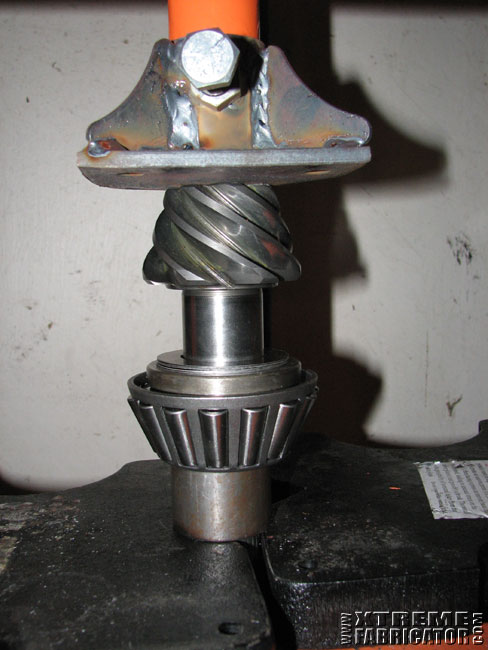
Ok...i havent had much time to work on it since my job is getting in the way. I have a question though...on the pinion...the bearing is so far down on the shaft that I can't get a splitter between the bearing and pinion head....is there any tricks to use? I resorted to putting the splitter on the bearing case? That hold the rollers in and ended up destroying it....so is there a better way to remove it? Thanks.
Ok here is my new pattern. I put a 0.0090 and a 0.0250 for a total of 0.0340" shims to space the pinion. Also, backlash is at 0.006". I'm really happy about the results but I'm no expert......what say you? Thanks! Drive Coast Reverse pattern?
Looks good. One trick I heard about is buying a 2nd bearing, and grinding it out a little bit so it slides on/off easily(for setting up the shims), then when you're happy with everything, you re-install the good bearing.
+1 if your going to be in the rear end much buy an extra bearing and use a coarse brake cylinder hone to hone it out till it slides on and off without pressing. If you have a crush sleeve it does not need crushed to set the pattern only to set the pre-load.
I find that the CNC technology the manufacturers used for the last 20 years is good enough that if you keep track of the shims that went with a set of gears you can move them with the gears and be really really close, the housing and third member are so consistent only changing the gear set changes the shims on the pinion... YMMV
I have a Dana 44 in my jeep and i made a pinion bearing and a set of carrier bearings that slip on and off even though I seldom get in there.. Just makes it easier to check things..
Oh yea,, if you can find a copy ,, Dana published a manual for setting up gears that's about the best overall "how to" I've ever found. Unfortunately I lost my hard copy and cant seem to find my E-copy..
Looks good. One trick I heard about is buying a 2nd bearing, and grinding it out a little bit so it slides on/off easily(for setting up the shims), then when you're happy with everything, you re-install the good bearing.
Originally Posted by pdxmotorhead
+1 if your going to be in the rear end much buy an extra bearing and use a coarse brake cylinder hone to hone it out till it slides on and off without pressing. If you have a crush sleeve it does not need crushed to set the pattern only to set the pre-load.
I find that the CNC technology the manufacturers used for the last 20 years is good enough that if you keep track of the shims that went with a set of gears you can move them with the gears and be really really close, the housing and third member are so consistent only changing the gear set changes the shims on the pinion... YMMV
I have a Dana 44 in my jeep and i made a pinion bearing and a set of carrier bearings that slip on and off even though I seldom get in there.. Just makes it easier to check things..
Oh yea,, if you can find a copy ,, Dana published a manual for setting up gears that's about the best overall "how to" I've ever found. Unfortunately I lost my hard copy and cant seem to find my E-copy..
Originally Posted by 01ssreda4
Looks pretty good.
Ok thanks a lot guys! I was gonna use my old bearing to grind out the cylinder to be able to slip on and off easily, but i tried with a dremel and it was not cutting it (pun intended). So I just went with what 01ssreda said to go with first (closest I could get anyway) and it worked the first time thank God. Anyway, looks like I'll be able to handle it from here on out....so thanks to everyone who contributed! WOOHOO!
Gas Monkey Built a 6-Wheel Ferrari Testarossa With a Corvette LT4 Engine
Slideshow: The controversial Ferrari F6 swaps its original flat-12 for a Corvette Z06-derived LT4 V8 and sends power to four rear wheels through a custom-built drivetrain.
7 Most Reliable High-Performance Engines GM Has Ever Built
Slideshow:These GM engines didn't just make huge power, they survived abuse, boost, track days, and six-digit mileage with a reputation for refusing to quit.
6 Common C5 Corvette Failures and What's Involved In Repairing Them
Slideshow: From wobbling harmonic balancers to failed EBCMs, these are the issues that define long-term C5 ownership and what repairs typically involve.
Retro Modern Bandit Pontiac Trans AM Comes With Burt Reynolds' Autograph
Slideshow: A modern Camaro transformed into a retro icon, this limited-run "Bandit" build blends nostalgia with brute force in a way few revivals manage.
Top 10 Greatest Cadillac V Series Performance Models Ever, Ranked
Slideshow: Cadillac didn't just crash the high-performance luxury vehicle party, it showed up loud, supercharged, and occasionally a little unhinged...







 HELP Read my gear pattern.