










What to do? First winter storage...

Thread Starter
On The Tree
Joined: Apr 2015
Posts: 175
Likes: 0
From: Lethbridge AB
 What to do? First winter storage...
 Hey guys, I'm looking for some storage tips.
This is the first winter since I bought my T/A.
It's a '99 30th Anniversary Trans Am with 19000 km's on the clock.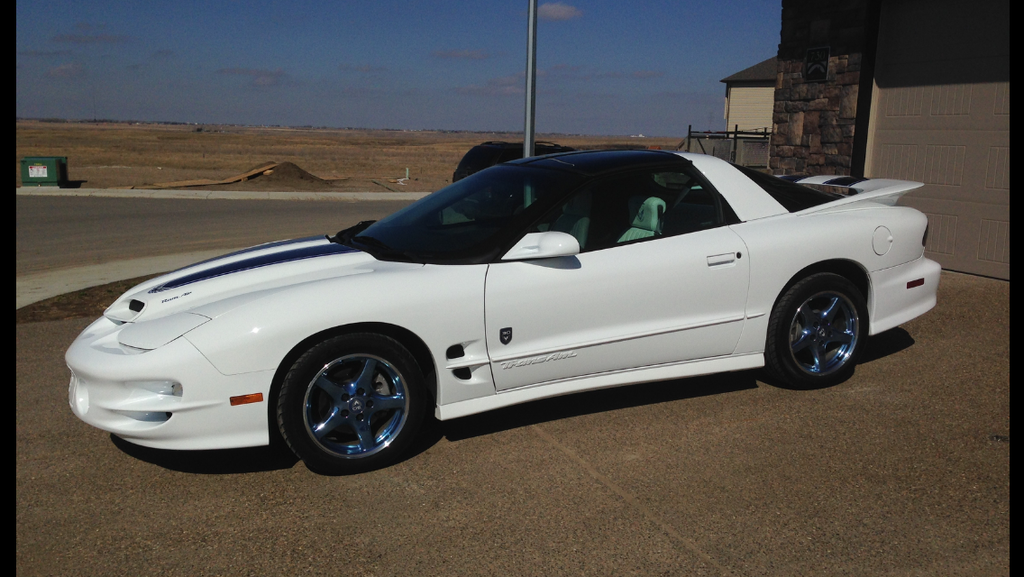
It is parked in my heated garage.
I filled the tank w/ premium fuel and added stabil. Aired the tires up to max psi.
And I planned on alternating my battery maintainer between my car and my RV batteries.
Would it be better to buy another charger to keep on the T/A full time?
Would it be better to disconnect the battery?
And from what I've read on here it is best not to start it until spring when I can actually drive it. Rather than let it idle in the garage.
Any advise appreciated. Thanks.
This is the first winter since I bought my T/A.
It's a '99 30th Anniversary Trans Am with 19000 km's on the clock.

It is parked in my heated garage.
I filled the tank w/ premium fuel and added stabil. Aired the tires up to max psi.
And I planned on alternating my battery maintainer between my car and my RV batteries.
Would it be better to buy another charger to keep on the T/A full time?
Would it be better to disconnect the battery?
And from what I've read on here it is best not to start it until spring when I can actually drive it. Rather than let it idle in the garage.
Any advise appreciated. Thanks.

TECH Junkie


Joined: Nov 2013
Posts: 3,913
Likes: 366
From: White Bear, Mn
I drive until tank is basically empty, hook up a battery tender (yes, invest in a dedicated one) and air up the tires. You can also put some thick capret/padding under the wheel sto help ward off flat spotting more.
I don't want old/**** gas in my tank the following year, but I'm sure someone will tell us why they fill up instead.
I don't want old/**** gas in my tank the following year, but I'm sure someone will tell us why they fill up instead.

Joined: Nov 2001
Posts: 34,629
Likes: 2,550
From: Schiller Park, ILL Member: #317
Hey guys, I'm looking for some storage tips.
This is the first winter since I bought my T/A.
It's a '99 30th Anniversary Trans Am with 19000 km's on the clock.
It is parked in my heated garage.
I filled the tank w/ premium fuel and added stabil. Aired the tires up to max psi.
And I planned on alternating my battery maintainer between my car and my RV batteries.
Would it be better to buy another charger to keep on the T/A full time?
Would it be better to disconnect the battery?
And from what I've read on here it is best not to start it until spring when I can actually drive it. Rather than let it idle in the garage.
Any advise appreciated. Thanks.
This is the first winter since I bought my T/A.
It's a '99 30th Anniversary Trans Am with 19000 km's on the clock.
It is parked in my heated garage.
I filled the tank w/ premium fuel and added stabil. Aired the tires up to max psi.
And I planned on alternating my battery maintainer between my car and my RV batteries.
Would it be better to buy another charger to keep on the T/A full time?
Would it be better to disconnect the battery?
And from what I've read on here it is best not to start it until spring when I can actually drive it. Rather than let it idle in the garage.
Any advise appreciated. Thanks.
Alternating the battery maintainer is fine, you don't need to have it hooked up all winter unless you have some sort of excessive drain. I prefer to not have anything hooked to the battery all day every day, just in case of malfunction (plenty of people use a full time tender, so I'm sure they're fine, I just choose not to do this.) I have a smart charger that I hook up every ~4 weeks or so to bring the battery back to full charge; it doesn't drop below 12.3-12.4v even after a month so the battery never discharges enough to hurt it. I've always gotten excellent battery life following this routine, so I continue to do so. I don't disconnect the battery because I drive the car so few miles each year that it would take months for the PCM to relearn all the soft settings and emissions readiness tests (which is a concern for me every other spring as that's when I have to take the e-test.) But if this is not a concern for you, then there is certainly no harm in disconnecting the battery.
You are correct about not starting it just to idle. Though if you do need/want to start it, the fact you're in a heated garage mitigates the concerns (such as cold weather cold starts and not getting the oil hot enough with no load due to cold ambient temps.)
As mentioned above, in addition to airing the tires up to max psi you can also put something under them. I also used carpet, specifically with a rubber lining.
Everything you did is correct. You want the full tank of fuel to keep moisture out of the tank (moisture is in the air, so the more air that's in the tank the more potential for moisture.) This is less important with cars that have a plastic gas tank (such as your '99), but still a good practice IMO. A full, fresh tank of quality fuel that's treated with Stabil will be absolutely fine in the spring (I've been doing this for 20 years, never a problem.)
Alternating the battery maintainer is fine, you don't need to have it hooked up all winter unless you have some sort of excessive drain. I prefer to not have anything hooked to the battery all day every day, just in case of malfunction (plenty of people use a full time tender, so I'm sure they're fine, I just choose not to do this.) I have a smart charger that I hook up every ~4 weeks or so to bring the battery back to full charge; it doesn't drop below 12.3-12.4v even after a month so the battery never discharges enough to hurt it. I've always gotten excellent battery life following this routine, so I continue to do so. I don't disconnect the battery because I drive the car so few miles each year that it would take months for the PCM to relearn all the soft settings and emissions readiness tests (which is a concern for me every other spring as that's when I have to take the e-test.) But if this is not a concern for you, then there is certainly no harm in disconnecting the battery.
You are correct about not starting it just to idle. Though if you do need/want to start it, the fact you're in a heated garage mitigates the concerns (such as cold weather cold starts and not getting the oil hot enough with no load due to cold ambient temps.)
As mentioned above, in addition to airing the tires up to max psi you can also put something under them. I also used carpet, specifically with a rubber lining.
Alternating the battery maintainer is fine, you don't need to have it hooked up all winter unless you have some sort of excessive drain. I prefer to not have anything hooked to the battery all day every day, just in case of malfunction (plenty of people use a full time tender, so I'm sure they're fine, I just choose not to do this.) I have a smart charger that I hook up every ~4 weeks or so to bring the battery back to full charge; it doesn't drop below 12.3-12.4v even after a month so the battery never discharges enough to hurt it. I've always gotten excellent battery life following this routine, so I continue to do so. I don't disconnect the battery because I drive the car so few miles each year that it would take months for the PCM to relearn all the soft settings and emissions readiness tests (which is a concern for me every other spring as that's when I have to take the e-test.) But if this is not a concern for you, then there is certainly no harm in disconnecting the battery.
You are correct about not starting it just to idle. Though if you do need/want to start it, the fact you're in a heated garage mitigates the concerns (such as cold weather cold starts and not getting the oil hot enough with no load due to cold ambient temps.)
As mentioned above, in addition to airing the tires up to max psi you can also put something under them. I also used carpet, specifically with a rubber lining.
Joined: Nov 2001
Posts: 34,629
Likes: 2,550
From: Schiller Park, ILL Member: #317
I'm sure the tender works fine as well and I wouldn't recommend against it, but personally I don't see any reason to start doing this either when I have no problem getting 6-7 years out of batteries using my current method.
Trending Topics
LS1 Tech Stories
The Best V8 Stories One Small Block at Time

6 Common C5 Corvette Failures and What's Involved In Repairing Them
Pouria Savadkouei
Retro Modern Bandit Pontiac Trans AM Comes With Burt Reynolds' Autograph
Verdad Gallardo
Top 10 Greatest Cadillac V Series Performance Models Ever, Ranked
Pouria Savadkouei
Top 10 Most Powerful Chevy Trucks Ever Made!

Hennessey's New Supercharged Silverado ZR2 Has 700 HP
Verdad Gallardo
Coachbuilt N2A Anteros Is an LS2-Powered C6 Corvette In Italian Clothes
Verdad Gallardo
Awesome K5 Blazer Restomod Comes With C7 Corvette Power
Verdad Gallardo
10 Camaros You Should Never Buy

10 LS Engine Myths That Refuse to Die
Verdad Gallardo Joined: Nov 2001
Posts: 34,629
Likes: 2,550
From: Schiller Park, ILL Member: #317




Lots of good advice here. Only thing I would add is that it's good to change engine oil and filter just before storage. There is carbon, water and fuel in used oil which is acidic. It would be good to get clean new oil in there before it sits.
Not a bad suggestion, but not entirely necessary either. Mine is a limited use show car, so the tires are over 10 years old and the car has sat on them every winter for those 10 winter seasons (at 45psi and parked on rubber lined carpet) without any lasting ill effects. And this is only one of many cars that I have stored this way over the last two decades without any tire issues. However the situation would be different for someone using bias ply/super soft competition level tires.
I'm sure the tender works fine as well and I wouldn't recommend against it, but personally I don't see any reason to start doing this either when I have no problem getting 6-7 years out of batteries using my current method.
I'm sure the tender works fine as well and I wouldn't recommend against it, but personally I don't see any reason to start doing this either when I have no problem getting 6-7 years out of batteries using my current method.

Joined: Nov 2001
Posts: 34,629
Likes: 2,550
From: Schiller Park, ILL Member: #317
It is not.
If the oil has significant usage on it prior to storage, then I would agree. If you've already changed it within the last few hundred miles or so, then I wouldn't bother.
If the oil has significant usage on it prior to storage, then I would agree. If you've already changed it within the last few hundred miles or so, then I wouldn't bother.

TECH Enthusiast
Joined: Nov 2011
Posts: 587
Likes: 12
From: Connecticut SE shore
RPM WS6 posts are always top notch. I enjoy reading them...and going back to read the old ones when I forgot exactly what he recommended.
I wouldn't worry much about the oil change if you have under 1500 miles on a quality oil, which I know you do. That's still basically new oil, where synthetics are designed to go 5000-7500 miles easy....and some getting 10K miles or more out of them. An annual oil change is a cake walk for these low mileage/sparingly driven cars. It might be that they can go 2-3 years with no problems whatsoever. For now, I'm just getting used to an annual oil change. My oil was changed in May and has 800 mi on it. I'm not changing it before winter. The oil additive package keeps your oil from becoming acidic. My Mobil 1 is not going to have a used up TBN in 1 year/2K miles and become acidic.
If your last run before parking for winter is long and hard (20-50 miles) that should burn off as much of the remaining contaminants as possible. There's certainly no problem doing a pre-winter oil change if that makes you feel better. If you can get on that schedule for one oil change per year, that seems optimal to me.
In my mind a cold start is at least anything under 100 deg F. That's cold for an engine that likes to run at 180-230 deg F. Best not to start it if you don't plan on driving it. I've created some set ups in the garage in years past for a "hot idle" run. But these days I'd just rather take it out for a run if the roads and temps are willing. If I'm concerned about the tires sitting in one place for a few months...I put it in neutral and manually push it 1-2 feet.
I wouldn't worry much about the oil change if you have under 1500 miles on a quality oil, which I know you do. That's still basically new oil, where synthetics are designed to go 5000-7500 miles easy....and some getting 10K miles or more out of them. An annual oil change is a cake walk for these low mileage/sparingly driven cars. It might be that they can go 2-3 years with no problems whatsoever. For now, I'm just getting used to an annual oil change. My oil was changed in May and has 800 mi on it. I'm not changing it before winter. The oil additive package keeps your oil from becoming acidic. My Mobil 1 is not going to have a used up TBN in 1 year/2K miles and become acidic.
If your last run before parking for winter is long and hard (20-50 miles) that should burn off as much of the remaining contaminants as possible. There's certainly no problem doing a pre-winter oil change if that makes you feel better. If you can get on that schedule for one oil change per year, that seems optimal to me.
In my mind a cold start is at least anything under 100 deg F. That's cold for an engine that likes to run at 180-230 deg F. Best not to start it if you don't plan on driving it. I've created some set ups in the garage in years past for a "hot idle" run. But these days I'd just rather take it out for a run if the roads and temps are willing. If I'm concerned about the tires sitting in one place for a few months...I put it in neutral and manually push it 1-2 feet.
Last edited by Firebrian; Dec 1, 2015 at 06:07 PM.
Joined: Nov 2001
Posts: 34,629
Likes: 2,550
From: Schiller Park, ILL Member: #317

I wouldn't worry much about the oil change if you have under 1500 miles on a quality oil, which I know you do. That's still basically new oil, where synthetics are designed to go 5000-7500 miles easy....and some getting 10K miles or more out of them. An annual oil change is a cake walk for these low mileage/sparingly driven cars. It might be that they can go 2-3 years with no problems whatsoever. For now, I'm just getting used to an annual oil change. My oil was changed in May and has 800 mi on it. I'm not changing it before winter. The oil additive package keeps your oil from becoming acidic. My Mobil 1 is not going to have a used up TBN in 1 year/2K miles and become acidic.
If your last run before parking for winter is long and hard (20-50 miles) that should burn off as much of the remaining contaminants as possible. There's certainly no problem doing a pre-winter oil change if that makes you feel better. If you can get on that schedule for one oil change per year, that seems optimal to me.
In my mind a cold start is at least anything under 100 deg F. That's cold for an engine that likes to run at 180-230 deg F. Best not to start it if you don't plan on driving it. I've created some set ups in the garage in years past for a "hot idle" run. But these days I'd just rather take it out for a run if the roads and temps are willing. If I'm concerned about the tires sitting in one place for a few months...I put it in neutral and manually push it 1-2 feet.
If your last run before parking for winter is long and hard (20-50 miles) that should burn off as much of the remaining contaminants as possible. There's certainly no problem doing a pre-winter oil change if that makes you feel better. If you can get on that schedule for one oil change per year, that seems optimal to me.
In my mind a cold start is at least anything under 100 deg F. That's cold for an engine that likes to run at 180-230 deg F. Best not to start it if you don't plan on driving it. I've created some set ups in the garage in years past for a "hot idle" run. But these days I'd just rather take it out for a run if the roads and temps are willing. If I'm concerned about the tires sitting in one place for a few months...I put it in neutral and manually push it 1-2 feet.
I'm also on the annual (sometimes biennial, depending on car and oil type used) oil change program. When you're only putting ~500 easy miles per year on a modern EFI engine with a top shelf oil, it's just not necessary to change it twice or more per year. I always do my '71 at least once per year, sometimes twice, as it's carb'ed and cammed and therefore has a much richer idle mixture and also uses a high ZDDP content conventional oil that's not designed for extended drain intervals. But for a stock internal EFI LS1, 500 miles on good quality synthetic oil is nothing, unless perhaps it's 500 miles on a track or a ton of 1-3 mile trips, so going two years has lately become the norm for me. I meant to send in a sample of the last two year cycle, but forgot to get the kit in time.
^^^I'm plus 1'ing that. I would have liked to have changed mine this year but just never had time/maybe too lazy. But thinking about it, I just cant see the need with next to no miles were put on this or last year. Seems like wasted effort. And wasted money. Ten years ago I would have scorned myself for not changing it, but I'm a little more involved in real life now, so I think I've become more relaxed/logical about such things.

TECH Apprentice
Joined: Jan 2004
Posts: 392
Likes: 0
Glad I read this post. I may do this since I plan on upgrading my suspension during the winter months and want to take my time. I changed my oil a couple months ago but I did not put many miles on it at all. It is well under 200-300 miles and I use Amsoil. The only thing I need to prepare for is the battery. I do have a charger but I have not used it in many years (it should still work).

You might also want to invest in a cover. The amount of bugs and dust where I live is ridiculous. Bugs love to fly around the light that is over my car and then die on it. Moths also like to fly around and poop (yes) on it. The cover I bought a few year ago was reasonably priced and is thick enough to help prevent accidental damage if something/someone bumps it with something.
Is it OK to post this link?

Is it OK to post this link?

TECH Resident
Joined: May 2005
Posts: 807
Likes: 1
From: Toronto
I usually do the same procedure of airing up tires, full tank with stabil, parked on rubber and carpeted mats. As well as a good cleaning. I came to a cross roads of changing my oil for the first time in 13 years. I have always changes it prior to storage aside from this year. I use GC 0W30 and it costs around 100 bucks with a good filter. I have put on around 700 miles this year. I could not justify buying the oil at this price so am waiting until spring to do the change as it will come on sale closer to that time. I feel like I should have done it, but again it's a good oil and I'm sure it could go 2 or more years the way it is used. It does feel wrong not to do it but life comes up! The question for you guys is in the spring, should I run the oil up to temp and then drop it? Or just let it drain for a day or two to try and get all the old oil out? The oil is obviously always golden even at the end of the season year after year