When you click on links to various merchants on this site and make a purchase, this can result in this site earning a commission. Affiliate programs and affiliations include, but are not limited to, the eBay Partner Network.
Has anyone used the 10$ can of sea foam with good results? You can put it in the oil or gas tank? Which is the preferred method. Does lucas fuel cleaner do the same thing? I seen they have a high mileage sea foam. For the sea foam is it better to run it thru the oil or gas tank? let me know if its works on cleaning the carbon buildup from intake valves and chambers as well as in the oil to clean up the crankcase. Id like to see some pictures or videos of this stuff in action. I read somewhere it causes alot of smoke from the exhaust as its either the seafoam smoking or old carbon buildup being burnt off?
Has anyone used the 10$ can of sea foam with good results? You can put it in the oil or gas tank? Which is the preferred method.
For me, the prefered method is to leave the Sea Foam on the shelf at whatever joint is selling it. If that's not an option, second best choice is to throw the Sea Foam in the trash can.
I run a bottle of [ Techron concentrate plus complete fuel system treatment | GM part # 88865595 | AC Delco 10-3012 ] through all of my recent GM engines about 4 times a year. That product (it's the same juice in all three bottles, only the labels and bottles are different) is actually recommended by GM in several TSBs relating to Fuel Gauge sender issues and fuel injector issues as preventive maintenance.
Other than that, I run TopTier™ gasoline in all my recent vintage GM cars (as specified in the owner's manuals).
Before I put anything in the tank or in the crankcase, or in the cooling system, I always read the SDS (Safety Data Sheet) first. Then I ask myself, "Self, why do I need to put ___{ingredient from SDS}________ in the gas tank?" I avoid products with "proprietary" contents. It's easy enough to keep your trade secrets and still tell everything that's in the product (along with maybe some things that aren't in the product).
As to Sea Foam specifically, why do you think it's a good idea to put Isopropanol (Isopropyl Alcohol) in your fuel tank? Or some mysterious "proprietary hydrocarbon blend?" And why would you add that to the crankcase?
I agree with everything Racer notes above. I would not pour any cleanser or detergent directly into the engine oil filler for fear of causing a sludge and varnish avalanche at the pump pickup in the pan. I do, however, run high concentrations of these products in my fuel tank and I also stick with Top Tier fuel. My favorite products are anything from Berrymans, AC Delco X66P, Chevron Techron and BG Products 44K Platinum.
And remember, these engines did not get grimy, sludged up and nasty on the inside overnight. You can't expect overnight remedies to work that quickly. Use Top Tier fuel and shorten your oil change intervals and you will eventually clean things up.
I usually run Seafoam in the fuel tank, but not in performance applications. I leave it for when I buy a $300 truck that runs like *** and has had gas sitting in the tank for a year.
Disclaimer on this next part. This is something I've done for years of buying vehicles to resell, part out, or use as donors on my own projects. I wouldn't recommend you do this.
When I want to clean out an intake manifold, I usually do something much worse.
I keep a nasty blend of acetone, methanol, water, and muriatic acid and a couple of other things in a gallon jug that has a siphon tube going through the lid with a 24" long small diameter hose (windshield sprayer hose) that has a cone shaped barb on the other end.
I start the engine, hold it about halfway up to the limiter, and shove that cone shaped barb in any vacuum line I can find. Will smoke bad enough that people will consider calling the fire department, but after dozens of times of siphoning an entire gallon of this mix into the engine and then using borescopes to check the intake manifold, intake ports on the head, backs of the valves, and tops of the pistons with through the spark plug holes, there's usually a dramatic reduction in build up.
Just for kicks I toss in some parts store oil detergent before hand and let it idle/warm up before I do this. Then I change the oil.
Between the detergent and the siphoned mix into the intake, it can be pretty alarming the amount of things I see come out of the exhaust or pan drain.
A leaky head gasket that allows coolant into the cylinder will clean up a lot of carbon buildup. If you want, maybe I can make a video that demonstrates that. Still, that doesn't make it a good idea to pour antifreeze/coolant into your fuel tank.
Seafoam has been proven by the boat crowd since the 30's, its ideal target is marine motors that run hard then sit.
It keeps fuel stable (Like the Stabil product) its a good top end lube preventing rust on the valves, and piston rings and cylinders when parked.
I doubt you find many commercial fisherman that don't use it.
I've run it when I had a engine that had issues like gummed up fuel system carb or injectors, I've also had a couple cars that started throwing secondary 02 codes, ran a can through the fuel tank and the codes went away.
I did this to a honda 1.6L and had a diag display plugged in,, the Sea Foam raises your exhaust temps about 300 degrees at WOT. and it causes the AFR to richen slightly, on the honda it was about a point richer on average.
I also checked the cat before and after and there was visibly way less carbon in the matrix of the cat. I also bore scoped the intake and
the valves were cleaner,, not perfect, but again a visible change.
Its not a rebuild in a can but IMHO its a reasonably effective product,
I use Techron in my modern vehicles, it doesn't raise the EGT as much and it seems to clean injectors a little better.
BTW for you Water/Meth injection guys.. In the Early 1900's a lot of the early Gasoline powered tractors used steam to boost their torque when pulling a plow.
My Grand father had a 1932 John Deer, it had a line from the radiator to the carburetor, and a lever on the dash to turn on steam. It also had a tank that held about a gallon of top end lube. The carb was a updraft Marvel carburetor and the tank said "for best Results use Marvel Mystery Oil to prevent cylinder rust" The oil was sucked in to the engine through a small pipe that fed in to the intake. That engine had Iron pistons and cylinders and was a horizontal 2 cylinder.
it would idle down to about 6 rpm and I don't think it turned much over 100 rpm ever.
Looked like this.
You started it by grabbing the flywheel and turning it.. Eventually we put a electric starter kit on it..
That flywheel weighed about 400 Lbs..
It's a good winterizer , that at about 2 oz per gallon does a good job as a fuel stabilizer, I have no clue as towards carbon cleaner. And I also wouldn't use it in my crank case. If I have a sticky part or am just doing a serious flush then it'll be 50/50 diesel and the cheapest same grade oil it normally uses for 7 to 10 min. Then just change the oil/ filter as normal.
Been using seafoam for decades now.
You drama queens above are seriously talking out of your ***.
It's been used by the auto industry literally millions of times.
Police agencies, taxi companies, US mail service vehicles, you name it.
I am sure someone here will chime in who has a buddy, cousin, neighbor, etc that used seafoam and destroyed their engine, but I would take it with more then a grain of salt.
Been using seafoam for decades now.
You drama queens above are seriously talking out of your ***.
It's been used by the auto industry literally millions of times.
Police agencies, taxi companies, US mail service vehicles, you name it.
I am sure someone here will chime in who has a buddy, cousin, neighbor, etc that used seafoam and destroyed their engine, but I would take it with more then a grain of salt.
Drinking the Seafoam propaganda like it's Kool-Aid isn't wise either.
GM's X66P cleans much better than Seafoam. It cost a lot more as well. I wouldn't say Seafoam is harmful used as gas or decarbon treatment just suboptimal.
Many dealerships for other brands of cars like BMW & Mercedes were using X66P for de-carbon treatment when their own and other profressional chemicals failed to do the trick.
There's definitely more than one way to do the given task etc. However, X66P is the best I've seen in action and I've used dozens of cans of Seafoam over the years. If it's on sale not opposed to Seafoam as gas treatment etc.
I've used Seafoam to remove carbon from pistons but in a more unorthodox way....
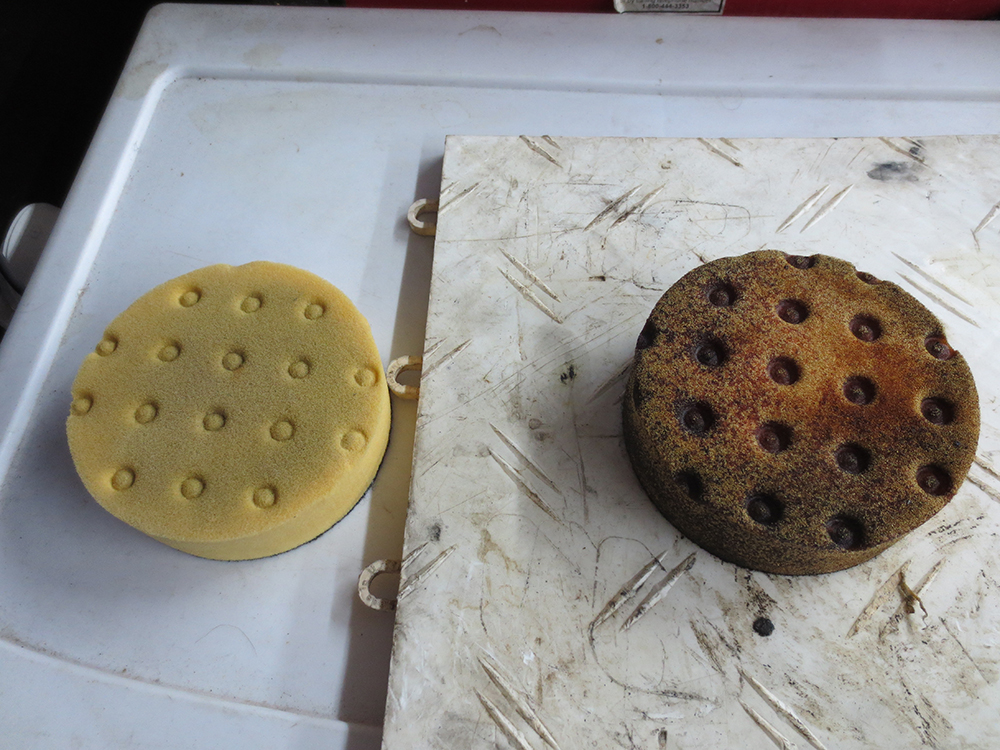
When I installed a set PRC 225 heads on my LQ9 I wanted to clean the carbon off the piston tops. Soaking a 4" (paint) polishing pad with Seafoam then shoving it in each bore for an hour or so softened the carbon so I could just wipe it off. The 4" pad fits the cylinder perfectly making cleaning much easier.
Originally Posted by pdxmotorhead
"for best Results use Marvel Mystery Oil to prevent cylinder rust"
MMO is a great product. It's great for freeing up seized pistons in engines that have sat for years. I also use MMO in all my air tools.
From: Halfway back on the Highway to Hell...again!
Whatever you do, DO NOT put it in your oil and drive it. A young guy I know did that because the idiot from autozone told him to. Well he drove it from Ft Knox to Ft Campbell. well...almost to FTCKY, it locked up on him and I got stuck rebuilding it and doing it dirt cheap because his dad was a good friend of mine in the Army as well.
Whatever you do, DO NOT put it in your oil and drive it. A young guy I know did that because the idiot from autozone told him to. Well he drove it from Ft Knox to Ft Campbell. well...almost to FTCKY, it locked up on him and I got stuck rebuilding it and doing it dirt cheap because his dad was a good friend of mine in the Army as well.
I call bullshit on this.
As stated above seafoam has been used for decades, not just by regular people but by first responder mechanics across the country, taxi companies, construction companies, you name it, they use it.
Maybe the guy dumped 3 cans of it into his crankcase, or something else was going on, but Seafoam did not lock up his engine.
From: Halfway back on the Highway to Hell...again!
Originally Posted by dannyz
I call bullshit on this.
As stated above seafoam has been used for decades, not just by regular people but by first responder mechanics across the country, taxi companies, construction companies, you name it, they use it.
Maybe the guy dumped 3 cans of it into his crankcase, or something else was going on, but Seafoam did not lock up his engine.
Then I'll say you're an idiot. It's used as motor flush. I believe it even says it on the can. You try it and let me know how it works out for you.
Nowthen, this is what Seafoam recommends...
Add one ounce of Sea Foam Motor Treatment for every quart of oil in the crankcase. When ready, remove oil filler cap and pour the recommended amount of Sea Foam directly into the engine crankcase. Do not exceed one treatment per oil change interval.
So pour a 16oz can in your 5qt LS1 and let us know how that works out for you. You must be that Autozone guy.
6 Common C5 Corvette Failures and What's Involved In Repairing Them
Slideshow: From wobbling harmonic balancers to failed EBCMs, these are the issues that define long-term C5 ownership and what repairs typically involve.
Retro Modern Bandit Pontiac Trans AM Comes With Burt Reynolds' Autograph
Slideshow: A modern Camaro transformed into a retro icon, this limited-run "Bandit" build blends nostalgia with brute force in a way few revivals manage.
Top 10 Greatest Cadillac V Series Performance Models Ever, Ranked
Slideshow: Cadillac didn't just crash the high-performance luxury vehicle party, it showed up loud, supercharged, and occasionally a little unhinged...
Coachbuilt N2A Anteros Is an LS2-Powered C6 Corvette In Italian Clothes
Slideshow: A one-off sports car that looks like a vintage Italian exotic-but hides a C6 Corvette underneath-just sold for the price of a new mid-engine Corvette.









 Sea foam