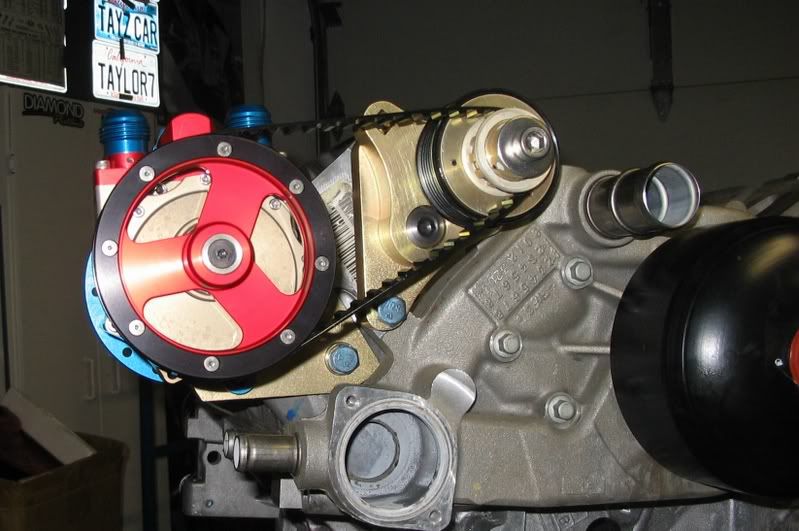



Vacuum pump to evacuate the crankcase and pull rings to the

TECH Resident
Joined: Nov 2002
Posts: 996
Likes: 0

Cool deal Texas, I'm glad we are on the same wavelength, and as a byproduct lots of people read this thread and hopefully understand a lot more about the issue.
QuickWS6, I am using my stock airpump to pull extra vacuum only at WOT from my crankcase using a microswitch activated my my throttle cam. My stock PCV system (from LS6 valley cover) is still in place for "regular" driving. I explained it in the beggining of this thread a bit better. When I have time I'll make up better direction.
Tommy
QuickWS6, I am using my stock airpump to pull extra vacuum only at WOT from my crankcase using a microswitch activated my my throttle cam. My stock PCV system (from LS6 valley cover) is still in place for "regular" driving. I explained it in the beggining of this thread a bit better. When I have time I'll make up better direction.
Tommy
Originally Posted by Texas_WS6
Now I have a method I would like to share with all of you to do exactlly what the vacuum pumps are intended to do. We take and make a Venturie that we place in the exhaust system. Then we run a ine to the crankase. We use basicaly a valve in this line going back to the crankcase that can be set to the desired vacuum. When the exhaust flows past the venturie it causes a vacuum on the crankcase. The nice thing about this set up is it is somewhat self regulating. As more exhaust goes throught the venturie, more cranckase air is pulled from the engine. This design woud not require engine HP to turn a pump. Think about it and if anyone wants a drawing of what I am talking about, just let me know and I will fax it to you.

From the Summit Catalog:
A great way to clean out your crankcase.
These Moroso crankcase evac systems reduce crankcase pressure throughout the entire rpm range for increased piston ring seal, reduced intake charge contamination, and fewer oil leaks. They've been track and dyno tested to produce significant increases in engine performance. Includes two of each of oil separators/breathers, breather/filler cap grommets, one-way check valve and weld-in nipple for header collector.
These Moroso crankcase evac systems reduce crankcase pressure throughout the entire rpm range for increased piston ring seal, reduced intake charge contamination, and fewer oil leaks. They've been track and dyno tested to produce significant increases in engine performance. Includes two of each of oil separators/breathers, breather/filler cap grommets, one-way check valve and weld-in nipple for header collector.
What we use in the industial world is quite abit different, but from what I see in the picture the idea is the same. So, yes, but the set up we use will give you a stronger pull and does not stick into the exhaust to cause any restriction. It is to hard for me to try and explain here exactly what it looks like, but you do have basicaly the same thing in mind that I have.
I know a good whay to explain it. You know the big BINKS wash down guns? They take compressed air and flow it threw a venture that goes all the way around the flow. There is no metal parts hanging down in the flow. So you would take your exhaust pipe, cut it in half. Take the pipe end that was just cut and is downstream of the exhaust flow, have it belled out. So say you have a 3" pipe, bell it to 3.5 or 3.75" and about 6" deep. Slip the belled end over the pipe comong from the exhaust manifolds. Push it all the way in then back it out an inch or two. Now close up the gap at the end of the bell. Pop a hole into the belled section but dont go through the inside pipe. Weld a collar over it that you can use to attach what ever size tubing you want that will run back to the engine. Keep in mind I sudgest to place some type of restriction in the line that you can adjust to control the vacuum. Now you have a chamber that is open to the exhaust flow through the gap you made when you pulled the inside pipe back out of the bell. This will create a Venturie that has no restrictions in it to block any exhaust flow. You dont have to buy anything, just get your exhaust man to make a few cuts, a bell, and weld on a collar for you. I would do this downstream of the muffler. That way you dont have to worry about exhaust pressure before the muffler going back up your new line and into the engine crankcase while you are just idling.
Just an inexpencive idea you might find worth trying.
I know a good whay to explain it. You know the big BINKS wash down guns? They take compressed air and flow it threw a venture that goes all the way around the flow. There is no metal parts hanging down in the flow. So you would take your exhaust pipe, cut it in half. Take the pipe end that was just cut and is downstream of the exhaust flow, have it belled out. So say you have a 3" pipe, bell it to 3.5 or 3.75" and about 6" deep. Slip the belled end over the pipe comong from the exhaust manifolds. Push it all the way in then back it out an inch or two. Now close up the gap at the end of the bell. Pop a hole into the belled section but dont go through the inside pipe. Weld a collar over it that you can use to attach what ever size tubing you want that will run back to the engine. Keep in mind I sudgest to place some type of restriction in the line that you can adjust to control the vacuum. Now you have a chamber that is open to the exhaust flow through the gap you made when you pulled the inside pipe back out of the bell. This will create a Venturie that has no restrictions in it to block any exhaust flow. You dont have to buy anything, just get your exhaust man to make a few cuts, a bell, and weld on a collar for you. I would do this downstream of the muffler. That way you dont have to worry about exhaust pressure before the muffler going back up your new line and into the engine crankcase while you are just idling.
Just an inexpencive idea you might find worth trying.
The LS1 also have thin rings which are prone to ring flutter. Flutter happens when the pressures between the 1st and second are unequal and begin to move in the lans. For some years top engine builders have filed the second ring with more gap to relieve the pressure. IE top is 24 second is 30. This has reduced the flutter and mid and upper HP gains of 12 to18 HP have been recorded.
Cstraub
Cstraub

Thread Starter
TECH Apprentice
Joined: Jun 2002
Posts: 355
Likes: 0
From: Earth
I am really encouraged by the response and traction we're getting here. Let's keep the thread alive and post some results, system set-ups, data and pics and we will all continue to gain. I'll be posting as soon as my pump is installed and I have some miles on it and data to share.
Thanks again.
Thanks again.
how many inches of vaccuum would you generally see with the header collector evac kit as posted above? If it's a decent pull, that would seem to be a great solution in a non emissions application.
LS1 Tech Stories
The Best V8 Stories One Small Block at Time

Topdon ONE vs. Artidiag 800 BT2: Which is the Diagnostic Tablet For You?
Pouria Savadkouei
Gas Monkey Built a 6-Wheel Ferrari Testarossa With a Corvette LT4 Engine
Verdad Gallardo
7 Most Reliable High-Performance Engines GM Has Ever Built
Verdad Gallardo
Amazing '71 Camaro Restomod Is Modern Muscle Car Under the Skin
Verdad Gallardo
6 Common C5 Corvette Failures and What's Involved In Repairing Them
Pouria Savadkouei
Retro Modern Bandit Pontiac Trans AM Comes With Burt Reynolds' Autograph
Verdad Gallardo
Top 10 Greatest Cadillac V Series Performance Models Ever, Ranked
Pouria Savadkouei
Top 10 Most Powerful Chevy Trucks Ever Made!

Hennessey's New Supercharged Silverado ZR2 Has 700 HP
Verdad Gallardo
On The Tree
Joined: Apr 2003
Posts: 135
Likes: 0
From: Waco,Tx
Vacuum pump - what?
You may or may not have heard of the concept of running a crankcase evac system. Generally there are three ways that you can do this.
Header/collector aspiration vacuum:
You have probably seen something like this before on a rail dragster. This consists of 2 tubes which fit into the header collectors at a 90 degree angle to the exhaust stream. The velocity/inertia of the exhaust gas will actually pull out gas through the tubes, which are connected to the crankcase (often through the valve-covers). This technique works well on open headered cars, but as you add backpressure (exhaust) the efficiency drops dramatically
Belt-drive vacuum pumps:
These systems use a vacuum pump which is powered through the engines belt system. This is most commonly used in dry-sump oiling systems. This allows for a great amount of vacuum to be generated (enough to maintain vacuum on even the largest motors). It requires custom bracketry and belt re-routing on a production style setup though.
Electric vacuum pumps:
These are by far the easiest to setup on a street vehicle. They can be mounted virtually anywhere and only require a power, ground, and connection to the crank-case to operate.
--------------------------------------------------------------------------------
Why a vacuum pump?
A vacuum pump will create a lower pressure zone relative to atmospheric pressure through continuous evacuation of air (since the system isn't sealed perfectly). Why would you want this? A crankcase vacuum reduces internal motor losses since the pistons have less to "work" against, improves ring seal, and improves oil control. On a stock car the PCV generally does the same thing - though it will not function very well in high load situations, and allows oil to get into the intake/cylinder heads. With an electric vacuum pump we can create the same depression, but over a wide variety of operating conditions, and without introduction oil into our engine induction system!
From:http://www.speeddemonmotorsports.com/
You may or may not have heard of the concept of running a crankcase evac system. Generally there are three ways that you can do this.
Header/collector aspiration vacuum:
You have probably seen something like this before on a rail dragster. This consists of 2 tubes which fit into the header collectors at a 90 degree angle to the exhaust stream. The velocity/inertia of the exhaust gas will actually pull out gas through the tubes, which are connected to the crankcase (often through the valve-covers). This technique works well on open headered cars, but as you add backpressure (exhaust) the efficiency drops dramatically
Belt-drive vacuum pumps:
These systems use a vacuum pump which is powered through the engines belt system. This is most commonly used in dry-sump oiling systems. This allows for a great amount of vacuum to be generated (enough to maintain vacuum on even the largest motors). It requires custom bracketry and belt re-routing on a production style setup though.
Electric vacuum pumps:
These are by far the easiest to setup on a street vehicle. They can be mounted virtually anywhere and only require a power, ground, and connection to the crank-case to operate.
--------------------------------------------------------------------------------
Why a vacuum pump?
A vacuum pump will create a lower pressure zone relative to atmospheric pressure through continuous evacuation of air (since the system isn't sealed perfectly). Why would you want this? A crankcase vacuum reduces internal motor losses since the pistons have less to "work" against, improves ring seal, and improves oil control. On a stock car the PCV generally does the same thing - though it will not function very well in high load situations, and allows oil to get into the intake/cylinder heads. With an electric vacuum pump we can create the same depression, but over a wide variety of operating conditions, and without introduction oil into our engine induction system!
From:http://www.speeddemonmotorsports.com/


Originally Posted by Cheatin' Chad
Yes it can be done .Moroso sells a vacuum pump just for this purpose but it is belt driven. You could probably use an electric pump.However I don't see an electric pump holding up as long.
I have seen converted A.I.R pumps (the belt driven kind) converted for vacuum pump use.
I have seen converted A.I.R pumps (the belt driven kind) converted for vacuum pump use.
TTT for a old thread anyone know anything about a belt driven evac setup on a vette?????????

Last edited by 1INSANEGTO; Sep 10, 2007 at 02:56 PM.

Here go for all those interested!!!!!!!!!!!!!!!!!!!!!!!!!!!!!!111
http://www.gzmotorsports.com/LSXVPK.html

http://www.gzmotorsports.com/LSXVPK.html