



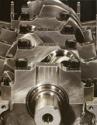





How much effect does internal part weight have on power?
 How much effect does internal part weight have on power?
 I was reading a thread about putting heavier forged rods and pistons in an LS7 and it start me thinking about the weight of internals. A standard forged rebuild on an LS1 or even an LQ is with h beam rods and heavier forged pistons (provided a stroker isn't built of course, then its got a heavier crank too). Speculation in that thread was 30rwhp or better loss because of the heavier rods and pistons in a built LS7 versus the standard parts and the same top end.
How much power are people leaving on the table with h beams and heavy pistons on a smaller engine? Is it enough to justify going with lighter (but not crazy) parts? Say i-beam rods and maybe a lighter forged piston? Or even stock rods with a forged piston on top?
How much power are people leaving on the table with h beams and heavy pistons on a smaller engine? Is it enough to justify going with lighter (but not crazy) parts? Say i-beam rods and maybe a lighter forged piston? Or even stock rods with a forged piston on top?

Launching!

Joined: Jan 2008
Posts: 225
Likes: 1
From: Fargo, ND
So top fuel, pro stock, F1, moto GP, ect all use exotic lightwight materials in their rotating assemblies for fun?
I think not.
Maybe in a street engine its "negligible", but in a higher end application theres a difference.
The 3lb rotational mass difference between (hypothetically) slinging around LS2 rods vs titanium LS7 rods?
This is all going to be speculation until somebody actually dynos one engine, and only changes out the rods, but I'll bet theres a difference in the way the engine behaves.
I think not.
Maybe in a street engine its "negligible", but in a higher end application theres a difference.
The 3lb rotational mass difference between (hypothetically) slinging around LS2 rods vs titanium LS7 rods?
This is all going to be speculation until somebody actually dynos one engine, and only changes out the rods, but I'll bet theres a difference in the way the engine behaves.
https://ls1tech.com/forums/dynamomet...bers-help.html
That's the thread I was referring to. I obviously don't think basic 347s with mostly mild to medium top end setups are going to pick up 30whp from just using lighter rods. Instead I question why h beams are the go to instead of i-beams? A stock rod has been proven to better than 700 on here.
I think some power can be found in better internal selections though.
That's the thread I was referring to. I obviously don't think basic 347s with mostly mild to medium top end setups are going to pick up 30whp from just using lighter rods. Instead I question why h beams are the go to instead of i-beams? A stock rod has been proven to better than 700 on here.
I think some power can be found in better internal selections though.

The 3lb rotational mass difference between (hypothetically) slinging around LS2 rods vs titanium LS7 rods?
This is all going to be speculation until somebody actually dynos one engine, and only changes out the rods, but I'll bet theres a difference in the way the engine behaves.
This is all going to be speculation until somebody actually dynos one engine, and only changes out the rods, but I'll bet theres a difference in the way the engine behaves.
Its not speculation. I've actually rebuilt an LS7 with steel rods and aluminum pistons. It didn't lose 30whp. It didn't lose any power, it gained!
Rotating weight reduction can help rate of acceleration which would help the HP number if the dyno is set to allow an aggressive rate of acceleration but steady state HP it wont make much difference.
Far a the 30hp claim, I think the decimal is in the wrong place.
Far a the 30hp claim, I think the decimal is in the wrong place.
You'll loose the potential to gain power with rpm. Lighter stuff can rev higher and faster. A Ti rod ls7 engine vs a steel rod ls7 has the potential to make more power. Top fuel piston's way a ton cuz they have a massive crown and top ring land to handle all that heat and cylinder pressure
Trending Topics
^^ that
I think you'd gain more in engine responsiveness and "spinability". The power gains don't come free - if you cheap out and don't build your valvetrain to handle the higher speeds then there would be no benefit in spinning higher because you'd still be floating valves at 6800.
I think you'd gain more in engine responsiveness and "spinability". The power gains don't come free - if you cheap out and don't build your valvetrain to handle the higher speeds then there would be no benefit in spinning higher because you'd still be floating valves at 6800.
LS1 Tech Stories
The Best V8 Stories One Small Block at Time

Gas Monkey Built a 6-Wheel Ferrari Testarossa With a Corvette LT4 Engine
Verdad Gallardo
7 Most Reliable High-Performance Engines GM Has Ever Built
Verdad Gallardo
Amazing '71 Camaro Restomod Is Modern Muscle Car Under the Skin
Verdad Gallardo
6 Common C5 Corvette Failures and What's Involved In Repairing Them
Pouria Savadkouei
Retro Modern Bandit Pontiac Trans AM Comes With Burt Reynolds' Autograph
Verdad Gallardo
Top 10 Greatest Cadillac V Series Performance Models Ever, Ranked
Pouria Savadkouei
Top 10 Most Powerful Chevy Trucks Ever Made!

Hennessey's New Supercharged Silverado ZR2 Has 700 HP
Verdad Gallardo
Coachbuilt N2A Anteros Is an LS2-Powered C6 Corvette In Italian Clothes
Verdad Gallardo Launching!
Joined: Jan 2008
Posts: 225
Likes: 1
From: Fargo, ND
LS7 weight-464grams
1456 grams aka slightly over 3lbs total difference in total rotating assembly weight.
there's so many factors that could have resulted in a gain by you replacing the rod and piston. Tuned vs untuned, piston design, ect.
I'm saying two tuned engines on averaged peak pulls, one with less rotating weight, which one makes more power, which is essentially what OP is asking.
which one makes more power, which is essentially what OP is asking.
If you put an exotic lightweight assembly in an otherwise stock LS1 it doesn't matter if it can spin to 8000RPM vs. 7000RPM on the stock assembly, if the heads and cam won't make power up there it won't matter.
there's so many factors that could have resulted in a gain by you replacing the rod and piston. Tuned vs untuned, piston design, ect.
I'm saying two tuned engines on averaged peak pulls, one with less rotating weight, which one makes more power, which is essentially what OP is asking.
I'm saying two tuned engines on averaged peak pulls, one with less rotating weight, which one makes more power, which is essentially what OP is asking.
The OP asked about lighter "but not crazy" components, and referenced I beams versus H beams. Not a huge difference there. Do you really think there will be a measure able difference or are you just trying to argue with me even though we agree?

Launching!
Joined: Jun 2010
Posts: 255
Likes: 1
From: Alberta, Canada
When it comes to pistons, and to a certain extent connecting rods, you gotta remember the engine has to switch the direction of travel every revolution. Momentum is working against you. At 6000rpm, the piston has to do this 6000 times per minute (60 times per second). This is just bench racing (and an exaggeration), but wouldn't you think it would take a lot more energy to toss around a 700g piston than a 500g piston? Not trying to start an argument, just some food for thought.
Lighter is better so long as it is strong enough BUT the power difference isn't going to be drastic.
I mean if you take $400 from your heads and valvetrain budget to put it into lighter rotating parts you probably wont get the bang for the buck that money would have given you in the heads.
I believe lighter will make more power but not a lot and depending how you launch the car or the shifts and such the faster recovery might help make the car quicker too. I do however think the 30hp number thrown around is a wild exaggeration.
I mean if you take $400 from your heads and valvetrain budget to put it into lighter rotating parts you probably wont get the bang for the buck that money would have given you in the heads.
I believe lighter will make more power but not a lot and depending how you launch the car or the shifts and such the faster recovery might help make the car quicker too. I do however think the 30hp number thrown around is a wild exaggeration.
Launching!
Joined: Jun 2010
Posts: 255
Likes: 1
From: Alberta, Canada
Lighter is better so long as it is strong enough BUT the power difference isn't going to be drastic.
I mean if you take $400 from your heads and valvetrain budget to put it into lighter rotating parts you probably wont get the bang for the buck that money would have given you in the heads.
I believe lighter will make more power but not a lot and depending how you launch the car or the shifts and such the faster recovery might help make the car quicker too. I do however think the 30hp number thrown around is a wild exaggeration.
I mean if you take $400 from your heads and valvetrain budget to put it into lighter rotating parts you probably wont get the bang for the buck that money would have given you in the heads.
I believe lighter will make more power but not a lot and depending how you launch the car or the shifts and such the faster recovery might help make the car quicker too. I do however think the 30hp number thrown around is a wild exaggeration.
Its actually very cheap and easy to see these effects. Going from a 30lb flywheel to a 15lb flywheel will generally have the same sort of effect. You wont be able to rev higher but you'll feel a drastic difference in the rev characteristics. The next cheapest test would be to turn down the counterweights on the crank and re balance everything.
As long as your not building a big power/big boost engine then taking weight out at pistons/rods is always a good thing, if its cost effective or not is up to the end user and what the goals are for engine and car.
As long as your not building a big power/big boost engine then taking weight out at pistons/rods is always a good thing, if its cost effective or not is up to the end user and what the goals are for engine and car.
Launching!
Joined: Jun 2010
Posts: 255
Likes: 1
From: Alberta, Canada
Its actually very cheap and easy to see these effects. Going from a 30lb flywheel to a 15lb flywheel will generally have the same sort of effect. You wont be able to rev higher but you'll feel a drastic difference in the rev characteristics. The next cheapest test would be to turn down the counterweights on the crank and re balance everything.
As long as your not building a big power/big boost engine then taking weight out at pistons/rods is always a good thing, if its cost effective or not is up to the end user and what the goals are for engine and car.
As long as your not building a big power/big boost engine then taking weight out at pistons/rods is always a good thing, if its cost effective or not is up to the end user and what the goals are for engine and car.

There's a reason this is referred to as parasitic frictional losses. Teeny tiny
little things that when enhanced can allow an air pump to accelerate itself
more easily. The less of it's own self it has working against rotational thrust.
Stock car guys use plastic fans(belt driven), serpentine underdrive pulleys,
small diameter balancers, lightweight clutch/flywheel or empty T-converters,
aluminum driveshafts, lightweight third members(spools), Ni-Chem coated diff gears, hollow axles, aluminum lug nuts, light weight rims, no inner tubes,
etc., etc. just to find a slight advantage. The engine makes NO more power but the ground sees more of what the engine makes.....a bit off topic but....
I remember reading an article back during the 18 degree NASCAR era where
teams that ponied up several thousand dollars for Wilson ported intakes were
major disappointed that the dynos showed no peak power gains from their
own previous in-house ported stuff. Keith told them to put the engines in the
cars and report back to him on the lap times. Long story short the engines
were able to accelerate through the power band faster by way of a more
balanced airflow distribution. More efficient Brake Specific Fuel Consumption
means more average torque across the band AND better fuel economy.
Think of all the little things GM has done to make the LS a better platform....
A single row T-chain has less surface area(rolling resistance). Rifle drilled
cam for approx. 2.5 lb. weight reduction. Low friction piston rings which re-
duces rotating drag....frees up power and mileage. Balancer/pulley as one
assembly...saves weight, pieces, and fasteners. Beehive valvesprings are a
really neat advancement. They are lightweight, sturdy at rpms, and great 4
longevity (w/factory cams). Even pos. deck pistons helps to lower emissions
by reducing dead quench(ring land area) which enhances BSFC. Theres at
least 25 more things that GM did to set the LS apart from others and yet hot
rodders are still looking for 25 more. Some squirt over dyno sheets and #'s
while others just take it to the track to put the smack down. 2 each their own
little things that when enhanced can allow an air pump to accelerate itself
more easily. The less of it's own self it has working against rotational thrust.
Stock car guys use plastic fans(belt driven), serpentine underdrive pulleys,
small diameter balancers, lightweight clutch/flywheel or empty T-converters,
aluminum driveshafts, lightweight third members(spools), Ni-Chem coated diff gears, hollow axles, aluminum lug nuts, light weight rims, no inner tubes,
etc., etc. just to find a slight advantage. The engine makes NO more power but the ground sees more of what the engine makes.....a bit off topic but....
I remember reading an article back during the 18 degree NASCAR era where
teams that ponied up several thousand dollars for Wilson ported intakes were
major disappointed that the dynos showed no peak power gains from their
own previous in-house ported stuff. Keith told them to put the engines in the
cars and report back to him on the lap times. Long story short the engines
were able to accelerate through the power band faster by way of a more
balanced airflow distribution. More efficient Brake Specific Fuel Consumption
means more average torque across the band AND better fuel economy.
Think of all the little things GM has done to make the LS a better platform....
A single row T-chain has less surface area(rolling resistance). Rifle drilled
cam for approx. 2.5 lb. weight reduction. Low friction piston rings which re-
duces rotating drag....frees up power and mileage. Balancer/pulley as one
assembly...saves weight, pieces, and fasteners. Beehive valvesprings are a
really neat advancement. They are lightweight, sturdy at rpms, and great 4
longevity (w/factory cams). Even pos. deck pistons helps to lower emissions
by reducing dead quench(ring land area) which enhances BSFC. Theres at
least 25 more things that GM did to set the LS apart from others and yet hot
rodders are still looking for 25 more. Some squirt over dyno sheets and #'s
while others just take it to the track to put the smack down. 2 each their own
Last edited by A.R. Shale Targa; Dec 14, 2013 at 11:23 AM.
I agree with all of that but at the same time folks need some perspective. I have seen too many guys get caught up in a detail like for instance light weight and maybe they spend $600 to save 10lbs and maybe put 5hp more to the ground, when spent differently that same $600 spent on topend might have gained them 30-40hp.
Or like the guy in another thread with a hardon over the LQ4 and LQ9 having different piston clearance specs and waned to believe that was the source of the HP difference.
Perspective is just too often lacking.
Or like the guy in another thread with a hardon over the LQ4 and LQ9 having different piston clearance specs and waned to believe that was the source of the HP difference.
Perspective is just too often lacking.

I was always told if you shave off 1lb of rotational mass that's like saving 100lbs off of the body so 1lb's of rotational mass is equivalent to a tenth of a second hope this helps.
You have your decimal place wrong. The "rule" is 10lbs of rotating weight is similar to 100lbs from the chassis.
That is a pretty rough rules though, the rpm at play and the distance the weight is from the center of rotation are important factors If I could save 4 lbs from the damper OR the driveshaft I would take it off the damper because the diameter is greater and in 1-3rd gears the damper is turning faster than the driveshaft.
If you think about what you wrote with 1lbs being equal to 100lbs that would mean a 10lbs lighter flywheel would be worth a full second, don't think you meant to argue that.
That is a pretty rough rules though, the rpm at play and the distance the weight is from the center of rotation are important factors If I could save 4 lbs from the damper OR the driveshaft I would take it off the damper because the diameter is greater and in 1-3rd gears the damper is turning faster than the driveshaft.
If you think about what you wrote with 1lbs being equal to 100lbs that would mean a 10lbs lighter flywheel would be worth a full second, don't think you meant to argue that.