



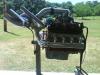





Need a new cam any suggestions

Thread Starter
Teching In
Joined: Oct 2013
Posts: 9
Likes: 0
 Need a new cam any suggestions
 I have a 408 with stage3 317 heads diamond Pistons - 2cc relief flats I have a Texas giant cam in there right now and after bending a valve I have found out the valves are grazing the Pistons looking for something Street able but with a noticeable lope to it
Compression ratio
Rear gears/tire size (height)
Vehicle/weight
Clutch/Converter stall size
Intended usage of vehicle..Auto X/Drag/Street w/ocassional track ?????
Induction setup....LS6/Fast/Carb(1or2plane)/ITB
OP, can you supply a bit more information mainly what A.R. Shale Targa has asked?
I have something in mind, but I'd like to see what other modifications you have done before I make that suggestion.
Thread Starter
Teching In
Joined: Oct 2013
Posts: 9
Likes: 0
Bunch more info needed.....
Compression ratio
Rear gears/tire size (height)
Vehicle/weight
Clutch/Converter stall size
Intended usage of vehicle..Auto X/Drag/Street w/ocassional track ?????
Induction setup....LS6/Fast/Carb(1or2plane)/ITB
Compression- 11:1
Stock rear; 315/45r18
Full interior 2000 Trans am
Monster stage 3 clutch tick master
Weekend driver with some track time autox and strip
Fast 102/102
42lb Mustang injectors
Compression ratio
Rear gears/tire size (height)
Vehicle/weight
Clutch/Converter stall size
Intended usage of vehicle..Auto X/Drag/Street w/ocassional track ?????
Induction setup....LS6/Fast/Carb(1or2plane)/ITB
Compression- 11:1
Stock rear; 315/45r18
Full interior 2000 Trans am
Monster stage 3 clutch tick master
Weekend driver with some track time autox and strip
Fast 102/102
42lb Mustang injectors
Thread Starter
Teching In
Joined: Oct 2013
Posts: 9
Likes: 0
Trending Topics
LS1 Tech Stories
The Best V8 Stories One Small Block at Time

Topdon ONE vs. Artidiag 800 BT2: Which is the Diagnostic Tablet For You?
Pouria Savadkouei
Gas Monkey Built a 6-Wheel Ferrari Testarossa With a Corvette LT4 Engine
Verdad Gallardo
7 Most Reliable High-Performance Engines GM Has Ever Built
Verdad Gallardo
Amazing '71 Camaro Restomod Is Modern Muscle Car Under the Skin
Verdad Gallardo
6 Common C5 Corvette Failures and What's Involved In Repairing Them
Pouria Savadkouei
Retro Modern Bandit Pontiac Trans AM Comes With Burt Reynolds' Autograph
Verdad Gallardo
Top 10 Greatest Cadillac V Series Performance Models Ever, Ranked
Pouria Savadkouei
Top 10 Most Powerful Chevy Trucks Ever Made!

Hennessey's New Supercharged Silverado ZR2 Has 700 HP
Verdad Gallardo Thread Starter
Teching In
Joined: Oct 2013
Posts: 9
Likes: 0
I think a combo of milled heads, 254 duration and I don't know if the original builder degreed the cam right but I'm being told that this cam is too much of a high rpm cam for me
I was def leaning toward installer error. Even with that cam the valve reliefs and possible deck height of the piston should not have made it hit. It is rather big, but with a narrow lsa that cam will still peak earlier than a smaller cam with a wider one, so high rpm is a misnomer. We have custom cams for $385 which is cheaper than most companies off shelf cams or we can get you any cam in the comp book for $360. Let us know if we can help!
This is more than enough overlap to have a healthy idle.
I just looked the specs up for that cam and I see it is a good bit larger than what I recommended. If you would like something in between what you have now, and what I recommended at first a 243/246 .624/.595 113+3 would be a good recommendation.
That said...
LSA is not the determining factor in how a camshaft will idle. LSA or lobe separation angle is a mathematically derived equation of two known center lines. Intake and exhaust.
The intake center line(or ICL) is the highest point on the intake lobe and the exhaust center line(ECL) is the highest point on the exhaust lobe.
If we have a 112ICL and a 116ECL then this means that there are 228 crank degrees of revolution in between the intake and exhaust maximum lobe lifts.
Since the cam rotates once for every two crank revolutions, to determine how many cam degrees these lobes are separated apart from one another we divide 228 by 2 which = 114. This is how LSA is computed.
All it tells us is how far the two lobes max lift points are separated from one another. If we bring those center lines in tighter we create more overlap of the opening and closing ramps of the intake and exhaust lobes. If we widen them further apart we create less overlap between those lobes. If we leave the center lines alone and add intake or exhaust duration we also increase overlap.
Overlap is what gives you the sound at idle everyone loves.
Thread Starter
Teching In
Joined: Oct 2013
Posts: 9
Likes: 0
A 239/246@.050 camshaft with a 112 ICL and a 116 ECL has 14.5 degrees of valve overlap@.050.
This is more than enough overlap to have a healthy idle.
I just looked the specs up for that cam and I see it is a good bit larger than what I recommended. If you would like something in between what you have now, and what I recommended at first a 243/246 .624/.595 113+3 would be a good recommendation.
That said...
LSA is not the determining factor in how a camshaft will idle. LSA or lobe separation angle is a mathematically derived equation of two known center lines. Intake and exhaust.
The intake center line(or ICL) is the highest point on the intake lobe and the exhaust center line(ECL) is the highest point on the exhaust lobe.
If we have a 112ICL and a 116ECL then this means that there are 228 crank degrees of revolution in between the intake and exhaust maximum lobe lifts.
Since the cam rotates once for every two crank revolutions, to determine how many cam degrees these lobes are separated apart from one another we divide 228 by 2 which = 114. This is how LSA is computed.
All it tells us is how far the two lobes max lift points are separated from one another. If we bring those center lines in tighter we create more overlap of the opening and closing ramps of the intake and exhaust lobes. If we widen them further apart we create less overlap between those lobes. If we leave the center lines alone and add intake or exhaust duration we also increase overlap.
Overlap is what gives you the sound at idle everyone loves.
This is more than enough overlap to have a healthy idle.
I just looked the specs up for that cam and I see it is a good bit larger than what I recommended. If you would like something in between what you have now, and what I recommended at first a 243/246 .624/.595 113+3 would be a good recommendation.
That said...
LSA is not the determining factor in how a camshaft will idle. LSA or lobe separation angle is a mathematically derived equation of two known center lines. Intake and exhaust.
The intake center line(or ICL) is the highest point on the intake lobe and the exhaust center line(ECL) is the highest point on the exhaust lobe.
If we have a 112ICL and a 116ECL then this means that there are 228 crank degrees of revolution in between the intake and exhaust maximum lobe lifts.
Since the cam rotates once for every two crank revolutions, to determine how many cam degrees these lobes are separated apart from one another we divide 228 by 2 which = 114. This is how LSA is computed.
All it tells us is how far the two lobes max lift points are separated from one another. If we bring those center lines in tighter we create more overlap of the opening and closing ramps of the intake and exhaust lobes. If we widen them further apart we create less overlap between those lobes. If we leave the center lines alone and add intake or exhaust duration we also increase overlap.
Overlap is what gives you the sound at idle everyone loves.
Last edited by Bwitt418; Apr 7, 2014 at 05:14 PM.
Not normally no. But that depends on advertised, @.006, and @.050 duration of the intake and exhaust as well. It will sound choppy if you go higher on the duration, but not be as rough as a 110 at idle using the same lobes.
The best bit of advice I can give is to find some cams you like the sound of in the size engine you have. Find their cam specs and compute the amount of overlap they have. This will give you a general idea of what different amounts of overlap in your size engine will sound like.
As Colorado Speed hinted at as well, you can even have a cam with the same @.050 durations and same ICL and ECL, but have differing durations @.006 and they will also sound different.
Confusing enough yet?

If we kept the duration@.050 239/246 and made it a 112+2 or a 111+2 the valve events would be different than they would be at 239/246 114+2.
When I spec a cam I choose a set of valve events that I feel will work best. These coincide directly with the intake/exhaust durations and center lines that will be ground to achieve those events.
The 239/246 @.050 duration is "similar" to the Polluter with its 239/244@.050 duration, but it's valve events on a 114+2 versus a 111+2 are different and thus will perform different.
Thread Starter
Teching In
Joined: Oct 2013
Posts: 9
Likes: 0
Just as Colorado Speed said, how choppy a camshaft profile with a 110 ICL and a 116 ECL is will also be determined by it's rated duration at different lobe lifts.
The best bit of advice I can give is to find some cams you like the sound of in the size engine you have. Find their cam specs and compute the amount of overlap they have. This will give you a general idea of what different amounts of overlap in your size engine will sound like.
As Colorado Speed hinted at as well, you can even have a cam with the same @.050 durations and same ICL and ECL, but have differing durations @.006 and they will also sound different.
Confusing enough yet?
The best bit of advice I can give is to find some cams you like the sound of in the size engine you have. Find their cam specs and compute the amount of overlap they have. This will give you a general idea of what different amounts of overlap in your size engine will sound like.
As Colorado Speed hinted at as well, you can even have a cam with the same @.050 durations and same ICL and ECL, but have differing durations @.006 and they will also sound different.
Confusing enough yet?
Dont think about it too much. Just get a cam. Any of them in the 230 intake duration area will "chop" at idle and the high 230 low 240 duration will help that...unless you get a very wide lsa. Some of the cams you hear on stock lq4s can seem quite big but are normally just the wrong size as they have lower compression ratio and the cam bleeds it all off with overlap, so they SOUND good but dont make very good power.
I aim for a 112 and up lsa if itll work because it will tend to be less peaky and have more torque and more usable power than any cut tighter. I actually prefer 113 and up but really 1* of lsa (depending on ground in advance) wont matter too much.
I aim for a 112 and up lsa if itll work because it will tend to be less peaky and have more torque and more usable power than any cut tighter. I actually prefer 113 and up but really 1* of lsa (depending on ground in advance) wont matter too much.
I really think you would like the 243/246 .624/.595 113+3 I recommended if you wanted something that will make strong low end as well as top end.
Thread Starter
Teching In
Joined: Oct 2013
Posts: 9
Likes: 0