






Why LSA doesn't matter

Thread Starter
FormerVendor
iTrader: (3)
Joined: Feb 2012
Posts: 7,480
Likes: 18
From: Mount Airy, NC

Hey Martin. I know you say lsa doesn't matter. But my cam is a 219/232. .625 .599. 109+0. Lsa. The car has been a bear to tune in the lower rpm ranges. And the hp peaked at 5600 on the dyno. And I noticed bank 1 runs just a hair leaner like +2 on the stft's. Would the same cam but on a 112lsa have totally diff. Characteristics then this lsa? And would it still have the midrange hp but possibly peak later?
And I guess the drivability would be alittle bit better? Thanks.
And I guess the drivability would be alittle bit better? Thanks.
The same camshaft cut on a 112 lsa would have 1.5 degrees of overlap @.050" lobe lift.
It's safe to say that this camshaft cut on a 112 lsa would behave totally differently in terms of driving manners than your current camshaft.
It will not make as much peak torque, but it will flatten out the torque curve and may even make more peak HP due to an earlier EVO event.
Your current cam has 7.5 degrees of overlap @.050" lobe lift.
The same camshaft cut on a 112 lsa would have 1.5 degrees of overlap @.050" lobe lift.
It's safe to say that this camshaft cut on a 112 lsa would behave totally differently in terms of driving manners than your current camshaft.
It will not make as much peak torque, but it will flatten out the torque curve and may even make more peak HP due to an earlier EVO event.
The same camshaft cut on a 112 lsa would have 1.5 degrees of overlap @.050" lobe lift.
It's safe to say that this camshaft cut on a 112 lsa would behave totally differently in terms of driving manners than your current camshaft.
It will not make as much peak torque, but it will flatten out the torque curve and may even make more peak HP due to an earlier EVO event.
The overlap triangle is created by curtain area during overlap.
The earlier you open the intake valve, the more curtain area it will obtain during the overlap event. Thus the effects of overlap becoming more pronounced, for better or worse. I.E. reversion, creating intake port velocity before the intake stroke, filling the cylinder before the intake stroke etc.
Same goes for the exhaust, the later you close it the more curtain area it will have during the overlap event. I.E. more short circuiting(blowing charge out the exhaust), allowing the suction on the exhaust port to pull harder on the intake port and cylinder during the RPM's where resonance tuning occurs etc.
With a given valve diameter and valve lift (the two main variables in determining curtain area) during overlap you're literally creating a triangular shape resulting from each valve's lift curve, which in this instance forms the overlap event. This is what allows the resonance tuning I have laid out in this thread to occur. Either at greater effect, or to a lesser effect. Of course the other factors I mentioned play into creating these greater and lesser effects as well.
The earlier you open the intake valve, the more curtain area it will obtain during the overlap event. Thus the effects of overlap becoming more pronounced, for better or worse. I.E. reversion, creating intake port velocity before the intake stroke, filling the cylinder before the intake stroke etc.
Same goes for the exhaust, the later you close it the more curtain area it will have during the overlap event. I.E. more short circuiting(blowing charge out the exhaust), allowing the suction on the exhaust port to pull harder on the intake port and cylinder during the RPM's where resonance tuning occurs etc.
With a given valve diameter and valve lift (the two main variables in determining curtain area) during overlap you're literally creating a triangular shape resulting from each valve's lift curve, which in this instance forms the overlap event. This is what allows the resonance tuning I have laid out in this thread to occur. Either at greater effect, or to a lesser effect. Of course the other factors I mentioned play into creating these greater and lesser effects as well.
Oh, one more question please sir ? Have you ever heard of Larry Widner ?
Last edited by squalor; Jul 2, 2015 at 08:48 PM.
Martin that last post was a lot to absorb. It almost sounds like on a NA engine you can really tell the engine how to behave but in some of your FI scenarios you are using the intake valve more as a gate than anything.
I'm almost imagining maxwell's daemon. Since air will follow the pressure gradient, the way to build pressure is to open the gate when the differential is in your favor and close the gate when it works against you. That is grossly oversimplified I know.
And unlike a NA engine, boost will guarantee filling. Regardless of duration. The main goal is to get the pressure where you want it when you want it.
And I think I finally "get" what you mean by LSA doesn't matter. It doesn't matter in the way cubic inches doesn't matter. Now of course 408 vs 346 matters, but to the initiated, 408 means 4" stroke and 4.060" bore. That's what really matters. So 408 is a shorthand description of a bore vs stroke combination more than anything else. A cam notation is really a shorthand way of saying when certain events occur. But the calculations behind the scenes are more complicated. The center lines are simply the middle of the open and close events. LSA really only affects comparing two cams of otherwise equal durations, but what the narrower LSA REALLY means is that the intake opens and closes earlier and the exhaust opens and closes later. That's why the two otherwise identical cams behave differently. The LSA is just easier to say.
I'm almost imagining maxwell's daemon. Since air will follow the pressure gradient, the way to build pressure is to open the gate when the differential is in your favor and close the gate when it works against you. That is grossly oversimplified I know.
And unlike a NA engine, boost will guarantee filling. Regardless of duration. The main goal is to get the pressure where you want it when you want it.
And I think I finally "get" what you mean by LSA doesn't matter. It doesn't matter in the way cubic inches doesn't matter. Now of course 408 vs 346 matters, but to the initiated, 408 means 4" stroke and 4.060" bore. That's what really matters. So 408 is a shorthand description of a bore vs stroke combination more than anything else. A cam notation is really a shorthand way of saying when certain events occur. But the calculations behind the scenes are more complicated. The center lines are simply the middle of the open and close events. LSA really only affects comparing two cams of otherwise equal durations, but what the narrower LSA REALLY means is that the intake opens and closes earlier and the exhaust opens and closes later. That's why the two otherwise identical cams behave differently. The LSA is just easier to say.
Thread Starter
FormerVendor
iTrader: (3)
Joined: Feb 2012
Posts: 7,480
Likes: 18
From: Mount Airy, NC
You've narrowed in on exactly what is important and what isn't as important Darth and Squalor.
It's really cool to see you guys picking up on this and that you're starting to realize what is going on inside of a running engine.
I see a few of you guys posting in other sections of tech, and in this one using the information that has been given to you to help others with their cam questions. It's refreshing to see from my perspective. I feel like I've spent countless hours with some customers trying to explain this, and 75% of the time I feel it goes in one ear and right out the other. So much to the point where I have "dumbed down" my explanations on nearly everything and very rarely go into "technical mode" anymore. That is unless otherwise asked to speak in such a manner. I honestly felt like I was wasting my time, and that no one really cared.
So it's very refreshing to see that some do care and actually want to learn about how an engine runs. Then utilize that information in helping others and in building their own combination.
I realize that a lot of people on here want to learn, but when faced with complex notions of thought they immediately curl into a fetal position and claim that, "It's too hard to learn, or my head hurts." No one ever said learning was easy, and if it was easy everyone would understand it. That said, once you start to envision this stuff, it really isn't that hard!
It's really cool to see you guys picking up on this and that you're starting to realize what is going on inside of a running engine.
I see a few of you guys posting in other sections of tech, and in this one using the information that has been given to you to help others with their cam questions. It's refreshing to see from my perspective. I feel like I've spent countless hours with some customers trying to explain this, and 75% of the time I feel it goes in one ear and right out the other. So much to the point where I have "dumbed down" my explanations on nearly everything and very rarely go into "technical mode" anymore. That is unless otherwise asked to speak in such a manner. I honestly felt like I was wasting my time, and that no one really cared.
So it's very refreshing to see that some do care and actually want to learn about how an engine runs. Then utilize that information in helping others and in building their own combination.
I realize that a lot of people on here want to learn, but when faced with complex notions of thought they immediately curl into a fetal position and claim that, "It's too hard to learn, or my head hurts." No one ever said learning was easy, and if it was easy everyone would understand it. That said, once you start to envision this stuff, it really isn't that hard!
Last edited by Sales@Tick; Jul 6, 2015 at 08:40 AM.
Thread Starter
FormerVendor
iTrader: (3)
Joined: Feb 2012
Posts: 7,480
Likes: 18
From: Mount Airy, NC
Was it last year, KCS was showing a 862 head that had LS3 intake valves (not cut down I think). It seems with a head that gets so much curtain area from it's valve size, a much milder cam could be used. Better street maners AND more power.
Oh, one more question please sir ? Have you ever heard of Larry Widner ?
Oh, one more question please sir ? Have you ever heard of Larry Widner ?
Why would "The General" (AKA General Motors) choose such a head then for its flagship truck, the Silverado? A truck that needs to tow heavy loads and haul heavy objects in its bed, something that NEEDS torque?!?!
Because GM understood that with ever creeping emissions standards and the need for more MPG, they had to find a way to make more torque and better fuel economy with less camshaft. Thus they increased valve size and subsequently increased low lift flow tremendously, thus not needing anywhere near as much valve overlap to make gobs of torque. When they increased valve size and enlarged the throat of the port, they had to also do the same to the rest of the port to ensure proper localized velocities and other quirks were engineered in tune with one another.
That name sounds familiar, but without tossing his name into a Google search, I am drawing a blank. What's his forte?
Appreciate the kind words Martin. I'll never design cams, but I do like to understand WHY certain things work well and others don't.
From my perspective it would be easy for you to keep the knowledge to yourself to protect your sphere of influence. Instead by sharing I think you have actually increased your influence- at least here on 'Tech.
Next stupid question. The injectors typically spray on the intake valve while closed. Then the valve opens, and the air/fuel mixture goes into the cylinder. During overlap, it loses some out the exhaust. Does direct injection change the dynamics to allow a bigger cam without the fuel smell - since you're spraying in the cylinder instead of on the valve?
From my perspective it would be easy for you to keep the knowledge to yourself to protect your sphere of influence. Instead by sharing I think you have actually increased your influence- at least here on 'Tech.
Next stupid question. The injectors typically spray on the intake valve while closed. Then the valve opens, and the air/fuel mixture goes into the cylinder. During overlap, it loses some out the exhaust. Does direct injection change the dynamics to allow a bigger cam without the fuel smell - since you're spraying in the cylinder instead of on the valve?
Thread Starter
FormerVendor
iTrader: (3)
Joined: Feb 2012
Posts: 7,480
Likes: 18
From: Mount Airy, NC
Appreciate the kind words Martin. I'll never design cams, but I do like to understand WHY certain things work well and others don't.
From my perspective it would be easy for you to keep the knowledge to yourself to protect your sphere of influence. Instead by sharing I think you have actually increased your influence- at least here on 'Tech.
Next stupid question. The injectors typically spray on the intake valve while closed. Then the valve opens, and the air/fuel mixture goes into the cylinder. During overlap, it loses some out the exhaust. Does direct injection change the dynamics to allow a bigger cam without the fuel smell - since you're spraying in the cylinder instead of on the valve?
From my perspective it would be easy for you to keep the knowledge to yourself to protect your sphere of influence. Instead by sharing I think you have actually increased your influence- at least here on 'Tech.
Next stupid question. The injectors typically spray on the intake valve while closed. Then the valve opens, and the air/fuel mixture goes into the cylinder. During overlap, it loses some out the exhaust. Does direct injection change the dynamics to allow a bigger cam without the fuel smell - since you're spraying in the cylinder instead of on the valve?
This seems to help with fuel smell a lot.
With that said, I would make a very educated assumption that when you wait until right before the point of ignition to fire the injector that you're not going to waste any fuel in the manner you depicted above, which is out the exhaust valve before it can close.
This would lower base specific fuel consumption numbers and allow the engine to run much more efficiently.
LS1 Tech Stories
The Best V8 Stories One Small Block at Time

6 Common C5 Corvette Failures and What's Involved In Repairing Them
Pouria Savadkouei
Retro Modern Bandit Pontiac Trans AM Comes With Burt Reynolds' Autograph
Verdad Gallardo
Top 10 Greatest Cadillac V Series Performance Models Ever, Ranked
Pouria Savadkouei
Top 10 Most Powerful Chevy Trucks Ever Made!

Hennessey's New Supercharged Silverado ZR2 Has 700 HP
Verdad Gallardo
Coachbuilt N2A Anteros Is an LS2-Powered C6 Corvette In Italian Clothes
Verdad Gallardo
Awesome K5 Blazer Restomod Comes With C7 Corvette Power
Verdad Gallardo
10 Camaros You Should Never Buy

10 LS Engine Myths That Refuse to Die
Verdad Gallardo
Teching In
Joined: Feb 2009
Posts: 1
Likes: 0
I thought this thread was pretty good and informative. I am in no way cam literate for the most part but I did start to understand what was being said and how it was working. That said I will be going back and reading this again. I will be looking for a cam for my truck soon so hopefully I can fully grasp what is going on from what I have read.
That name (Larry Widner) sounds familiar, but without tossing his name into a Google search, I am drawing a blank. What's his forte?
85 SILVERADO, welcome to our little slice of heaven. This place will really help you understand alot about engines and maybe along your way, you will have a little fun too. I am somewhat cam literate now but Martin ,,, Martin is the OVERLORD OF OVERLAP !


I drew out some diagrams showing the timing events for my current cam (238/248 ground by Cam Motion) and a cam which Martin and I have been discussing as a replacement (248/260 LLSR, also ground by Cam Motion). I have read this and other threads regarding cam event timing, but I'm much more of a visual learner, so this helped me and I thought it might help others...
I found a diagram drawn like this somewhere else online, so I pull out my technical drawing software (Visio 2007 for anyone curious) and made these. The first image below shows the cam timing events of my current hydraulic roller based on the cam doctor cam card I received from CM. I also showed the ignition point at WOT (26*) just for relative comparison sake. The inner circle represents the intake lobe while the outer circle represents the exhaust lobe.
IVO = 10.7
IVC = 47.5
EVO = 62.3
EVC = 5.9

Now, Martin and I are discussing replacing the HR with an LLSR. I have given him my set of requirements for this, and he's speced out a cam with advertized numbers of 248/260, 112+4. So here is what that looks like overlaid on top of the current cam:
IVO = 16
IVC = 52
EVO = 66
EVC = 14
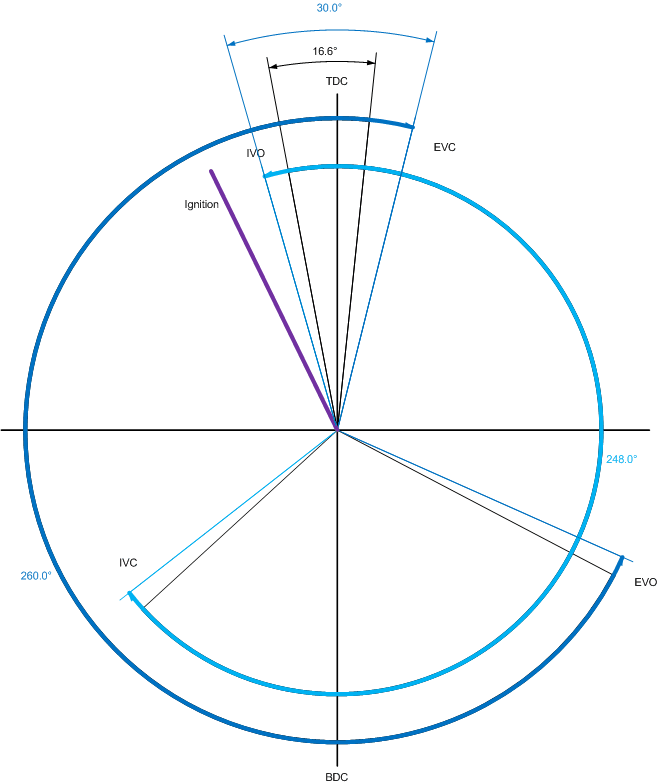
Ok, so everything expands, and you can see the relative changes pretty well. But then I thought, "I've heard the LLSR is similar to an HR with 8* less timing." So I drew another picture, this one showing the current cam with the HR equivalent overlaid:

Well look at that... I know it's hard to see the differences, but the HR equivalent of the LLSR has almost the exact same IVC and EVO timings, a slightly earlier IVO, and a later EVC.
Finally, I drew the lobe centerlines on the LLSR plot and added the LSA. It's 112*, just what Martin told me.
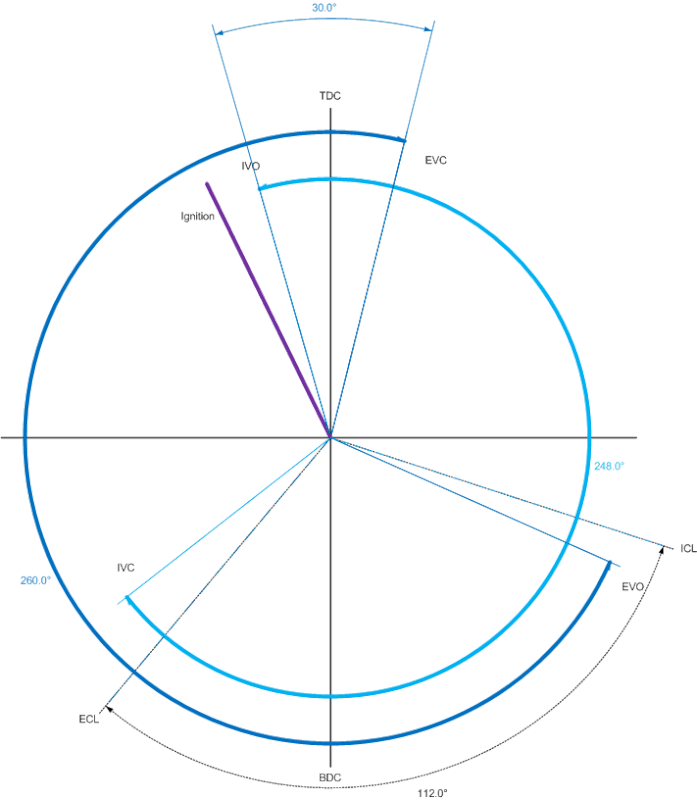
Using the pictures helped me visualize this a lot better. I didn't label the intake/compression/power/exhaust strokes, but I can 'see' them by looking at these. Now I need to go back and re-read how moving each of these points affects the operation of the engine.
I found a diagram drawn like this somewhere else online, so I pull out my technical drawing software (Visio 2007 for anyone curious) and made these. The first image below shows the cam timing events of my current hydraulic roller based on the cam doctor cam card I received from CM. I also showed the ignition point at WOT (26*) just for relative comparison sake. The inner circle represents the intake lobe while the outer circle represents the exhaust lobe.
IVO = 10.7
IVC = 47.5
EVO = 62.3
EVC = 5.9

Now, Martin and I are discussing replacing the HR with an LLSR. I have given him my set of requirements for this, and he's speced out a cam with advertized numbers of 248/260, 112+4. So here is what that looks like overlaid on top of the current cam:
IVO = 16
IVC = 52
EVO = 66
EVC = 14

Ok, so everything expands, and you can see the relative changes pretty well. But then I thought, "I've heard the LLSR is similar to an HR with 8* less timing." So I drew another picture, this one showing the current cam with the HR equivalent overlaid:

Well look at that... I know it's hard to see the differences, but the HR equivalent of the LLSR has almost the exact same IVC and EVO timings, a slightly earlier IVO, and a later EVC.
Finally, I drew the lobe centerlines on the LLSR plot and added the LSA. It's 112*, just what Martin told me.

Using the pictures helped me visualize this a lot better. I didn't label the intake/compression/power/exhaust strokes, but I can 'see' them by looking at these. Now I need to go back and re-read how moving each of these points affects the operation of the engine.

Graphs like that have been around for years and they provide a very nice visualization. One thing that I have found interesting lately is looking at the overlap centerline and how the square port heads appear to be responding to an more exhaust biased overlap centerline compared to the cathedral port heads. This is likely a bi-product of the intake valve timing with the big heads, but still an interesting correlation.
Graphs like that have been around for years and they provide a very nice visualization. One thing that I have found interesting lately is looking at the overlap centerline and how the square port heads appear to be responding to an more exhaust biased overlap centerline compared to the cathedral port heads. This is likely a bi-product of the intake valve timing with the big heads, but still an interesting correlation.
It would think it is certainly a factor as well of the sheer size of the intake valve and intake tract in relation to the displacement it is feeding.
Martin, I don't know how to ask this technically, so I'll try this...
Imagine water running through a trough, slightly downhill, but enough to get some velocity to it. At the end of the trough, the water is just running off the edge - over a cliff for all I care. Now, at the end of a trough, I suddenly throw a plank in front blocking the water from falling off the edge. The water is still coming from upstream with its own momentum, and it "piles up" on top of itself, momentarily flows backwards, etc. A whole lot happens right then, because fluids can't and don't stop (or start) on a dime, so to speak.
Now, substitute intake port for trough, air for water, intake valve for plank, cylinder vacuum for gravity. Now, I know there is a difference, because water, being liquid, has constant volume and density. Air can compress, which adds another layer of complexity to the scenario
So, my question to you is - when the intake valve closes, how does the air in the runner react? Does it stop and reverse itself momentarily? Does it somewhat compress and then when the intake valve opens again, sort of shoot into the cylinder, because it finally has a place to go? Since the events are happening in milliseconds, does it just present as general turbulence?
Then, if that weren't enough, the fuel injector fires while this is going on before the valve opens - assuming EOIT has remained stock - so, does the cooling effect of evaporating fuel then serve to reduce intake runner pressure? If so, does this then work FOR or AGAINST making power? I could see it helping by creating a partial vacuum and getting flow started from the manifold plenum and also due to colder air being more dense. I could see it working against by reducing the pressure differential across the intake valve, slowing down the initial cylinder fill.
I know that was a pretty wonky way to ask a question, but I have really twisted my mind into a knot trying to figure out how to even ask this, or if it even mattered to engine performance.
Imagine water running through a trough, slightly downhill, but enough to get some velocity to it. At the end of the trough, the water is just running off the edge - over a cliff for all I care. Now, at the end of a trough, I suddenly throw a plank in front blocking the water from falling off the edge. The water is still coming from upstream with its own momentum, and it "piles up" on top of itself, momentarily flows backwards, etc. A whole lot happens right then, because fluids can't and don't stop (or start) on a dime, so to speak.
Now, substitute intake port for trough, air for water, intake valve for plank, cylinder vacuum for gravity. Now, I know there is a difference, because water, being liquid, has constant volume and density. Air can compress, which adds another layer of complexity to the scenario
So, my question to you is - when the intake valve closes, how does the air in the runner react? Does it stop and reverse itself momentarily? Does it somewhat compress and then when the intake valve opens again, sort of shoot into the cylinder, because it finally has a place to go? Since the events are happening in milliseconds, does it just present as general turbulence?
Then, if that weren't enough, the fuel injector fires while this is going on before the valve opens - assuming EOIT has remained stock - so, does the cooling effect of evaporating fuel then serve to reduce intake runner pressure? If so, does this then work FOR or AGAINST making power? I could see it helping by creating a partial vacuum and getting flow started from the manifold plenum and also due to colder air being more dense. I could see it working against by reducing the pressure differential across the intake valve, slowing down the initial cylinder fill.
I know that was a pretty wonky way to ask a question, but I have really twisted my mind into a knot trying to figure out how to even ask this, or if it even mattered to engine performance.
Thread Starter
FormerVendor
iTrader: (3)
Joined: Feb 2012
Posts: 7,480
Likes: 18
From: Mount Airy, NC
This question really leads us down the rabbit hole. I am not sure how far I want to go as I could literally sit here for days and explain this. For now, I'm going to keep it as elementary as I can and directly answer your question without explaining why and how this happens.
Completely disregard wet flow for now, and only focus on dry flow alone.
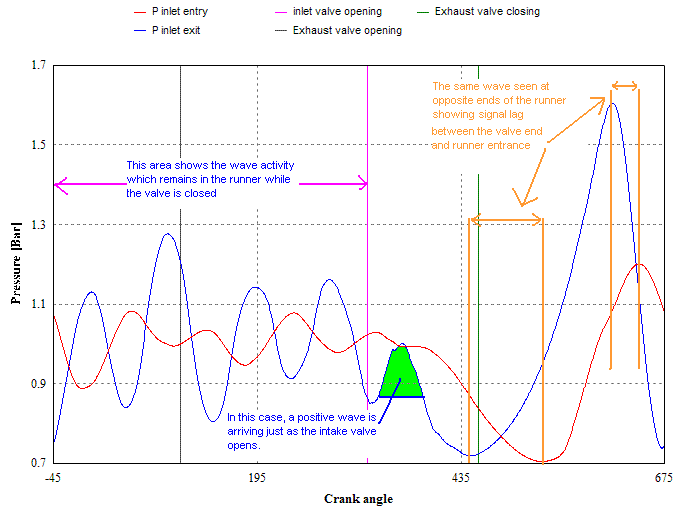
This graph doesn't show when the IVC event occurs, but just assume it occurs at the peak of the blue pressure trace. I actually used this exact same graph back on page 2 or 3 I believe(maybe page 4) to describe harmonics in the intake tract. Read back for a refresher course if you'd like before reading this.
As you can see, when the intake valve closes, pressure is higher than atmospheric. This would be considered "positive" pressure. Think of the analogy you made regarding the plank and water flowing down the trough....
When this positive pressure piles up against the intake valve, it reverberates all the way back up the intake tract until it reaches the plenum. Once it reaches the plenum it reaches an open end in the system and reverses signal traveling back down the intake port as negative pressure. "Negative" pressure lower than atmospheric that is.
This happens in the same way that the high pressure pulse upon the EVO event reflects back up the primary tube once it reaches the collector. It is the change in area (the area has to become larger and not smaller for this to occur) at the open end of the plenum that causes this rarefraction wave to occur. As you can see from the graph above, this happens multiple times while the intake valve is closed.
I really would like to explain the fine details as to why this happens, how it happens and how you can adjust parts on the engine or cam timing to capitalize on these pressure waves, but I'd have to write a book to do so. Changing the length of the intake manifold, changing the taper of the intake manifold runner, changing the MCSA of the intake port, changing the stroke of the engine, and engine speed all have an impact on these harmonics and pressures. Especially when they occur in the RPM range and how large the peaks and troughs in the pressure waves are. As I've said many times in this thread, cam timing just capitalizes on all of this.
As far as how fuel could change the dynamics regarding pressure in the runner, I'm sure it plays a part, but I can't really elaborate on that as I honestly don't know the answer. I'm by no means an expert in physics.
Anytime you would like to know more about this, just give me a call. I'd be glad to explain it more over the phone, or if you or anyone else can ask specific questions regarding the subject matter, I might be able to answer without writing a book.
Completely disregard wet flow for now, and only focus on dry flow alone.

This graph doesn't show when the IVC event occurs, but just assume it occurs at the peak of the blue pressure trace. I actually used this exact same graph back on page 2 or 3 I believe(maybe page 4) to describe harmonics in the intake tract. Read back for a refresher course if you'd like before reading this.
As you can see, when the intake valve closes, pressure is higher than atmospheric. This would be considered "positive" pressure. Think of the analogy you made regarding the plank and water flowing down the trough....
When this positive pressure piles up against the intake valve, it reverberates all the way back up the intake tract until it reaches the plenum. Once it reaches the plenum it reaches an open end in the system and reverses signal traveling back down the intake port as negative pressure. "Negative" pressure lower than atmospheric that is.
This happens in the same way that the high pressure pulse upon the EVO event reflects back up the primary tube once it reaches the collector. It is the change in area (the area has to become larger and not smaller for this to occur) at the open end of the plenum that causes this rarefraction wave to occur. As you can see from the graph above, this happens multiple times while the intake valve is closed.
I really would like to explain the fine details as to why this happens, how it happens and how you can adjust parts on the engine or cam timing to capitalize on these pressure waves, but I'd have to write a book to do so. Changing the length of the intake manifold, changing the taper of the intake manifold runner, changing the MCSA of the intake port, changing the stroke of the engine, and engine speed all have an impact on these harmonics and pressures. Especially when they occur in the RPM range and how large the peaks and troughs in the pressure waves are. As I've said many times in this thread, cam timing just capitalizes on all of this.
As far as how fuel could change the dynamics regarding pressure in the runner, I'm sure it plays a part, but I can't really elaborate on that as I honestly don't know the answer. I'm by no means an expert in physics.
Anytime you would like to know more about this, just give me a call. I'd be glad to explain it more over the phone, or if you or anyone else can ask specific questions regarding the subject matter, I might be able to answer without writing a book.

This question really leads us down the rabbit hole. I am not sure how far I want to go as I could literally sit here for days and explain this. For now, I'm going to keep it as elementary as I can and directly answer your question without explaining why and how this happens. Completely disregard wet flow for now, and only focus on dry flow alone. This graph doesn't show when the IVC event occurs, but just assume it occurs at the peak of the blue pressure trace. I actually used this exact same graph back on page 2 or 3 I believe(maybe page 4) to describe harmonics in the intake tract. Read back for a refresher course if you'd like before reading this. As you can see, when the intake valve closes, pressure is higher than atmospheric. This would be considered "positive" pressure. Think of the analogy you made regarding the plank and water flowing down the trough.... When this positive pressure piles up against the intake valve, it reverberates all the way back up the intake tract until it reaches the plenum. Once it reaches the plenum it reaches an open end in the system and reverses signal traveling back down the intake port as negative pressure. "Negative" pressure lower than atmospheric that is. This happens in the same way that the high pressure pulse upon the EVO event reflects back up the primary tube once it reaches the collector. It is the change in area (the area has to become larger and not smaller for this to occur) at the open end of the plenum that causes this rarefraction wave to occur. As you can see from the graph above, this happens multiple times while the intake valve is closed. I really would like to explain the fine details as to why this happens, how it happens and how you can adjust parts on the engine or cam timing to capitalize on these pressure waves, but I'd have to write a book to do so. Changing the length of the intake manifold, changing the taper of the intake manifold runner, changing the MCSA of the intake port, changing the stroke of the engine, and engine speed all have an impact on these harmonics and pressures. Especially when they occur in the RPM range and how large the peaks and troughs in the pressure waves are. As I've said many times in this thread, cam timing just capitalizes on all of this. As far as how fuel could change the dynamics regarding pressure in the runner, I'm sure it plays a part, but I can't really elaborate on that as I honestly don't know the answer. I'm by no means an expert in physics. Anytime you would like to know more about this, just give me a call. I'd be glad to explain it more over the phone, or if you or anyone else can ask specific questions regarding the subject matter, I might be able to answer without writing a book.
I recognize the chart from earlier in the thread, but it means more now than it did the first couple of times I read it.
I have very poor reception right now but will call when I get back to the mainland.
I think I suspected some of your answer. Port size, geometry, engine configuration would all play in, but there would be some point everything was in sync. The valve opens during peak pressure differential and lets as much in as possible and then closes just before the cylinder won't fill anymore. This would be when the cam ces into its tune and the engine takes off?

Registered User
Joined: Nov 2015
Posts: 1
Likes: 0
Lots of good info. I have always thought that Isa effected vacuum. Else than that i think most people put to big of a cam into low RPM street machines.
I have figured out that a heavy(Suburban) vehicle needs low duration and mild lift. Of course figuring out how to get a good sounding exhaust note(lope) is what i am looking for.
I figure most after market cams will at least give me a power increase if i don't go crazy.
I have read that stock Vortec heads flow to about .460. I will read more about the 216/219 or 217/221 thinking mentioned.
Thanks for taking the time to write all of this info.
I have figured out that a heavy(Suburban) vehicle needs low duration and mild lift. Of course figuring out how to get a good sounding exhaust note(lope) is what i am looking for.
I figure most after market cams will at least give me a power increase if i don't go crazy.
I have read that stock Vortec heads flow to about .460. I will read more about the 216/219 or 217/221 thinking mentioned.
Thanks for taking the time to write all of this info.
Teching In
Joined: Jul 2014
Posts: 26
Likes: 0
From: Fort Worth
Do you have to have the cam card to determine centerline? Or is there some way of figuring it out. From what i've been reading, if there is, I can't figure it out. Just trying to get a lot more learning about it in. That way I can do a better job at picking a cam for myself.