When you click on links to various merchants on this site and make a purchase, this can result in this site earning a commission. Affiliate programs and affiliations include, but are not limited to, the eBay Partner Network.
I had my set up pretty deep (2 full turns) which should be .94 loaded with a comp 7.4 rod on a LS7 lifter. I did some measurements and this is what I got. I know that rods are measured in "gauge length", but I took the radius out of the numbers due to the tools on hand. The distance still is what it is as I checked each rod on the car.
Preload 1
Comp 7.4 rod gave me 2 full turns from 0 lash to approximately .094 preload
Preload 2
Stock 98 vette rod gave me 1 3/4 turns from0 lash
Setting my test rod to:
7.375 yield 1 1/2 turns
7.350 yield 1 1/4 turns
7.325 yield 3/4 turn
Here it is set to 7.375
I think this gives me the best preload of approximately .070- 1 1/2 turns
Do I need to order about .020 shorter to account for the radius/oil hole?
If 7.375 as measured gives me what i need for preload, and being the comp measured approx .019 longer (my method) is it safe to assume a 7.375 would measure 7.395? If that's the case I'd need to order 3.50 to keep the 1 1/2 turn preload? correct?
Last edited by 02WSsicks; Jan 4, 2015 at 06:05 AM.
The difference between gauge length and overall length (OAL), which is what you are measuring is typically 0.015"-0.017" and you are getting 0.019" in the first photo. Also, the stock pushrods are not 7.400" gauge length, they are 7.385" gauge length. The 7.400" number is something started by the vendors as the stock replacement for the GM pushrods when an aftermarket cam is installed to make up for the base circle difference.
I am confused, what did you measure for zero lash length with the adjustable pushrod? Count turns and compute then use your method. The difference should be approximately what I provided between gauge and OAL.
I used the comp 7.4 to start. Took it to zero lash, and got two full turns to 22ftlbs. I'm thinking that is a little much. After that I just kept adjusting in .250 until I got to 1 1/2 turns which equaled 7.375 OAL. So do I need to order 10 to 15 thou longer or short because of my OAL measurement. Thinking shorter?
Or is the full two turns with the comp 7.4 preload ok?
Some other information. The 2 turns to 22 lb-ft is not 0.094" preload. If you watch carefully, you will see the rocker bottom and then the rest of the bolt turns are preloading the bolt (stretching the joint if you will). I checked this a few different ways and on my car and I found that once the rocker hit bottom, it was 1/3 turn until I reached 22 lb-ft. Therefore, the 1/3 turn needs to be subtracted when figuring the calculated preload. So for 2 turns, you would get:
2 turns minus 1/3 turn in 1.667 turns of bolt movement developing lifter preload.
Next you need to convert turns to bolt movement. Since the bolt is 8mmX1.25mm the bolt movement is: 1.67*1.25mm= 2.08mm
Convert to inches: 2.08/25.4 = 0.0819 inches
However, you also need to correct for the rocker ratio using parallel triangles. With stock rockers, the seat rocker ratio is 1.54 not 1.7 so the correction would be:
0.0819 * (2.54/1.54) = 0.135" preload at the lifter (approximately).
Not sure what preload you are seeking, but I would measure to OAL for zero lash with your home made adjustable pushrod. Next, add your preload to the measurement. Then subtract 0.019 from the result and see where you are for gauge length. You will likely not hit a perfect length so then you must decide to add or subtract to the available length.
To verify, if you have a dial indicator, adjust your pushrod to the gauge length you want to buy plus 0.019" and put it in the motor and tighten to 22 lb-ft and measure the preload as the lifter plunger depresses. Note that it will take a minute to bleed down and the valve may open during the tightening.
One other note, I would strongly consider some larger OD pushrods. The Manton 11/32" fit most heads and they actually use OAL when you order rather than gauge length. They will also make them any length you want so you can hit your target preload with the Mantons and not settle for incremental lengths of 0.025".
Yup, put a dial indicator on the rocker cup end. Watched it bleed down. Torqued to 22lbs and and zeroed the indicator, and brought it back up to double check. The comp 7.4 gave me about .090. I guess it's ok to run that loaded. I chasing a chirp out of my exhaust, and thinking a lighter pre-load may help.
What's the "range" for the Ls7 lifters? I've seen 60-120 listed somewhere?
So according to your calculation I'm over the .120 max and bottoming out the lifter with 2 turns on the comp 7.4 rod?
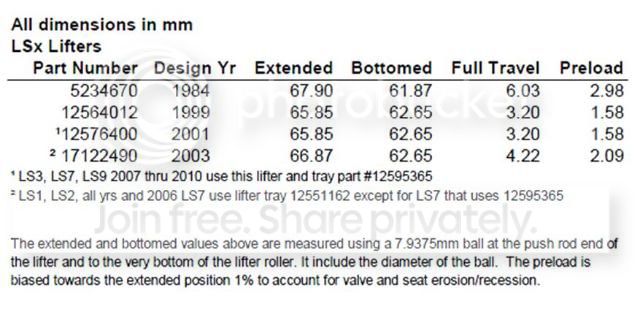
I believe the LS7 lifter has a larger range of motion. There is a post that was provided by a GM engineer on another forum that shows the plunger position and range. I would need to find that post again. (Found it on another forum, here is the link: Pushrod Table)
The numbers computed are based on two turns and the 1/3 turn that my car required to preload the rocker bolt. Your car might have a different bolt preload value than the 1/3 provided in my prior post.
When you set the dial indicator, it should be when the bolt is just tight enough to take out all the lash so there is no clearance between the rocker tip and valve stem and pushrod and cup. When I verified this on my car, I used the 0.047" for one turn provided by Shane in his original post and calculating the preload, measuring with a dial indicator when pre-loading the lifter, and using an adjustable pushrod set to zero lash and adding my pushrod length to the zero lash value. All were within several thousandths of each other.
Last edited by vettenuts; Jan 5, 2015 at 08:16 AM.
So assuming the higher part number lifter (2003 release) is identical what I just bought new delphi LS7 lifter 12499225, the full travel would be .166 of an inch. If I have it preloaded to approx .090 or your calculated .135 I'd have at worse about .031 travel. So now the question, is .090 to .135 too much preload? Car ran great on the dyno with no signs of float. Verses changing rod length shorter, to reduce preload to the range of .060-.080?
here is that lifter max travel post that somebody mentioned earlier
More preload vs less preload..
with more preload, the closer you get to the bottom of the lifter travel, the more it acts like a solid lifter...which can be beneficial to get more rpm out of the valvetrain
however, if the lifter pumps up, you suddenly have all that extra lift added into the valvetrain and catastrophic things can and will happen
running less preload, you have a bigger oil cushion and a quieter valvetrain, but it usually wont rev as high as a solid lifter would...however, with higher oil pressures than stock, it can somewhat counteract the hydraulics making it react more like a solid lifter(but not actually solid)
you also do not have to worry about pump up as much as it only makes a small difference if you have a small amount of preload.
Most cam manufacturers will recommend "less" preload, typically .020~.060 total preload.
here is that lifter max travel post that somebody mentioned earlier
More preload vs less preload..
with more preload, the closer you get to the bottom of the lifter travel, the more it acts like a solid lifter...which can be beneficial to get more rpm out of the valvetrain
however, if the lifter pumps up, you suddenly have all that extra lift added into the valvetrain and catastrophic things can and will happen
running less preload, you have a bigger oil cushion and a quieter valvetrain, but it usually wont rev as high as a solid lifter would...however, with higher oil pressures than stock, it can somewhat counteract the hydraulics making it react more like a solid lifter(but not actually solid)
you also do not have to worry about pump up as much as it only makes a small difference if you have a small amount of preload.
Most cam manufacturers will recommend "less" preload, typically .020~.060 total preload.
Ok, so I conclude that I'm running dangerously close to potentially crashing the valve train. Thinking as I'm running about 45-50 psi oil pressure with a 5W-30 as the engine spins upward to 6700 rpm's, and as the springs start to lose force as they wear, I'm probably asking for it. I'd think it's safer to shorten up the rod length toward middle ground of plunger travel.
Weird because the heads are un-milled, and to my knowledge the block has not been decked, and the base circle on my cam is smaller than stock?
I think if you do a search, there are quite a few guys running stock heads and shorter pushrods than the 7.400" version. As I stated earlier, if you do pull the trigger on shorter pushrods, I would see of the Manton 11/32" pushrods will fit. The larger OD is much stiffer and will not bounce the valves at high RPM. When I went to larger pushrods, you could see the difference above 6,200 RPM so I was experiencing some pushrod flex but you would never know unless you did back to back dyno runs. You just need to see if they will fit your motor.
I think if you do a search, there are quite a few guys running stock heads and shorter pushrods than the 7.400" version. As I stated earlier, if you do pull the trigger on shorter pushrods, I would see of the Manton 11/32" pushrods will fit. The larger OD is much stiffer and will not bounce the valves at high RPM. When I went to larger pushrods, you could see the difference above 6,200 RPM so I was experiencing some pushrod flex but you would never know unless you did back to back dyno runs. You just need to see if they will fit your motor.
Gas Monkey Built a 6-Wheel Ferrari Testarossa With a Corvette LT4 Engine
Slideshow: The controversial Ferrari F6 swaps its original flat-12 for a Corvette Z06-derived LT4 V8 and sends power to four rear wheels through a custom-built drivetrain.
7 Most Reliable High-Performance Engines GM Has Ever Built
Slideshow:These GM engines didn't just make huge power, they survived abuse, boost, track days, and six-digit mileage with a reputation for refusing to quit.
6 Common C5 Corvette Failures and What's Involved In Repairing Them
Slideshow: From wobbling harmonic balancers to failed EBCMs, these are the issues that define long-term C5 ownership and what repairs typically involve.
Retro Modern Bandit Pontiac Trans AM Comes With Burt Reynolds' Autograph
Slideshow: A modern Camaro transformed into a retro icon, this limited-run "Bandit" build blends nostalgia with brute force in a way few revivals manage.
Top 10 Greatest Cadillac V Series Performance Models Ever, Ranked
Slideshow: Cadillac didn't just crash the high-performance luxury vehicle party, it showed up loud, supercharged, and occasionally a little unhinged...







 Push rod length and preload