


Valve shrouding


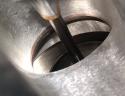
Before you start any chamber work, you need a couple of old valves to sacrifice that way you won't grind into your valve job. You want to take them and grind the face down until you don't have any margin left on the valve... like a pizza cutter, that way you can get your grinder in tight next to the seat. I do mine in a lathe, but you could put the valves in a drill and use a bench grinder or angle grinder.


Very nice work & thanks for posting. Have you ever ground down valves for the purpose of lightening their weight? I know that they were ground here in order to protect the seats. Am just curious about removing maybe .030" of the intake valve face to save some weight.
Have heard that modifying the port swirl ramp decreases the efficiency of the A/F mix within the port, yet most head porters reduce & smooth it. Thoughts?
Very nice work & thanks for posting. Have you ever ground down valves for the purpose of lightening their weight? I know that they were ground here in order to protect the seats. Am just curious about removing maybe .030" of the intake valve face to save some weight.
Have heard that modifying the port swirl ramp decreases the efficiency of the A/F mix within the port, yet most head porters reduce & smooth it. Thoughts?
Have heard that modifying the port swirl ramp decreases the efficiency of the A/F mix within the port, yet most head porters reduce & smooth it. Thoughts?
No, the tail end of the swirl ramp located just below the spark plug hole. Don't know for sure because it's an area that I haven't been able to physically measure, but it has been claimed that lowering/smoothing this are reduces the effect of the swirl within the chamber; therefore, lowering the efficiency of the A/F mix on fuel injected heads where fuel enters @ the top of the runner on the head.

We're not noobs here. The "real gain" from the lighter valves is the improved valve train stability @ high RPM. Removing material from the valve face is the kinda thing that could be an in-expense alternative to sodium filled valve stems. So, it's worth experimenting with. Would adjust for the compression difference with more head decking or a thinner gasket. Heat damage may be an issue & is a concern. Finding out is the fun part. A lot of guys could benefit if this works. Granted I wouldn't expect it to hold up to the heat that can come from nitrous or a blower, but NA seems doable. We'd also remove less or none from the exhaust valves.
Your valve seat contact area has a whole lot to do with transferring the heat from the valves, not so much as the valve margin (within a reasonable amount)
But the valve would have less thermal capacity. The heat transferred to the valve from the combustion chamber would have slightly more surface area and less weight to spread and transfer that heat through so would run hotter.
Not a lot of wheels left to be reinvented with the OHV pushrod V8, at least not by the shadetree.
Not a lot of wheels left to be reinvented with the OHV pushrod V8, at least not by the shadetree.
But the valve would have less thermal capacity. The heat transferred to the valve from the combustion chamber would have slightly more surface area and less weight to spread and transfer that heat through so would run hotter.
Not a lot of wheels left to be reinvented with the OHV pushrod V8, at least not by the shadetree.
Not a lot of wheels left to be reinvented with the OHV pushrod V8, at least not by the shadetree.
No, the tail end of the swirl ramp located just below the spark plug hole. Don't know for sure because it's an area that I haven't been able to physically measure, but it has been claimed that lowering/smoothing this are reduces the effect of the swirl within the chamber; therefore, lowering the efficiency of the A/F mix on fuel injected heads where fuel enters @ the top of the runner on the head.
No, the tail end of the swirl ramp located just below the spark plug hole. Don't know for sure because it's an area that I haven't been able to physically measure, but it has been claimed that lowering/smoothing this are reduces the effect of the swirl within the chamber; therefore, lowering the efficiency of the A/F mix on fuel injected heads where fuel enters @ the top of the runner on the head.
I see most of the CNC programs that address chamber shape remove it. I intended to leave mine in place , all the compression I can get. Maybe the answer can be found with a thread wand.
Not to mention it's a real pain in the *** to machine titanium.
I have read of shops putting a radius on the margin of a exhaust valve to help flow into the port; the same article said it is not done on the intake valve. I have hollow stem LS6 valves and worry about the P to V I will end up with. I would like to have more clearance than my lifter preload.
We have seen valves with a concave face about half the diameter of the valve so I guess that would be safe. I don't know the effect that would have on the movement of the A/F mixture in the chamber though. We have seen the stem cut down after the guide, like a Manley Pro-Flo so that could be a benefit. Getting all 8 intake valves to measure the same would seem to be inportant.

That triangular bump next to the spark plug hole ? on 243 and 799 heads ? I see most of the CNC programs that address chamber shape remove it. I intended to leave mine in place , all the compression I can get. Maybe the answer can be found with a thread wand.
Interesting tool, but it doesn't measure any difference in the A/F mix related to less "swirl" within the port. Would probably need to install wide band 02 sensors in the primary exhaust tubes to find out if the mix is any different between an untouched swirl ramp & a "ported" one.
See in the pic, the port on the left circled in red has a vague looking wing below the intake valve? The pic on the right, the untouched port, can be seen a well defined wing or swirl ramp below the intake valve.
That wing shape is also something that custom head porters machine or grind into the intake valve bowl in order to speed airflow & improve the efficiency of the mix. Short of a CNC, don't know how they shape it into the intake valve bowl consistently 8 times, but the do.
the port on the left circled in red has a vague looking wing
The thread wand can not measure A/F mix but it can show turbulence.
BTW Farmington, if you read the post instead of just looking at the pictures you would know the valves with the margin cut off were meant for a guide and not to be used in a working engine.