



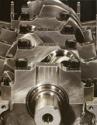



Potential oiling issues
 Potential oiling issues
 I see enough references to cavitation with wet sump LS motors at high rpm to scare me but I have not found anything definitive. I have an iron 6.0L, Patriot headed motor with top end Callies crank and rods, Diamond pistions, Melling 10296 oil pump and around 250 degree Cammotion cam. It has a plated TKO 600 and Ram slider clutch. I recently replaced the Fast 90/90 with a sheet metal intake and 105 and the difference is stunning. The torque peak moved from 4800 to 5900 and hp peak to 7800. I am going to have to shift at 8600 or better. I have a hard time understanding how it can cavitate unless the pump runs dry, and can't understand how the pump can run dry (this is not a road racer) unless the oil is trapped up top like the old SBC did, and I can't see how oil can get trapped up top in an LS motor. I see guys saying they run a bigger Moroso (or whatever) pans but that would not solve oil trapped in the top end. Nor would the baffles I see mentioned. I know that launching can pull more G's than cornering, but unless the car is on the back bumper, I can't see how the pump could run dry. Does anyone have good information on this issue?

TECH Enthusiast
Joined: Feb 2007
Posts: 625
Likes: 0
From: Raleigh, NC
A tiny amount of air is in solution with the oil. When the pressure of the oil drops due to suction between the pump rotors and the pickup tube inlet, the air in solution can expand and form measurable bubbles.
Thanks for the link. Good background information, but I still have trouble understanding cavitation. They say when the inlet (port, tube, etc) can't supply oil fast enough, "tiny air bubbles form along the trailing edge of the gears and aerate the oil", but where does the air come from? They mention the steel front plate flexing and leaking, so maybe it is there. Maybe a Melling pump, with it's cast face plate, doesn't do that. Melling shows a graph with the 10296 stable to 8000.
I believe Mellings are better about cavitation due to their design versus an OEM pump. As stated in that article, rerouting excess oil back into the inlet helps fight against that cavitation at higher speeds which is why I chose to run a 10296 with the low pressure spring.
At first, I couldn't understand what problem a tiny amount of air could cause. Then I remebered pv=nrt - as the pressure goes to zero, the volume gets large. This I can understand.
I believe Mellings are better about cavitation due to their design versus an OEM pump. As stated in that article, rerouting excess oil back into the inlet helps fight against that cavitation at higher speeds which is why I chose to run a 10296 with the low pressure spring.
Trending Topics
TECH Enthusiast
Joined: Feb 2007
Posts: 625
Likes: 0
From: Raleigh, NC
The oil gets air mixed in solution from all the windage in the crankcase. Any time a liquid slings around violently it will pick up air into solution. The only way the drainback path is going to increase airation is if the cavitys for the drainback path are also used for breathing between main bearings.
What you are talking about here is one of the reasons crankcase evac systems are popular in some forms of racing. Crankcase evac systems force the air in solution within the oil and oil vapor to boil out of solution because the overall internal system "ambient" pressure drops. They increase oiling effectiveness more so than they increase power, but increased power is always a nice benefit.
LS1 Tech Stories
The Best V8 Stories One Small Block at Time

6 Common C5 Corvette Failures and What's Involved In Repairing Them
Pouria Savadkouei
Retro Modern Bandit Pontiac Trans AM Comes With Burt Reynolds' Autograph
Verdad Gallardo
Top 10 Greatest Cadillac V Series Performance Models Ever, Ranked
Pouria Savadkouei
Top 10 Most Powerful Chevy Trucks Ever Made!

Hennessey's New Supercharged Silverado ZR2 Has 700 HP
Verdad Gallardo
Coachbuilt N2A Anteros Is an LS2-Powered C6 Corvette In Italian Clothes
Verdad Gallardo
Awesome K5 Blazer Restomod Comes With C7 Corvette Power
Verdad Gallardo
10 Camaros You Should Never Buy

10 LS Engine Myths That Refuse to Die
Verdad Gallardo Basically, yes.
The oil gets air mixed in solution from all the windage in the crankcase. Any time a liquid slings around violently it will pick up air into solution. The only way the drainback path is going to increase airation is if the cavitys for the drainback path are also used for breathing between main bearings.
The oil gets air mixed in solution from all the windage in the crankcase. Any time a liquid slings around violently it will pick up air into solution. The only way the drainback path is going to increase airation is if the cavitys for the drainback path are also used for breathing between main bearings.
What you are talking about here is one of the reasons crankcase evac systems are popular in some forms of racing. Crankcase evac systems force the air in solution within the oil and oil vapor to boil out of solution because the overall internal system "ambient" pressure drops. They increase oiling effectiveness more so than they increase power, but increased power is always a nice benefit.

I didn't read all of the replies to your question. But I do know how cavitation works. I worked in a field where we dealt with it all the time.
You can get cavitation anytime you are trying to move a fluid faster than that fluid can be moved. And the fluid movement can be affected by many different things. Your question is about a wet sump pickup. If the pump is trying to suck the oil faster than the oil itself can move, then it will cause an air pocket which is cavitation. The pump is going to pull something into itself, be it oil or air. So it pulls the oil from all sides until the oil can not move into the sump fast enough and a void is started around the pickup like a whirlpool of water going down your bathtub drain. Now your getting air into your pump instead of oil.
And then there is cavitation where the air is actually separated from the fluid. Think of a boat prop in the water. You can hit the throttle wide open when your sitting still and the prop can slip in the water like spinning a tire. When that prop spins in the water it creates a pocket of air and it cavitates IF you can spin it fast and hard enough. You are compressing the water and the air gets left behind.
OR, simply run your hand through a bathtub of water as fast as you can and you will get an air pocket behind your hand. Cavitation.
Yea, I know, there are a ton more ways to explain this with math and science. I just tried to make it simple.
BTW, I ran my 565 dragster engine over 8000rpm with a wet sump oil pump and pickup. With 20w50 oil with no problems. I shifted at 8k. Crossed the stripe at about 8400. As long as you have enough clearance between the pickup screen and the bottom of the pan you should be fine. And you need enough oil volume.
You can get cavitation anytime you are trying to move a fluid faster than that fluid can be moved. And the fluid movement can be affected by many different things. Your question is about a wet sump pickup. If the pump is trying to suck the oil faster than the oil itself can move, then it will cause an air pocket which is cavitation. The pump is going to pull something into itself, be it oil or air. So it pulls the oil from all sides until the oil can not move into the sump fast enough and a void is started around the pickup like a whirlpool of water going down your bathtub drain. Now your getting air into your pump instead of oil.
And then there is cavitation where the air is actually separated from the fluid. Think of a boat prop in the water. You can hit the throttle wide open when your sitting still and the prop can slip in the water like spinning a tire. When that prop spins in the water it creates a pocket of air and it cavitates IF you can spin it fast and hard enough. You are compressing the water and the air gets left behind.
OR, simply run your hand through a bathtub of water as fast as you can and you will get an air pocket behind your hand. Cavitation.
Yea, I know, there are a ton more ways to explain this with math and science. I just tried to make it simple.
BTW, I ran my 565 dragster engine over 8000rpm with a wet sump oil pump and pickup. With 20w50 oil with no problems. I shifted at 8k. Crossed the stripe at about 8400. As long as you have enough clearance between the pickup screen and the bottom of the pan you should be fine. And you need enough oil volume.
BTW, I ran my 565 dragster engine over 8000rpm with a wet sump oil pump and pickup. With 20w50 oil with no problems. I shifted at 8k. Crossed the stripe at about 8400. As long as you have enough clearance between the pickup screen and the bottom of the pan you should be fine. And you need enough oil volume.