




HP vs TQ Theory

TECH Enthusiast
Joined: Apr 2009
Posts: 723
Likes: 4

Ok.
So what, exactly, is the estimated sum net difference we are talking about here in terms of discernible variance in VE, or power production, (ie, on V8R's engine being used in the model) between an engine that would be equipped with a 180, or even a 360, crossover header vs not?
More over, the variance mentioned between the high VE table vs low VE table that gets "averaged"?
So what, exactly, is the estimated sum net difference we are talking about here in terms of discernible variance in VE, or power production, (ie, on V8R's engine being used in the model) between an engine that would be equipped with a 180, or even a 360, crossover header vs not?
More over, the variance mentioned between the high VE table vs low VE table that gets "averaged"?
Last edited by gtfoxy; Nov 25, 2015 at 06:22 AM.

TECH Senior Member


Joined: Apr 2002
Posts: 6,080
Likes: 17
From: So.Cal.
HP vs TQ Theory
Originally Posted by gtfoxy
...
More over, the variance mentioned between the high VE table vs low VE table that gets "averaged"?
More over, the variance mentioned between the high VE table vs low VE table that gets "averaged"?
( notice the terminology I used: VE table vs VE... i.e. "table" implying it is the calibration table, and lack of "table" implying it is the actual physical VE )
Thread Starter
Joined: Jul 2014
Posts: 10,450
Likes: 1,873
From: My own internal universe
Out of necessity and availability of data, I sort of assumed a 1-7/8" pace-setter 32" typical LS header.
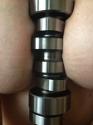
As to my cam timing, 227/236 - 112+3
Event......0.006"............0.050"
EVO........79.5 BBDC......53 BBDC
EVC........29.5 ATDC.......3 ATDC
EVD........289 Degrees....236 Degrees
IVO.........31 BTDC..........4.5 BTDC
IVC..........69 ABDC.........42.5 ABDC
IVD.........280 Degrees.....227 Degrees
Side comment, not pertinent to discussion - I have really enjoyed this cam. Drives well, enough lope to get attention, and unless I try to coast at 15mph in third, it's fine. Knowing more now than I did, if I were to re-spec the cam, I would hold the exhaust duration constant, and open up the intake a bit more. Maybe after the dual exhaust is in. At the time, I figured my set up was very intake biased, so I wanted the added exhaust duration to compensate for the comparatively aneamic exhaust flow.
As to my cam timing, 227/236 - 112+3
Event......0.006"............0.050"
EVO........79.5 BBDC......53 BBDC
EVC........29.5 ATDC.......3 ATDC
EVD........289 Degrees....236 Degrees
IVO.........31 BTDC..........4.5 BTDC
IVC..........69 ABDC.........42.5 ABDC
IVD.........280 Degrees.....227 Degrees
Side comment, not pertinent to discussion - I have really enjoyed this cam. Drives well, enough lope to get attention, and unless I try to coast at 15mph in third, it's fine. Knowing more now than I did, if I were to re-spec the cam, I would hold the exhaust duration constant, and open up the intake a bit more. Maybe after the dual exhaust is in. At the time, I figured my set up was very intake biased, so I wanted the added exhaust duration to compensate for the comparatively aneamic exhaust flow.
TECH Enthusiast
Joined: Apr 2009
Posts: 723
Likes: 4
In the calibration there's only one VE table, when it is tuned/corrected it averages between the two actual (unsymmetric) VE's that result from separated headers.
( notice the terminology I used: VE table vs VE... i.e. "table" implying it is the calibration table, and lack of "table" implying it is the actual physical VE )
( notice the terminology I used: VE table vs VE... i.e. "table" implying it is the calibration table, and lack of "table" implying it is the actual physical VE )
One dyno of a friends pro-stock circle track motor the difference between a 180 cross over header vs regular was 8-9lb/ft & about 7hp on a 475HP SBC.
So in the range of about .7lb/min of theoretical VE variance. Entirely impossible to know in this circumstance.
TECH Enthusiast
Joined: Apr 2009
Posts: 723
Likes: 4
Out of necessity and availability of data, I sort of assumed a 1-7/8" pace-setter 32" typical LS header.
As to my cam timing, 227/236 - 112+3
Event......0.006"............0.050"
EVO........79.5 BBDC......53 BBDC
EVC........29.5 ATDC.......3 ATDC
EVD........289 Degrees....236 Degrees
IVO.........31 BTDC..........4.5 BTDC
IVC..........69 ABDC.........42.5 ABDC
IVD.........280 Degrees.....227 Degrees
Side comment, not pertinent to discussion - I have really enjoyed this cam. Drives well, enough lope to get attention, and unless I try to coast at 15mph in third, it's fine. Knowing more now than I did, if I were to re-spec the cam, I would hold the exhaust duration constant, and open up the intake a bit more. Maybe after the dual exhaust is in. At the time, I figured my set up was very intake biased, so I wanted the added exhaust duration to compensate for the comparatively aneamic exhaust flow.
As to my cam timing, 227/236 - 112+3
Event......0.006"............0.050"
EVO........79.5 BBDC......53 BBDC
EVC........29.5 ATDC.......3 ATDC
EVD........289 Degrees....236 Degrees
IVO.........31 BTDC..........4.5 BTDC
IVC..........69 ABDC.........42.5 ABDC
IVD.........280 Degrees.....227 Degrees
Side comment, not pertinent to discussion - I have really enjoyed this cam. Drives well, enough lope to get attention, and unless I try to coast at 15mph in third, it's fine. Knowing more now than I did, if I were to re-spec the cam, I would hold the exhaust duration constant, and open up the intake a bit more. Maybe after the dual exhaust is in. At the time, I figured my set up was very intake biased, so I wanted the added exhaust duration to compensate for the comparatively aneamic exhaust flow.
Have any WOT EGT's?
Also, & I know this sounds odd, cranking compression & maybe a leak down average number?
Thread Starter
Joined: Jul 2014
Posts: 10,450
Likes: 1,873
From: My own internal universe
I don't have any EGT's, unfortunately. cranking compression when I last tested it was 205-210 depending on cylinder. I was pretty pleased with it. I didn't really do much of a leak down test, since the heads were brand new. I left the gauge on for about a minute and didn't see any drop, so I moved on. I've been thinking to redo the compression check now that I have a couple thousand miles on the motor. Probably should.
LS1 Tech Stories
The Best V8 Stories One Small Block at Time

Amazing '71 Camaro Restomod Is Modern Muscle Car Under the Skin
Verdad Gallardo
6 Common C5 Corvette Failures and What's Involved In Repairing Them
Pouria Savadkouei
Retro Modern Bandit Pontiac Trans AM Comes With Burt Reynolds' Autograph
Verdad Gallardo
Top 10 Greatest Cadillac V Series Performance Models Ever, Ranked
Pouria Savadkouei
Top 10 Most Powerful Chevy Trucks Ever Made!

Hennessey's New Supercharged Silverado ZR2 Has 700 HP
Verdad Gallardo
Coachbuilt N2A Anteros Is an LS2-Powered C6 Corvette In Italian Clothes
Verdad Gallardo
Awesome K5 Blazer Restomod Comes With C7 Corvette Power
Verdad Gallardo
10 Camaros You Should Never Buy

I have a 122 cubic inch engine in a 2800lb vehicle. It has OEM internals with an aftermarket camshaft grind. Compression is 8.5:1, the engine has 140,000~Miles, compression test result is 130psi across the board with OEM camshafts (I put the OEM cams in to test compression and compare fuel economy etc...) The aftermarket camshaft duration is 270*~ it has a major lope. Expected rebuild is around 220,000 miles (3-5 years away). Power output is 380rwhp at 17.8psi boost (factory numbers with OEM cams is 268rwhp @ 13psi) 93 octane.
Results/data
Fuel economy on the highway with OEM camshaft vs aftermarket camshaft is identical, if not better with the aftermarket cam. It cruises with the same injector duty and nets 26-29mpg depending how I drive on the highway, with 30 max.
The upgrade camshaft reduced idle quality and added 50% more injector duty to the idle speed (from 1% to 1.5% injector duty) and more airflow was necessary at the IACV to hold a reasonable 850~rpm idle, although the engine sounds most happy between 880-920rpm. The cam is too large for the turbo (on purpose for the lope) the trade-off being the reduced economy at idle (but not highway or normal driving).
highway injector duty cycle at 60mph is exactly 6%. Disconnecting the turbine (deactivating the flapper so it hangs open) raises that to 6.5%. This is a great example of how "pumping losses" or if you want "parasitic losses" due to the engine having to work harder for it's air results with less fuel economy. Cruise vacuum also drops but the engine uses a MAF and I do not have a boost gauge accurate enough for the job (the boost controller gives me a peak boost number but little else). Is it so obvious that a turbocharger would/should improve BSFC for a highway cruise? And if that doesn't mess you up yet, heres a next observation, I have ten or so feet of intercooler plumbing with 2.5" and 3" plumbing, along with a 3"x48"x12" intercooler (tons of volume to move) and I suspect this is the major reason why the turbocharger seems to be "helping my fuel economy" (because without one, the engine has to draw air through all that pipe, it cant be easy) So would the engine achieve a higher economy without all the extra plumbing, how much of a difference would it make. Can we calculate how much energy is lost pulling X CFM through pipe with a length/cross section Y?
Results/data
Fuel economy on the highway with OEM camshaft vs aftermarket camshaft is identical, if not better with the aftermarket cam. It cruises with the same injector duty and nets 26-29mpg depending how I drive on the highway, with 30 max.
The upgrade camshaft reduced idle quality and added 50% more injector duty to the idle speed (from 1% to 1.5% injector duty) and more airflow was necessary at the IACV to hold a reasonable 850~rpm idle, although the engine sounds most happy between 880-920rpm. The cam is too large for the turbo (on purpose for the lope) the trade-off being the reduced economy at idle (but not highway or normal driving).
highway injector duty cycle at 60mph is exactly 6%. Disconnecting the turbine (deactivating the flapper so it hangs open) raises that to 6.5%. This is a great example of how "pumping losses" or if you want "parasitic losses" due to the engine having to work harder for it's air results with less fuel economy. Cruise vacuum also drops but the engine uses a MAF and I do not have a boost gauge accurate enough for the job (the boost controller gives me a peak boost number but little else). Is it so obvious that a turbocharger would/should improve BSFC for a highway cruise? And if that doesn't mess you up yet, heres a next observation, I have ten or so feet of intercooler plumbing with 2.5" and 3" plumbing, along with a 3"x48"x12" intercooler (tons of volume to move) and I suspect this is the major reason why the turbocharger seems to be "helping my fuel economy" (because without one, the engine has to draw air through all that pipe, it cant be easy) So would the engine achieve a higher economy without all the extra plumbing, how much of a difference would it make. Can we calculate how much energy is lost pulling X CFM through pipe with a length/cross section Y?
Last edited by kingtal0n; Nov 26, 2015 at 12:59 AM.
Thread Starter
Joined: Jul 2014
Posts: 10,450
Likes: 1,873
From: My own internal universe
I have a 122 cubic inch engine in a 2800lb vehicle. It has OEM internals with an aftermarket camshaft grind. Compression is 8.5:1, the engine has 140,000~Miles, compression test result is 130psi across the board with OEM camshafts (I put the OEM cams in to test compression and compare fuel economy etc...) The aftermarket camshaft duration is 270*~ it has a major lope. Expected rebuild is around 220,000 miles (3-5 years away). Power output is 380rwhp at 17.8psi boost (factory numbers with OEM cams is 268rwhp @ 13psi) 93 octane. Results/data Fuel economy on the highway with OEM camshaft vs aftermarket camshaft is identical, if not better with the aftermarket cam. It cruises with the same injector duty and nets 26-29mpg depending how I drive on the highway, with 30 max. The upgrade camshaft reduced idle quality and added 50% more injector duty to the idle speed (from 1% to 1.5% injector duty) and more airflow was necessary at the IACV to hold a reasonable 850~rpm idle, although the engine sounds most happy between 880-920rpm. The cam is too large for the turbo (on purpose for the lope) the trade-off being the reduced economy at idle (but not highway or normal driving). highway injector duty cycle at 60mph is exactly 6%. Disconnecting the turbine (deactivating the flapper so it hangs open) raises that to 6.5%. This is a great example of how "pumping losses" or if you want "parasitic losses" due to the engine having to work harder for it's air results with less fuel economy. Cruise vacuum also drops but the engine uses a MAF and I do not have a boost gauge accurate enough for the job (the boost controller gives me a peak boost number but little else). Is it so obvious that a turbocharger would/should improve BSFC for a highway cruise? And if that doesn't mess you up yet, heres a next observation, I have ten or so feet of intercooler plumbing with 2.5" and 3" plumbing, along with a 3"x48"x12" intercooler (tons of volume to move) and I suspect this is the major reason why the turbocharger seems to be "helping my fuel economy" (because without one, the engine has to draw air through all that pipe, it cant be easy) So would the engine achieve a higher economy without all the extra plumbing, how much of a difference would it make. Can we calculate how much energy is lost pulling X CFM through pipe with a length/cross section Y?
The cams are separate in the 4-valve/cyl head, and there is a rocker arm style transfer from the lobe to valve, so duration estimates do not carry over from this world to that. If you want a comparison I would say it has the characteristic of a 234* @ .050 duration 110 or 112 LSA in your world, so the rpm limit is something like 8,200 but I would only take it to 8,000 for a dyno event, raising the power cap to the turbochargers maximum output with minimal boost (TO4E 50 trim with a 63 a/r turbine T3) would you like to see a dyno