



HP vs TQ Theory

TECH Addict
Joined: Jul 2013
Posts: 2,189
Likes: 123
From: Portland, Oregon

Your mention of rod ratio, and thusly piston acceleration, versus the rise in cylinder pressure is something that I have been thinking about since the beginning of this discussion. I haven't brought it up because it might be worthy of its own discussion altogether.
Higher octane rating fuels generally burn slower, but are generally compressed to a higher degree. So it probably all ends up balancing out at some point, as far as pressure is concerned.
But do lower octane rating fuels, which burn faster, cater to the faster piston acceleration of lower rod ratios? To continue the reloading analogy, it's like using a faster powder in a shorter barrel to achieve the same percentage of powder-burn as a slower powder in a longer barrel.
Inversely, do high octane, slow burning fuels cater to high rod ratios, with less piston acceleration away from top dead center?
Then, what's better? The slow push or do you want to "kick the slug" with a single and sudden violent shove?
Higher octane rating fuels generally burn slower, but are generally compressed to a higher degree. So it probably all ends up balancing out at some point, as far as pressure is concerned.
But do lower octane rating fuels, which burn faster, cater to the faster piston acceleration of lower rod ratios? To continue the reloading analogy, it's like using a faster powder in a shorter barrel to achieve the same percentage of powder-burn as a slower powder in a longer barrel.
Inversely, do high octane, slow burning fuels cater to high rod ratios, with less piston acceleration away from top dead center?
Then, what's better? The slow push or do you want to "kick the slug" with a single and sudden violent shove?

TECH Enthusiast
Joined: Apr 2009
Posts: 723
Likes: 4
I found this:
Patm X CR = Max Stat. Cyl. Pressure
14.7psi X 8.5=125psi. I don't see any problem.
here:
http://www.sr20-forum.com/forced-ind...test-woes.html
Can anyone verify that its a real quick easy dirty way to calculate what it claims to?
How are you all doing DCR maths? I saw a thread about that and I was pretty sure darth was in it.
And as to this...
If you want more power you get a larger turbo. Largers turbochargers flow more air and thus more horsepower. More air = more power. Peak air mass flow rate= peak power.
Cylinder pressure is completely separate entity all together. Pressure gives us torque, it gives us force on the lever system that the engine pretends to own. Some of the energy goes up in heat; we dont know how much so math involving energy flow is fairly useless. We can correlate power with airflow, but not cylinder pressure with airflow, or cylinder pressure with power. In order to get power (work) from cylinder pressure, a basic equation would at least need to include rpm, and an advanced equation would contain variables involving the moment of leverage and friction variables, and other sorts of numbers of which I can vaguely conceive enough of to know we are not going to get anywhere useful with that sort of equation.
Patm X CR = Max Stat. Cyl. Pressure
14.7psi X 8.5=125psi. I don't see any problem.
here:
http://www.sr20-forum.com/forced-ind...test-woes.html
Can anyone verify that its a real quick easy dirty way to calculate what it claims to?
How are you all doing DCR maths? I saw a thread about that and I was pretty sure darth was in it.
And as to this...
If you want more power you get a larger turbo. Largers turbochargers flow more air and thus more horsepower. More air = more power. Peak air mass flow rate= peak power.
Cylinder pressure is completely separate entity all together. Pressure gives us torque, it gives us force on the lever system that the engine pretends to own. Some of the energy goes up in heat; we dont know how much so math involving energy flow is fairly useless. We can correlate power with airflow, but not cylinder pressure with airflow, or cylinder pressure with power. In order to get power (work) from cylinder pressure, a basic equation would at least need to include rpm, and an advanced equation would contain variables involving the moment of leverage and friction variables, and other sorts of numbers of which I can vaguely conceive enough of to know we are not going to get anywhere useful with that sort of equation.
TECH Enthusiast
Joined: Apr 2009
Posts: 723
Likes: 4
Your mention of rod ratio, and thusly piston acceleration, versus the rise in cylinder pressure is something that I have been thinking about since the beginning of this discussion. I haven't brought it up because it might be worthy of its own discussion altogether.
Higher octane rating fuels generally burn slower, but are generally compressed to a higher degree. So it probably all ends up balancing out at some point, as far as pressure is concerned.
But do lower octane rating fuels, which burn faster, cater to the faster piston acceleration of lower rod ratios? To continue the reloading analogy, it's like using a faster powder in a shorter barrel to achieve the same percentage of powder-burn as a slower powder in a longer barrel.
Inversely, do high octane, slow burning fuels cater to high rod ratios, with less piston acceleration away from top dead center?
Then, what's better? The slow push or do you want to "kick the slug" with a single and sudden violent shove?
Higher octane rating fuels generally burn slower, but are generally compressed to a higher degree. So it probably all ends up balancing out at some point, as far as pressure is concerned.
But do lower octane rating fuels, which burn faster, cater to the faster piston acceleration of lower rod ratios? To continue the reloading analogy, it's like using a faster powder in a shorter barrel to achieve the same percentage of powder-burn as a slower powder in a longer barrel.
Inversely, do high octane, slow burning fuels cater to high rod ratios, with less piston acceleration away from top dead center?
Then, what's better? The slow push or do you want to "kick the slug" with a single and sudden violent shove?
Octane is a bit of a misnomer. That is why you are viewing it the way you are, which isn't incorrect, there is just more to it. The only advantage to higher octane is in the heavier hydrocarbons present in the fuel for engines that possess poor vaporization, homogenization & distribution. This limits the static & dynamic compression that can be ran on a given fuel. The heavier & harder to combust hydrocarbons aren't as sensitive to pre-ignition of various sources. But ideally the better vaporization the better the resultant energy, so there is a limit to which octane doesn't help.
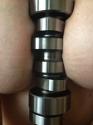
Think of matching the acceleration rates to having a bycicle upside down. Rotate the pedal as fast as you can & let it spin. Now throw your hand in there & try to match the velocity of the pedal so as to cause an increase in torque. Or even match its moment of inertia to maintain a given RPM.
Thread Starter
Joined: Jul 2014
Posts: 10,450
Likes: 1,873
From: My own internal universe
I found this:
Patm X CR = Max Stat. Cyl. Pressure
14.7psi X 8.5=125psi. I don't see any problem.
here:
http://www.sr20-forum.com/forced-ind...test-woes.html
Can anyone verify that its a real quick easy dirty way to calculate what it claims to?
Patm X CR = Max Stat. Cyl. Pressure
14.7psi X 8.5=125psi. I don't see any problem.
here:
http://www.sr20-forum.com/forced-ind...test-woes.html
Can anyone verify that its a real quick easy dirty way to calculate what it claims to?
How are you all doing DCR maths? I saw a thread about that and I was pretty sure darth was in it.
And as to this...
If you want more power you get a larger turbo. Largers turbochargers flow more air and thus more horsepower. More air = more power. Peak air mass flow rate= peak power.
Cylinder pressure is completely separate entity all together. Pressure gives us torque, it gives us force on the lever system that the engine pretends to own. Some of the energy goes up in heat; we dont know how much so math involving energy flow is fairly useless. We can correlate power with airflow, but not cylinder pressure with airflow, or cylinder pressure with power. In order to get power (work) from cylinder pressure, a basic equation would at least need to include rpm, and an advanced equation would contain variables involving the moment of leverage and friction variables, and other sorts of numbers of which I can vaguely conceive enough of to know we are not going to get anywhere useful with that sort of equation.
And as to this...
If you want more power you get a larger turbo. Largers turbochargers flow more air and thus more horsepower. More air = more power. Peak air mass flow rate= peak power.
Cylinder pressure is completely separate entity all together. Pressure gives us torque, it gives us force on the lever system that the engine pretends to own. Some of the energy goes up in heat; we dont know how much so math involving energy flow is fairly useless. We can correlate power with airflow, but not cylinder pressure with airflow, or cylinder pressure with power. In order to get power (work) from cylinder pressure, a basic equation would at least need to include rpm, and an advanced equation would contain variables involving the moment of leverage and friction variables, and other sorts of numbers of which I can vaguely conceive enough of to know we are not going to get anywhere useful with that sort of equation.
The pressure I'm chasing after is after you burn the fuel. I'm trying to find a way to approximate the force required to open the exhaust valve, and then calculate work from there. The spring pressure is surprisingly not that big a load by comparison to the cylinder pressure.
I'm using a variation of your equation above to take VE and estimate the work being done to compress gases during the compression stroke as a factor drawing work off the motor:
Compressive Force = 14.7*VE * Bore area (pi-r-squared) * DCR
But, I think I need to figure in the pressure differential as well. There is a positive gradient from the manifold to the cylinder. The higher that gradient, the more the cylinder fills (i.e. open the throttle, more air in the cylinder). At idle, my intake manifold has 0.55 KPa of pressure per the MAP sensor, so the cylinder pressure must be lower than that during the intake stroke. The GM airmass equations would be very useful here, but I don't know them. Really, pretty amazing when you think about it - the pressure in the engine drops from 5000-ish psi to a vacuum in the time it takes to rotate once, so at 1,200 rpm, that's occurring in 0.05 seconds.
Then, you have to integrate to get to TQ losses from there, and the math gets really sticky from there, because the stroke isn't constant as a mechanical advantage - depends on the angle of rotation and angle of the rod. And you only have 4 compression strokes per rotation. I keep having to convert everything to work and then go back from there. When I feel like the equations are decent, I'll attach the file and we can go from there.
What I'm seeing is that the compressive losses are actually worst just past peak TQ, and start to draw down from there. In other words, as the engine spins faster past peak TQ, it loses less output to the compression stroke.
But, everything else aside, what I keep seeing is that the only power drain that increases faster than power output increases (causing a net decrease) as RPM increases past peak is the work needed to accelerate the pistons and rods up and down. Everything else is either linear or parabolic going the other way (decreasing loss at higher RPM). The only function that increases faster than linear with RPM is acceleration losses in the rotating assembly.
Remember, we don't expect to perfectly model every engine combination. The point was to determine why power peaks where it does.
I think about your turbo example quite a lot, because with all that added air going in, the power peak should move dramatically to higher RPM based on the model I'm formulating. But I have no experience with FI, so I don't even know if this is what happens in reality.
I'm going back to my stock engine numbers to see how it predicts.
I really think that the trend I'm seeing is that being able to get more air in sort of naturally moves peak power to the right (higher RPM), because it enables the engine to overcome higher power drains and achieve higher RPM in addition to the increased TQ at every RPM. If you just increase TQ at every RPM, you raise the HP curve, but don't necessarily shift it.
For ***** and giggles, I extended out the pumping capacity of a 346 with no other considerations, and peak airflow would be around 13,000 rpm. At that point, loss of VE overtakes number of rotations, and airflow drops off. Then, for complete and utter lunacy, at 26,000 it would not longer be capable of moving air at all. But also at that point, it would not be able to drive itself anyway - if it didn't explode.
Damn, that was a book
TECH Enthusiast
Joined: Apr 2009
Posts: 723
Likes: 4
Torque area under the curve is something entirely different. That would be the difference as HP, or the ability to do work at a given rate, or rate of acceleration, is more over the operating range.
TECH Enthusiast
Joined: Apr 2009
Posts: 723
Likes: 4
Right. The equation you quoted should give you static pressure, but it doesn't. My engine compression tests at 205-210 across the cylinders. If I use that equation, I get 128.3 or 168.3 depending on DCR or SCR is used. So the equation doesn't predict even cranking compression. Naturally aspirated, 11.45 static compression, 8.73 dynamic. I use Piano Prodigy's VE calculator to get DCR off the .006 valve events calculator. So, there is more to it, because the cylinder continues to fill after BDC due to air momentum. That tidbit came from martin's giant LSA thread.
The pressure I'm chasing after is after you burn the fuel. I'm trying to find a way to approximate the force required to open the exhaust valve, and then calculate work from there. The spring pressure is surprisingly not that big a load by comparison to the cylinder pressure.
I'm using a variation of your equation above to take VE and estimate the work being done to compress gases during the compression stroke as a factor drawing work off the motor:
Compressive Force = 14.7*VE * Bore area (pi-r-squared) * DCR
But, I think I need to figure in the pressure differential as well. There is a positive gradient from the manifold to the cylinder. The higher that gradient, the more the cylinder fills (i.e. open the throttle, more air in the cylinder). At idle, my intake manifold has 0.55 KPa of pressure per the MAP sensor, so the cylinder pressure must be lower than that during the intake stroke. The GM airmass equations would be very useful here, but I don't know them. Really, pretty amazing when you think about it - the pressure in the engine drops from 5000-ish psi to a vacuum in the time it takes to rotate once, so at 1,200 rpm, that's occurring in 0.05 seconds.
Then, you have to integrate to get to TQ losses from there, and the math gets really sticky from there, because the stroke isn't constant as a mechanical advantage - depends on the angle of rotation and angle of the rod. And you only have 4 compression strokes per rotation. I keep having to convert everything to work and then go back from there. When I feel like the equations are decent, I'll attach the file and we can go from there.
What I'm seeing is that the compressive losses are actually worst just past peak TQ, and start to draw down from there. In other words, as the engine spins faster past peak TQ, it loses less output to the compression stroke.
But, everything else aside, what I keep seeing is that the only power drain that increases faster than power output increases (causing a net decrease) as RPM increases past peak is the work needed to accelerate the pistons and rods up and down. Everything else is either linear or parabolic going the other way (decreasing loss at higher RPM). The only function that increases faster than linear with RPM is acceleration losses in the rotating assembly.
Remember, we don't expect to perfectly model every engine combination. The point was to determine why power peaks where it does.
I think about your turbo example quite a lot, because with all that added air going in, the power peak should move dramatically to higher RPM based on the model I'm formulating. But I have no experience with FI, so I don't even know if this is what happens in reality.
I'm going back to my stock engine numbers to see how it predicts.
I really think that the trend I'm seeing is that being able to get more air in sort of naturally moves peak power to the right (higher RPM), because it enables the engine to overcome higher power drains and achieve higher RPM in addition to the increased TQ at every RPM. If you just increase TQ at every RPM, you raise the HP curve, but don't necessarily shift it.
For ***** and giggles, I extended out the pumping capacity of a 346 with no other considerations, and peak airflow would be around 13,000 rpm. At that point, loss of VE overtakes number of rotations, and airflow drops off. Then, for complete and utter lunacy, at 26,000 it would not longer be capable of moving air at all. But also at that point, it would not be able to drive itself anyway - if it didn't explode.
Damn, that was a book
The pressure I'm chasing after is after you burn the fuel. I'm trying to find a way to approximate the force required to open the exhaust valve, and then calculate work from there. The spring pressure is surprisingly not that big a load by comparison to the cylinder pressure.
I'm using a variation of your equation above to take VE and estimate the work being done to compress gases during the compression stroke as a factor drawing work off the motor:
Compressive Force = 14.7*VE * Bore area (pi-r-squared) * DCR
But, I think I need to figure in the pressure differential as well. There is a positive gradient from the manifold to the cylinder. The higher that gradient, the more the cylinder fills (i.e. open the throttle, more air in the cylinder). At idle, my intake manifold has 0.55 KPa of pressure per the MAP sensor, so the cylinder pressure must be lower than that during the intake stroke. The GM airmass equations would be very useful here, but I don't know them. Really, pretty amazing when you think about it - the pressure in the engine drops from 5000-ish psi to a vacuum in the time it takes to rotate once, so at 1,200 rpm, that's occurring in 0.05 seconds.
Then, you have to integrate to get to TQ losses from there, and the math gets really sticky from there, because the stroke isn't constant as a mechanical advantage - depends on the angle of rotation and angle of the rod. And you only have 4 compression strokes per rotation. I keep having to convert everything to work and then go back from there. When I feel like the equations are decent, I'll attach the file and we can go from there.
What I'm seeing is that the compressive losses are actually worst just past peak TQ, and start to draw down from there. In other words, as the engine spins faster past peak TQ, it loses less output to the compression stroke.
But, everything else aside, what I keep seeing is that the only power drain that increases faster than power output increases (causing a net decrease) as RPM increases past peak is the work needed to accelerate the pistons and rods up and down. Everything else is either linear or parabolic going the other way (decreasing loss at higher RPM). The only function that increases faster than linear with RPM is acceleration losses in the rotating assembly.
Remember, we don't expect to perfectly model every engine combination. The point was to determine why power peaks where it does.
I think about your turbo example quite a lot, because with all that added air going in, the power peak should move dramatically to higher RPM based on the model I'm formulating. But I have no experience with FI, so I don't even know if this is what happens in reality.
I'm going back to my stock engine numbers to see how it predicts.
I really think that the trend I'm seeing is that being able to get more air in sort of naturally moves peak power to the right (higher RPM), because it enables the engine to overcome higher power drains and achieve higher RPM in addition to the increased TQ at every RPM. If you just increase TQ at every RPM, you raise the HP curve, but don't necessarily shift it.
For ***** and giggles, I extended out the pumping capacity of a 346 with no other considerations, and peak airflow would be around 13,000 rpm. At that point, loss of VE overtakes number of rotations, and airflow drops off. Then, for complete and utter lunacy, at 26,000 it would not longer be capable of moving air at all. But also at that point, it would not be able to drive itself anyway - if it didn't explode.
Damn, that was a book
OK. First I would like you to understand VE is the base of the equation. This along with a A/F ratio, stoich being optimal, gives you your total potential energy per cycle. Next is flame propagation at a given dynamic chamber pressure. That is the real deal. Nothing can be done without the fuels energy increasing chamber pressure.
Now take a torque number & convert it to HP or Joules. Then divide the fuel consumption by the power per cycle. That is you BSFC.
Using the propagation rate that is elevated by proximity in the chamber gives you a working dynamic pressure capability. Proximity is manifested by compression ratio.
Indeed there is a limit to which a motor will cease to gain RPM. In one case I know of, & this was in the 5HP/cu in range, it was equivalent to the compression ratio. Which in this case was 21:1. The max engine speed was 21,000RPM. Releasing the brake on the dyno did not impact the maximum achieved RPM.
Last edited by gtfoxy; Nov 5, 2015 at 02:02 PM.
Thread Starter
Joined: Jul 2014
Posts: 10,450
Likes: 1,873
From: My own internal universe
And, for some scrutiny, here is the way I'm calculating torque losses due to RPM and acceleration of the pistons after completely redoing the equation:
G-Force at piston&rod = 2 x (pi*rpm/60)^2 x stroke / 386.1 (gravitational constant in inches per second per second)
Centrifugal Force = G-Force x mass (piston + rod). even though angles change, the net movement of the center of gravity ends up equaling the stroke, for what that's worth knowing. I used 8.42 Kg or 18.52 pounds.
Work = force x distance
Work to spin engine at RPM = centrifugal force x (2 x stroke(ft)) x (2 x pi) x 0.00181818 (converts to HP as units)
TQ = HP/rpm x 5252
TQ required to overcome internal acceleration forces = {[2 x (pi x rpm/60)^2 x stroke /386.1] x mass (p&r)(18.52) x (2 x stroke) x (2 x pi) x 0.00181818} /rpm x 5252
simplifies to:
TQ Req = mass (p&r) x rpm x stroke^2 / 7042.49338
Example: at 1200 rpm, on a stock bottom end 346, you would need to exert 41.4 ft-lbs of torque to spin the engine at a constant speed of 1200 rpm. Or you would need a 9.46 HP motor. Look at it either way
Example: at 6800 rpm, on a stock bottom end 346, you would need to exert 234.6 ft-lbs of torque to spin the engine at a constant 6800 rpm. or you would need a 303.8 HP motor
G-Force at piston&rod = 2 x (pi*rpm/60)^2 x stroke / 386.1 (gravitational constant in inches per second per second)
Centrifugal Force = G-Force x mass (piston + rod). even though angles change, the net movement of the center of gravity ends up equaling the stroke, for what that's worth knowing. I used 8.42 Kg or 18.52 pounds.
Work = force x distance
Work to spin engine at RPM = centrifugal force x (2 x stroke(ft)) x (2 x pi) x 0.00181818 (converts to HP as units)
TQ = HP/rpm x 5252
TQ required to overcome internal acceleration forces = {[2 x (pi x rpm/60)^2 x stroke /386.1] x mass (p&r)(18.52) x (2 x stroke) x (2 x pi) x 0.00181818} /rpm x 5252
simplifies to:
TQ Req = mass (p&r) x rpm x stroke^2 / 7042.49338
Example: at 1200 rpm, on a stock bottom end 346, you would need to exert 41.4 ft-lbs of torque to spin the engine at a constant speed of 1200 rpm. Or you would need a 9.46 HP motor. Look at it either way
Example: at 6800 rpm, on a stock bottom end 346, you would need to exert 234.6 ft-lbs of torque to spin the engine at a constant 6800 rpm. or you would need a 303.8 HP motor
LS1 Tech Stories
The Best V8 Stories One Small Block at Time

Gas Monkey Built a 6-Wheel Ferrari Testarossa With a Corvette LT4 Engine
Verdad Gallardo
7 Most Reliable High-Performance Engines GM Has Ever Built
Verdad Gallardo
Amazing '71 Camaro Restomod Is Modern Muscle Car Under the Skin
Verdad Gallardo
6 Common C5 Corvette Failures and What's Involved In Repairing Them
Pouria Savadkouei
Retro Modern Bandit Pontiac Trans AM Comes With Burt Reynolds' Autograph
Verdad Gallardo
Top 10 Greatest Cadillac V Series Performance Models Ever, Ranked
Pouria Savadkouei
Top 10 Most Powerful Chevy Trucks Ever Made!

Hennessey's New Supercharged Silverado ZR2 Has 700 HP
Verdad Gallardo
Coachbuilt N2A Anteros Is an LS2-Powered C6 Corvette In Italian Clothes
Verdad Gallardo TECH Addict
Joined: Jul 2013
Posts: 2,189
Likes: 123
From: Portland, Oregon
I would like to think that I have a fairly firm grasp of what the octane rating of fuel means. I'm not the kind of person who just thinks that the octane rating is a percentage of "the stuff that burns" in gasoline.
The heavier molecules are more stable and resist compression ignition to a greater extent than that of less robust molecules. This resistance to spontaneous compression ignition consequently means that the fuel generally burns slower. The combustion events are still very quick for any octane rating fuels, but the burn rate does effect how the pressure builds.
The only advantage to greater compression ignition resistance is it allows for more compression. More compression is more pressure, and more pressure is more power.
However, most modern internal combustion engines (with spark ignition) fall into a pretty narrow spectrum. You see, on average, a cylinder with a volume of ~.6-.8 liters, with a compression ratio of ~9:1-11:1, and rod ratios between 1.5 and 2.0, all with fuel around 85-93 octane...
And if you measured every combination of these, I bet you could find that gasoline, in general (with octane ratings of 85-93) has a relatively narrow spectrum of pressures it sees when lit under 9:1-11:1 compression.
And whatever approximate average cylinder pressure that ended up being would be pretty handy to know.
The heavier molecules are more stable and resist compression ignition to a greater extent than that of less robust molecules. This resistance to spontaneous compression ignition consequently means that the fuel generally burns slower. The combustion events are still very quick for any octane rating fuels, but the burn rate does effect how the pressure builds.
The only advantage to greater compression ignition resistance is it allows for more compression. More compression is more pressure, and more pressure is more power.
However, most modern internal combustion engines (with spark ignition) fall into a pretty narrow spectrum. You see, on average, a cylinder with a volume of ~.6-.8 liters, with a compression ratio of ~9:1-11:1, and rod ratios between 1.5 and 2.0, all with fuel around 85-93 octane...
And if you measured every combination of these, I bet you could find that gasoline, in general (with octane ratings of 85-93) has a relatively narrow spectrum of pressures it sees when lit under 9:1-11:1 compression.
And whatever approximate average cylinder pressure that ended up being would be pretty handy to know.

More air mass = more power. Just because the engine eats the power to spin itself does not mean there wasn't any additional power produced.
BSFC is interesting- it will tell us how well the fuel is being used to make work, as a percentage or ratio. We already know BSFC peaks at peak torque- why is that btw?
What I was getting at is this: Lets say we calculate BSFC perfectly. Now we know what fraction of fuel is being used to provide work, yes. However, we still do not know where the rest of the energy went. Oh sure, we can say "it turns to heat" but then what? How much remains in the exhaust, how much transfers to the coolant, how much radiates as infrared from plumbing, where is all the leftover energy going? We have no way to know that.
BSFC is interesting- it will tell us how well the fuel is being used to make work, as a percentage or ratio. We already know BSFC peaks at peak torque- why is that btw?
What I was getting at is this: Lets say we calculate BSFC perfectly. Now we know what fraction of fuel is being used to provide work, yes. However, we still do not know where the rest of the energy went. Oh sure, we can say "it turns to heat" but then what? How much remains in the exhaust, how much transfers to the coolant, how much radiates as infrared from plumbing, where is all the leftover energy going? We have no way to know that.
Thread Starter
Joined: Jul 2014
Posts: 10,450
Likes: 1,873
From: My own internal universe
TECH Enthusiast
Joined: Apr 2009
Posts: 723
Likes: 4
And, for some scrutiny, here is the way I'm calculating torque losses due to RPM and acceleration of the pistons after completely redoing the equation:
G-Force at piston&rod = 2 x (pi*rpm/60)^2 x stroke / 386.1 (gravitational constant in inches per second per second)
Centrifugal Force = G-Force x mass (piston + rod). even though angles change, the net movement of the center of gravity ends up equaling the stroke, for what that's worth knowing. I used 8.42 Kg or 18.52 pounds.
Work = force x distance
Work to spin engine at RPM = centrifugal force x (2 x stroke(ft)) x (2 x pi) x 0.00181818 (converts to HP as units)
TQ = HP/rpm x 5252
TQ required to overcome internal acceleration forces = {[2 x (pi x rpm/60)^2 x stroke /386.1] x mass (p&r)(18.52) x (2 x stroke) x (2 x pi) x 0.00181818} /rpm x 5252
simplifies to:
TQ Req = mass (p&r) x rpm x stroke^2 / 7042.49338
Example: at 1200 rpm, on a stock bottom end 346, you would need to exert 41.4 ft-lbs of torque to spin the engine at a constant speed of 1200 rpm. Or you would need a 9.46 HP motor. Look at it either way
Example: at 6800 rpm, on a stock bottom end 346, you would need to exert 234.6 ft-lbs of torque to spin the engine at a constant 6800 rpm. or you would need a 303.8 HP motor
G-Force at piston&rod = 2 x (pi*rpm/60)^2 x stroke / 386.1 (gravitational constant in inches per second per second)
Centrifugal Force = G-Force x mass (piston + rod). even though angles change, the net movement of the center of gravity ends up equaling the stroke, for what that's worth knowing. I used 8.42 Kg or 18.52 pounds.
Work = force x distance
Work to spin engine at RPM = centrifugal force x (2 x stroke(ft)) x (2 x pi) x 0.00181818 (converts to HP as units)
TQ = HP/rpm x 5252
TQ required to overcome internal acceleration forces = {[2 x (pi x rpm/60)^2 x stroke /386.1] x mass (p&r)(18.52) x (2 x stroke) x (2 x pi) x 0.00181818} /rpm x 5252
simplifies to:
TQ Req = mass (p&r) x rpm x stroke^2 / 7042.49338
Example: at 1200 rpm, on a stock bottom end 346, you would need to exert 41.4 ft-lbs of torque to spin the engine at a constant speed of 1200 rpm. Or you would need a 9.46 HP motor. Look at it either way
Example: at 6800 rpm, on a stock bottom end 346, you would need to exert 234.6 ft-lbs of torque to spin the engine at a constant 6800 rpm. or you would need a 303.8 HP motor
Until you start looking at BSFC, it is a lot of mental gymnastics.
So this gives me an idea. If you can calculate how much HP you THINK is required to spin at a constant RPM, you can then test your theory by driving the car. I briefly touched on this in the "lean cruise" thread where I explained how to determine how many mpg actual you are able to achieve. So for your example above, now that you have a number to go on (9.46hp) You can find out for a fact if the engine really does need 9.46 horsepower (ballpark depending on resolution) several ways. One would be through BSFC vs injector duty cycle (knowing mass flow rate of fuel and BSFC should give you an approx horsepower number), another way would be through MPG, you drive 30 miles on 1 gallon that is simply 30mpg, if you know the vehicle weighs 3000lbs you should be able to work backwards using the formula for horsepower (Weight->distance:time) to find how many horsepower you are actually using. of course you will grab drivetrain losses; this is where additional testing is necessary, you would need a few cars with similar engines to start making a real world statistical analysis of power:weight:bsfc calculations. I have a new question, I have been wondering myself for years. We know BSFC is best at peak torque during WOT; My question is: What about cruise? Does Cruise BSFC also get better as you approach peak torque region? My intuition tells me NO WAY. But I have no math or theory to prove it.
IMO the more you rely on such equations (and less on real world experience) the more likely you are to make a mistake. For example I would much rather copy someones camshaft profile that has a proven real world result, rather than attempt to use a gaudy mathematical formula to try and get a custom grind, that might utterly fail due to a simply error/miscalculation. You not only need to provide MATH formula, you also need to provide PROOF that it works, and has an application, and then your story might become a reference, and then finally it might become acceptable/usable. It might take several failed "grinds" for example to finally hit which variables really matter, as some that you have given more significance to at first seem to disappear into the background noise.
Last edited by kingtal0n; Nov 5, 2015 at 02:37 PM.
Thread Starter
Joined: Jul 2014
Posts: 10,450
Likes: 1,873
From: My own internal universe
Tal0n, I really enjoy your responses. Challenging and thought provoking!
I agree. i'm only hypothesizing that after peak power, the parasitic losses exceed the additional power output, resulting in a net loss
I'm struggling with this as well. I think one could use a temperature gradient, thermal transfer of materials (aluminum) and exposure time to calculate a reasonably good KJ number for heat lost to the cooling system. A decent empirical method would be to measure coolant temperature into and out of the engine multiplied by GPM. So, I think that number is achievable.
Then, heat losses out the tailpipe, one would need to measure EGT, calculate EG mass from fuel and air mass input to the engine, some minor fudge factor for blow-by gases, and possibly come up with a heat lost out the exhaust number.
And you'd still have energy left over, so it would not be perfect by any means, but enough to account for the vast majority of losses.
At some point, you'd likely need to simply calculate the total energy in, subtract out what you can measure and list the rest as "other losses". But I doubt you'd get a scenario where the "other" losses exceeded the ones you could account for?
On to fueling. That has to be done. I think all of you are correct that the inputs need to be accounted for, so need to start working out the fueling. That'll shed some light on quite a lot.
BSFC is interesting- it will tell us how well the fuel is being used to make work, as a percentage or ratio. We already know BSFC peaks at peak torque- why is that btw?
What I was getting at is this: Lets say we calculate BSFC perfectly. Now we know what fraction of fuel is being used to provide work, yes. However, we still do not know where the rest of the energy went. Oh sure, we can say "it turns to heat" but then what? How much remains in the exhaust, how much transfers to the coolant, how much radiates as infrared from plumbing, where is all the leftover energy going? We have no way to know that.
What I was getting at is this: Lets say we calculate BSFC perfectly. Now we know what fraction of fuel is being used to provide work, yes. However, we still do not know where the rest of the energy went. Oh sure, we can say "it turns to heat" but then what? How much remains in the exhaust, how much transfers to the coolant, how much radiates as infrared from plumbing, where is all the leftover energy going? We have no way to know that.
Then, heat losses out the tailpipe, one would need to measure EGT, calculate EG mass from fuel and air mass input to the engine, some minor fudge factor for blow-by gases, and possibly come up with a heat lost out the exhaust number.
And you'd still have energy left over, so it would not be perfect by any means, but enough to account for the vast majority of losses.
At some point, you'd likely need to simply calculate the total energy in, subtract out what you can measure and list the rest as "other losses". But I doubt you'd get a scenario where the "other" losses exceeded the ones you could account for?
On to fueling. That has to be done. I think all of you are correct that the inputs need to be accounted for, so need to start working out the fueling. That'll shed some light on quite a lot.
TECH Addict
Joined: Jul 2013
Posts: 2,189
Likes: 123
From: Portland, Oregon
And I think this all very much pertains to BSFC. The power an engine makes that we can measure is surplus to what is required to move the rotating assembly at that rpm. So going through the mental gymnastics to find a semi-accurate estimate of the power required to spin the motor is required to find out how much work any amount of fuel is capable of producing.
If it takes 300hp just to spin the motor at 6800rpms, and you can measure the surplus of, say, 400hp at that rpm, the fuel being consumed is technically producing 700hp worth of work...
... I think...
If it takes 300hp just to spin the motor at 6800rpms, and you can measure the surplus of, say, 400hp at that rpm, the fuel being consumed is technically producing 700hp worth of work...
... I think...
Thread Starter
Joined: Jul 2014
Posts: 10,450
Likes: 1,873
From: My own internal universe
I would like to think that I have a fairly firm grasp of what the octane rating of fuel means. I'm not the kind of person who just thinks that the octane rating is a percentage of "the stuff that burns" in gasoline.
The heavier molecules are more stable and resist compression ignition to a greater extent than that of less robust molecules. This resistance to spontaneous compression ignition consequently means that the fuel generally burns slower. The combustion events are still very quick for any octane rating fuels, but the burn rate does effect how the pressure builds.
The only advantage to greater compression ignition resistance is it allows for more compression. More compression is more pressure, and more pressure is more power.
However, most modern internal combustion engines (with spark ignition) fall into a pretty narrow spectrum. You see, on average, a cylinder with a volume of ~.6-.8 liters, with a compression ratio of ~9:1-11:1, and rod ratios between 1.5 and 2.0, all with fuel around 85-93 octane...
And if you measured every combination of these, I bet you could find that gasoline, in general (with octane ratings of 85-93) has a relatively narrow spectrum of pressures it sees when lit under 9:1-11:1 compression.
And whatever approximate average cylinder pressure that ended up being would be pretty handy to know.
The heavier molecules are more stable and resist compression ignition to a greater extent than that of less robust molecules. This resistance to spontaneous compression ignition consequently means that the fuel generally burns slower. The combustion events are still very quick for any octane rating fuels, but the burn rate does effect how the pressure builds.
The only advantage to greater compression ignition resistance is it allows for more compression. More compression is more pressure, and more pressure is more power.
However, most modern internal combustion engines (with spark ignition) fall into a pretty narrow spectrum. You see, on average, a cylinder with a volume of ~.6-.8 liters, with a compression ratio of ~9:1-11:1, and rod ratios between 1.5 and 2.0, all with fuel around 85-93 octane...
And if you measured every combination of these, I bet you could find that gasoline, in general (with octane ratings of 85-93) has a relatively narrow spectrum of pressures it sees when lit under 9:1-11:1 compression.
And whatever approximate average cylinder pressure that ended up being would be pretty handy to know.
 - that number is 4800 psi on a 9:1 compression SBC using 87 octane gas, peaking at 23 degrees after TDC.
I agree with you, that is probably close enough. Probably a bit higher if CR increases to 11. I doubt much effect going from 87 to 93 octane ratings.
Thread Starter
Joined: Jul 2014
Posts: 10,450
Likes: 1,873
From: My own internal universe
And I think this all very much pertains to BSFC. The power an engine makes that we can measure is surplus to what is required to move the rotating assembly at that rpm. So going through the mental gymnastics to find a semi-accurate estimate of the power required to spin the motor is required to find out how much work any amount of fuel is capable of producing.
If it takes 300hp just to spin the motor at 6800rpms, and you can measure the surplus of, say, 400hp at that rpm, the fuel being consumed is technically producing 700hp worth of work...
... I think...
If it takes 300hp just to spin the motor at 6800rpms, and you can measure the surplus of, say, 400hp at that rpm, the fuel being consumed is technically producing 700hp worth of work...
... I think...
TECH Enthusiast
Joined: Apr 2009
Posts: 723
Likes: 4
And I think this all very much pertains to BSFC. The power an engine makes that we can measure is surplus to what is required to move the rotating assembly at that rpm. So going through the mental gymnastics to find a semi-accurate estimate of the power required to spin the motor is required to find out how much work any amount of fuel is capable of producing.
If it takes 300hp just to spin the motor at 6800rpms, and you can measure the surplus of, say, 400hp at that rpm, the fuel being consumed is technically producing 700hp worth of work...
... I think...
If it takes 300hp just to spin the motor at 6800rpms, and you can measure the surplus of, say, 400hp at that rpm, the fuel being consumed is technically producing 700hp worth of work...
... I think...
It is present as a moment of inertia. That is derived from measured torque.
The rotating assembly is in possession of that energy. It is not taken away but is a systemic entity. If you don't have a possession of that minimum, with no ability to gain RPM, that is the measured inertia.