



HP vs TQ Theory

Residual heat energy is very real & is a quantifiable entity. You measure it in EGT's
You said you EGT's went up as it leaned out. You also lost power so there was an increase jn residual spent exhaust gas energy. The same is true in over rich conditions as well.
What I am asking is what happens when the thermal energy present in the chamber is converted, even as in the case you experienced from a proper, for your engines tuning, meaning an overall operation stasis, from one that was improper?
You said you EGT's went up as it leaned out. You also lost power so there was an increase jn residual spent exhaust gas energy. The same is true in over rich conditions as well.
What I am asking is what happens when the thermal energy present in the chamber is converted, even as in the case you experienced from a proper, for your engines tuning, meaning an overall operation stasis, from one that was improper?
even as in the case you experienced from a proper, for your engines tuning, meaning an overall operation stasis, from one that was improper?
Furthermore, EGT cannot be used in any mathematical calculation, I do not think it is quantifiable for most situations, theory or otherwise, without disclaimers; EGT is a differential and every EGT sensor will give a different reading in different locations, which not only vary from sensor to sensor but cylinder to cylinder. Traditionally, an increasing EGT means you either need more fuel, or more timing if applicable. In other words, more timing may cause pressure spikes that rupture pistons and head gaskets in some situations, where in others it will provide a better positioning of the piston to take advantage of the air/fuel and provide lower EGT. Extra Fuel, on the other hand, nearly always lowers EGT the same way water injection is expected to.
Lean engines "lose power" (I use quotes because to "lose" something we had to have "more of it to begin with" so keep in mind this is using a standard, or comparison to an engine that makes "more of that something" with more fuel mass) when the amount of energy in the bonds of gasoline is less than the power that would have been extracted from a higher quantity (mass) of fuel when that is available (a richer engine) and we can measure that as BSFC. Engines that run too rich lose power for a different reason; there is plenty of energy available in the bonds of gasoline to exceed the power output of the leaner engine, however, the temperature decrease due to the excessive fuel, and the lack of sufficient O2 partners results with reduced output.
Simply put, the energy for doing work comes from the chemical bonds; if you know how many joules you can extract from 1 ounce of gasoline, well, the number does not change but rather each individual engine has it's own efficiency that takes a chunk of that original known exact value (exact mass -> moles -> energy in bonds is possible to know, whereas how much of that a given engine will actually use is calculated through BSFC and the rest is lost to the surroundings in one way or the other)
Last edited by kingtal0n; Nov 5, 2015 at 04:16 PM.

TECH Enthusiast
Joined: Apr 2009
Posts: 723
Likes: 4
"thermal energy" is present in all objects on Earth, including the atmosphere, as temperature can be measured above absolute zero and translates to movement (molecular motion is due to temperature above absolute zero in matter)
Wat? What is an operation stasis? How about you provide solutions and explanations so readers can see what you are trying to say.
Furthermore, EGT cannot be used in any mathematical calculation, I do not think it is quantifiable for most situations, theory or otherwise, without disclaimers; EGT is a differential and every EGT sensor will give a different reading in different locations, which not only vary from sensor to sensor but cylinder to cylinder. Traditionally, an increasing EGT means you either need more fuel, or more timing if applicable. In other words, more timing may cause pressure spikes that rupture pistons and head gaskets in some situations, where in others it will provide a better positioning of the piston to take advantage of the air/fuel and provide lower EGT. Extra Fuel, on the other hand, nearly always lowers EGT the same way water injection is expected to. It only lowers power output after some critical point when comparing the amount of energy in the bonds of gasoline compared to the power extracted (we measure that as BSFC). Simply put, the energy for doing work comes from the chemical bonds; if you know how many joules you can extract from 1 ounce of gasoline, well, the number does not change but rather each individual engine has it's own efficiency that takes a chunk of that original known exact value (exact mass -> moles -> energy in bonds is possible to know, whereas how much of that a given engine will actually use is calculated through BSFC and the rest is lost to the surroundings in one way or the other)
Wat? What is an operation stasis? How about you provide solutions and explanations so readers can see what you are trying to say.
Furthermore, EGT cannot be used in any mathematical calculation, I do not think it is quantifiable for most situations, theory or otherwise, without disclaimers; EGT is a differential and every EGT sensor will give a different reading in different locations, which not only vary from sensor to sensor but cylinder to cylinder. Traditionally, an increasing EGT means you either need more fuel, or more timing if applicable. In other words, more timing may cause pressure spikes that rupture pistons and head gaskets in some situations, where in others it will provide a better positioning of the piston to take advantage of the air/fuel and provide lower EGT. Extra Fuel, on the other hand, nearly always lowers EGT the same way water injection is expected to. It only lowers power output after some critical point when comparing the amount of energy in the bonds of gasoline compared to the power extracted (we measure that as BSFC). Simply put, the energy for doing work comes from the chemical bonds; if you know how many joules you can extract from 1 ounce of gasoline, well, the number does not change but rather each individual engine has it's own efficiency that takes a chunk of that original known exact value (exact mass -> moles -> energy in bonds is possible to know, whereas how much of that a given engine will actually use is calculated through BSFC and the rest is lost to the surroundings in one way or the other)
But the reality is chamber pressure is a function of enthalpy. The pressure is derived from the chemical bonding occurring amongst the gaseous combustion. Those gaseous reactions are mass acceleration on an atomic scale. That mass acceleration is what the rotating assembly derives its torque from.
In ICE's as this energy present in the gases is converted to torque the amount of residual heat energy is lowered.
The trick is to have this happen at the calculated stoich ratio. That is where all bonds are in near perfect harmony as the gases have formed their proper bonds & energy is transferred. If it isn't then there are things going on in the engine that are not indicative to proper gaseous formations. If the bonds can not form at a stoich ratio, energy is wasted & is present as residual heat energy in the exhaust & moving off the stoich number results in a loss of power.
Forget what you know about richer requirements for gasoline to make max power. That is a bi product of the fuel not being in a vapor. If it were & in proper homogenization & distribution it will function like propane or natural gas: In a linear stoich value at all RPM's & load ranges.
When that can happen then higher compression ratios are possible & BSFC number decreases.
Last edited by gtfoxy; Nov 5, 2015 at 04:19 PM.
I get all that.
But the reality is chamber pressure is a function of enthalpy. The pressure is derived from the chemical bonding occurring amongst the gaseous combustion. Those gaseous reactions are mass acceleration on an atomic scale. That mass acceleration is what the rotating assembly derives its torque from.
In ICE's as this energy present in the gases is converted to torque the amount of residual heat energy is lowered.
The trick is to have this happen at the calculated stoich ratio. That is where all bonds are in near perfect harmony as the gases have formed their proper bonds & energy is transferred. If it isn't then there are things going on in the engine that are not indicative to proper gaseous formations. If the bonds can not form at a stoich ratio, energy is wasted & is present as residual heat energy in the exhaust & moving off the stoich number results in a loss of power.
Forget what you know about richer requirements to make max power. That is a bi product of the fuel not being in a vapor. If it were & in proper homogenization & distribution it will function like propane or natural gas: In a linear stoich value at all RPM's & load ranges.
But the reality is chamber pressure is a function of enthalpy. The pressure is derived from the chemical bonding occurring amongst the gaseous combustion. Those gaseous reactions are mass acceleration on an atomic scale. That mass acceleration is what the rotating assembly derives its torque from.
In ICE's as this energy present in the gases is converted to torque the amount of residual heat energy is lowered.
The trick is to have this happen at the calculated stoich ratio. That is where all bonds are in near perfect harmony as the gases have formed their proper bonds & energy is transferred. If it isn't then there are things going on in the engine that are not indicative to proper gaseous formations. If the bonds can not form at a stoich ratio, energy is wasted & is present as residual heat energy in the exhaust & moving off the stoich number results in a loss of power.
Forget what you know about richer requirements to make max power. That is a bi product of the fuel not being in a vapor. If it were & in proper homogenization & distribution it will function like propane or natural gas: In a linear stoich value at all RPM's & load ranges.
No engines produced by any manufacturer on planet Earth to my knowledge uses a stoich wide open throttle air fuel ratio, or 17:1 static compression ratios. I think you are the only one. It would need to be severely anemic with an incredibly low VE (simulated cruise). You can't go around saying 17:1 CR, 15:1 AF, 93 octane without some kind of proof.
I know for a fact that 99.9% of the engines people own on 99.8% of all gasoline engine technical discussion forums would be ruined if you tried a 15:1 gasoline air fuel ratio at wide open throttle repeatedly. You may have a special particular design (in theory) for your own personal amusement with no pictures/videos/data backing any of your claims up, which I find merely tolerable and unrealistic for 99.9% of our discussion.
TECH Enthusiast
Joined: Apr 2009
Posts: 723
Likes: 4
No engines produced by any manufacturer on planet Earth to my knowledge uses a stoich wide open throttle air fuel ratio, or 17:1 static compression ratios. I think you are the only one.
I know for a fact that 99.9% of the engines people own on 99.8% of all gasoline engine technical discussion forums would be ruined if you tried a 15:1 gasoline air fuel ratio at wide open throttle repeatedly. You may have a special particular design (in theory) for your own personal amusement with no pictures/videos/data backing any of your claims up, which I find merely tolerable and unrealistic for 99.9% of our discussion.
I know for a fact that 99.9% of the engines people own on 99.8% of all gasoline engine technical discussion forums would be ruined if you tried a 15:1 gasoline air fuel ratio at wide open throttle repeatedly. You may have a special particular design (in theory) for your own personal amusement with no pictures/videos/data backing any of your claims up, which I find merely tolerable and unrealistic for 99.9% of our discussion.
Does a discussion on torque development not coincide with proper engine dynamics allowing further understanding of those dynamics & how they correlate to energy conversion?
Also, what is that old saying, "garbage in, garbage out."?
It is not for my own personal amusement. I just happen to have knowledge of things at different operating engine dynamics.
Things exist in this world not always seen in YouTube or in everyday occurrences. That does not mean they don't exist.

TECH Addict
Joined: Jul 2013
Posts: 2,189
Likes: 123
From: Portland, Oregon
Put away the dualing pistols, gentlemen. I'm sure both sides of the argument has their reasons, but unless the development of this theoretical 17:1 compression/15:1 afr @ WOT motor is somehow going to contribute to us finding what correlates with the location of peak horsepower, I think it's best saved for its own discussion.
Now, if you have cylinder pressure data for your 17:1 compression/15:1 afr @ WOT motor PLEASE share it with us.
Now, if you have cylinder pressure data for your 17:1 compression/15:1 afr @ WOT motor PLEASE share it with us.
TECH Enthusiast
Joined: Apr 2009
Posts: 723
Likes: 4
Put away the dualing pistols, gentlemen. I'm sure both sides of the argument has their reasons, but unless the development of this theoretical 17:1 compression/15:1 afr @ WOT motor is somehow going to contribute to us finding what correlates with the location of peak horsepower, I think it's best saved for its own discussion.
Now, if you have cylinder pressure data for your 17:1 compression/15:1 afr @ WOT motor PLEASE share it with us.
Now, if you have cylinder pressure data for your 17:1 compression/15:1 afr @ WOT motor PLEASE share it with us.
But It is OK that it is a tuff pill to swallow. I understand people are a very much a visual type of entity. Things are hard to accept when not perceived in such a manner. Understand however what I am talking about is very much known in the aerospace industry. They keep all the cool tech for themselves.
Pressure trace data for ICE's, as you have mentioned, is an elusive beast.
I'll leave this here so you guys can see the basis for the engine dynamics I am discussing. I am not a representative of this company other than I know how the tech works & have spent years in discussion with the designer. He has taught me a great deal & I consider him a mentor. This is the basis for what I will be adapting to An LS engine in the near future. http://www.smartcarby.com
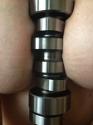
Vader, I attempted to put your question onto paper. I hope it provides insight.

By adjusting camshaft profiles, we see these results. If parasitic loss were an exponential function, or one that increased dramatically after 6000 or 7000rpm as you are suggesting, enough to see it in the VE or Torque curve, then 9,xxxrpm small block Chevrolets with properly dressed valvetrains would not be able to produce the power they do.

By adjusting camshaft profiles, we see these results. If parasitic loss were an exponential function, or one that increased dramatically after 6000 or 7000rpm as you are suggesting, enough to see it in the VE or Torque curve, then 9,xxxrpm small block Chevrolets with properly dressed valvetrains would not be able to produce the power they do.
Thread Starter
Joined: Jul 2014
Posts: 10,450
Likes: 1,873
From: My own internal universe
Vader, I attempted to put your question onto paper. I hope it provides insight. By adjusting camshaft profiles, we see these results. If parasitic loss were an exponential function, or one that increased dramatically after 6000 or 7000rpm as you are suggesting, enough to see it in the VE or Torque curve, then 9,xxxrpm small block Chevrolets with properly dressed valvetrains would not be able to produce the power they do.
What I'm expecting to find is that increasing the VE at higher RPM will have two effects - both an increase in peak power and average TQ AND a shift of the power peak to higher RPM, because the parasitic losses don't really change. So, the engine should reach its equilibrium at a higher RPM and consequently dyno with more HP as a result.
On the no load engine revving, I can see both sides. I think that under load, since the MAP is higher, it would naturally force more air into the cylinder, preventing reversion and greatly improving VE exactly as you describe. On the other hand, at 6800 rpm, I'm thinking that the overlap event is so short lived you don't get the short circuiting you do at lower rpm. So the differences become a bit more negligible.
On fueling, I think the decision to run at 15:1 at WOT should be reconsidered, but for reasons not mentioned. I don't want to derail my own thread but this is a safety concern.
Chemical reactions are all about three things - geometry, energy, and proximity. You can have a perfect ratio of 14.7:1 in the cylinder, but if it is not homogenous, all the fuel will not react with all the oxygen. And it will not be homogenous in milliseconds between injection and ignition. Based on air composition any octane molecule is 4x as likely to encounter nitrogen as it is oxygen. Oxygen is more likely to encounter nitrogen vs fuel. The most abundant chemical in the combustion chamber is nitrogen. Oxygen will react with anything - even itself. Less available fuel means more available oxygen, which increases the chance of undesirable reactions.
Oxygen will react with fuel preferentially. As temperature increases - and therefore available energy - the chances of reacting with other stuff increases. Oxygen will react with aluminum and iron before nitrogen. At high engine loads, the real risk if running lean is that you burn metal and not fuel. This is due to having excess oxygen and plenty of available energy. The added fuel enrichment makes it far more difficult for oxygen to react with anything else by increasing the odds of encountering fuel molecules and also providing more than enough fuel to consume all the oxygen, which cools the combustion chamber, eliminates knock, and reduces EGT, but most importantly protects the engine.
Sorry for the digression, but I saw it as a safety concern
LS1 Tech Stories
The Best V8 Stories One Small Block at Time

Gas Monkey Built a 6-Wheel Ferrari Testarossa With a Corvette LT4 Engine
Verdad Gallardo
7 Most Reliable High-Performance Engines GM Has Ever Built
Verdad Gallardo
Amazing '71 Camaro Restomod Is Modern Muscle Car Under the Skin
Verdad Gallardo
6 Common C5 Corvette Failures and What's Involved In Repairing Them
Pouria Savadkouei
Retro Modern Bandit Pontiac Trans AM Comes With Burt Reynolds' Autograph
Verdad Gallardo
Top 10 Greatest Cadillac V Series Performance Models Ever, Ranked
Pouria Savadkouei
Top 10 Most Powerful Chevy Trucks Ever Made!

Hennessey's New Supercharged Silverado ZR2 Has 700 HP
Verdad Gallardo
Coachbuilt N2A Anteros Is an LS2-Powered C6 Corvette In Italian Clothes
Verdad Gallardo


TECH Enthusiast
Joined: Apr 2009
Posts: 723
Likes: 4
You're pointing out exactly what I'm wrestling with and why I wanted to find a way to model it. Also the reason I wanted to go back to my stock engine as a comparison for the built engine.
What I'm expecting to find is that increasing the VE at higher RPM will have two effects - both an increase in peak power and average TQ AND a shift of the power peak to higher RPM, because the parasitic losses don't really change. So, the engine should reach its equilibrium at a higher RPM and consequently dyno with more HP as a result.
On the no load engine revving, I can see both sides. I think that under load, since the MAP is higher, it would naturally force more air into the cylinder, preventing reversion and greatly improving VE exactly as you describe. On the other hand, at 6800 rpm, I'm thinking that the overlap event is so short lived you don't get the short circuiting you do at lower rpm. So the differences become a bit more negligible.
On fueling, I think the decision to run at 15:1 at WOT should be reconsidered, but for reasons not mentioned. I don't want to derail my own thread but this is a safety concern.
Chemical reactions are all about three things - geometry, energy, and proximity. You can have a perfect ratio of 14.7:1 in the cylinder, but if it is not homogenous, all the fuel will not react with all the oxygen. And it will not be homogenous in milliseconds between injection and ignition. Based on air composition any octane molecule is 4x as likely to encounter nitrogen as it is oxygen. Oxygen is more likely to encounter nitrogen vs fuel. The most abundant chemical in the combustion chamber is nitrogen. Oxygen will react with anything - even itself. Less available fuel means more available oxygen, which increases the chance of undesirable reactions.
Oxygen will react with fuel preferentially. As temperature increases - and therefore available energy - the chances of reacting with other stuff increases. Oxygen will react with aluminum and iron before nitrogen. At high engine loads, the real risk if running lean is that you burn metal and not fuel. This is due to having excess oxygen and plenty of available energy. The added fuel enrichment makes it far more difficult for oxygen to react with anything else by increasing the odds of encountering fuel molecules and also providing more than enough fuel to consume all the oxygen, which cools the combustion chamber, eliminates knock, and reduces EGT, but most importantly protects the engine.
Sorry for the digression, but I saw it as a safety concern
What I'm expecting to find is that increasing the VE at higher RPM will have two effects - both an increase in peak power and average TQ AND a shift of the power peak to higher RPM, because the parasitic losses don't really change. So, the engine should reach its equilibrium at a higher RPM and consequently dyno with more HP as a result.
On the no load engine revving, I can see both sides. I think that under load, since the MAP is higher, it would naturally force more air into the cylinder, preventing reversion and greatly improving VE exactly as you describe. On the other hand, at 6800 rpm, I'm thinking that the overlap event is so short lived you don't get the short circuiting you do at lower rpm. So the differences become a bit more negligible.
On fueling, I think the decision to run at 15:1 at WOT should be reconsidered, but for reasons not mentioned. I don't want to derail my own thread but this is a safety concern.
Chemical reactions are all about three things - geometry, energy, and proximity. You can have a perfect ratio of 14.7:1 in the cylinder, but if it is not homogenous, all the fuel will not react with all the oxygen. And it will not be homogenous in milliseconds between injection and ignition. Based on air composition any octane molecule is 4x as likely to encounter nitrogen as it is oxygen. Oxygen is more likely to encounter nitrogen vs fuel. The most abundant chemical in the combustion chamber is nitrogen. Oxygen will react with anything - even itself. Less available fuel means more available oxygen, which increases the chance of undesirable reactions.
Oxygen will react with fuel preferentially. As temperature increases - and therefore available energy - the chances of reacting with other stuff increases. Oxygen will react with aluminum and iron before nitrogen. At high engine loads, the real risk if running lean is that you burn metal and not fuel. This is due to having excess oxygen and plenty of available energy. The added fuel enrichment makes it far more difficult for oxygen to react with anything else by increasing the odds of encountering fuel molecules and also providing more than enough fuel to consume all the oxygen, which cools the combustion chamber, eliminates knock, and reduces EGT, but most importantly protects the engine.
Sorry for the digression, but I saw it as a safety concern
In vaporous, homogenous & tight proximity combustion the bond formations occur in the right manner. What that means is the atomic masses are closer to the right "mixing" as the enthalpy increases. For example the CO2 bonds can form but If there isn't sufficient enthalpy & proximity then those bonds can not form & you end up with gas mix ratios that are not in proper ratios. This means, due to the lack of proximity, vaporization, homogenization & distribution the engine will not make the power at the rpm the energy balancing would predicate it to be.
The ethalpy model is simple to understand. On a given A/F charge you have xxx potential energy. That can translate to a set enthalpy value in a given volume. For a given enthalpy in a given volume you end up with xxxx temperature. Reduce the volume you increase the temperature & thusly the pressure. More pressure, if converted at the right rate, means more torque & the ability to gain RPM.
Last edited by gtfoxy; Nov 6, 2015 at 08:43 AM.
Thread Starter
Joined: Jul 2014
Posts: 10,450
Likes: 1,873
From: My own internal universe
Vader, I attempted to put your question onto paper. I hope it provides insight.

By adjusting camshaft profiles, we see these results. If parasitic loss were an exponential function, or one that increased dramatically after 6000 or 7000rpm as you are suggesting, enough to see it in the VE or Torque curve, then 9,xxxrpm small block Chevrolets with properly dressed valvetrains would not be able to produce the power they do.
By adjusting camshaft profiles, we see these results. If parasitic loss were an exponential function, or one that increased dramatically after 6000 or 7000rpm as you are suggesting, enough to see it in the VE or Torque curve, then 9,xxxrpm small block Chevrolets with properly dressed valvetrains would not be able to produce the power they do.
The change in rotating mass and stroke completely changes the calculated power peak. At 8,000 RPM, it still isn't calculating that it hit peak power. The calculated TQ "load" is less than half. So, I extended out the RPMs and used a linear extension of the VE, and I'm getting peak power at 9600 RPM.
So, the bottom line on the model is that reducing rotating mass delays the point at which the TQ necessary to spin the motor shoots up. Also in the model is that reducing stroke delays the take off point AND reduces its severity. So, if I were to follow the model and make a spin-monster LS1, I would shorten the stroke, use a wide bore, and put some really high flowing heads on it. Use a cam that moves the peak VE filling to a higher point, and it will calculate out a peak power that is pretty high.
Haven't had time to log the fueling yet, so I'm going to run some comparisons using my motor under various conditions:
*Stock
*Cam only upgrade
*Current config - H/C/I
I'm going to guess that the model will show with each step to increase airflow, peak power moved to the right as well as up.
TECH Enthusiast
Joined: Apr 2009
Posts: 723
Likes: 4
Something else that was bugging me was - what about some of the Honda engines that make peak power near 10K? So, for a quick and dirty test, I took a Honda 2.4L, looked up the piston mass, connecting rod mass, and bore and stroke into the equation. I left VE alone, because I have no idea where to start on the VE's for Hondas - if they even call it that.
The change in rotating mass and stroke completely changes the calculated power peak. At 8,000 RPM, it still isn't calculating that it hit peak power. The calculated TQ "load" is less than half. So, I extended out the RPMs and used a linear extension of the VE, and I'm getting peak power at 9600 RPM.
So, the bottom line on the model is that reducing rotating mass delays the point at which the TQ necessary to spin the motor shoots up. Also in the model is that reducing stroke delays the take off point AND reduces its severity. So, if I were to follow the model and make a spin-monster LS1, I would shorten the stroke, use a wide bore, and put some really high flowing heads on it. Use a cam that moves the peak VE filling to a higher point, and it will calculate out a peak power that is pretty high.
Haven't had time to log the fueling yet, so I'm going to run some comparisons using my motor under various conditions:
*Stock
*Cam only upgrade
*Current config - H/C/I
I'm going to guess that the model will show with each step to increase airflow, peak power moved to the right as well as up.
The change in rotating mass and stroke completely changes the calculated power peak. At 8,000 RPM, it still isn't calculating that it hit peak power. The calculated TQ "load" is less than half. So, I extended out the RPMs and used a linear extension of the VE, and I'm getting peak power at 9600 RPM.
So, the bottom line on the model is that reducing rotating mass delays the point at which the TQ necessary to spin the motor shoots up. Also in the model is that reducing stroke delays the take off point AND reduces its severity. So, if I were to follow the model and make a spin-monster LS1, I would shorten the stroke, use a wide bore, and put some really high flowing heads on it. Use a cam that moves the peak VE filling to a higher point, and it will calculate out a peak power that is pretty high.
Haven't had time to log the fueling yet, so I'm going to run some comparisons using my motor under various conditions:
*Stock
*Cam only upgrade
*Current config - H/C/I
I'm going to guess that the model will show with each step to increase airflow, peak power moved to the right as well as up.
I also wanted to touch on something in your prior post that deals with reversion. We know it is caused by intake valve closure. We see the pulse time decreases with RPM because the valve event time is decreased. As engine RPM increases the slowing of the airmass is not as prevalent as at lower speeds. In the range of 10,000RPM & above you start to see a dramatic difference in the time of the event.
Also keep in mind the very nature of the valved head will limit RPM capability on a given energy charge & compression ratio. Try your model with a 2-stroke of identical measurements to see the impact, providing this modeling software you are using can accommodate that calculation.
TECH Addict
Joined: Jul 2013
Posts: 2,189
Likes: 123
From: Portland, Oregon
You just described the COPO 327... Obviously GM was concerned with exactly what you just mentioned. It would have been easier for the general to just use the 4.8L and 6.275" rods, in forged construction, in the ls2 block, for 328ci with a rod ratio of 1.92, but they chose to design a new, shorter 3.15" stroke and used a 6.35" rod for a 2.0+ rod ratio. Using the 4.065" bore also allowed the use of custom ls7 heads. I think this is a perfect example of what you are talking about, and it's a badass LSx motor, not a hon-duh.
[QUOTE=Darth_V8r;19029009]
Thats like saying overlap is NON ADJUSTABLE. Overlap is quite adjustable, that is exactly why we love to measure and talk about it, and we can use any profile to give the desired characteristic, which I will sum up briefly,
For high exhaust gas pressure application, overlap shall be shorter in theory, to prevent reversion of exhaust gas due to high pressure exhaust gas.
For low exhaust gas pressure application, overlap shall be longer to permit cleansing of the cylinder at the expense of economy, fuel, and air.
And yet some turbo applications have large exhaust gas manifold pressures that still use long duration overlaps, so this is a general rule with exceptions like the rest.

We are not born with eyes capable of witness to the marvel of design at the angstrom or nano level. Might be right, no way to know, the thought needs to go higher if you want progress. Maybe start with: Chemical reactions
http://chemwiki.ucdavis.edu/Physical.../Reaction_Rate
http://chemwiki.ucdavis.edu/Physical...s/The_Rate_Law
The only way I know of right now to quantitate without quantitating is to use someone elses quantification. Reactions behave in predictable models. But we can go higher than that probably, how about, will what I learn change the way I tune combustion engines. Consider we can certainly change spark and fuel for any reason in either direction. If we have a number in front of us that seems reasonable, and it seems to be working, we might think all is well and the engine tolerates it and life goes on. It was not optimal but it worked to some extent. How close is optimal? 1* btdc off? 0.01* btdc off? the scale, or magnitude of the question is important, without knowing what resolution characteristics are necessary (how fine of an adjustment I can measure) my gathered data could be misinterpreted. In this case, the non-optimal timing number is appreciated for two reasons.
1. the factory undoubtedly tested the engine in a wide range of situations and different timing options, to ensure a lasting characteristic would be imparted as much as possible in the design and tune.
2. The resolution the system is capable of handling, for example how exactly on 24.00000001* btdc every plug fires at 7,400rpm. Do you really think you are hitting 24.00000001*? I Seriously doubt that, and this thought naturally leads us to the realization that even if the number in the ECU is perfect, or completely wrong, the actual real-world value is just as likely to be incorrect or perfect (our ecu says "24" and we got "23.92475" actual. Didn't everything still work out just fine?), eventually as the system is measured to some magnitude of resolution scale, so it is a question of how much resolution do we need, and can we notice if we are not getting enough, or if we can lose some and still be fine.
In this case, we know ECU are capable of managing close enough to the number we install in the timing map ourselves. The reaction of combustion in modern engines seems to tolerate a wide range of situations, Doesn't that sound better if I say that the engines tolerate a wide range of combustion situations? So again, back to the non-optimal number and our perception about what "worked" even when it did not work so well, without getting knowledge about what really happened (if the engine could tell us directly that the number was not optimal, then it could also adjust for itself. thats a whole other issue we are not getting into) we have no way to correct ourselves and make adjustments, whereas a dynometer does give us that opportunity along with EGT data and other sources we are more likely to make connections that affect our memories using commonly available engine testing equipment (standards) to measure and adjust our engines, rather than seeking answers through analytical chemistry. Although both cases could change your mind as to what numbers are safe.
For example Imagine today I give you a speech about how dangerous M80's are. If you saw one the same day, you might avoid it more strongly than if three years goes by, and some of the fear evoked memory had dissipated. If one of your engines blew 3 years ago because the pump failed, you would be more likely to watchout for that situation. So your decision due to memory (experience) is driving reactions of skeletal muscle (movement). The same way your input to a timing map (movement) is due to memory (combined of all memory, experience, chemistry math, molecular behavior in solutions/reactions, intuition, conscious perspective). If the motor came apart and you saw marks on the head and piston that looked like detonation, would you suspect the WOT numbers or the octane? All the while it was really oil getting past the old pcv valve, which you didn't see on the piston because your water injection kept everything clean.
will what I learn change the way I build combustion engines
perhaps this would lead to a novel design, or modifications, and then testing, data, and finally a measured result. This process requires funds, equipment, time, it is expensive and if done right would certainly yield information that improves our engines. This perspective is, each human is in a race to design the best engines for their needs/situation, and it takes money/effort to build and test engines with theorys. In another case, the person asking this question has no equipment, no time, is simply curious and cannot perform the tests themselves. So now we must use others quantifications (or is it quantitations? or quantitati...) instead, use existing designs (they are more likely to use OEM parts/designs and specifications). They with the most testing experience memory, those facilities with the equipment and economy to measure at high resolution and make adjustments from measured results. Isn't That R&D?
.... I treat combustion engines
Maybe you see something in the paper that says an additive improves engine life. You add it to your engine, did you treat it better or worse? Since you cannot duplicate the engine exactly and run it both ways, you have no way to know if you did the motor a disservice. The theme is "keep it simple" for preventing unmeasurable points of entry for failure. The less you do, the less likely something can go wrong. The fewer things that change, the more likely we are going to still have the same thing. The resolution adjustment applicable for us here is in the microns, consider paper filters that protect engines and oil filters. We can treat an engine poorly if we remove the factory paper filter for something worse, even if the engine can flow more through it. Recognize when the changes we are making are treating the engine poorly. Analytical chemistry might scare you into using higher octane fuels and larger fans, will you also have a memory that just because a fan is larger does not mean it will work better or flow more air, and that higher octane fuels are more expensive for a reason related to their desirability.
and I think we can all use this to productive thought
http://cdn4.explainthatstuff.com/ele...ine-torque.png
On the no load engine revving, I can see both sides. I think that under load, since the MAP is higher, it would naturally force more air into the cylinder, preventing reversion and greatly improving VE exactly as you describe. On the other hand, at 6800 rpm, I'm thinking that the overlap event is so short lived you don't get the short circuiting you do at lower rpm. So the differences become a bit more negligible.
For high exhaust gas pressure application, overlap shall be shorter in theory, to prevent reversion of exhaust gas due to high pressure exhaust gas.
For low exhaust gas pressure application, overlap shall be longer to permit cleansing of the cylinder at the expense of economy, fuel, and air.
And yet some turbo applications have large exhaust gas manifold pressures that still use long duration overlaps, so this is a general rule with exceptions like the rest.
On fueling, I think the decision to run at 15:1 at WOT should be reconsidered, but for reasons not mentioned. I don't want to derail my own thread but this is a safety concern.
Chemical reactions are all about three things - geometry, energy, and proximity. You can have a perfect ratio of 14.7:1 in the cylinder, but if it is not homogenous, all the fuel will not react with all the oxygen. And it will not be homogenous in milliseconds between injection and ignition. Based on air composition any octane molecule is 4x as likely to encounter nitrogen as it is oxygen. Oxygen is more likely to encounter nitrogen vs fuel. The most abundant chemical in the combustion chamber is nitrogen. Oxygen will react with anything - even itself. Less available fuel means more available oxygen, which increases the chance of undesirable reactions.
Oxygen will react with fuel preferentially. As temperature increases - and therefore available energy - the chances of reacting with other stuff increases. Oxygen will react with aluminum and iron before nitrogen. At high engine loads, the real risk if running lean is that you burn metal and not fuel. This is due to having excess oxygen and plenty of available energy. The added fuel enrichment makes it far more difficult for oxygen to react with anything else by increasing the odds of encountering fuel molecules and also providing more than enough fuel to consume all the oxygen, which cools the combustion chamber, eliminates knock, and reduces EGT, but most importantly protects the engine.
Oxygen will react with fuel preferentially. As temperature increases - and therefore available energy - the chances of reacting with other stuff increases. Oxygen will react with aluminum and iron before nitrogen. At high engine loads, the real risk if running lean is that you burn metal and not fuel. This is due to having excess oxygen and plenty of available energy. The added fuel enrichment makes it far more difficult for oxygen to react with anything else by increasing the odds of encountering fuel molecules and also providing more than enough fuel to consume all the oxygen, which cools the combustion chamber, eliminates knock, and reduces EGT, but most importantly protects the engine.
We are not born with eyes capable of witness to the marvel of design at the angstrom or nano level. Might be right, no way to know, the thought needs to go higher if you want progress. Maybe start with: Chemical reactions
http://chemwiki.ucdavis.edu/Physical.../Reaction_Rate
http://chemwiki.ucdavis.edu/Physical...s/The_Rate_Law
The only way I know of right now to quantitate without quantitating is to use someone elses quantification. Reactions behave in predictable models. But we can go higher than that probably, how about, will what I learn change the way I tune combustion engines. Consider we can certainly change spark and fuel for any reason in either direction. If we have a number in front of us that seems reasonable, and it seems to be working, we might think all is well and the engine tolerates it and life goes on. It was not optimal but it worked to some extent. How close is optimal? 1* btdc off? 0.01* btdc off? the scale, or magnitude of the question is important, without knowing what resolution characteristics are necessary (how fine of an adjustment I can measure) my gathered data could be misinterpreted. In this case, the non-optimal timing number is appreciated for two reasons.
1. the factory undoubtedly tested the engine in a wide range of situations and different timing options, to ensure a lasting characteristic would be imparted as much as possible in the design and tune.
2. The resolution the system is capable of handling, for example how exactly on 24.00000001* btdc every plug fires at 7,400rpm. Do you really think you are hitting 24.00000001*? I Seriously doubt that, and this thought naturally leads us to the realization that even if the number in the ECU is perfect, or completely wrong, the actual real-world value is just as likely to be incorrect or perfect (our ecu says "24" and we got "23.92475" actual. Didn't everything still work out just fine?), eventually as the system is measured to some magnitude of resolution scale, so it is a question of how much resolution do we need, and can we notice if we are not getting enough, or if we can lose some and still be fine.
In this case, we know ECU are capable of managing close enough to the number we install in the timing map ourselves. The reaction of combustion in modern engines seems to tolerate a wide range of situations, Doesn't that sound better if I say that the engines tolerate a wide range of combustion situations? So again, back to the non-optimal number and our perception about what "worked" even when it did not work so well, without getting knowledge about what really happened (if the engine could tell us directly that the number was not optimal, then it could also adjust for itself. thats a whole other issue we are not getting into) we have no way to correct ourselves and make adjustments, whereas a dynometer does give us that opportunity along with EGT data and other sources we are more likely to make connections that affect our memories using commonly available engine testing equipment (standards) to measure and adjust our engines, rather than seeking answers through analytical chemistry. Although both cases could change your mind as to what numbers are safe.
For example Imagine today I give you a speech about how dangerous M80's are. If you saw one the same day, you might avoid it more strongly than if three years goes by, and some of the fear evoked memory had dissipated. If one of your engines blew 3 years ago because the pump failed, you would be more likely to watchout for that situation. So your decision due to memory (experience) is driving reactions of skeletal muscle (movement). The same way your input to a timing map (movement) is due to memory (combined of all memory, experience, chemistry math, molecular behavior in solutions/reactions, intuition, conscious perspective). If the motor came apart and you saw marks on the head and piston that looked like detonation, would you suspect the WOT numbers or the octane? All the while it was really oil getting past the old pcv valve, which you didn't see on the piston because your water injection kept everything clean.
will what I learn change the way I build combustion engines
perhaps this would lead to a novel design, or modifications, and then testing, data, and finally a measured result. This process requires funds, equipment, time, it is expensive and if done right would certainly yield information that improves our engines. This perspective is, each human is in a race to design the best engines for their needs/situation, and it takes money/effort to build and test engines with theorys. In another case, the person asking this question has no equipment, no time, is simply curious and cannot perform the tests themselves. So now we must use others quantifications (or is it quantitations? or quantitati...) instead, use existing designs (they are more likely to use OEM parts/designs and specifications). They with the most testing experience memory, those facilities with the equipment and economy to measure at high resolution and make adjustments from measured results. Isn't That R&D?
.... I treat combustion engines
Maybe you see something in the paper that says an additive improves engine life. You add it to your engine, did you treat it better or worse? Since you cannot duplicate the engine exactly and run it both ways, you have no way to know if you did the motor a disservice. The theme is "keep it simple" for preventing unmeasurable points of entry for failure. The less you do, the less likely something can go wrong. The fewer things that change, the more likely we are going to still have the same thing. The resolution adjustment applicable for us here is in the microns, consider paper filters that protect engines and oil filters. We can treat an engine poorly if we remove the factory paper filter for something worse, even if the engine can flow more through it. Recognize when the changes we are making are treating the engine poorly. Analytical chemistry might scare you into using higher octane fuels and larger fans, will you also have a memory that just because a fan is larger does not mean it will work better or flow more air, and that higher octane fuels are more expensive for a reason related to their desirability.
and I think we can all use this to productive thought
http://cdn4.explainthatstuff.com/ele...ine-torque.png
Last edited by kingtal0n; Nov 6, 2015 at 11:01 AM.
Thread Starter
Joined: Jul 2014
Posts: 10,450
Likes: 1,873
From: My own internal universe
Problem with a oversize bore & short stroke is attaining enough compression to gain the nessecary proximity. A square bore/stroke offers a better balance.
I also wanted to touch on something in your prior post that deals with reversion. We know it is caused by intake valve closure. We see the pulse time decreases with RPM because the valve event time is decreased. As engine RPM increases the slowing of the airmass is not as prevalent as at lower speeds. In the range of 10,000RPM & above you start to see a dramatic difference in the time of the event.
Also keep in mind the very nature of the valved head will limit RPM capability on a given energy charge & compression ratio. Try your model with a 2-stroke of identical measurements to see the impact, providing this modeling software you are using can accommodate that calculation.
I also wanted to touch on something in your prior post that deals with reversion. We know it is caused by intake valve closure. We see the pulse time decreases with RPM because the valve event time is decreased. As engine RPM increases the slowing of the airmass is not as prevalent as at lower speeds. In the range of 10,000RPM & above you start to see a dramatic difference in the time of the event.
Also keep in mind the very nature of the valved head will limit RPM capability on a given energy charge & compression ratio. Try your model with a 2-stroke of identical measurements to see the impact, providing this modeling software you are using can accommodate that calculation.
Simple intuition would tell me that the pumping losses would be more severe, accelerative losses would be identical, but having double the firing events would calculate out to a high revving **** that sounds like a really badass chainsaw. Having the oil mixed in with the gas would slow combustion down, so energy extraction would be reduced. But I wouldn't know where to begin on the maths, VE's, airflows, etc. At least with the LS1, I have data logs I can verify against, without which I don't think the model could even be started.
At higher and higher RPM - and I know this figures in as loss of VE - it gets harder and harder to "start" and "stop" the air. Air has momentum (as it has mass) so it doesn't stop or start on a dime. As the valves are moving faster and faster, the time to fill the cylinder is reduced, but also that initial delay to get the air moving to fill the cylinder. This is where higher overlap comes in, because the intake manifold pressure > cylinder Pressure > exhaust manifold pressure, so you can use that increased dP to "jump start" the air flow, but as RPM climbs, you will need more overlap to gain an earlier jump start.
There comes a point at which it makes more sense to just go jet engine so that the air has continuous momentum
Thread Starter
Joined: Jul 2014
Posts: 10,450
Likes: 1,873
From: My own internal universe
Thats like saying overlap is NON ADJUSTABLE. Overlap is quite adjustable, that is exactly why we love to measure and talk about it, and we can use any profile to give the desired characteristic, which I will sum up briefly,
For high exhaust gas pressure application, overlap shall be shorter in theory, to prevent reversion of exhaust gas due to high pressure exhaust gas.
For low exhaust gas pressure application, overlap shall be longer to permit cleansing of the cylinder at the expense of economy, fuel, and air.
And yet some turbo applications have large exhaust gas manifold pressures that still use long duration overlaps, so this is a general rule with exceptions like the rest.
For high exhaust gas pressure application, overlap shall be shorter in theory, to prevent reversion of exhaust gas due to high pressure exhaust gas.
For low exhaust gas pressure application, overlap shall be longer to permit cleansing of the cylinder at the expense of economy, fuel, and air.
And yet some turbo applications have large exhaust gas manifold pressures that still use long duration overlaps, so this is a general rule with exceptions like the rest.
I understand the general reasonings behind choosing cams for NA vs Turbo, but I would imagine a turbo application that is spinning in the 8500 rpm range, you would need the overlap to be quite large. But again, in this scenario, at 8500 rpm, the overlap duration in milliseconds is quite small vs the duration at idle.

(rest of the post)
The combustion environment I deal with is 3,000*F ambient with the heat source operating at 10,000*F. We also inject oxygen into the liquid steel at supersonic speeds, and we also inject carbon, natural gas, etc. It's quite a lot to deal with. our exhaust temps are around 2200 *F, and we measure primary and secondary combustion of carbon and nitrogen. And I'm the guy who has to set all this up to work in the automation with a bunch of non-matching units of volume, mass, and time.
The thing you have to manage more that anything else in this type of environment is oxygen. At high temperatures, oxygen is going to react with anything it can find. This is completely independent of spark timing or what the ignition source is or anything else. It's just simply - a lot of available oxygen and a lot of available energy. unless you are in a closed environment that has both the oxidant and reactant self contained - like solid rocket fuel - when you are talking chemical energy, you are talking oxygen.
If the temperature is high enough, oxygen will react rapidly with (burn as opposed to corrode) anything that is readily available. In the case of Nitrogen, this is around 1350*F. In the case of iron, this is closer to 2,000*F. However, oxygen still prefers Carbon to most common metals, if it is available and accessible. The energy required to get metals to burn is higher than carbon, but once they do burn, they release a tremendous amount of energy. We use carbon to keep the furnace cool by making sure the oxygen doesn't only react with iron. Without carbon, the furnace could not contain the temperatures. At these temperatures, carbon will actually steel oxygen from metal oxides, converting the oxides back to metal, and releasing CO to the atmosphere / exhaust. The net effect of this reaction is endothermic - meaning that it took more energy to reverse the metal oxide reaction than to burn the carbon.
All that was to try to illustrate a concept. Here is a more practical example - an acetylene torch. You have fuel and oxygen that you use to cut steel. but, the fuel does not cut the steel. The fuel and oxygen heat the steel to the point at which iron will start to burn. Then, you pull a trigger and start dumping oxygen with no added fuel. What happens? The temperature dramatically increases and the oxygen (NOT the fuel) cuts the steel by literally burning through it, using iron as the fuel to propagate the heat. The point is that the fuel is not the source of the chemical energy, it's the oxygen. The other point is that oxygen will react with anything, but it has its preferences due to lower energy of activation.
If carbon is readily available and hydrogen is readily available (guess what fuel is made of), the metals are protected. But if it is hot enough, and there is more oxygen than fuel available, the oxygen will find something to react with, which means engine parts. And before you go thinking aluminum is different from iron - you're right. Aluminum reacts MUCH faster than iron with oxygen. I use aluminum to steal the oxygen out of lime so that the calcium can react with sulfur. The only reason aluminum doesn't corrode is the oxides form a protective layer on the outside of the metal - same reason stainless doesn't corrode. But all bets are off when it's 2,000*F and there is a surplus of oxygen.
Regardless of horsepower, perfect timing, etc, at WOT, having excess fuel is FAR safer than having excess oxygen.
Whew! I need a beer.
TECH Addict
Joined: Jul 2013
Posts: 2,189
Likes: 123
From: Portland, Oregon
I see here, as with many discussions, we have failed to establish a common tongue.
I believe it was Voltaire who said, "define your terms".
We should just use the OP's 346 for this discussion. That way we have set datum(s) to measure off of. Whatever his compression ratio is, should be the compression ratio of this discussion. Cam/valve events, intake, exhaust, everything that the OP has should be the definition and focal point of all theory discussed here.
That should simplify this a bit and keep us on the same page.
Also, we aren't rocket surgeons, so let's deal in terms of precision that make sense for our application. While an intimate understanding, to the N-th degree, is surely desirable, it's not practical or even feasible for us without a lot of high tech (think: expensive) specialty equipment. Like mentioned about the precision of the spark ignition, if things are off but it doesn't matter, then it doesn't matter. If you get a cam that is off by one degree, will you notice? Probably not. If your afr is off by 0.1, are you going to notice? Probably not. Is there a difference between .05 squish and .03 quench? Probably. Does it matter to us? Nope.
None of us are pushing the envelope to an extreme enough case for that level of precision to be necessary.
Let's worry about just getting a working model that's close enough to, well, work. We can worry about getting the model more precise later by factoring in more variables as we gain a better understanding of the process. But we need a working model first.
I believe it was Voltaire who said, "define your terms".
We should just use the OP's 346 for this discussion. That way we have set datum(s) to measure off of. Whatever his compression ratio is, should be the compression ratio of this discussion. Cam/valve events, intake, exhaust, everything that the OP has should be the definition and focal point of all theory discussed here.
That should simplify this a bit and keep us on the same page.
Also, we aren't rocket surgeons, so let's deal in terms of precision that make sense for our application. While an intimate understanding, to the N-th degree, is surely desirable, it's not practical or even feasible for us without a lot of high tech (think: expensive) specialty equipment. Like mentioned about the precision of the spark ignition, if things are off but it doesn't matter, then it doesn't matter. If you get a cam that is off by one degree, will you notice? Probably not. If your afr is off by 0.1, are you going to notice? Probably not. Is there a difference between .05 squish and .03 quench? Probably. Does it matter to us? Nope.
None of us are pushing the envelope to an extreme enough case for that level of precision to be necessary.
Let's worry about just getting a working model that's close enough to, well, work. We can worry about getting the model more precise later by factoring in more variables as we gain a better understanding of the process. But we need a working model first.
Thread Starter
Joined: Jul 2014
Posts: 10,450
Likes: 1,873
From: My own internal universe
I see here, as with many discussions, we have failed to establish a common tongue.
I believe it was Voltaire who said, "define your terms".
We should just use the OP's 346 for this discussion. That way we have set datum(s) to measure off of. Whatever his compression ratio is, should be the compression ratio of this discussion. Cam/valve events, intake, exhaust, everything that the OP has should be the definition and focal point of all theory discussed here.
That should simplify this a bit and keep us on the same page.
Also, we aren't rocket surgeons, so let's deal in terms of precision that make sense for our application. While an intimate understanding, to the N-th degree, is surely desirable, it's not practical or even feasible for us without a lot of high tech (think: expensive) specialty equipment. Like mentioned about the precision of the spark ignition, if things are off but it doesn't matter, then it doesn't matter. If you get a cam that is off by one degree, will you notice? Probably not. If your afr is off by 0.1, are you going to notice? Probably not. Is there a difference between .05 squish and .03 quench? Probably. Does it matter to us? Nope.
None of us are pushing the envelope to an extreme enough case for that level of precision to be necessary.
Let's worry about just getting a working model that's close enough to, well, work. We can worry about getting the model more precise later by factoring in more variables as we gain a better understanding of the process. But we need a working model first.
I believe it was Voltaire who said, "define your terms".
We should just use the OP's 346 for this discussion. That way we have set datum(s) to measure off of. Whatever his compression ratio is, should be the compression ratio of this discussion. Cam/valve events, intake, exhaust, everything that the OP has should be the definition and focal point of all theory discussed here.
That should simplify this a bit and keep us on the same page.
Also, we aren't rocket surgeons, so let's deal in terms of precision that make sense for our application. While an intimate understanding, to the N-th degree, is surely desirable, it's not practical or even feasible for us without a lot of high tech (think: expensive) specialty equipment. Like mentioned about the precision of the spark ignition, if things are off but it doesn't matter, then it doesn't matter. If you get a cam that is off by one degree, will you notice? Probably not. If your afr is off by 0.1, are you going to notice? Probably not. Is there a difference between .05 squish and .03 quench? Probably. Does it matter to us? Nope.
None of us are pushing the envelope to an extreme enough case for that level of precision to be necessary.
Let's worry about just getting a working model that's close enough to, well, work. We can worry about getting the model more precise later by factoring in more variables as we gain a better understanding of the process. But we need a working model first.
I have gone back through and made things a bit more generic. Added fields for:
CID
Bore (in)
Stroke (in)
SCR
DCR
EV diameter (in)
IV diameter (in)
NumCylinders
Expansion ratio (basically a DCR in reverse using the EVO event)
Piston weight (g)
Rod weight (g)
MassP&R (lbs)
In part, this has to do with the ability to make subtle changes later on and test the model against known configurations.

TECH Enthusiast
Joined: Apr 2009
Posts: 723
Likes: 4
I see here, as with many discussions, we have failed to establish a common tongue.
I believe it was Voltaire who said, "define your terms".
We should just use the OP's 346 for this discussion. That way we have set datum(s) to measure off of. Whatever his compression ratio is, should be the compression ratio of this discussion. Cam/valve events, intake, exhaust, everything that the OP has should be the definition and focal point of all theory discussed here.
That should simplify this a bit and keep us on the same page.
Also, we aren't rocket surgeons, so let's deal in terms of precision that make sense for our application. While an intimate understanding, to the N-th degree, is surely desirable, it's not practical or even feasible for us without a lot of high tech (think: expensive) specialty equipment. Like mentioned about the precision of the spark ignition, if things are off but it doesn't matter, then it doesn't matter. If you get a cam that is off by one degree, will you notice? Probably not. If your afr is off by 0.1, are you going to notice? Probably not. Is there a difference between .05 squish and .03 quench? Probably. Does it matter to us? Nope.
None of us are pushing the envelope to an extreme enough case for that level of precision to be necessary.
Let's worry about just getting a working model that's close enough to, well, work. We can worry about getting the model more precise later by factoring in more variables as we gain a better understanding of the process. But we need a working model first.
I believe it was Voltaire who said, "define your terms".
We should just use the OP's 346 for this discussion. That way we have set datum(s) to measure off of. Whatever his compression ratio is, should be the compression ratio of this discussion. Cam/valve events, intake, exhaust, everything that the OP has should be the definition and focal point of all theory discussed here.
That should simplify this a bit and keep us on the same page.
Also, we aren't rocket surgeons, so let's deal in terms of precision that make sense for our application. While an intimate understanding, to the N-th degree, is surely desirable, it's not practical or even feasible for us without a lot of high tech (think: expensive) specialty equipment. Like mentioned about the precision of the spark ignition, if things are off but it doesn't matter, then it doesn't matter. If you get a cam that is off by one degree, will you notice? Probably not. If your afr is off by 0.1, are you going to notice? Probably not. Is there a difference between .05 squish and .03 quench? Probably. Does it matter to us? Nope.
None of us are pushing the envelope to an extreme enough case for that level of precision to be necessary.
Let's worry about just getting a working model that's close enough to, well, work. We can worry about getting the model more precise later by factoring in more variables as we gain a better understanding of the process. But we need a working model first.
However, understand ,a program is going to be only as effective as the measure of error. Greater the error in extrapolation of known data will cause an inherent error value in the model. You ideally want a model based off an absolute of a adiabatic function.A Engine, & just about every othe ICE, or energy conversion in the real world, is going to be non-adiabatic. Knowing this will then give a scalar variance within a given range of BSFC.
That is where you need to start the calculations. Use the outer limits of the non-adiabatic system for the intended fuel. Then calculate a given compression gradient which results in a relative energy capability. Then once you have established a theoretical enthalpy value you can begin to analyze the engines dynamics as it pertains to a given model.This is getting into 3rd order calculations.
Last edited by gtfoxy; Nov 6, 2015 at 02:03 PM.