



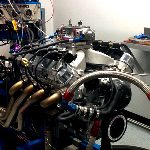


HP vs TQ Theory

You are missing the big picture. You are trying to account for 5 or 10 horsepower at the end of a dynamic range system with multiple variables.
You need several thousands of dollars of novel equipment and testing just to state a theory for where the air went. Without any actual proof that your missing 12.73cfm didn't go up in heat at the end of a run or lost due to overlap, or that it was affected by the octane or spark timing or even the quality of a spark- you are just punching rocks. In the above example, lets play pretend and say that mass flow increased while power decreased and we verified that this was truly observed and recorded. I can still give you one hundred other reasons why this can happen, everything from spark efficiency to air fuel ratio can account for a couple horses, especially on the big end of a run under such circustances. You would then need to adjust these variables and re-run the engine several (hundreds) of times in different scenarios to prove (provide substantial data to back your theory) that there was no way to make the power "re-appear" by adjusting your inputs and software.
Think of this another way. Lets take combustion out of the picture all together- spin the engine by hand (or with a machine) and simply measure the amount of force it takes to spin at xxxxrpm. Then you can run the engine and subtract the difference- walaa in three seconds I have calculated my work required to counter friction forces within the engine. Doing it the way you are trying to, going through fuel and air calculations, is not going to give you anything measurable since the energy splashes all over the system in un-accountable ways.
Consider this. At the start of the run, I guarantee you the piston surface, piston wall, valve, intake runners, etc... was all a lot cooler than it is near the end of the run. This heat is constantly being transferred to the air and coolant nearby. This will undoubtedly have an effect on air density as the temperature of those components is increasing. It will also affect the vaporization of the fuel and change the swirl characteristics of incoming air and a whole slew of other variables.
You need several thousands of dollars of novel equipment and testing just to state a theory for where the air went. Without any actual proof that your missing 12.73cfm didn't go up in heat at the end of a run or lost due to overlap, or that it was affected by the octane or spark timing or even the quality of a spark- you are just punching rocks. In the above example, lets play pretend and say that mass flow increased while power decreased and we verified that this was truly observed and recorded. I can still give you one hundred other reasons why this can happen, everything from spark efficiency to air fuel ratio can account for a couple horses, especially on the big end of a run under such circustances. You would then need to adjust these variables and re-run the engine several (hundreds) of times in different scenarios to prove (provide substantial data to back your theory) that there was no way to make the power "re-appear" by adjusting your inputs and software.
Think of this another way. Lets take combustion out of the picture all together- spin the engine by hand (or with a machine) and simply measure the amount of force it takes to spin at xxxxrpm. Then you can run the engine and subtract the difference- walaa in three seconds I have calculated my work required to counter friction forces within the engine. Doing it the way you are trying to, going through fuel and air calculations, is not going to give you anything measurable since the energy splashes all over the system in un-accountable ways.
Consider this. At the start of the run, I guarantee you the piston surface, piston wall, valve, intake runners, etc... was all a lot cooler than it is near the end of the run. This heat is constantly being transferred to the air and coolant nearby. This will undoubtedly have an effect on air density as the temperature of those components is increasing. It will also affect the vaporization of the fuel and change the swirl characteristics of incoming air and a whole slew of other variables.
Last edited by kingtal0n; Oct 30, 2015 at 02:53 PM.
Thread Starter
Joined: Jul 2014
Posts: 10,450
Likes: 1,873
From: My own internal universe
Think of this another way. Lets take combustion out of the picture all together- spin the engine by hand (or with a machine) and simply measure the amount of force it takes to spin at xxxxrpm. Then you can run the engine and subtract the difference- walaa in three seconds I have calculated my work required to counter friction forces within the engine. Doing it the way you are trying to, going through fuel and air calculations, is not going to give you anything measurable since the energy splashes all over the system in un-accountable ways.
I can still give you one hundred other reasons why this can happen, everything from spark efficiency to air fuel ratio can account for a couple horses, especially on the big end of a run under such circustances. You would then need to adjust these variables and re-run the engine several (hundreds) of times in different scenarios to prove (provide substantial data to back your theory) that there was no way to make the power "re-appear" by adjusting your inputs and software.
So, assuming constant AFR, is airmass or spark timing more relevant to power output? Or do none of them matter compared to 3300g's of internal resistance? That's the answer I'm chasing that overriding variable or two that cannot be overcome to make more power at higher RPM
Consider this. At the start of the run, I guarantee you the piston surface, piston wall, valve, intake runners, etc... was all a lot cooler than it is near the end of the run. This heat is constantly being transferred to the air and coolant nearby. This will undoubtedly have an effect on air density as the temperature of those components is increasing. It will also affect the vaporization of the fuel and change the swirl characteristics of incoming air and a whole slew of other variables.
Thread Starter
Joined: Jul 2014
Posts: 10,450
Likes: 1,873
From: My own internal universe
Like I said in my first response to this discussion, we could really use an equation for cylinder pressure that uses octane rating, compression ratio, air fuel ratio, and cylinder volume as inputs.
I don't know if the btu vs octane rating relationship is linear, but it should be capable of being calculated.
Air fuel ratio and cylinder volume are really only used to find the mass of fuel available for combustion.
A spreadsheet in which you can link each cell to the formula, so you can play with different values for each input would be awesome.
Figuring out the correct formula is why I was so adamant about finding the source of those multipliers that you originally didn't have an explanation for.
I am trying to follow along with this discussion, making the interactive spreadsheet in Excel as we go. But it's my first time seeing or playing with a lot of these formulas, so I need things broken down into layman's terms. It's been a fun process so far, and this discussion has been quite eye opening and helpful.
I don't know if the btu vs octane rating relationship is linear, but it should be capable of being calculated.
Air fuel ratio and cylinder volume are really only used to find the mass of fuel available for combustion.
A spreadsheet in which you can link each cell to the formula, so you can play with different values for each input would be awesome.
Figuring out the correct formula is why I was so adamant about finding the source of those multipliers that you originally didn't have an explanation for.
I am trying to follow along with this discussion, making the interactive spreadsheet in Excel as we go. But it's my first time seeing or playing with a lot of these formulas, so I need things broken down into layman's terms. It's been a fun process so far, and this discussion has been quite eye opening and helpful.
I need to find the chemical energies of various octane rated gases. I know from O-chem that higher octane ratings mean the molecule is more stable and less prone to spontaneous combustion, but I don't remember if it changes the free energy of combustion. It might actually decrease it slightly.

TECH Addict
Joined: Jul 2013
Posts: 2,189
Likes: 123
From: Portland, Oregon
We don't have thousands of dollars worth of equipment. Hell, I don't even own an LS engine.
But we do have MS Excel, and at least the desire to try figure this out.
It's purely academic, mental masturbation at its finest. We aren't going to prove or disprove anything, but we may gain a better understanding of how this **** works in the process.
For the sake of this discussion, we have agreed that peak torque and peak volumetric efficiency coincide. Whether it's correct, who knows, at least we will be wrong together.
What we are looking for, is what happens, what changes, when the power peaks.
VE is the overall efficiency of the engine as an air pump. The pump's ability to move air can be measured and recorded. Whatever heads/valves/intake/architecture that combination has, achieves a maximum efficiency at a certain rpm. And it has been witnessed by more than just the people here that this specific point of maximum pumping efficiency happens to coincide with where that engine's torque peaks. After it reaches peak efficiency and starts to drop off on the other side, amazingly so does torque production. A correlation.
We want to know what correlates with the location of peak horsepower. What (MEASURABLE characteristic) peaks and falls in relation to the peak and fall of horsepower?
Because heat transfer to the cooling system, and heat generated by friction, and spark quality/timing are all present before and after peak power. If anything, those "variables" are almost the only constants in the equation.
But we do have MS Excel, and at least the desire to try figure this out.
It's purely academic, mental masturbation at its finest. We aren't going to prove or disprove anything, but we may gain a better understanding of how this **** works in the process.
For the sake of this discussion, we have agreed that peak torque and peak volumetric efficiency coincide. Whether it's correct, who knows, at least we will be wrong together.
What we are looking for, is what happens, what changes, when the power peaks.
VE is the overall efficiency of the engine as an air pump. The pump's ability to move air can be measured and recorded. Whatever heads/valves/intake/architecture that combination has, achieves a maximum efficiency at a certain rpm. And it has been witnessed by more than just the people here that this specific point of maximum pumping efficiency happens to coincide with where that engine's torque peaks. After it reaches peak efficiency and starts to drop off on the other side, amazingly so does torque production. A correlation.
We want to know what correlates with the location of peak horsepower. What (MEASURABLE characteristic) peaks and falls in relation to the peak and fall of horsepower?
Because heat transfer to the cooling system, and heat generated by friction, and spark quality/timing are all present before and after peak power. If anything, those "variables" are almost the only constants in the equation.
Last edited by DavidBoren; Oct 30, 2015 at 03:58 PM.
We don't have thousands of dollars worth of equipment. Hell, I don't even own an LS engine.
But we do have MS Excel, and at least the desire to try figure this out.
It's purely academic, mental masturbation at its finest. We aren't going to prove or disprove anything, but we may gain a better understanding of how this **** works in the process.
But we do have MS Excel, and at least the desire to try figure this out.
It's purely academic, mental masturbation at its finest. We aren't going to prove or disprove anything, but we may gain a better understanding of how this **** works in the process.
I'm doing the same thing, but I have some variables static. I used a fixed cylinder volume for a 346 CID LS1, so I would need to re-tool to allow for changing from 5.7L to 6.2L.
I need to find the chemical energies of various octane rated gases. I know from O-chem that higher octane ratings mean the molecule is more stable and less prone to spontaneous combustion, but I don't remember if it changes the free energy of combustion. It might actually decrease it slightly.
I need to find the chemical energies of various octane rated gases. I know from O-chem that higher octane ratings mean the molecule is more stable and less prone to spontaneous combustion, but I don't remember if it changes the free energy of combustion. It might actually decrease it slightly.
---Let us also consider easy to visualize real world examples of octane vs torque output, consider the following:
As we adjust compression ratio up, energy per combustion event (torque) output achievable with natural aspiration increases while octane limitations for forced induction (and power output with boost pressure possible decreases) decrease, if we hold temperature and octane constant. For example, with 9:1 you might support 600bhp with 18psi, whereas with 10:1 you are limited to 540bhp using the same octane rating, even though the engine is more efficient at absorbing power from combustion. Keep the example going, at 11:1 now you might be limited to 420bhp using the same octane (barely 1-3psi of boost before it knocks) and at 12:1 you could not even get away with atmospheric pressure using the same octane. All the while we understand that compression ratio increases would be advantageous while using appropriate octane and give us the most energy extraction per combustion event, our limitation in these cases is derived from the fuel we are restricted to, not the engine's compression ratio (it isn't the 13:1 engine's fault that it cannot use 93 octane fuel, we can't say that "this engine was not build properly" we can only say that "our application calls for a lower compression ratio").
Now, in the above example where I increase compression ratio and find that I can make less and less power given the same octane, imagine if each compression ratio increase was also coupled with a decrease to air intake temperature. There should be some temp T, where a given increase to compression ratio is tolerated by the octane at the same final mass of cylinder fill (torque per cylinder). In other words, if I raise compression from 9:1 to 11:1, I can keep my power cap of 540bhp if I couple the compression ratio increase to a decrease in intake air temp T. Thus, an 11:1 engine that would have shown us knock at 8psi of boost with all else equal to it's 9:1 brother, might NOT knock if we decrease the intake air temp some T degrees (perhaps a 40*F reduction in temp would do it, just a guess) by using a method like water injection, which works to raise power caps (reduce knocking chance) because it directly lower combustion temperature.
Another thought to consider is this,
If you are driving along at 65mph and your fuel economy is 30mpg. EGT is 950*F.
If you start injecting 100% water, EGT will drop. What will happen to fuel economy?
Fuel economy should decrease, since the high heat capacity of water will lower cylinder temperatures and rob energy. Why is this desirable for some WOT situations where power output is the goal and water injection seems to rob power?
Last edited by kingtal0n; Nov 1, 2015 at 02:41 AM.

TECH Senior Member


Joined: Apr 2002
Posts: 6,080
Likes: 17
From: So.Cal.
HP vs TQ Theory and 2,2,4-trimethylpentane is an octane isomer.
LS1 Tech Stories
The Best V8 Stories One Small Block at Time

Gas Monkey Built a 6-Wheel Ferrari Testarossa With a Corvette LT4 Engine
Verdad Gallardo
7 Most Reliable High-Performance Engines GM Has Ever Built
Verdad Gallardo
Amazing '71 Camaro Restomod Is Modern Muscle Car Under the Skin
Verdad Gallardo
6 Common C5 Corvette Failures and What's Involved In Repairing Them
Pouria Savadkouei
Retro Modern Bandit Pontiac Trans AM Comes With Burt Reynolds' Autograph
Verdad Gallardo
Top 10 Greatest Cadillac V Series Performance Models Ever, Ranked
Pouria Savadkouei
Top 10 Most Powerful Chevy Trucks Ever Made!

Hennessey's New Supercharged Silverado ZR2 Has 700 HP
Verdad Gallardo
Coachbuilt N2A Anteros Is an LS2-Powered C6 Corvette In Italian Clothes
Verdad Gallardo So just to clarify, when I write 0-octane or zero octane, what I am saying is, the product has NO octane, its octane rating is 0 (that is, high knock would be experienced if you used it in your engine, as if the pump said 0 instead of 87 or 93). When I say n-heptane and n-octane these are straight hydrocarbon chains I am referring to.
The lesson hinges on the idea behind branching and steric hindrance- asking why does 2,2,4-trimethylpentane has "100 octane rating" when straight chain versions with near identical number of carbons has "0 octane rating"- What a stark contrast for such similar molecules! "gasoline" Can be a mix of 6-9 carbon chains, whatever they can get into a slurry and test that hits the right spot in their industrial distillation apparatus is what we get. I take it one step further when I ask about water injection, and how water having no fuel properties by itself seems to adjust the octane rating of fuel (seems to make it more compatible) and point out that is has to do with temperature. Once we establish this idea, we can move on methanol and ethanol and compare those two, seeing how similar they are, and why people are using them as fuels and how the temperatures of their reactions and energy evolutions make them more well suited to "race fuel applications". A couple of terms to research next is, flame front, bsfc, adiabatic efficiency, plug indexing
Last edited by kingtal0n; Nov 1, 2015 at 09:33 AM.
Thread Starter
Joined: Jul 2014
Posts: 10,450
Likes: 1,873
From: My own internal universe
But overall you are correct. The more branches there are in a carbon chain, the more stable it is. Means it can tolerate more compression and requires more energy to reach the combustion point. However, it also has a lower free energy. Both of those make it somewhat slower burning which is why you hear people say you need to add more timing for higher octane fuels.
Also, your post points out the naming of the octane rating. It isn't a percentage of octane in the fuel. It's really a measurement of resistance to spontaneous combustion.
Also, your post points out the naming of the octane rating. It isn't a percentage of octane in the fuel. It's really a measurement of resistance to spontaneous combustion.
.... hinges on the idea behind branching and steric hindrance- asking why does 2,2,4-trimethylpentane has "100 octane rating" when straight chain versions with near identical number of carbons has "0 octane rating"- What a stark contrast for such similar molecules! "gasoline" Can be a mix of 6-9 carbon chains, whatever they can get into a slurry and test that hits the right spot in their industrial distillation apparatus is what we get.
Your definition of octane could use a tear down and rebuild for a higher level (knowing less, is knowing more). They run the gasoline in a test engine and adjust compression ratio or something. Spontaneous combustion is something else entirely. I think you mean pre-ignition? What they actually test for is engine knock, and what that really means is anyones best guess. I believe they are simply looking for pressure spikes, and probably have a tool that measures pressure cycles, they really arn't that expensive anymore either (you can get such a tool for $5000 I believe, I know one company called tfxengine makes one). There is no mention of temperature in any of the literature I have seen (very little) for the test nor combustion chamber design, keep in mind that the design of the engine itself will influence the octane compatibility, for example in 1993 the GM LT-1 achieved a very high compression ratio thanks to a temperature related modification in the design of the engine. These factors culminate in our understanding of each individual engine for fine tuning.
Last edited by kingtal0n; Nov 1, 2015 at 01:24 PM.
Thread Starter
Joined: Jul 2014
Posts: 10,450
Likes: 1,873
From: My own internal universe
I believe I have been very clear as to what I mean when I write these words. Terminology should be clarified and if you need any further clarification I will be happy to provide it. Your definition of octane could use a tear down and rebuild for a higher level (knowing less, is knowing more). They run the gasoline in a test engine and adjust compression ratio or something. Spontaneous combustion is something else entirely. I think you mean pre-ignition? What they actually test for is engine knock, and what that really means is anyones best guess. I believe they are simply looking for pressure spikes, and probably have a tool that measures pressure cycles, they really arn't that expensive anymore either (you can get such a tool for $5000 I believe, I know one company called tfxengine makes one). There is no mention of temperature in any of the literature I have seen (very little) for the test nor combustion chamber design, keep in mind that the design of the engine itself will influence the octane compatibility, for example in 1993 the GM LT-1 achieved a very high compression ratio thanks to a temperature related modification in the design of the engine. These factors culminate in our understanding of each individual engine for fine tuning.
Taking the engine design comment you made, I fully agree. Reducing the amount of latent energy in the system prior to filling the cylinder should allow the same AKI rated gas to tolerate higher compression. Energy is needed to start the reaction. Not much, as evidenced by the spark plug.
I have been scouring for a few days trying to find non-approximation blanket statements about internal combustion engine pressures and temperatures, and it's been very fruitless. I've pulled university papers looking for this info. The closest I could find was a Duke paper showing a 9:1 SBC reaching roughly 4800 psi peak pressure with actual data to back it up. I've seen temperature statements ranging from 2200 to 4000 degree flame fronts with no data to back them up. That's why I resorted to the Gibbs free energy and heat of enthalpy.
Then there is the lack of data showing how much heat is lost through the cylinder walls. Mostly guesses near 35-40%. And the lack of data showing how much raw heat goes out the tailpipe. Hooking up the engine to a mill stand is getting more tempting.
TECH Addict
Joined: Jul 2013
Posts: 2,189
Likes: 123
From: Portland, Oregon
I could not find anything conclusive on average cylinder pressure in my searches, either. I have came to my own conclusions that this is an area not easily measured, or the actual number has been deemed irrelevant.
I would imagine more than one test engine has more than one special probe or sending unit measuring actual cylinder pressure in some common unit, such as psi or bar. This is, however, not data that is released to or accessible by us mere mortals.
And, for most people, the actual number is irrelevant. We have ways to control cylinder pressure that we can easily measure and manipulate. Power goes up or down as a result. If cylinder pressure gets too high, **** breaks. Seems to be mankind's most common meter of how much of anything is too much.
It sucks because the data should be readily available. It seems it would be easy enough to recreate the conditions of combustion in a cylinder and measure the pressure with different octane/anti-knock fuels at different compression ratios. Run the test enough times to establish a trend or equation relating to compression, octane, and cylinder volume. There is no way we are the first to be curious about this.
I would imagine more than one test engine has more than one special probe or sending unit measuring actual cylinder pressure in some common unit, such as psi or bar. This is, however, not data that is released to or accessible by us mere mortals.
And, for most people, the actual number is irrelevant. We have ways to control cylinder pressure that we can easily measure and manipulate. Power goes up or down as a result. If cylinder pressure gets too high, **** breaks. Seems to be mankind's most common meter of how much of anything is too much.
It sucks because the data should be readily available. It seems it would be easy enough to recreate the conditions of combustion in a cylinder and measure the pressure with different octane/anti-knock fuels at different compression ratios. Run the test enough times to establish a trend or equation relating to compression, octane, and cylinder volume. There is no way we are the first to be curious about this.
here is a quote for such a device
A complete system consists of 3 main components:
TFX Analyzer + Pressure Sensor(s) + Crank Sensor (or MVCSA adapter).
Lets assume as a start that you wish to go with an instrumented spark plug instead of a head mounted sensor, and that your engine already has a crank sensor, then the least expensive solution would be:
TFX 1 Analyzer ($3395)
1 pressure channel, 1 crank sensor channel, live data display capability, includes all software and updates.
Instrumented Spark Plug ($1495 each)
Suitable for NA to 40 psi boost. M14 thread, 19 mm reach, gasket seat (other dimensions available).
MVCSA (Multi Vehicle Crank Sensor Adapter) ($425)
Allows the analyzer to connect to the engine's existing crank trigger signal. Works for low voltage and high voltage crank triggers. Suitable for a wide range of trigger patterns i.e. 60-2, 36-6, 36-1, 24-2, 24-1 etc., and if you encounter a particular engine which has a trigger pattern that is not already in our library, we will generate the necessary code to add it to our library. No charge.
The total would then be $5315 + shipping.
A complete system consists of 3 main components:
TFX Analyzer + Pressure Sensor(s) + Crank Sensor (or MVCSA adapter).
Lets assume as a start that you wish to go with an instrumented spark plug instead of a head mounted sensor, and that your engine already has a crank sensor, then the least expensive solution would be:
TFX 1 Analyzer ($3395)
1 pressure channel, 1 crank sensor channel, live data display capability, includes all software and updates.
Instrumented Spark Plug ($1495 each)
Suitable for NA to 40 psi boost. M14 thread, 19 mm reach, gasket seat (other dimensions available).
MVCSA (Multi Vehicle Crank Sensor Adapter) ($425)
Allows the analyzer to connect to the engine's existing crank trigger signal. Works for low voltage and high voltage crank triggers. Suitable for a wide range of trigger patterns i.e. 60-2, 36-6, 36-1, 24-2, 24-1 etc., and if you encounter a particular engine which has a trigger pattern that is not already in our library, we will generate the necessary code to add it to our library. No charge.
The total would then be $5315 + shipping.
TECH Addict
Joined: Jul 2013
Posts: 2,189
Likes: 123
From: Portland, Oregon
That seems like a very reasonable price for what could be a valuable tuning tool. Every engine dyno should have this available.
If more people actually gave a ****, collecting cylinder pressure data would have been common practice by now, and we could use it as another measurable unit for comparison, like to see just how similar those two engines (the 403 and 418) in the previous example really are. Camshaft makers could use this data, tuners, everyone benefits from a greater pool of knowledge.
I can see why the average Joe doesn't have a $5500 pressure reader... a lot of us struggle to even afford hptuners, but for a shop that already bought an engine dyno, this data collection tool should be part of their arsenal.
If you take your performance vehicle in to get a performance alignment done, you expect that shop to have the latest and greatest tools available to give you the most accurate results possible, right? We invent sensors to measure everything else we possibly can. You can graph your air fuel ratio, your rpms, your intake air temperature, your exhaust temperature, you can listen for knock in high definition, you can monitor vacuum, water temperature, oil temperature, water and oil pressure... We literally go out of our way to monitor and control and tune every aspect we possibly can, yet cylinder pressure data is nonexistent? On today's interwebs you can find just about anything, and yet there's no data for this? I can find two girls and one cup, but I can't find how many cups (copper units of pressure) are in the average gasoline combustion engine in relation to that gasoline's octane rating?
Out of all the engine masters challenges and hippies and college students out there getting government grants to study fuel economy, nobody has bought one of these gadgets and tested cylinder pressure versus at the pump octane rating? There has been absolutely no curiosity to the measurable impact of octane that have led to anything being published? I can literally find 8th grader scientific method papers on how many licks it takes to get to the center of a tootsie pop, but no 87 octane fuel creates "X" psi per cubic inch at "Y" compression ratio studies.
If more people actually gave a ****, collecting cylinder pressure data would have been common practice by now, and we could use it as another measurable unit for comparison, like to see just how similar those two engines (the 403 and 418) in the previous example really are. Camshaft makers could use this data, tuners, everyone benefits from a greater pool of knowledge.
I can see why the average Joe doesn't have a $5500 pressure reader... a lot of us struggle to even afford hptuners, but for a shop that already bought an engine dyno, this data collection tool should be part of their arsenal.
If you take your performance vehicle in to get a performance alignment done, you expect that shop to have the latest and greatest tools available to give you the most accurate results possible, right? We invent sensors to measure everything else we possibly can. You can graph your air fuel ratio, your rpms, your intake air temperature, your exhaust temperature, you can listen for knock in high definition, you can monitor vacuum, water temperature, oil temperature, water and oil pressure... We literally go out of our way to monitor and control and tune every aspect we possibly can, yet cylinder pressure data is nonexistent? On today's interwebs you can find just about anything, and yet there's no data for this? I can find two girls and one cup, but I can't find how many cups (copper units of pressure) are in the average gasoline combustion engine in relation to that gasoline's octane rating?
Out of all the engine masters challenges and hippies and college students out there getting government grants to study fuel economy, nobody has bought one of these gadgets and tested cylinder pressure versus at the pump octane rating? There has been absolutely no curiosity to the measurable impact of octane that have led to anything being published? I can literally find 8th grader scientific method papers on how many licks it takes to get to the center of a tootsie pop, but no 87 octane fuel creates "X" psi per cubic inch at "Y" compression ratio studies.
Last edited by DavidBoren; Nov 2, 2015 at 09:36 AM.
That seems like a very reasonable price for what could be a valuable tuning tool. Every engine dyno should have this available.
If more people actually gave a ****, collecting cylinder pressure data would have been common practice by now, and we could use it as another measurable unit for comparison, like to see just how similar those two engines (the 403 and 418) in the previous example really are. Camshaft makers could use this data, tuners, everyone benefits from a greater pool of knowledge.
I can see why the average Joe doesn't have a $5500 pressure reader... a lot of us struggle to even afford hptuners, but for a shop that already bought an engine dyno, this data collection tool should be part of their arsenal.
If you take your performance vehicle in to get a performance alignment done, you expect that shop to have the latest and greatest tools available to give you the most accurate results possible, right? We invent sensors to measure everything else we possibly can. You can graph your air fuel ratio, your rpms, your intake air temperature, your exhaust temperature, you can listen for knock in high definition, you can monitor vacuum, water temperature, oil temperature, water and oil pressure... We literally go out of our way to monitor and control and tune every aspect we possibly can, yet cylinder pressure data is nonexistent? On today's interwebs you can find just about anything, and yet there's no data for this? I can find two girls and one cup, but I can't find how many cups (copper units of pressure) are in the average gasoline combustion engine in relation to that gasoline's octane rating?
Out of all the engine masters challenges and hippies and college students out there getting government grants to study fuel economy, nobody has bought one of these gadgets and tested cylinder pressure versus at the pump octane rating? There has been absolutely no curiosity to the measurable impact of octane that have led to anything being published? I can literally find 8th grader scientific method papers on how many licks it takes to get to the center of a tootsie pop, but no 87 octane fuel creates "X" psi per cubic inch at "Y" compression ratio studies.
If more people actually gave a ****, collecting cylinder pressure data would have been common practice by now, and we could use it as another measurable unit for comparison, like to see just how similar those two engines (the 403 and 418) in the previous example really are. Camshaft makers could use this data, tuners, everyone benefits from a greater pool of knowledge.
I can see why the average Joe doesn't have a $5500 pressure reader... a lot of us struggle to even afford hptuners, but for a shop that already bought an engine dyno, this data collection tool should be part of their arsenal.
If you take your performance vehicle in to get a performance alignment done, you expect that shop to have the latest and greatest tools available to give you the most accurate results possible, right? We invent sensors to measure everything else we possibly can. You can graph your air fuel ratio, your rpms, your intake air temperature, your exhaust temperature, you can listen for knock in high definition, you can monitor vacuum, water temperature, oil temperature, water and oil pressure... We literally go out of our way to monitor and control and tune every aspect we possibly can, yet cylinder pressure data is nonexistent? On today's interwebs you can find just about anything, and yet there's no data for this? I can find two girls and one cup, but I can't find how many cups (copper units of pressure) are in the average gasoline combustion engine in relation to that gasoline's octane rating?
Out of all the engine masters challenges and hippies and college students out there getting government grants to study fuel economy, nobody has bought one of these gadgets and tested cylinder pressure versus at the pump octane rating? There has been absolutely no curiosity to the measurable impact of octane that have led to anything being published? I can literally find 8th grader scientific method papers on how many licks it takes to get to the center of a tootsie pop, but no 87 octane fuel creates "X" psi per cubic inch at "Y" compression ratio studies.
Last edited by kingtal0n; Nov 2, 2015 at 07:11 PM.
Thread Starter
Joined: Jul 2014
Posts: 10,450
Likes: 1,873
From: My own internal universe
Lets get 5500 LS1 owners to donate $1 and buy the device and use it to gain knowledge for everybody about whatever engines we can get our hands on to test. 5500 people want to know what 24* to 36* of timing looks like with 91, 93, etoh, and meth injection, and nitrous, in your favorite engines... and of course at varying boost pressures... while correlated to dyno data to compare torque graphs with cylinder pressure data for the best use. So now we also need an engine dyno facility to donate its time. And someone with the engine of course. Companies offer engine's dyno tuned and use related technology for ensuring that whatever cylinder pressure devices would say would be reasonable (no dangerous spikes they hope) so I can imagine there is an additional complexity related with the apparatus that seems unnecessary for engine builders who own dynos. It seems like the device has a niche only with us, owners of performance vehicles without easy access to engine dynometers. ... ? The real question is, what would we do with such a device. Getting stock numbers is great for historical reasons, but I am far more interested in boost numbers with poor fuel, then with good fuel, then with good fuel and a temperature drop, then throw the poor fuel back at it. I want to see thresholds for cylinder pressures to find limitations. When does the factory Headgasket on an LM7 give up? How much cylinder pressure does it take? The OEM gasket finds its limit, great, historic facts are nice. But what is the next limitation? I feel like it would be the piston next, a cast piston or anything related and known to be OEM "fragile" should fail next on the list if we are talking OEM engines. By piston I am including ring-related failures of course. Again, historic, but applicable now. Now we can take a stock LM7 and we know how much timing and how much boost will give us a very wide safety margin, even for poor gas, on a stock engine with a cam or some head work so that we can create a fleet of them, cookie cutter reliable daily driver vehicles with mostly stock engines in power ranges with cylinder pressures that are known to be safe. On the other hand, anyone can guarantee you that an ethanol powered LM7 on 5psi of boost would probably be fine. So the device comes with a tag that says "Alot of what I am about to tell you, you could have already guessed" especially if we are handling low-boost easy situations. So the market then would be more towards built engines, forged internals, trying to find safe cylinder pressures with plenty of compressor to spare (a situation where the turbo will always provide you with more power if your engine can handle it by raising the boost)at some point the limitation becomes holding the engine together, not lifting the head for example, first I wonder if such a device would handle this situation or if it would be ruined. And second I wonder if this device would really yield anything useful, as in many of these situations, for example I have seen a 2.6L engine produce 1200rwhp using C16 and the head was coming off because of the 450shot of nitrous to spin the turbine, if we had any data from that kind of run, would it really tell us anything? Maybe after we ruined a few engines a distinctive pattern might emerge. I mean only that there is a narrow margin of engine owners who can use this data, and they are between the two extreme ends of power (easy obvious low boost vs holding the head on becomes an issue) likely with a forged piston, since the factory piston would limit us from using ethanol and raising boost to 12 or 18psi, which is where my mind is at in any kind of daily driver / street application.
Probably won't happen though. I was wanting the number to figure out the load required to open the exhaust valve. Pressure divided by volume ratio between TDC and EVO times exhaust valve area. But I can't find a pressure number I could use. If I go off of the only two data points I could find, a 9:1 SBC had 4800-ish psi peak pressure and a 27:1 diesel had 13,000-ish peak pressure.
A very quick and dirty y=mx+b leaving out the fuel difference gives
Peak Pressure = CR x MAP x 477.3 + 210.5.
Not scientific at all, but potentially good enough for approximations, since that's all we have?
Quick laugh test, my engine at 11.45, peak pressure = 5700? Anyone having hysterical fits of laughter over that number?
TECH Addict
Joined: Jul 2013
Posts: 2,189
Likes: 123
From: Portland, Oregon
I couldn't tell you if that number is even remotely accurate, as I have absolutely no idea. But I very much disagree that the linear model you created using those two points is close enough to make any predictions, approximations, or estimates. I think it's been covered that seeing a correlation because you want there to be a correlation is a potentially dangerous misinterpretation of the data.
But I am very interested in this data. More people should be, as well. We know that too much timing with too little octane leads to too high of cylinder pressure. How much is too much cylinder pressure? We don't know. But we can see what the timing is and reduce that, or see what the octane is and raise it, or any combination of the two. For some reason, this is enough for people. Changing timing between ten and forty degrees is easier to deal with rather than cylinder pressures that I can only imagine are in the thousands of psi/cup.
Do any of our sponsors have an engine dyno? The problem with everyone donating a $1 to fund the equipment is trusting whoever owns the paypal account to actually do what is intended once there's $5000 sitting there. A sponsor has some amount of accountability, at least. And a sponsor with an engine dyno would already have a huge piece of the puzzle. I would gladly donate $10 if something ever came of this. Hell, I would donate $10 now for the equipment, and $10 later any time the sponsor needed a new test engine.
But I am very interested in this data. More people should be, as well. We know that too much timing with too little octane leads to too high of cylinder pressure. How much is too much cylinder pressure? We don't know. But we can see what the timing is and reduce that, or see what the octane is and raise it, or any combination of the two. For some reason, this is enough for people. Changing timing between ten and forty degrees is easier to deal with rather than cylinder pressures that I can only imagine are in the thousands of psi/cup.
Do any of our sponsors have an engine dyno? The problem with everyone donating a $1 to fund the equipment is trusting whoever owns the paypal account to actually do what is intended once there's $5000 sitting there. A sponsor has some amount of accountability, at least. And a sponsor with an engine dyno would already have a huge piece of the puzzle. I would gladly donate $10 if something ever came of this. Hell, I would donate $10 now for the equipment, and $10 later any time the sponsor needed a new test engine.
Thread Starter
Joined: Jul 2014
Posts: 10,450
Likes: 1,873
From: My own internal universe
I don't think that AKI or timing affect how high the pressure is so much as how early the pressure peaks. If it peaks too early, that's the problem.