396hp ls1 !!! JakeFusion

TECH Addict


Joined: Aug 2005
Posts: 2,305
Likes: 126
From: Monroe,NY


Some people will argue til their last word they are. Im sure there were a few threads about that on here plus the whole "what is a street car" threads etc
some people dont notice what others will and before there was a tuner around every corner some shops just told "big cam guys" that is how their car will drive and they should get used to it.
I dont want to turn this in to that type of thread, but like i said, with a customer overseas, youd better be right on or have a pissed off customer half a world away.
some people dont notice what others will and before there was a tuner around every corner some shops just told "big cam guys" that is how their car will drive and they should get used to it.
I dont want to turn this in to that type of thread, but like i said, with a customer overseas, youd better be right on or have a pissed off customer half a world away.

Wellllll, I'm a fan of the show and watch every episode.
From day one they've called those cars "Street Cars". Even when everyone was running fiberglass Pro Mods, guys like Daddy Dave still called his "Steel Car" a street car.
IMO, those are not true street cars, although, everyones opinion is mixed on this subject. Usually those with one piece of OEM parts still on there lol.
Baddass none the less though.

^ right. Not all of us are close personal friends so we get to see what happens on tv. Obviously its lilely way diff from real life, but most of us dont get to see them in real life.



i liked to stay streetbale car !
What do you think about this specs custam cam
231/241 115 !
The overlap 6 !!
my rear -end gears 3.42
What do you think about this specs custam cam
231/241 115 !
The overlap 6 !!
my rear -end gears 3.42
While 6 degrees is streetable, it won't retain stock-like manners.


TECH Fanatic


Joined: Jan 2017
Posts: 1,758
Likes: 442
Because exhaust duration makes power. You don't lose much torque. But it carries a lot better. This idea of single pattern or 4 degree split isn't how you make your car fast. SBCs, 5.0s, and BBC with similar heads are not cammed like that. Of course, the intake plays a part in that more than the heads, but still, engine physics didn't change. More and more LS guys are going back to the older school for making power. Geoff @ EPS was one of the first to put long exhaust durations back into his shelf grinds.
And you don't need a lot more than 230 duration intake in an LS1. Bigger is not better. The FAST will help. But it still won't hit 440. I suspect the heads, though worked, are not TEA or AI level.
For example, my 227/244 cam carries better than most bigger cams and drives better. It's making more power than the 234/242 111 I had in there...
And you don't need a lot more than 230 duration intake in an LS1. Bigger is not better. The FAST will help. But it still won't hit 440. I suspect the heads, though worked, are not TEA or AI level.
For example, my 227/244 cam carries better than most bigger cams and drives better. It's making more power than the 234/242 111 I had in there...

Thread Starter
Teching In
Joined: Oct 2016
Posts: 9
Likes: 0
My car has 6 degrees of split and carries from 6100 peak to the 6600 shift point very cleanly...too much exhaust creates too much heat and trades bottom/mid torque for top end power. For street cars, the mid range torque would be more desirable provided you can hook. And this creates less overlap for a more stable idle quality. Perhaps if you need that much exh duration on an NA motor you really needed more intake duration to begin with...
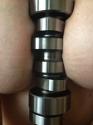

Here's where I think you should be looking cam-wise: 230/238-114+3
46 degree IVC so it should peak around 6300-6500 rpm and carry nicely
56 degree EVO will be a nice spot between mid range torque and top end carrying. You can recover some this lost midrange just by bumping up compression a smidge, by the way. personally, i like to see earlier EVO to help with power past peak.
6 degrees of overlap, so it'll drive pretty nice.
That cam with a set of worked 243's should put you soundly into 430 territory depending on the quality of the head work that was done and no other changes to your build.
46 degree IVC so it should peak around 6300-6500 rpm and carry nicely
56 degree EVO will be a nice spot between mid range torque and top end carrying. You can recover some this lost midrange just by bumping up compression a smidge, by the way. personally, i like to see earlier EVO to help with power past peak.
6 degrees of overlap, so it'll drive pretty nice.
That cam with a set of worked 243's should put you soundly into 430 territory depending on the quality of the head work that was done and no other changes to your build.
My car has 6 degrees of split and carries from 6100 peak to the 6600 shift point very cleanly...too much exhaust creates too much heat and trades bottom/mid torque for top end power. For street cars, the mid range torque would be more desirable provided you can hook. And this creates less overlap for a more stable idle quality. Perhaps if you need that much exh duration on an NA motor you really needed more intake duration to begin with...
Guess which cam made the most power and is fastest?
Also, this pulls to 7300 cleanly with a 110 IVC and a 227 lobe... I just have it set at 7000 because there's no since in destroying my shortblock because I can.
And the current combo is not designed for NA performance. It just happens to provide the best NA performance.
Thread Starter
Teching In
Joined: Oct 2016
Posts: 9
Likes: 0
Here's where I think you should be looking cam-wise: 230/238-114+3
46 degree IVC so it should peak around 6300-6500 rpm and carry nicely
56 degree EVO will be a nice spot between mid range torque and top end carrying. You can recover some this lost midrange just by bumping up compression a smidge, by the way. personally, i like to see earlier EVO to help with power past peak.
6 degrees of overlap, so it'll drive pretty nice.
That cam with a set of worked 243's should put you soundly into 430 territory depending on the quality of the head work that was done and no other changes to your build.
46 degree IVC so it should peak around 6300-6500 rpm and carry nicely
56 degree EVO will be a nice spot between mid range torque and top end carrying. You can recover some this lost midrange just by bumping up compression a smidge, by the way. personally, i like to see earlier EVO to help with power past peak.
6 degrees of overlap, so it'll drive pretty nice.
That cam with a set of worked 243's should put you soundly into 430 territory depending on the quality of the head work that was done and no other changes to your build.
should be Enough with 3.42s ??
THANKS

Combo in my sig with the BTR stage II cam (227/234 on 113 lsa) stock valve, no port work 243s milled .035, fast 92mm, 92mm throttle body, 25% UD Pulley put down 442 rwhp 405 tq and I love the way it drives compared to my old Torquer V3 cam. This was on a SBE LS1 as well. I don't think Id go much bigger than a 230 intake duration like was mentioned early in the thread, it really helps it not feel as lazy on the bottom end.



On The Tree
Joined: Aug 2007
Posts: 141
Likes: 2
Longer Exhaust Duration: Is this really necessary?
Most stock camshafts from American production V8, V6 and 4 cylinder engines manufactured today are ground with the longer exhaust lobe duration. Or, another way of looking at this is that they are ground with shorter intake durations! The former embraces the viewpoint that either the Exhaust Ports or Exhaust Pipe system is somewhat restrictive, and is in need of an assist. The latter suggests that the intake system is rather efficient and cam timing can be trimmed back a bit with out much sacrifice in power, in order to maximize throttle response and cruising efficiency.
Take your pick here. There is no absolutely correct viewpoint - because both are probably true! In a stock engine running at conservative RPM levels, for the sake of overall efficiency, fuel economy and a quiet smooth running engine, this staggering of intake and exhaust duration is quite common and appropriate.
However, High Performance is another thing entirely. Change one factor, let's say in this case, the exhaust system (installing headers and larger pipes) and you have just negated in most cases, the need for that longer exhaust lobe. Now couple this change with a different intake system and camshaft and you have really scrambled the equation. But, wait just a moment. Why is it that so many people (racers & cam grinders alike) insist on running a cam with longer exhaust duration regardless of what equipment is employed? The answer is "habit". Most of them have been somewhat successful in doing it their way and will probably never change unless virtually forced by circumstances to do so.
Before we go any further however let's review what it actually is we are trying to do with an engine when we attempt to make more power. Our best result comes when we are cognizant of the fact that an engine is basically an air pump. We pump it in and out (although in a different form) and we have problems when one side or the other is restricted. Balance or the equilibrium or flow should be our objective, unless of course we are not trying to make more horsepower!
Example #1 (Oval track racing) Here, I have often observed that the most experienced drivers are those who are most likely to run a single pattern (equal on intake and exhaust duration) cam. Why? Because such cams always, I repeat always make more torque! These veterans have a more educated foot and greater experience in feathering the throttle in the corners. They can therefore, utilize the benefit of added torque, in the lower to mid RPM range, to their advantage.
Their counterparts, the younger drivers on the circuit, generally are not as experienced and may at times actually get "crossed up" in the corners especially with a lighter car or when they are learning the ropes. In their case, a longer exhaust duration is often the more appropriate choice. It will often help them to drive better, more "flat footed" if you will, without consequence. But please for the sake of accuracy, let us be truthful. The benefit comes from an actual bleeding off of low to mid range torque, which is always what happens when Exh. Duration is lengthened, not from any improvement. The improvement, (if any) would come because of an improvement in scavenging at the extreme upper end of the power curve and would usually be marginal at best. Yet the so-called "extra power" potential of a longer Exh. Duration cam is most often why they are touted - power most people are backing away from at the end of the strait away!
Example #2 (Drag Racing) At the drag strip it's a little different and I feel more honest. Here, racers have long enjoyed longer exhaust and longer durations across the board (If I may add specifically for the purpose of "killing" low-end torque) to keep the tires from too easily breaking lose. This has been successful and sometimes actually results in a slight increase in top end power - something you can actually use in drag racing since it is a full throttle endeavor through the lights. Keep in mind here though, it's quite possible that a longer duration cam overall would have done just as well or better. In other words if you needed that longer exhaust for top end, perhaps the intake could have benefited from such a lengthening as well.
One of my favorite expressions is how "The Drag Racing mentality has infiltrated the ranks of Oval Track". Many have crossed over and made the switch in the past 10-15 years and some have brought their preconceived notions about how to cam an engine with them. A few may actually read these concepts and if they do so will at least come away with a better understanding of what they are doing. On the other hand they also could find that this information might actually help their cars to run just a bit faster!
http://www.iskycams.com/tech-tips-2000.html#2003
Most stock camshafts from American production V8, V6 and 4 cylinder engines manufactured today are ground with the longer exhaust lobe duration. Or, another way of looking at this is that they are ground with shorter intake durations! The former embraces the viewpoint that either the Exhaust Ports or Exhaust Pipe system is somewhat restrictive, and is in need of an assist. The latter suggests that the intake system is rather efficient and cam timing can be trimmed back a bit with out much sacrifice in power, in order to maximize throttle response and cruising efficiency.
Take your pick here. There is no absolutely correct viewpoint - because both are probably true! In a stock engine running at conservative RPM levels, for the sake of overall efficiency, fuel economy and a quiet smooth running engine, this staggering of intake and exhaust duration is quite common and appropriate.
However, High Performance is another thing entirely. Change one factor, let's say in this case, the exhaust system (installing headers and larger pipes) and you have just negated in most cases, the need for that longer exhaust lobe. Now couple this change with a different intake system and camshaft and you have really scrambled the equation. But, wait just a moment. Why is it that so many people (racers & cam grinders alike) insist on running a cam with longer exhaust duration regardless of what equipment is employed? The answer is "habit". Most of them have been somewhat successful in doing it their way and will probably never change unless virtually forced by circumstances to do so.
Before we go any further however let's review what it actually is we are trying to do with an engine when we attempt to make more power. Our best result comes when we are cognizant of the fact that an engine is basically an air pump. We pump it in and out (although in a different form) and we have problems when one side or the other is restricted. Balance or the equilibrium or flow should be our objective, unless of course we are not trying to make more horsepower!
Example #1 (Oval track racing) Here, I have often observed that the most experienced drivers are those who are most likely to run a single pattern (equal on intake and exhaust duration) cam. Why? Because such cams always, I repeat always make more torque! These veterans have a more educated foot and greater experience in feathering the throttle in the corners. They can therefore, utilize the benefit of added torque, in the lower to mid RPM range, to their advantage.
Their counterparts, the younger drivers on the circuit, generally are not as experienced and may at times actually get "crossed up" in the corners especially with a lighter car or when they are learning the ropes. In their case, a longer exhaust duration is often the more appropriate choice. It will often help them to drive better, more "flat footed" if you will, without consequence. But please for the sake of accuracy, let us be truthful. The benefit comes from an actual bleeding off of low to mid range torque, which is always what happens when Exh. Duration is lengthened, not from any improvement. The improvement, (if any) would come because of an improvement in scavenging at the extreme upper end of the power curve and would usually be marginal at best. Yet the so-called "extra power" potential of a longer Exh. Duration cam is most often why they are touted - power most people are backing away from at the end of the strait away!
Example #2 (Drag Racing) At the drag strip it's a little different and I feel more honest. Here, racers have long enjoyed longer exhaust and longer durations across the board (If I may add specifically for the purpose of "killing" low-end torque) to keep the tires from too easily breaking lose. This has been successful and sometimes actually results in a slight increase in top end power - something you can actually use in drag racing since it is a full throttle endeavor through the lights. Keep in mind here though, it's quite possible that a longer duration cam overall would have done just as well or better. In other words if you needed that longer exhaust for top end, perhaps the intake could have benefited from such a lengthening as well.
One of my favorite expressions is how "The Drag Racing mentality has infiltrated the ranks of Oval Track". Many have crossed over and made the switch in the past 10-15 years and some have brought their preconceived notions about how to cam an engine with them. A few may actually read these concepts and if they do so will at least come away with a better understanding of what they are doing. On the other hand they also could find that this information might actually help their cars to run just a bit faster!
http://www.iskycams.com/tech-tips-2000.html#2003


Combo in my sig with the BTR stage II cam (227/234 on 113 lsa) stock valve, no port work 243s milled .035, fast 92mm, 92mm throttle body, 25% UD Pulley put down 442 rwhp 405 tq and I love the way it drives compared to my old Torquer V3 cam. This was on a SBE LS1 as well. I don't think Id go much bigger than a 230 intake duration like was mentioned early in the thread, it really helps it not feel as lazy on the bottom end.