





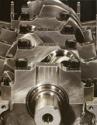




Introducing..Summit Pro LS Forged Pistons!!!!!

We apologize for the delay in answering this. All piston manufacturers and all machinists would prefer to hone a minimum of .005 to get a fresh surface. Bore/hone a block when wear is more severe with 50k plus miles or has surface rust. Best option? Take to it a machine shop. Almost always a better outcome other than the expense and potentially having the machine shop "adding another thou" to the measurement to ensure the job "doesn't come back".
What is the reality though? We all know someone that built an engine on a dirt floor and was successful.
Let's start off with the first comment we hear... "The cylinder is like new, you can still see the cross hatch". The problem is a cylinder will still have cross-hatch at 200k miles and still be completely worn out because the crosshatch may be up to .008" deep to begin with. The result is excessive piston to wall. Smoke, Oil Consumption. Piston Slap etc. Remember even .001 over our .004 "metal to metal" spec is 25% more than we recommended to begin with.
So how do you measure it? Unfortunately, this is beyond feeler gauges and snap gauges. Dial bore gauges only accurate to .001 in. are better, but if you've ever used a quality dial bore gauge accurate to .0001, you will feel naked if you are forced to use anything lesser. Not many hobbyists have those tools though.
Option 2: Ok, so 90% of folks don't own a good dial bore gauge and/or 4-5" Transfer Micrometer. What's the next criteria to having success with a standard bore piston? Well, best case scenario is you are running a low mileage engine and it hasn't been opened up and sitting. Metal sweats in changes in heat/cold and it rusts.
So what hone to use? Never use a three stone hone for this type of work. We're all familiar with bottle or "dingle ball" hones and the Brush Research Flex Hone are the best of the bunch. This is the part number most commonly used with LS 5.3 through 7.0L engines. Here are the instructions. Another option we like is the Wiseco W6079 Soft Hone Brush...it cleans the bores without removing the material...meaning less chance for error by the operator.
Lastly, Clean the bores with acetone and white paper towels until they absolutely come up clean. This might take 30-45 minutes or more. A lot of stones and dingle ball brushes use aluminum oxide abrasives. ANY left in the bore will come loose and quickly wear out EVERYTHING.
This is really just the tip of the iceberg, but you really need to consider this before making your decision to stay standard or hone or bore/hone. We haven't hit on the importance of torque plate honing and often "sending the boring bar" down a perfectly good looking bore at .030 over won't clean up all surfaces.
What is the reality though? We all know someone that built an engine on a dirt floor and was successful.
Let's start off with the first comment we hear... "The cylinder is like new, you can still see the cross hatch". The problem is a cylinder will still have cross-hatch at 200k miles and still be completely worn out because the crosshatch may be up to .008" deep to begin with. The result is excessive piston to wall. Smoke, Oil Consumption. Piston Slap etc. Remember even .001 over our .004 "metal to metal" spec is 25% more than we recommended to begin with.
So how do you measure it? Unfortunately, this is beyond feeler gauges and snap gauges. Dial bore gauges only accurate to .001 in. are better, but if you've ever used a quality dial bore gauge accurate to .0001, you will feel naked if you are forced to use anything lesser. Not many hobbyists have those tools though.
Option 2: Ok, so 90% of folks don't own a good dial bore gauge and/or 4-5" Transfer Micrometer. What's the next criteria to having success with a standard bore piston? Well, best case scenario is you are running a low mileage engine and it hasn't been opened up and sitting. Metal sweats in changes in heat/cold and it rusts.
So what hone to use? Never use a three stone hone for this type of work. We're all familiar with bottle or "dingle ball" hones and the Brush Research Flex Hone are the best of the bunch. This is the part number most commonly used with LS 5.3 through 7.0L engines. Here are the instructions. Another option we like is the Wiseco W6079 Soft Hone Brush...it cleans the bores without removing the material...meaning less chance for error by the operator.
Lastly, Clean the bores with acetone and white paper towels until they absolutely come up clean. This might take 30-45 minutes or more. A lot of stones and dingle ball brushes use aluminum oxide abrasives. ANY left in the bore will come loose and quickly wear out EVERYTHING.
This is really just the tip of the iceberg, but you really need to consider this before making your decision to stay standard or hone or bore/hone. We haven't hit on the importance of torque plate honing and often "sending the boring bar" down a perfectly good looking bore at .030 over won't clean up all surfaces.
Let's start off with the first comment we hear... "The cylinder is like new, you can still see the cross hatch". The problem is a cylinder will still have cross-hatch at 200k miles and still be completely worn out because the crosshatch may be up to .008" deep to begin with. The result is excessive piston to wall. Smoke, Oil Consumption. Piston Slap etc. Remember even .001 over our .004 "metal to metal" spec is 25% more than we recommended to begin with.
however I'm still having some trouble understanding exactly ,
It seems like you are suggesting to take original engines with 50k-200k mileage and hone them out for STD+.005" style pistons,
And that it will be very rare to use actual STD size pistons unless the engine has less than 50k mileage roughly
Sorry I know this area is highly varied and there is no one size fits all solution
however I'm still having some trouble understanding exactly ,
It seems like you are suggesting to take original engines with 50k-200k mileage and hone them out for STD+.005" style pistons,
And that it will be very rare to use actual STD size pistons unless the engine has less than 50k mileage roughly
however I'm still having some trouble understanding exactly ,
It seems like you are suggesting to take original engines with 50k-200k mileage and hone them out for STD+.005" style pistons,
And that it will be very rare to use actual STD size pistons unless the engine has less than 50k mileage roughly

Thread Starter
LS1Tech Sponsor


Joined: Jan 2008
Posts: 2,235
Likes: 1,526
From: Ohio, Georgia, Nevada, Texas
Sorry I know this area is highly varied and there is no one size fits all solution
however I'm still having some trouble understanding exactly ,
It seems like you are suggesting to take original engines with 50k-200k mileage and hone them out for STD+.005" style pistons,
And that it will be very rare to use actual STD size pistons unless the engine has less than 50k mileage roughly
however I'm still having some trouble understanding exactly ,
It seems like you are suggesting to take original engines with 50k-200k mileage and hone them out for STD+.005" style pistons,
And that it will be very rare to use actual STD size pistons unless the engine has less than 50k mileage roughly
Also to clarify our earlier comment about honing. A bottle brush is just there to get the cross hatch and it's not designed to get you up to the next available bore size like 4.005 for instance.

11 Second Club

Joined: Jan 2003
Posts: 1,000
Likes: 134
Sorry I know this area is highly varied and there is no one size fits all solution
however I'm still having some trouble understanding exactly ,
It seems like you are suggesting to take original engines with 50k-200k mileage and hone them out for STD+.005" style pistons,
And that it will be very rare to use actual STD size pistons unless the engine has less than 50k mileage roughly
however I'm still having some trouble understanding exactly ,
It seems like you are suggesting to take original engines with 50k-200k mileage and hone them out for STD+.005" style pistons,
And that it will be very rare to use actual STD size pistons unless the engine has less than 50k mileage roughly

On The Tree


Joined: Mar 2013
Posts: 110
Likes: 14
From: Puerto Rico
Yes, KCS nailed it. It's best to take any block to a machine shop prior to ordering pistons. They'll have a setting fixture and good dial bore gauge and can tell you how much wear the bore has. Many people do run standard bore pistons and they're pretty loose. That's a little like rebuilding an engine though and not getting all the life out of it you could if you were to just start at the next bore size where the bores can clean up.
Also to clarify our earlier comment about honing. A bottle brush is just there to get the cross hatch and it's not designed to get you up to the next available bore size like 4.005 for instance.
Also to clarify our earlier comment about honing. A bottle brush is just there to get the cross hatch and it's not designed to get you up to the next available bore size like 4.005 for instance.
Thread Starter
LS1Tech Sponsor
Joined: Jan 2008
Posts: 2,235
Likes: 1,526
From: Ohio, Georgia, Nevada, Texas
Hello, when piston manufacturers call out a bore size-they dial in their own skirt diameter clearance for that bore because different forging styles have different needs. If you hone the block to 3.903, you would find our pistons to be .004" smaller (3.899) as measured at the gauge point in the skirt coating. Boring isn't necessary with an LS1 and usually isn't done unless .010 in. or more bore size is required, so for you..just honing is necessary and this costs less money at a machine shop.
As for method, it is best for the machinist to use a micrometer to measure the piston and set the micrometer off that.. Then they use the micrometer to set the dial bore gauge. Then they use the dial bore gauge to hone the cylinders in relation to the pistons. This is the best way to make sure fluctuations in shop temperature are never an issue.
Thank you for your patronage!
As for method, it is best for the machinist to use a micrometer to measure the piston and set the micrometer off that.. Then they use the micrometer to set the dial bore gauge. Then they use the dial bore gauge to hone the cylinders in relation to the pistons. This is the best way to make sure fluctuations in shop temperature are never an issue.
Thank you for your patronage!
LS1 Tech Stories
The Best V8 Stories One Small Block at Time

Gas Monkey Built a 6-Wheel Ferrari Testarossa With a Corvette LT4 Engine
Verdad Gallardo
7 Most Reliable High-Performance Engines GM Has Ever Built
Verdad Gallardo
Amazing '71 Camaro Restomod Is Modern Muscle Car Under the Skin
Verdad Gallardo
6 Common C5 Corvette Failures and What's Involved In Repairing Them
Pouria Savadkouei
Retro Modern Bandit Pontiac Trans AM Comes With Burt Reynolds' Autograph
Verdad Gallardo
Top 10 Greatest Cadillac V Series Performance Models Ever, Ranked
Pouria Savadkouei
Top 10 Most Powerful Chevy Trucks Ever Made!

Hennessey's New Supercharged Silverado ZR2 Has 700 HP
Verdad Gallardo
Coachbuilt N2A Anteros Is an LS2-Powered C6 Corvette In Italian Clothes
Verdad Gallardo
I have a set that are going in my Aluminum block 5.3. I am very impressed with the quality and fit/finish of the pistons.
The only thing, and it may have bene mentioned but it wasnt quite clear to me. Is the compression height is lower than expected. What i mean by that is that with a STD deck height in my block im .010" BELOW the deck.
Not a problem for my deal since its turboed, but might be a problem for others. Also, if you do the math and consider a stock deck height of 9.240 they come out to 10 below the deck.
The only thing, and it may have bene mentioned but it wasnt quite clear to me. Is the compression height is lower than expected. What i mean by that is that with a STD deck height in my block im .010" BELOW the deck.
Not a problem for my deal since its turboed, but might be a problem for others. Also, if you do the math and consider a stock deck height of 9.240 they come out to 10 below the deck.
Thread Starter
LS1Tech Sponsor
Joined: Jan 2008
Posts: 2,235
Likes: 1,526
From: Ohio, Georgia, Nevada, Texas
I have a set that are going in my Aluminum block 5.3. I am very impressed with the quality and fit/finish of the pistons.
The only thing, and it may have bene mentioned but it wasnt quite clear to me. Is the compression height is lower than expected. What i mean by that is that with a STD deck height in my block im .010" BELOW the deck.
Not a problem for my deal since its turboed, but might be a problem for others. Also, if you do the math and consider a stock deck height of 9.240 they come out to 10 below the deck.
The only thing, and it may have bene mentioned but it wasnt quite clear to me. Is the compression height is lower than expected. What i mean by that is that with a STD deck height in my block im .010" BELOW the deck.
Not a problem for my deal since its turboed, but might be a problem for others. Also, if you do the math and consider a stock deck height of 9.240 they come out to 10 below the deck.
This is for a several reasons. The iron blocks from the factory varied between 9.230 and 9.240. We didn't want anyone unexpectedly find our pistons tapping the head. If you have a True 9.240 deck, you can run a commonly available. .040 gasket (or less) to hit the factory quench if people are hunting for compression. Finally they aren't making Gen. 3/4 any longer and we expect the blocks will need the decks trued up in the future as people drag them out of the boneyards and want to rebuild them.
On The Tree
Joined: Mar 2013
Posts: 110
Likes: 14
From: Puerto Rico
Hello, when piston manufacturers call out a bore size-they dial in their own skirt diameter clearance for that bore because different forging styles have different needs. If you hone the block to 3.903, you would find our pistons to be .004" smaller (3.899) as measured at the gauge point in the skirt coating. Boring isn't necessary with an LS1 and usually isn't done unless .010 in. or more bore size is required, so for you..just honing is necessary and this costs less money at a machine shop.
As for method, it is best for the machinist to use a micrometer to measure the piston and set the micrometer off that.. Then they use the micrometer to set the dial bore gauge. Then they use the dial bore gauge to hone the cylinders in relation to the pistons. This is the best way to make sure fluctuations in shop temperature are never an issue.
Thank you for your patronage!
As for method, it is best for the machinist to use a micrometer to measure the piston and set the micrometer off that.. Then they use the micrometer to set the dial bore gauge. Then they use the dial bore gauge to hone the cylinders in relation to the pistons. This is the best way to make sure fluctuations in shop temperature are never an issue.
Thank you for your patronage!
My rods are 6.125 summit.
Last edited by booz; Oct 3, 2019 at 02:57 PM.
Thread Starter
LS1Tech Sponsor
Joined: Jan 2008
Posts: 2,235
Likes: 1,526
From: Ohio, Georgia, Nevada, Texas
Our pistons are .005 in the hole @ a 9.240 blueprint height. Meaning zero deck at 9.235 You would need to mill the block .011 to return to .006 positive deck. It is best to measure deck height prior to cutting because we see them vary.
Thread Starter
LS1Tech Sponsor
Joined: Jan 2008
Posts: 2,235
Likes: 1,526
From: Ohio, Georgia, Nevada, Texas
Please see our previous notes on this. Your measurements will need to be retaken with a bridge indicator. Verify the piston is in the center of dwell. Then measure positive and negative values when rocked and average them. Then take the average of both sides,
.010" below the deck... also using the wallace racing calculator i come up with .01"

Thread Starter
LS1Tech Sponsor
Joined: Jan 2008
Posts: 2,235
Likes: 1,526
From: Ohio, Georgia, Nevada, Texas
Please run the math for yourself. Their calculator appears to be rounding up as evidenced by it only going out to two decimal points. A problem with their website. 1/2 stroke 1.811 plus rod centers 6.125 plus compression height 1.299=9.235. Having a deck that’s 9.245 is possible but we haven’t seen it yet as they always go zero to the low. Always a first time though. Who’s rods were you running?
Last edited by Summitracing; Oct 3, 2019 at 05:37 PM.


On The Tree
Joined: Mar 2013
Posts: 110
Likes: 14
From: Puerto Rico
The reason I ask about the deck is cause my last build was with .41 gasket to build compression and detonate less with the tighter quench. I have 59cc heads. Do you recommend decking the block to be like before?
I have now stock LS1 gasket for this build. I think they are .51 thickness.
What compression I will.make with 59cc heads?
Do you recommend decking it so my quench be better?
I have now stock LS1 gasket for this build. I think they are .51 thickness.
What compression I will.make with 59cc heads?
Do you recommend decking it so my quench be better?
Thread Starter
LS1Tech Sponsor
Joined: Jan 2008
Posts: 2,235
Likes: 1,526
From: Ohio, Georgia, Nevada, Texas
As it sits, a .041 gasket would net .046 quench which is decent. Compression is up at 11.9:1 which is pretty stout. A .051 gasket drops to 11.6:1, but the quench goes away. You could deck the block .011 with your present gaskets to hit .045 net. If you're feeling your oats you could deck it as much as .020 to set quench at .036...which is as tight as we recommend and would net 12.25:1.
What are you thinking about for fuel and how much cam do you have in it?
What are you thinking about for fuel and how much cam do you have in it?