


Hate to ask... Cam selection


TECH Regular
Joined: Jul 2019
Posts: 421
Likes: 71
From: Tasmania Australia

It probably is too small a cam but its cost about 6 to $7000 for engine rebuild my 99 LS1 so far which is what the car cost me a few years ago to buy and that's with me assembling the engine which Ive never done before. I feel safe with the factory LS6 redline of 6500 rpm as I found an old thread that said GM tested it continually at that level for a day or two in development testing. Its my daily commuter and I can't really afford for it to break.
Some who have done the calculations say to rev 800 rpm too 1000 rpm past peak HP for best times so that would mean if revving to 6500 and we were to pick the lesser number of 800 rpm past peak HP that would mean it's best to choose a cam that peaks around 5700 rpm and if a cam were to peak at 6000 rpm 800 plus would be 6800 rpm? I'm thinking If I had a cam that peaked at 6300 rpm and I only ever revved 6500 that would be the law of diminishing returns and I don't have a cam optimised for my desired rpm range.
Some who have done the calculations say to rev 800 rpm too 1000 rpm past peak HP for best times so that would mean if revving to 6500 and we were to pick the lesser number of 800 rpm past peak HP that would mean it's best to choose a cam that peaks around 5700 rpm and if a cam were to peak at 6000 rpm 800 plus would be 6800 rpm? I'm thinking If I had a cam that peaked at 6300 rpm and I only ever revved 6500 that would be the law of diminishing returns and I don't have a cam optimised for my desired rpm range.
Last edited by TimsLS1; Jan 21, 2020 at 07:42 PM.


TECH Regular
Joined: Jul 2019
Posts: 421
Likes: 71
From: Tasmania Australia
Mine is with the 99 rod bolts although they are the later two dot version, despite a lot of research on this there was no real consensus of opinion on what year the rod bolt changed and it effected my cam choice. I only discovered later to my surprise I had the later stronger 2 dot rod bolts in my 99 LS after it was disassembled
https://help.summitracing.com/app/an...n-rod-bolts%3F
https://help.summitracing.com/app/an...n-rod-bolts%3F


Man i haven't heard a good heavy vs light flywheel/clutch arguement in a while.
In the end it won't break you, though.
I would go with an LT1-S. Lighter than the LS7 clutch/flywheel, engages like a stock clutch because, well it basically IS... and a lot of the mass is a little more centered in the middle, so that reduces MoI.
You should really only notice a lighter clutch/flywheel the most in lower gears. Accelerating in higher gears takes up less torque since the flywheel/clutch angular acceleration is much lower.
In the end it won't break you, though.
I would go with an LT1-S. Lighter than the LS7 clutch/flywheel, engages like a stock clutch because, well it basically IS... and a lot of the mass is a little more centered in the middle, so that reduces MoI.
You should really only notice a lighter clutch/flywheel the most in lower gears. Accelerating in higher gears takes up less torque since the flywheel/clutch angular acceleration is much lower.
Mine is with the 99 rod bolts although they are the later two dot version, despite a lot of research on this there was no real consensus of opinion on what year the rod bolt changed and it effected my cam choice. I only discovered later to my surprise I had the later stronger 2 dot rod bolts in my 99 LS after it was disassembled
https://help.summitracing.com/app/an...n-rod-bolts%3F
https://help.summitracing.com/app/an...n-rod-bolts%3F
TECH Regular
Joined: Jul 2019
Posts: 421
Likes: 71
From: Tasmania Australia
Yes that's a good idea but my engine builder hadn't done it before and wasn't too confident so I went with my old Gen 3 rods and my near new Gen4 rods I purchased for this are still sitting here beside me unused, I was thinking of swapping over the rod bolts out of them into the gen 3 rods although the gen3 rods are all re balanced now and I noticed the head on the gen4 rods are longer and thought perhaps the extra weight of the bolts might throw the balance out in the gen3 rods.
Last edited by TimsLS1; Jan 21, 2020 at 06:46 PM.
TECH Regular
Joined: Jul 2019
Posts: 421
Likes: 71
From: Tasmania Australia
Thanks for that 00pooterSS that helps.
I'm wondering how this 217/228 cam will perform it already has 11 degree split and I've finished porting and cc the heads I have 10% more increase in volume on exhaust port than I do on intake (almost no extra on intake) so with the split and porting together I am very exhaust biased. I don't mind revving it so long as it won't break and there is some benefit to it I have all the valve upgrades for it. Any thoughts appreciated.
.
I'm wondering how this 217/228 cam will perform it already has 11 degree split and I've finished porting and cc the heads I have 10% more increase in volume on exhaust port than I do on intake (almost no extra on intake) so with the split and porting together I am very exhaust biased. I don't mind revving it so long as it won't break and there is some benefit to it I have all the valve upgrades for it. Any thoughts appreciated.
Lets say you measured max power at 5000 rpm. You could manipulate the cam timing to change the power number. If you added some duration to that cam you would make more power AND still be able to manipulate the power at that RPM by changing the cam timing
Last edited by TimsLS1; Jan 21, 2020 at 07:30 PM.


TECH Regular
Joined: Jul 2019
Posts: 421
Likes: 71
From: Tasmania Australia
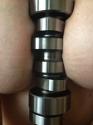
I was running a BTR 219/224 113 lsa +3 .551 lift in it which I really enjoyed but power dropped of rapidly after 6000 rpm, Im hoping the 217/228 (0 advance ground in) 110 LSA .590 lift will make a bit more power but even if it doesn't Im thinking it will still be quicker as it will hold on to its power longer to 6500 rpm and as a result will not have such a big drop in power when changing gears.

TECH Regular
Joined: Jul 2019
Posts: 421
Likes: 71
From: Tasmania Australia
True, but there is not the gain in power as if the duration actually increased. Really can't correlate the two.
The online overlap calculator tells me the top cam below will have more overlap despite it having a disadvantage with where it is advanced to in relation to the bottom cam.
220/230 at 50 (+4 advance cam) and installed as recommended
216/226 at 50 (0 advance cam) but installed with -4 retard on key way timing
Is there enough correlation between the two cams to predict which will have more top end power when installed this way?
Last edited by TimsLS1; Jan 24, 2020 at 05:45 PM.


TECH Regular
Joined: Jul 2019
Posts: 421
Likes: 71
From: Tasmania Australia
All else identical but let's say for example 110 LSA, your welcome to change the parameters if it helps explain things, I'm just trying understand it a little better.
Ive purchased 4 different cams in last 6 months a resold them because I can never decide.
Ive purchased 4 different cams in last 6 months a resold them because I can never decide.
Last edited by TimsLS1; Jan 24, 2020 at 09:02 PM.
All else being equal, up to a point, the bigger cam will make more power. Once you get to something stupidly big it will go the other way unless you increase rpm.
I still stand by original suggestion of 226/230 for what you described in your original post. If you truly want to learn more about cam theory, plenty here are happy to help. But I do not want to clutter your thread up going into it.
I still stand by original suggestion of 226/230 for what you described in your original post. If you truly want to learn more about cam theory, plenty here are happy to help. But I do not want to clutter your thread up going into it.

All else being equal, up to a point, the bigger cam will make more power. Once you get to something stupidly big it will go the other way unless you increase rpm.
I still stand by original suggestion of 226/230 for what you described in your original post. If you truly want to learn more about cam theory, plenty here are happy to help. But I do not want to clutter your thread up going into it.
I still stand by original suggestion of 226/230 for what you described in your original post. If you truly want to learn more about cam theory, plenty here are happy to help. But I do not want to clutter your thread up going into it.
I was going to recommend him go with the larger of the two cams on the +4 and ask about what the LSA is to see what the IVC is. But, then I realized I don't know enough to recommend the right IVC for him. I assume it's close to 40?
TECH Regular
Joined: Jul 2019
Posts: 421
Likes: 71
From: Tasmania Australia
I agree a 226/230 is perfect I have a dyno graph here (sorry don't know how to post pic of it) of a 225/232 112.5 lsa cam in a LS1 it show before and after with just addition of Cam compared to stock cam. Unusually it also shows power from 1000 to 2000 rpm and power is exactly same as stock cam and torque is only down about 10 nm under 2000. It makes 294 rwkw at 63000 rpm
Last edited by TimsLS1; Jan 26, 2020 at 04:07 PM.

TECH Senior Member


Joined: Jun 2016
Posts: 22,288
Likes: 3,615
From: Central Cal.
Tim, no matter what you do, there will always be a cam that will be another notch up, likely as not giving up something else in the process. Decide what you really want out of your car, and stick to it. If you want to be top dog, there will ALWAYS be someone who WILL take that crown, at least until you one-up him again.
WTR388, with AutoCross being high on your list of importance, I take most of the drag racing oriented cam suggestions with a grain of salt when directed to an autocrosser. Contact Sam Strano, for advice and parts selection for autocross. Sam hasxwon many championships in a 4th Gen Z28. He also ran a 3rd Gen for a while. His suggestions on cam selection for autocross goals are based on experience and successful SCCA racing.
While i don't autocross I'm aware some drivers prefer cam grinds very different from the typical drag race type of cam. The obsolete single pattern cam that has a fat mid range of torque is even favored by some as it aids in pulling thru corners etc. That sort of cam is 20+ years out of date in the typical LS enthusiast's mind. Smooth power deliver can also matter because sudden surge of power from a drag cam that "comes on at 5,500 rpm" can upset the car coming out of a corner in some cases that's at the limit of traction or so I've been told.
FWIW - I run a old obsolete 229/229 single pattern in my 91 RS with a 383 LS1 stroker, T56 8.8 rear 4.10's. The car drives like stock and has excellent torque in 4500 -6000 rpm range pulling out of corners. As long as you stay over 4500 rpm the power is very linear. Its a fun ride and the car is driver friendly.
I think Sam Strano will be able to best help you met your goals with best autocross set up.
Sincerely 99BB
While i don't autocross I'm aware some drivers prefer cam grinds very different from the typical drag race type of cam. The obsolete single pattern cam that has a fat mid range of torque is even favored by some as it aids in pulling thru corners etc. That sort of cam is 20+ years out of date in the typical LS enthusiast's mind. Smooth power deliver can also matter because sudden surge of power from a drag cam that "comes on at 5,500 rpm" can upset the car coming out of a corner in some cases that's at the limit of traction or so I've been told.
FWIW - I run a old obsolete 229/229 single pattern in my 91 RS with a 383 LS1 stroker, T56 8.8 rear 4.10's. The car drives like stock and has excellent torque in 4500 -6000 rpm range pulling out of corners. As long as you stay over 4500 rpm the power is very linear. Its a fun ride and the car is driver friendly.
I think Sam Strano will be able to best help you met your goals with best autocross set up.
Sincerely 99BB