When you click on links to various merchants on this site and make a purchase, this can result in this site earning a commission. Affiliate programs and affiliations include, but are not limited to, the eBay Partner Network.
So a larger valve head will make less power on the same bore size as one with a smaller valve?
Yes, absolutely. Sometimes. Not all the time, but sometimes.
Consider what would happen if you had a 3.8" valve and a 4" bore. (yeah I know, but do the thought experiment) Now, imagine increasing the valve size to 3.95". Is it going to flow more? Somehow I doubt it. Because there's no room around the edge of the valve. It's referred to as "shrouding".
Same deal in a real-world motor even if not quite as extreme. Especially with a smaller bore one. It's REEEEEEEL EEEEEEEEZY to make that happen. In fact in the old SBC, you could actually make 2.02" valves crash into the top of the deck given the right sloppy factory tolerances. You can learn the most amazing things sometimes by bolting the heads onto the block with no crank & pistons, and just observe how the parts all fit.
You can make the same thing happen with too much lift: if the head chamber is bigger than the bore around the valve, then opening the valve to where it makes it all the way down into the bore, might actually result in LESS flow than lower lifts.
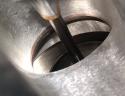
Here's a pic of some old SBC heads with larger valves in them, that I was relieving the chamber for the exact same reason.
So a larger valve head will make less power on the same bore size as one with a smaller valve?
We all know you're the jedi here.
This isn't the first time you've tried to bait me about shrouding. I'd love to learn from you, and even be corrected by you if I've said something wrong, but can you cut out the baiting bull ****?
I'll play along anyway **** it. I don't think focusing on a larger valve in a situation where the valve is already a decent size is as important as focusing on reducing shrouding/focusing on valve angles/cuts/optimizing the current valve.
Yes, absolutely. Sometimes. Not all the time, but sometimes.
Consider what would happen if you had a 3.8" valve and a 4" bore. (yeah I know, but do the thought experiment) Now, imagine increasing the valve size to 3.95". Is it going to flow more? Somehow I doubt it. Because there's no room around the edge of the valve. It's referred to as "shrouding".
Same deal in a real-world motor even if not quite as extreme. Especially with a smaller bore one. It's REEEEEEEL EEEEEEEEZY to make that happen. In fact in the old SBC, you could actually make 2.02" valves crash into the top of the deck given the right sloppy factory tolerances. You can learn the most amazing things sometimes by bolting the heads onto the block with no crank & pistons, and just observe how the parts all fit.
You can make the same thing happen with too much lift: if the head chamber is bigger than the bore around the valve, then opening the valve to where it makes it all the way down into the bore, might actually result in LESS flow than lower lifts.
Here's a pic of some old SBC heads with larger valves in them, that I was relieving the chamber for the exact same reason.
There isn't any room for the cylinder pressure to exhaust, so in your example, that engine would never run. What do you considered shrouded? I hear talk all the time about "shrouding", but what is considered shrouded?
You're saying that lifting the valve too much will result in less flow. Does that mean the engine will make less power? Where is the tipping point?
Relieving the chamber to the bore makes it look good on the flow bench but in most cases it costs you power. You've just introduced a path for reversion into the inlet.
You took it easier on rb than I was thinking you were going to.
I haven't seen if you've responded to my comment yet. But I didn't want to answer because I figured it would be a trap.
So to answer your question. I do not know how to properly communicate what shrouding is in the way you would. I know it's a thing. I know that larger valves in a poorly designed chamber "should" create a worse situation.
I didn't realize relieving the chamber would actually cause more problems than good though, that's interesting. Why does relieving the chamber to the bore introduce reversion if the valve already has so much area open to reversion? Or are you saying you've basically unshrouded the reversion?
So that being said, I assume you also don't recommend notching the bore?
This isn't the first time you've tried to bait me about shrouding. I'd love to learn from you, and even be corrected by you if I've said something wrong, but can you cut out the baiting bull ****?
I'll play along anyway **** it. I don't think focusing on a larger valve in a situation where the valve is already a decent size is as important as focusing on reducing shrouding/focusing on valve angles/cuts/optimizing the current valve.
I'm not baiting.... sometimes you have to be stimulated to look outside the box. The same way of thinking equals the same results. You gotta try stuff. Most of the time it doesn't work, but sometimes it's better.
Everything is a balance and usually comes down to how much $$$ you want to spend. Then it comes down to sacrifice. How big of a valve will the casting take? Where is the valve centerline? Will the casting allow me to move the valve over? How much valve can I fit in the bore?
2" valve with a 91% throat is 2.6" sq
2.05" valve with a 91% throat is 2.73" sq
The 243/799 heads that I do will flow around 118-120 cfm/in on my bench. By going from a 2" valve to a 2.05" valve, you just increased your flow 15-20cfm on the same bore size.
I'm not baiting.... sometimes you have to be stimulated to look outside the box. The same way of thinking equals the same results. You gotta try stuff. Most of the time it doesn't work, but sometimes it's better.
Everything is a balance and usually comes down to how much $$$ you want to spend. Then it comes down to sacrifice. How big of a valve will the casting take? Where is the valve centerline? Will the casting allow me to move the valve over? How much valve can I fit in the bore?
2" valve with a 91% throat is 2.6" sq
2.05" valve with a 91% throat is 2.73" sq
The 243/799 heads that I do will flow around 118-120 cfm/in on my bench. By going from a 2" valve to a 2.05" valve, you just increased your flow 15-20cfm on the same bore size.
Does that play out on a stock chamber?
For example just throwing the valve in the head otherwise stock. All things staying the same?
I appreciate the info, but I also want to know if I gave bad advice and need to stop.
You took it easier on rb than I was thinking you were going to.
I haven't seen if you've responded to my comment yet. But I didn't want to answer because I figured it would be a trap.
So to answer your question. I do not know how to properly communicate what shrouding is in the way you would. I know it's a thing. I know that larger valves in a poorly designed chamber "should" create a worse situation.
I didn't realize relieving the chamber would actually cause more problems than good though, that's interesting. Why does relieving the chamber to the bore introduce reversion if the valve already has so much area open to reversion? Or are you saying you've basically unshrouded the reversion?
So that being said, I assume you also don't recommend notching the bore?
I don't know the right answer on shrouding....... I think there are a lot if different answers for that all depending on the architecture of the cylinder head that you're working with. But if I can keep making the inlet valve bigger while still increasing flow on the same bore... to me that is making more power.
Think of how a shear plate works under a carb. Compare what's going on there to the inlet side of your chamber.
I don't know the right answer on shrouding....... I think there are a lot if different answers for that all depending on the architecture of the cylinder head that you're working with. But if I can keep making the inlet valve bigger while still increasing flow on the same bore... to me that is making more power.
Think of how a shear plate works under a carb. Compare what's going on there to the inlet side of your chamber.
Thinking of it that way it seems that the relieving almost helps the path of reversion.
So you leave the chamber, put in a bigger valve, and let the additional surface area provide the flow rather than taking it further away from the wall?
I would think there's also situations where valve events promote less reversion than others, and relieving/notching would improve that situation...?
Felix C saw this while reading some older threads on the forum about porting and valve angles. Thought it might be of interest. Post. #6 has many links & #7 has a lot of discussion regarding details of porting.
Does that play out on a stock chamber?
For example just throwing the valve in the head otherwise stock. All things staying the same?
I appreciate the info, but I also want to know if I gave bad advice and need to stop.
The chamber does need a little work but going to a 2.05” valve (is typically what I do) doesn’t require a lot of additional work on the chamber outside of blending the valve job in. But let me add.... if you just stick a bigger valve in it, and don’t get the throat, bowl, and short turn right... you’ve actually made it worse.
There isn't any room for the cylinder pressure to exhaust, so in your example, that engine would never run.
That's THE POINT. In the oversimplified example, NO GASES (or at least, very little) would be able to get past the valve, because it's so close to the cyl walls. That's called SHROUDING.
introduced a path for reversion into the inlet.
That makes NO SENSE WHATSOEVER. Reversion has very little to do with anything about port or valve flow, and is more a function of valve TIMING. (cam properties)
I'm struggling to understand how anyone can NOT understand, that if the valve is TOO LARGE and its size puts it up against a surface that's perpendicular to it and doesn't leave room for gases to flow around it, how that limits flow through the valve. It's SO OBVIOUS, even a child can see it. My photos of those larger valves in 305 heads show it SO CLEARLY, there's no room for doubt. I guess though, you have to have enough mechanical mental wherewithal to realize that since it's a 305, there are 2 cyls turned one way in a head, and 2 the other (mirror images); which is what the photos are of. The cyls are mirrored, not identical like a LS motor.
I guess you could notch the block to cure shrouding by the bore, but that's a kind of blunt instrument. But it's done by the factory in some motors; big block Chevy for example. But then, there's enough material cast into that place in those, that there's enough room to do that without risk of hitting water. Not sure that's an effective realistic option in a LS motor.
And of course all of that leaves aside the question of, is the valve really The Bottleneck in any given situation, to begin with. If SOMETHING ELSE limits flow, then it doesn't matter how large you make the valve; no more stuff can get through the total package. Granted, usually it is; but not always.
I'm guessing this person has decided that they know more than all the rest of the engine builders in the world and has an idea in his head that even though it has NO BASIS IN FACTS, he just can't seem to get it out? Is there some history here?
The chamber does need a little work but going to a 2.05” valve (is typically what I do) doesn’t require a lot of additional work on the chamber outside of blending the valve job in. But let me add.... if you just stick a bigger valve in it, and don’t get the throat, bowl, and short turn right... you’ve actually made it worse.
That's what I was figuring and why I have told people don't just throw a valve in there/posted what I did above in this post. Thank you for confirming. I don't mind being corrected, I don't want to spread inaccurate info. Good to know I haven't been I can't remember all the threads where I said "don't do that" lol
Felix C saw this while reading some older threads on the forum about porting and valve angles. Thought it might be of interest. Post. #6 has many links & #7 has a lot of discussion regarding details of porting.
That's THE POINT. In the oversimplified example, NO GASES (or at least, very little) would be able to get past the valve, because it's so close to the cyl walls. That's called SHROUDING.
That makes NO SENSE WHATSOEVER. Reversion has very little to do with anything about port or valve flow, and is more a function of valve TIMING. (cam properties)
I'm struggling to understand how anyone can NOT understand, that if the valve is TOO LARGE and its size puts it up against a surface that's perpendicular to it and doesn't leave room for gases to flow around it, how that limits flow through the valve. It's SO OBVIOUS, even a child can see it. My photos of those larger valves in 305 heads show it SO CLEARLY, there's no room for doubt. I guess though, you have to have enough mechanical mental wherewithal to realize that since it's a 305, there are 2 cyls turned one way in a head, and 2 the other (mirror images); which is what the photos are of. The cyls are mirrored, not identical like a LS motor.
I guess you could notch the block to cure shrouding by the bore, but that's a kind of blunt instrument. But it's done by the factory in some motors; big block Chevy for example. But then, there's enough material cast into that place in those, that there's enough room to do that without risk of hitting water. Not sure that's an effective realistic option in a LS motor.
And of course all of that leaves aside the question of, is the valve really The Bottleneck in any given situation, to begin with. If SOMETHING ELSE limits flow, then it doesn't matter how large you make the valve; no more stuff can get through the total package. Granted, usually it is; but not always.
I'm guessing this person has decided that they know more than all the rest of the engine builders in the world and has an idea in his head that even though it has NO BASIS IN FACTS, he just can't seem to get it out? Is there some history here?
If the reversion deal doesn't make any sense to you, you should study the system a little harder. Anywhere in the system that you can mitigate reversion, you make more power. Including in the exhaust... But there are other reasons which the edge of the chamber makes more power as well...
You still haven't defined what you consider shrouded? You do realize that the cylinder wall is not perpendicular to the valves in most engines right? Although some diesels and w- series engine do come to mind that are.
All of my "basis in facts" are what I have personally learned by doing over the years. If you're stuck in your ways, that's your problem.
"Shrouded" = when the edge of the valve is up against something perpendicular (more or less) to it. Doesn't have to be EXACTLY perpendicular.
Yes I realize that the valve isn't "perpendicular" to the bore in most motors; it's at, what, 18° or something, in the LS series; but close enough to perpendicular to cause the issue at hand.
You STILL haven't figured out why ALMOST NOTHING can get through a 3.95" valve in a 4.00" bore, have you? It's because of SHROUDING. If the valve was 3.5" then it'd have 0.25" all the way around for material to pass through and around it and into the cyl. If it was 3" it'd have 0.5" all the way around. A 3" valve would flow ALOT MORE THAN a 3.95" one. Enlarging the valve from 3" to 3.95" will make it flow LESS. ALOT LESS.
This is why SOMETIMES - not always, but SOMETIMES - you can actually get LESS flow, IN A MOTOR, from a larger valve than a smaller one... because the valve is right up against the cyl wall or the wall of the head chamber (as shown in my photos), and there's no room AROUND the valve for material to pass through and AROUND it. The REST OF THE MOTOR gets in the way of flow through the valve.
NONE of this has ANYTHING to do with "reversion". "Reversion" is a function of valve TIMING, specifically, it occurs when the valve is open at some time when the pressures on the 2 sides of it are in the wrong orientation. (such as, when the int valve opens when there's vacuum in the intake manifold but there's still leftover combustion pressure in the cyl because it hasn't all "blown down" through the exh valve yet) It is NOT RELATED in any manner way shape form or fashion to the shape of the chamber, or the shape of ANYTHING ELSE, around the valve.
It still boggles the mind how somebody can fail to be able to see this. I'm a teacher at the university level sometimes; I learned a long time ago that sometimes a student gets an idea into their head that's WRONG, but they can't see how it is WRONG; and the only way for me, as a teacher, to TEACH them, is to figure out what their WRONGNESS is, explain to them what about it is WRONG, and then once THAT light bulb comes on in their head, explain what's RIGHT. I'm failing to see how you fail to see how you're WRONG.
I'm a teacher at the university level sometimes; I learned a long time ago that sometimes a student gets an idea into their head that's WRONG, but they can't see how it is WRONG; and the only way for me, as a teacher, to TEACH them, is to figure out what their WRONGNESS is, explain to them what about it is WRONG, and then once THAT light bulb comes on in their head, explain what's RIGHT. I'm failing to see how you fail to see how you're WRONG.
6 Common C5 Corvette Failures and What's Involved In Repairing Them
Slideshow: From wobbling harmonic balancers to failed EBCMs, these are the issues that define long-term C5 ownership and what repairs typically involve.
Retro Modern Bandit Pontiac Trans AM Comes With Burt Reynolds' Autograph
Slideshow: A modern Camaro transformed into a retro icon, this limited-run "Bandit" build blends nostalgia with brute force in a way few revivals manage.
Top 10 Greatest Cadillac V Series Performance Models Ever, Ranked
Slideshow: Cadillac didn't just crash the high-performance luxury vehicle party, it showed up loud, supercharged, and occasionally a little unhinged...
Coachbuilt N2A Anteros Is an LS2-Powered C6 Corvette In Italian Clothes
Slideshow: A one-off sports car that looks like a vintage Italian exotic-but hides a C6 Corvette underneath-just sold for the price of a new mid-engine Corvette.