







243 valve cut question

"Shrouded" = when the edge of the valve is up against something perpendicular (more or less) to it. Doesn't have to be EXACTLY perpendicular.
Yes I realize that the valve isn't "perpendicular" to the bore in most motors; it's at, what, 18° or something, in the LS series; but close enough to perpendicular to cause the issue at hand.
You STILL haven't figured out why ALMOST NOTHING can get through a 3.95" valve in a 4.00" bore, have you? It's because of SHROUDING. If the valve was 3.5" then it'd have 0.25" all the way around for material to pass through and around it and into the cyl. If it was 3" it'd have 0.5" all the way around. A 3" valve would flow ALOT MORE THAN a 3.95" one. Enlarging the valve from 3" to 3.95" will make it flow LESS. ALOT LESS.
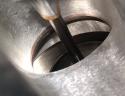
This is why SOMETIMES - not always, but SOMETIMES - you can actually get LESS flow, IN A MOTOR, from a larger valve than a smaller one... because the valve is right up against the cyl wall or the wall of the head chamber (as shown in my photos), and there's no room AROUND the valve for material to pass through and AROUND it. The REST OF THE MOTOR gets in the way of flow through the valve.
NONE of this has ANYTHING to do with "reversion". "Reversion" is a function of valve TIMING, specifically, it occurs when the valve is open at some time when the pressures on the 2 sides of it are in the wrong orientation. (such as, when the int valve opens when there's vacuum in the intake manifold but there's still leftover combustion pressure in the cyl because it hasn't all "blown down" through the exh valve yet) It is NOT RELATED in any manner way shape form or fashion to the shape of the chamber, or the shape of ANYTHING ELSE, around the valve.
It still boggles the mind how somebody can fail to be able to see this. I'm a teacher at the university level sometimes; I learned a long time ago that sometimes a student gets an idea into their head that's WRONG, but they can't see how it is WRONG; and the only way for me, as a teacher, to TEACH them, is to figure out what their WRONGNESS is, explain to them what about it is WRONG, and then once THAT light bulb comes on in their head, explain what's RIGHT. I'm failing to see how you fail to see how you're WRONG.
Yes I realize that the valve isn't "perpendicular" to the bore in most motors; it's at, what, 18° or something, in the LS series; but close enough to perpendicular to cause the issue at hand.
You STILL haven't figured out why ALMOST NOTHING can get through a 3.95" valve in a 4.00" bore, have you? It's because of SHROUDING. If the valve was 3.5" then it'd have 0.25" all the way around for material to pass through and around it and into the cyl. If it was 3" it'd have 0.5" all the way around. A 3" valve would flow ALOT MORE THAN a 3.95" one. Enlarging the valve from 3" to 3.95" will make it flow LESS. ALOT LESS.
This is why SOMETIMES - not always, but SOMETIMES - you can actually get LESS flow, IN A MOTOR, from a larger valve than a smaller one... because the valve is right up against the cyl wall or the wall of the head chamber (as shown in my photos), and there's no room AROUND the valve for material to pass through and AROUND it. The REST OF THE MOTOR gets in the way of flow through the valve.
NONE of this has ANYTHING to do with "reversion". "Reversion" is a function of valve TIMING, specifically, it occurs when the valve is open at some time when the pressures on the 2 sides of it are in the wrong orientation. (such as, when the int valve opens when there's vacuum in the intake manifold but there's still leftover combustion pressure in the cyl because it hasn't all "blown down" through the exh valve yet) It is NOT RELATED in any manner way shape form or fashion to the shape of the chamber, or the shape of ANYTHING ELSE, around the valve.
It still boggles the mind how somebody can fail to be able to see this. I'm a teacher at the university level sometimes; I learned a long time ago that sometimes a student gets an idea into their head that's WRONG, but they can't see how it is WRONG; and the only way for me, as a teacher, to TEACH them, is to figure out what their WRONGNESS is, explain to them what about it is WRONG, and then once THAT light bulb comes on in their head, explain what's RIGHT. I'm failing to see how you fail to see how you're WRONG.
Most people are using a 2.00 or 2.02 intake valve on a 3.9 inch bore. Even adding in a 1.5 or 1.6 exhaust valve get to 3.6 total valve area and not 3.95. Not sure where BR04Av is getting that number.

Launching!

Joined: Oct 2018
Posts: 201
Likes: 43
From: Illinois
The chamber does need a little work but going to a 2.05” valve (is typically what I do) doesn’t require a lot of additional work on the chamber outside of blending the valve job in. But let me add.... if you just stick a bigger valve in it, and don’t get the throat, bowl, and short turn right... you’ve actually made it worse.
Ive recently kinda went down this road. Been reading and reading and getting tips from people such as Ed Curtis. I took a pair of 862’s and had them cut for ls1 intake valves, I blended the valve seat into the bowl, cleaned up casting slag, knocked out the rocker bolt jump, bullet shaped the guides and got rid of the swirl ramp. I read a lot of conflicting information on the swirl ramp so hopefully I made the right choice for a 7000+ rpm drag car. I also bought dykum to port match my holley split race intake to the heads. These heads are on a 255/261 .650/.650 lift ls1 engine with domes, just over 14:1 compression. The heads are for sure going to be my restriction, so I’ve been devouring any information on the subject I can. I bought ferrea valves for these heads and they are off getting the works done currently in the valve job area. Really curious to see how it plains out.
Launching!
Joined: Oct 2018
Posts: 201
Likes: 43
From: Illinois
Ive recently kinda went down this road. Been reading and reading and getting tips from people such as Ed Curtis. I took a pair of 862’s and had them cut for ls1 intake valves, I blended the valve seat into the bowl, cleaned up casting slag, knocked out the rocker bolt jump, bullet shaped the guides and got rid of the swirl ramp. I read a lot of conflicting information on the swirl ramp so hopefully I made the right choice for a 7000+ rpm drag car. I also bought dykum to port match my holley split race intake to the heads. These heads are on a 255/261 .650/.650 lift ls1 engine with domes, just over 14:1 compression. The heads are for sure going to be my restriction, so I’ve been devouring any information on the subject I can. I bought ferrea valves for these heads and they are off getting the works done currently in the valve job area. Really curious to see how it plains out.
94 or 95% seat. 30/45/60 if memory is correct. Just pop the valve out on bench and it will jump 20cfm. That tells u right there. How bad it is.
But yet they still make decent power for what they are on a 5.3 or even a 6.0 in stock form( with no vj or port work )with a cam/intake change. That's just a example. Not saying that's what above poster needs. Just for discussion sake, Flow that port in reverse and then a 243 in reverse may tell you something. Maybe not. Ed actually gave me a good idea to try on a ford head .there are alot of conflicting opinions and there always will be.

TECH Addict


Joined: Dec 2017
Posts: 2,180
Likes: 969
Dunning-Kruger effect
Not sure where BR04Av is getting that number
Yup, gotta love it.
Nowhere in particular... it's just a thought experiment. I'm trying to get d00d to imagine putting A valve in A cylindrical tube, and imagine how much material would flow through THE valve into THE tube if the valve was 3.95" and the tube was 4.00". Then, how much "more" this LARGER valve would flow than a 3.5" or even a 3" valve into the same tube. It's an attempt at making an example of where enlarging the valve will REDUCE flow because the margin of the valve is SHROUDED; i.e. where the margin of the valve is up against something, or so close to it, that material CAN'T get around the edge of the valve. But his Dunning-Kruger is preventing him from seeing that, even when there's a photo of it right in front of him.
Nowhere in particular... it's just a thought experiment. I'm trying to get d00d to imagine putting A valve in A cylindrical tube, and imagine how much material would flow through THE valve into THE tube if the valve was 3.95" and the tube was 4.00". Then, how much "more" this LARGER valve would flow than a 3.5" or even a 3" valve into the same tube. It's an attempt at making an example of where enlarging the valve will REDUCE flow because the margin of the valve is SHROUDED; i.e. where the margin of the valve is up against something, or so close to it, that material CAN'T get around the edge of the valve. But his Dunning-Kruger is preventing him from seeing that, even when there's a photo of it right in front of him.
Or is it too far gone?
LS1 Tech Stories
The Best V8 Stories One Small Block at Time

6 Common C5 Corvette Failures and What's Involved In Repairing Them
Pouria Savadkouei
Retro Modern Bandit Pontiac Trans AM Comes With Burt Reynolds' Autograph
Verdad Gallardo
Top 10 Greatest Cadillac V Series Performance Models Ever, Ranked
Pouria Savadkouei
Top 10 Most Powerful Chevy Trucks Ever Made!

Hennessey's New Supercharged Silverado ZR2 Has 700 HP
Verdad Gallardo
Coachbuilt N2A Anteros Is an LS2-Powered C6 Corvette In Italian Clothes
Verdad Gallardo
Awesome K5 Blazer Restomod Comes With C7 Corvette Power
Verdad Gallardo
10 Camaros You Should Never Buy

10 LS Engine Myths That Refuse to Die
Verdad Gallardo Ive recently kinda went down this road. Been reading and reading and getting tips from people such as Ed Curtis. I took a pair of 862’s and had them cut for ls1 intake valves, I blended the valve seat into the bowl, cleaned up casting slag, knocked out the rocker bolt jump, bullet shaped the guides and got rid of the swirl ramp. I read a lot of conflicting information on the swirl ramp so hopefully I made the right choice for a 7000+ rpm drag car. I also bought dykum to port match my holley split race intake to the heads. These heads are on a 255/261 .650/.650 lift ls1 engine with domes, just over 14:1 compression. The heads are for sure going to be my restriction, so I’ve been devouring any information on the subject I can. I bought ferrea valves for these heads and they are off getting the works done currently in the valve job area. Really curious to see how it plains out.
Sounds like you're on the right path to making those heads as good as they can be and have the bases covered.
Just curious, what's the bore size?
Nowhere in particular... it's just a thought experiment. I'm trying to get d00d to imagine putting A valve in A cylindrical tube, and imagine how much material would flow through THE valve into THE tube if the valve was 3.95" and the tube was 4.00". Then, how much "more" this LARGER valve would flow than a 3.5" or even a 3" valve into the same tube. It's an attempt at making an example of where enlarging the valve will REDUCE flow because the margin of the valve is SHROUDED; i.e. where the margin of the valve is up against something, or so close to it, that material CAN'T get around the edge of the valve. But his Dunning-Kruger is preventing him from seeing that, even when there's a photo of it right in front of him.
You don't realize how much you actually don't know yet. The dynamics around the valve in a running engine is not as simple as you make it out to be. If you knew who WE TODD DID actually is, you may tone your ego down a little bit and listen to what he says.