When you click on links to various merchants on this site and make a purchase, this can result in this site earning a commission. Affiliate programs and affiliations include, but are not limited to, the eBay Partner Network.
I've done hours of research on this and need some advice. I'm building a 6.0 for a 78 C10 that will be mainly a show vehicle and a cruiser in good weather, will never see the track. But I want to get all the machine work as correct as possible. I want to bore this to 4.065, stock stroke. Using the calculators if I run a true flat top with 70cc (317's milled just a tad to clean up), I get 10.82-1, if using a flat top with two reliefs totaling 1.8cc I get 10.59-1. The cam I'm looking at is a Summit truck cam 8719 with intake closing at 36. Either way I get above 9.5 dynamic which I think is too high. Question is: How does the factory LS3 with 10.7-1 running true flat tops and 68cc heads run on pump gas from the factory with no problem? Is it the cam profile? The two cheap pistons I'm seeing are true flat and flat with 1.8cc, I don't want or need forged pistons. I don't want to have to mix or run race fuel, just mid to high grade pump gas. So, can I get away with 10.6 to 10.8 static? Thanks.
Most 10:1 engines with injection can run 87 octane, because many 5.3's run that compression and use regular. 10.6 or so can run 91 octane (no 93 in California...). You should be OK
I'd say yes you can get away with it, may need 93 octane depending on the environment. I'd probably do at least ~222/233 sized cam Summit Ghost Cam over the ~207/219 that's not really much cam for a 6.2 liter LS. The 4.065 bore will yield 12 more cubes for a 376/6.2 liter same as an LS3
Modern fuel injected engines have knock sensors and precision fuel metering to help allow the higher compression ratios. Likewise correct quench reduces sensitivity to detonation. Aluminum heads and aluminum block helps dissipate heat much better than cast iron. Spraying (fuel injection) the hot intake valve to better atomize fuel for better mixture All of these are factors in allowing an LS1/LS2/LS3 etc to do what it does.p
My carburated Dart 400 small block chevy "shows" a dynamic compression of 9.96 and has 10.85 to 1 static compression. Runs fine on 93 octane unless the temp is over 95 degrees and low humidity.
My 383 LS1 runs 11.3 compression, the 416 LS ~11.7 compression - no issues with 93
Last edited by 99 Black Bird T/A; Mar 25, 2022 at 03:32 PM.
Thanks. I do plan on running a .040 quench so I don't want to use a thicker gasket. I want to go with a truck cam large enough to hear but not large enough to need a high stall converter. I've done all that in the past with BB Olds motors, this one is just gonna get drove normal but with a little spice.
Most 10:1 engines with injection can run 87 octane, because many 5.3's run that compression and use regular. 10.6 or so can run 91 octane (no 93 in California...). You should be OK
Thanks, I replied under "quick reply", I'm learning this forum.
I'd say yes you can get away with it, may need 93 octane depending on the environment. I'd probably do at least ~222/233 sized cam Summit Ghost Cam over the ~207/219 that's not really much cam for a 6.2 liter LS. The 4.065 bore will yield 12 more cubes for a 376/6.2 liter same as an LS3
Modern fuel injected engines have knock sensors and precision fuel metering to help allow the higher compression ratios. Likewise correct quench reduces sensitivity to detonation. Aluminum heads and aluminum block helps dissipate heat much better than cast iron. Spraying (fuel injection) the hot intake valve to better atomize fuel for better mixture All of these are factors in allowing an LS1/LS2/LS3 etc to do what it does.p
My carburated Dart 400 small block chevy "shows" a dynamic compression of 9.96 and has 10.85 to 1 static compression. Runs fine on 93 octane unless the temp is over 95 degrees and low humidity.
My 383 LS1 runs 11.3 compression, the 416 LS ~11.7 compression - no issues with 93
I still wonder how a stock LS3 rated at 10.7 gets away with running on pump gas. I assume with a .052 or thicker gasket?
I still wonder how a stock LS3 rated at 10.7 gets away with running on pump gas. I assume with a .052 or thicker gasket?
Thicker gaskets doesn't help unless it dropped compression (if anything it hurts quench, so makes it worse).
Aluminum block dissipates heat, the factory cam ramps @.006" are lazy even though the .050" durations are short, and you have low & high octane tables, burst knock prediction, etc. etc. as safety measures.
Thicker gaskets doesn't help unless it dropped compression (if anything it hurts quench, so makes it worse).
Aluminum block dissipates heat, the factory cam ramps @.006" are lazy even though the .050" durations are short, and you have low & high octane tables, burst knock prediction, etc. etc. as safety measures.
Makes sense, that's why I'm keeping the quench at .038-.040. I'm just wondering about the LS3 factory set -up. How it can be 10.7 and be fine.
Makes sense, that's why I'm keeping the quench at .038-.040. I'm just wondering about the LS3 factory set -up. How it can be 10.7 and be fine.
It runs 91-93 gas easily with no ping. Knock sensors DO help with that.
I've wondered why GM didn't put .045 gaskets in all LS engines as that would have helped quench to a point where even the slight increase in compression would have been inconsequential.
It runs 91-93 gas easily with no ping. Knock sensors DO help with that.
I've wondered why GM didn't put .045 gaskets in all LS engines as that would have helped quench to a point where even the slight increase in compression would have been inconsequential.
Yes, I've wondered that myself. Seems like they are all .052 I believe. I guess I'll look for some pistons with more relief.
On 6.2 pistons with the two valve relieves that are staggered I have a concern that the inward relief will be where the squish pad is on the head. Does anybody know if the relief will miss that or be right under it? I'm prob over thinking this but that's one of my hang ups. Thanks.
You're over thinking it. Think about the combination. IT WORKS.
Plus, how else would you do it? I'm sure it has been brainstormed more than a few times.
The relief cut needs to be there.
The squish pad is everywhere the chamber is not.
How would you change any of that??
You're over thinking it. Think about the combination. IT WORKS.
Plus, how else would you do it? I'm sure it has been brainstormed more than a few times.
The relief cut needs to be there.
The squish pad is everywhere the chamber is not
How would you change any of that??
Yea, I know I over think stuff. The option is true flat top like an LS3 or piston with two reliefs that are staggered. I'm only looking at reliefs for lowering compression without interfering with the squish pad, I know the pad is everywhere the chamber is not but would one of the reliefs be where the pad is? Kinda like a piston with a recess, except just one valve relief.
Use the 1.8cc valve reliefs, buy an MLS gasket that gets you .036 to .043 quench distance, find a knowledgeable tuner to dial it in, fill it up with 91, and send it.
Use the 1.8cc valve reliefs, buy an MLS gasket that gets you .036 to .043 quench distance, find a knowledgeable tuner to dial it in, fill it up with 91, and send it.
That's the plan, Thanks. I appreciate all the replies.
Yea, I know I over think stuff. The option is true flat top like an LS3 or piston with two reliefs that are staggered. I'm only looking at reliefs for lowering compression without interfering with the squish pad, I know the pad is everywhere the chamber is not but would one of the reliefs be where the pad is? Kinda like a piston with a recess, except just one valve relief.
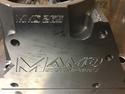
No. Valve reliefs are out in the chamber, well above (north of) the squish area. Here’s a pic I took of an LS7 head on a sleeved block…picture taken from the bottom of the bore looking up with no piton/rod assembly in yet, for mock-up…to help you picture cylinder orientation of an inline valve layout. Hope this helps…
The cam I'm looking at is a Summit truck cam 8719 with intake closing at 36. Either way I get above 9.5 dynamic which I think is too high.
You need to use the advertised/seat (aka .004"/.006") duration value to calculate dynamic compression correctly. Re-calculate DCR using 63* instead of 36*.
No. Valve reliefs are out in the chamber, well above (north of) the squish area. Here’s a pic I took of an LS7 head on a sleeved block…picture taken from the bottom of the bore looking up with no piton/rod assembly in yet, for mock-up…to help you picture cylinder orientation of an inline valve layout. Hope this helps…
You need to use the advertised/seat (aka .004"/.006") duration value to calculate dynamic compression correctly. Re-calculate DCR using 63* instead of 36*.
Gas Monkey Built a 6-Wheel Ferrari Testarossa With a Corvette LT4 Engine
Slideshow: The controversial Ferrari F6 swaps its original flat-12 for a Corvette Z06-derived LT4 V8 and sends power to four rear wheels through a custom-built drivetrain.
7 Most Reliable High-Performance Engines GM Has Ever Built
Slideshow:These GM engines didn't just make huge power, they survived abuse, boost, track days, and six-digit mileage with a reputation for refusing to quit.
6 Common C5 Corvette Failures and What's Involved In Repairing Them
Slideshow: From wobbling harmonic balancers to failed EBCMs, these are the issues that define long-term C5 ownership and what repairs typically involve.
Retro Modern Bandit Pontiac Trans AM Comes With Burt Reynolds' Autograph
Slideshow: A modern Camaro transformed into a retro icon, this limited-run "Bandit" build blends nostalgia with brute force in a way few revivals manage.
Top 10 Greatest Cadillac V Series Performance Models Ever, Ranked
Slideshow: Cadillac didn't just crash the high-performance luxury vehicle party, it showed up loud, supercharged, and occasionally a little unhinged...








 Dynamic compression question.