



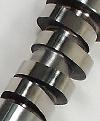


What effect do ramp rates have on how an engine runs?
 What effect do ramp rates have on how an engine runs?
 Do high ramp rates increase low end tq, or high end hp? Also, does it effect idle stability? I was looking at some of Comp's new Extreme cams and thought that they looked nice. Ramp rates are calculated by valve lift/adv. duration correct? Any serious disadvantages to ramp rates like the hammer cam has? Sure that valvetrain will be slightly louder, but can the seats take that slamming action for thousands of miles? Thanks guys. BTW, this new site is awesome. <img src="graemlins/gr_cheers.gif" border="0" alt="[cheers]" />

FormerVendor
Joined: Nov 2001
Posts: 3,065
Likes: 6
From: Houston, Tx.
Re: What effect do ramp rates have on how an engine runs? They're pretty much all good except that appropriate springs must be used to control the now higher valve velocities, so they may take away some rpm and reliability if setup wrong or used with bogus springs. They should add power everwhere since you can get more area under the curve without stretching the base timing events or even in some cases shortening them up some for the same .050 timing for example. There's a limit to everything but it's another frontier the cam companies are pushing to get another little bit more out of the same engines.
Re: What effect do ramp rates have on how an engine runs? A faster rate cam will have less total duration than a slower rate cam (even though they have the same duration at .050)
Take these two cams:
Comp 222/222 duration at .050, advertised duration 275/275
Lunati 221/221 duration at .050, advertised duration 283/283
Even though the Lunati has less duration at .050, it will idle poorer because it has 8 more degrees of total advertised duration than the Comp Cam. This is what a faster ramp cam will give you. The Comp will idle better and probably have more meat under the curve, making more power.
Take these two cams:
Comp 222/222 duration at .050, advertised duration 275/275
Lunati 221/221 duration at .050, advertised duration 283/283
Even though the Lunati has less duration at .050, it will idle poorer because it has 8 more degrees of total advertised duration than the Comp Cam. This is what a faster ramp cam will give you. The Comp will idle better and probably have more meat under the curve, making more power.
__________________

2013 Corvette Grand Sport A6 LME forged 416, Greg Good ported TFS 255 LS3 heads, 222/242 .629"/.604" 121LSA Pat G blower cam, ARH 1 7/8" headers, ESC Novi 1500 Supercharger w/8 rib direct drive conversion, 747rwhp/709rwtq on 93 octane, 801rwhp/735rwtq on race fuel, 10.1 @ 147.25mph 1/4 mile, 174.7mph Half Mile.
2016 Corvette Z51 M7 Magnuson Heartbeat 2300 supercharger, TSP LT headers, Pat G tuned, 667rwhp, 662rwtq, 191mph TX Mile.
2009.5 Pontiac G8 GT 6.0L, A6, AFR 230v2 heads. 506rwhp/442rwtq. 11.413 @ 121.29mph 1/4 mile, 168.7mph TX Mile
2000 Pewter Ram Air Trans Am M6 heads/cam 508 rwhp/445 rwtq SAE, 183.092 TX Mile
2022 Cadillac Escalade 6.2L A10 S&B CAI, Corsa catback.
2023 Corvette 3LT Z51 soon to be modified.
Custom LSX tuning in person or via email press here.
2013 Corvette Grand Sport A6 LME forged 416, Greg Good ported TFS 255 LS3 heads, 222/242 .629"/.604" 121LSA Pat G blower cam, ARH 1 7/8" headers, ESC Novi 1500 Supercharger w/8 rib direct drive conversion, 747rwhp/709rwtq on 93 octane, 801rwhp/735rwtq on race fuel, 10.1 @ 147.25mph 1/4 mile, 174.7mph Half Mile.
2016 Corvette Z51 M7 Magnuson Heartbeat 2300 supercharger, TSP LT headers, Pat G tuned, 667rwhp, 662rwtq, 191mph TX Mile.
2009.5 Pontiac G8 GT 6.0L, A6, AFR 230v2 heads. 506rwhp/442rwtq. 11.413 @ 121.29mph 1/4 mile, 168.7mph TX Mile
2000 Pewter Ram Air Trans Am M6 heads/cam 508 rwhp/445 rwtq SAE, 183.092 TX Mile
2022 Cadillac Escalade 6.2L A10 S&B CAI, Corsa catback.
2023 Corvette 3LT Z51 soon to be modified.
Custom LSX tuning in person or via email press here.

TECH Apprentice
Joined: Nov 2001
Posts: 339
Likes: 0
From: Indianapolis, IN
Re: What effect do ramp rates have on how an engine runs? Patrick is correct its the Advertised - @.050 duration numbers that give ramp rate from what I understand
look at some of the comp cams they have some real fast ramp rates but low lift if you worry about lift like some
look at some of the comp cams they have some real fast ramp rates but low lift if you worry about lift like some

Teching In
Joined: Nov 2001
Posts: 30
Likes: 0
From: Dallas
Re: What effect do ramp rates have on how an engine runs? And anyone that has compared the different lobes available will immediately notice a difference between a Comp and a Lunati....the slower ramp makes for a lazy engine off-idle.
[ December 04, 2001: Message edited by: HouseofSpeed ]</p>
[ December 04, 2001: Message edited by: HouseofSpeed ]</p>
Trending Topics
LS1 Tech Stories
The Best V8 Stories One Small Block at Time

Gas Monkey Built a 6-Wheel Ferrari Testarossa With a Corvette LT4 Engine
Verdad Gallardo
7 Most Reliable High-Performance Engines GM Has Ever Built
Verdad Gallardo
Amazing '71 Camaro Restomod Is Modern Muscle Car Under the Skin
Verdad Gallardo
6 Common C5 Corvette Failures and What's Involved In Repairing Them
Pouria Savadkouei
Retro Modern Bandit Pontiac Trans AM Comes With Burt Reynolds' Autograph
Verdad Gallardo
Top 10 Greatest Cadillac V Series Performance Models Ever, Ranked
Pouria Savadkouei
Top 10 Most Powerful Chevy Trucks Ever Made!

Hennessey's New Supercharged Silverado ZR2 Has 700 HP
Verdad Gallardo
Coachbuilt N2A Anteros Is an LS2-Powered C6 Corvette In Italian Clothes
Verdad Gallardo
TECH Addict
Joined: Nov 2001
Posts: 2,207
Likes: 0
From: College Station, Tx
Re: What effect do ramp rates have on how an engine runs? If you calculate valve lift / duration (for that lift) you are just getting the average rotational lift rate for that one specific interval.
Likewise if you follow the suggestion of taking the difference between advertised and duration @0.050 you are just taking the average rate of rotationl lift over that interval.
Just like you can have two cams that are similar @ 0.050 but vary wildly, you can have 2 cams that have the same average arbitrary rate, but still vary wildly.
For every single discrete lift value there is an instantaneous rate for that value. Only if all of these matched would the cam be the same.
For instance you could have 2 cams that have the same average rate from 0.007 to 0.050, yet were totally different - one might ramp up slowly, at an average acceleration, while the other had a quick initial acceleration, then levelled of - or another that opened slowly and then took off - yet they could all have the same average.
Furthermore, camshafts are all assymetric these days - the opening profile is completely different from the closing profile - and since duration numbers are just an average of these two events it's hard to compare two different lobes using them - you could have 2 lobes with identical advertised duration and duration @0.050 as well as lift figures, etc - yet be very different. One could have a very quick opening and a slow exhaust, the other could have a slow exhaust and a quick openinig - and even a third that was closer to average (with an infinite number of variations in between).
It's easy to say "hey, these lobes are quick" - since they have alot of lift with a low duration number - but that really doesn't tell you anything except overall averages.
If you have a cam doctor/cam pro then have at it - you can catalouge each lobe precisely and see what the differences are - position, velocity, acceleration, jerk, etc. are provided directly (I seem to recall) and of course you could extrapolate whatever else you wanted (though that should be plenty).
Unfortunately most of us don't have one <img src="images/icons/frown.gif" border="0"> . Where does that leave you? Empirical data. What works. Don't worry so much about average rates of acceleration, etc. - go with camshafts that have been proven to work, etc. If you want to try something new you can gamble, or do some research - talk to the cam manufactures (it helps to get past the front line support folk with many companies), talk to shops who know what they are doing/have expereince. If you really wanted to you could get some time on a cam doctor - if the shop has one and are interested in your grind they may catalouge it as a favor - and if they have done a good bit of business they may already have a good stack of info on popular grinds. Of course then you are stuck with interpreting this data, which isn't easy in itself. When you get to here, basically more agressive is better until you start to have problems. The most common thing I have seen seems to be the intake valve bouncing on the seat - yeah, not enough seat pressure can easily cause this, but it seems to many quite a few new grinds are picking up some "ramp rate" on the intake valve closing - this is great for dynamic compression, but can also lead to rpm problems easily.
And finally, if all this gives you a headache don't worry about it <img src="images/icons/smile.gif" border="0"> . If you go with a good lobe and a good manufacturer, and talk to a good speed shop you should do fine. Sure, there may be a grind that has 3 hp more. 4 ft-lbs of torque more. There probablly always will be - so just save up your money and stroke it <img src="images/icons/wink.gif" border="0"> .
Chris Bennight
Likewise if you follow the suggestion of taking the difference between advertised and duration @0.050 you are just taking the average rate of rotationl lift over that interval.
Just like you can have two cams that are similar @ 0.050 but vary wildly, you can have 2 cams that have the same average arbitrary rate, but still vary wildly.
For every single discrete lift value there is an instantaneous rate for that value. Only if all of these matched would the cam be the same.
For instance you could have 2 cams that have the same average rate from 0.007 to 0.050, yet were totally different - one might ramp up slowly, at an average acceleration, while the other had a quick initial acceleration, then levelled of - or another that opened slowly and then took off - yet they could all have the same average.
Furthermore, camshafts are all assymetric these days - the opening profile is completely different from the closing profile - and since duration numbers are just an average of these two events it's hard to compare two different lobes using them - you could have 2 lobes with identical advertised duration and duration @0.050 as well as lift figures, etc - yet be very different. One could have a very quick opening and a slow exhaust, the other could have a slow exhaust and a quick openinig - and even a third that was closer to average (with an infinite number of variations in between).
It's easy to say "hey, these lobes are quick" - since they have alot of lift with a low duration number - but that really doesn't tell you anything except overall averages.
If you have a cam doctor/cam pro then have at it - you can catalouge each lobe precisely and see what the differences are - position, velocity, acceleration, jerk, etc. are provided directly (I seem to recall) and of course you could extrapolate whatever else you wanted (though that should be plenty).
Unfortunately most of us don't have one <img src="images/icons/frown.gif" border="0"> . Where does that leave you? Empirical data. What works. Don't worry so much about average rates of acceleration, etc. - go with camshafts that have been proven to work, etc. If you want to try something new you can gamble, or do some research - talk to the cam manufactures (it helps to get past the front line support folk with many companies), talk to shops who know what they are doing/have expereince. If you really wanted to you could get some time on a cam doctor - if the shop has one and are interested in your grind they may catalouge it as a favor - and if they have done a good bit of business they may already have a good stack of info on popular grinds. Of course then you are stuck with interpreting this data, which isn't easy in itself. When you get to here, basically more agressive is better until you start to have problems. The most common thing I have seen seems to be the intake valve bouncing on the seat - yeah, not enough seat pressure can easily cause this, but it seems to many quite a few new grinds are picking up some "ramp rate" on the intake valve closing - this is great for dynamic compression, but can also lead to rpm problems easily.
And finally, if all this gives you a headache don't worry about it <img src="images/icons/smile.gif" border="0"> . If you go with a good lobe and a good manufacturer, and talk to a good speed shop you should do fine. Sure, there may be a grind that has 3 hp more. 4 ft-lbs of torque more. There probablly always will be - so just save up your money and stroke it <img src="images/icons/wink.gif" border="0"> .
Chris Bennight

TECH Regular
Joined: Nov 2001
Posts: 450
Likes: 0
From: Tullahoma TN
Re: What effect do ramp rates have on how an engine runs? Cams with overly aggressive ramps can hurt you on a street car. Some problems are:
1) possible valve bounce
2) early valve spring fatigue and/or breakage
3) need for $$$ high pressure springs
4) springs need replacing more frequently
5) less reliability and high rpm valvetrain stability
6) really need $$$ lightweight valve train components (retainers, valves, etc) for high rpm stability.
All of this is no problem if your car is mainly a weekend warrior or a strip only car. However if you drive your car on a daily basis and don't want to change valvespings once a year, I would stay with moderately aggressive ramps. It's all a tradeoff, power vs. long term reliability.
[ December 05, 2001: Message edited by: 2quick4u ]</p>
1) possible valve bounce
2) early valve spring fatigue and/or breakage
3) need for $$$ high pressure springs
4) springs need replacing more frequently
5) less reliability and high rpm valvetrain stability
6) really need $$$ lightweight valve train components (retainers, valves, etc) for high rpm stability.
All of this is no problem if your car is mainly a weekend warrior or a strip only car. However if you drive your car on a daily basis and don't want to change valvespings once a year, I would stay with moderately aggressive ramps. It's all a tradeoff, power vs. long term reliability.
[ December 05, 2001: Message edited by: 2quick4u ]</p>



Joined: Nov 2001
Posts: 34,643
Likes: 2,571
From: Schiller Park, ILL Member: #317
Re: What effect do ramp rates have on how an engine runs? I am looking at going with a custom ground Comp Xtreme RPM .563/.563//220/220//114. Would the B1 be a better choice for valvetrain longevity with it’s slower ramp rates? Is there enough difference between these two (ramp rate wise) to even really make a difference in the life of your valve springs?
Re: What effect do ramp rates have on how an engine runs? Between the B1 or the 220/220 114 Comp, you won't see 2 hp difference and you won't see 1000 miles difference in valve spring life (according to Jeff at MTI). Go with the cheaper one, they're both great!
__________________
2013 Corvette Grand Sport A6 LME forged 416, Greg Good ported TFS 255 LS3 heads, 222/242 .629"/.604" 121LSA Pat G blower cam, ARH 1 7/8" headers, ESC Novi 1500 Supercharger w/8 rib direct drive conversion, 747rwhp/709rwtq on 93 octane, 801rwhp/735rwtq on race fuel, 10.1 @ 147.25mph 1/4 mile, 174.7mph Half Mile.
2016 Corvette Z51 M7 Magnuson Heartbeat 2300 supercharger, TSP LT headers, Pat G tuned, 667rwhp, 662rwtq, 191mph TX Mile.
2009.5 Pontiac G8 GT 6.0L, A6, AFR 230v2 heads. 506rwhp/442rwtq. 11.413 @ 121.29mph 1/4 mile, 168.7mph TX Mile
2000 Pewter Ram Air Trans Am M6 heads/cam 508 rwhp/445 rwtq SAE, 183.092 TX Mile
2022 Cadillac Escalade 6.2L A10 S&B CAI, Corsa catback.
2023 Corvette 3LT Z51 soon to be modified.
Custom LSX tuning in person or via email press here.
2013 Corvette Grand Sport A6 LME forged 416, Greg Good ported TFS 255 LS3 heads, 222/242 .629"/.604" 121LSA Pat G blower cam, ARH 1 7/8" headers, ESC Novi 1500 Supercharger w/8 rib direct drive conversion, 747rwhp/709rwtq on 93 octane, 801rwhp/735rwtq on race fuel, 10.1 @ 147.25mph 1/4 mile, 174.7mph Half Mile.
2016 Corvette Z51 M7 Magnuson Heartbeat 2300 supercharger, TSP LT headers, Pat G tuned, 667rwhp, 662rwtq, 191mph TX Mile.
2009.5 Pontiac G8 GT 6.0L, A6, AFR 230v2 heads. 506rwhp/442rwtq. 11.413 @ 121.29mph 1/4 mile, 168.7mph TX Mile
2000 Pewter Ram Air Trans Am M6 heads/cam 508 rwhp/445 rwtq SAE, 183.092 TX Mile
2022 Cadillac Escalade 6.2L A10 S&B CAI, Corsa catback.
2023 Corvette 3LT Z51 soon to be modified.
Custom LSX tuning in person or via email press here.
Joined: Nov 2001
Posts: 34,643
Likes: 2,571
From: Schiller Park, ILL Member: #317
Re: What effect do ramp rates have on how an engine runs? Thanks Patrick. I'll stick with the comp then, as I can get the comp almost $100 cheaper than the B1.
 Re: What effect do ramp rates have on how an engine runs?
 Too aggressive of a ramp speed and everything John Tullis said happens... I think some of the Comp Xtreme stuff is maybe a bit too hardcore for the springs that are accessible to us (that fit in the stock seat pockets).
I had a Xtreme Energy 236/240/111LSA custom grind and had to use 977's which are double spring jobbies.
I had a Xtreme Energy 236/240/111LSA custom grind and had to use 977's which are double spring jobbies.
 Re: What effect do ramp rates have on how an engine runs?
 [quote]Originally posted by RPM WS6:
<strong>Thanks Patrick. I'll stick with the comp then, as I can get the comp almost $100 cheaper than the B1.</strong><hr></blockquote>
hmmmm, if the custom is $100 cheaper, than couldn't you get a "custom ground" comp with the B1 lunati specs and save a few $$?
<strong>Thanks Patrick. I'll stick with the comp then, as I can get the comp almost $100 cheaper than the B1.</strong><hr></blockquote>
hmmmm, if the custom is $100 cheaper, than couldn't you get a "custom ground" comp with the B1 lunati specs and save a few $$?
Re: What effect do ramp rates have on how an engine runs? [quote]Originally posted by RED QUASAR:
<strong>
hmmmm, if the custom is $100 cheaper, than couldn't you get a "custom ground" comp with the B1 lunati specs and save a few $$?</strong><hr></blockquote>
Nope, MTI owns the rights to the 'new' comp grind. Someone correct me if I'm wrong. I thought I remember Tony saying this.
Brad
<strong>
hmmmm, if the custom is $100 cheaper, than couldn't you get a "custom ground" comp with the B1 lunati specs and save a few $$?</strong><hr></blockquote>
Nope, MTI owns the rights to the 'new' comp grind. Someone correct me if I'm wrong. I thought I remember Tony saying this.
Brad
Teching In
Joined: Nov 2001
Posts: 30
Likes: 0
From: Dallas
Re: What effect do ramp rates have on how an engine runs? Not to step on anyone's pee-pee here, but we are talking about hydraulic rollers, correct? Give me the aggressive ramp EVERY time. Many of you that are giving the cons of the more aggressive lobes are speaking in tongues.
As Chris mentioned...you will be hard-pressed to find a symmetrical lobe offered by any cam grinder. Since the great Duntov brought the asymmetrical lobe to the masses, cam technology has moved strictly in that direction. This allows us to open quickly and yet slow the seating of the valve down as to not "bounce" it off the seat. What wasn't mentioned is that improper spring selection will lead to valve bounce way before an aggressive lobe will....a quality spring at the proper installed height and with the proper seat and open pressures can PROPERLY control the oscillation of the valve, but what is often overlooked is that which kills the spring...top-side oiling. What keeps the spring from dying in a high-pressure, high RPM environment? Proper oiling...to make sure the spring doesn't succumb to fatigue...exactly why Katech's tall "C5R" covers have spray bars. That, of course, only applies to a spring of substance and not some piece of crap from AutoZone. Your head man needs to know the application in question, have the cam card, and know what you want in terms of durability and performance. That will allow him to work within your budget to reach your goals and do so ONE TIME with the proper parts.
But again, that is only an issue with serious springs in serious applications. For the stuff that we see in the street-strip world, how many people have gone to a solid so far? Not many, and a lot won't because of misinformation regarding solids and their longevity/durability on a "street" application. Just as misinformation here will cause some of you to shy away from "aggressive" hydraulics.
SO, as a compromise...we either pick a relatively aggressive lobe for a hydraulic and make some power...or we err on the conservative side and compromise the potential of the engine. Go with the more aggressive lobe...you will be glad you did and it can be just as cost-effective and durable as the ***** version...if properly selected and installed.
As Chris mentioned...and before I forget....compare two similar lobes if you have the means. See which lobe loses the ramp race by comparing duration at .005, .010, .025, and so on to max....the faster lobe will make more power, even if the adverised and .050 numbers are identical.
[ December 05, 2001: Message edited by: HouseofSpeed ]</p>
As Chris mentioned...you will be hard-pressed to find a symmetrical lobe offered by any cam grinder. Since the great Duntov brought the asymmetrical lobe to the masses, cam technology has moved strictly in that direction. This allows us to open quickly and yet slow the seating of the valve down as to not "bounce" it off the seat. What wasn't mentioned is that improper spring selection will lead to valve bounce way before an aggressive lobe will....a quality spring at the proper installed height and with the proper seat and open pressures can PROPERLY control the oscillation of the valve, but what is often overlooked is that which kills the spring...top-side oiling. What keeps the spring from dying in a high-pressure, high RPM environment? Proper oiling...to make sure the spring doesn't succumb to fatigue...exactly why Katech's tall "C5R" covers have spray bars. That, of course, only applies to a spring of substance and not some piece of crap from AutoZone. Your head man needs to know the application in question, have the cam card, and know what you want in terms of durability and performance. That will allow him to work within your budget to reach your goals and do so ONE TIME with the proper parts.
But again, that is only an issue with serious springs in serious applications. For the stuff that we see in the street-strip world, how many people have gone to a solid so far? Not many, and a lot won't because of misinformation regarding solids and their longevity/durability on a "street" application. Just as misinformation here will cause some of you to shy away from "aggressive" hydraulics.
SO, as a compromise...we either pick a relatively aggressive lobe for a hydraulic and make some power...or we err on the conservative side and compromise the potential of the engine. Go with the more aggressive lobe...you will be glad you did and it can be just as cost-effective and durable as the ***** version...if properly selected and installed.
As Chris mentioned...and before I forget....compare two similar lobes if you have the means. See which lobe loses the ramp race by comparing duration at .005, .010, .025, and so on to max....the faster lobe will make more power, even if the adverised and .050 numbers are identical.
[ December 05, 2001: Message edited by: HouseofSpeed ]</p>
TECH Regular
Joined: Nov 2001
Posts: 450
Likes: 0
From: Tullahoma TN
Re: What effect do ramp rates have on how an engine runs? [quote]Originally posted by HouseofSpeed:
<strong>
But again, that is only an issue with serious springs in serious applications. For the stuff that we see in the street-strip world, how many people have gone to a solid so far? Not many, and a lot won't because of misinformation regarding solids and their longevity/durability on a "street" application. Just as misinformation here will cause some of you to shy away from "aggressive" hydraulics.
SO, as a compromise...we either pick a relatively aggressive lobe for a hydraulic and make some power...or we err on the conservative side and compromise the potential of the engine. Go with the more aggressive lobe...you will be glad you did and it can be just as cost-effective and durable as the ***** version...if properly selected and installed.
HouseofSpeed ]</strong><hr></blockquote>
Tell that to the folks who had aggressive ramp cams and Comp 941 springs installed 'professionally' only to have broken springs and a screwed up engine.
The more aggressive you go, the more durability and realiability you will give up. The higher the lifter acceleration rates, the higher the momentum of the parts and the forces exerted on the valvetrain. The only way around this is too replace the entire valvetrain with $$$ lightweight racing components like GM did with the $42 a piece lightweight valves on the '02 LS6.
If you decide to go with a very aggressive lobe design, I would use lighter lifters than stock or one of ARE's rev kits that has springs on top of the lifters for added insurance.
When I talk about durability I'm not talking about race car durability where the engine is torn down and completely rebuilt at least once a year, I'm talking about street car 100,000+ mile durability.
[ December 06, 2001: Message edited by: 2quick4u ]</p>
<strong>
But again, that is only an issue with serious springs in serious applications. For the stuff that we see in the street-strip world, how many people have gone to a solid so far? Not many, and a lot won't because of misinformation regarding solids and their longevity/durability on a "street" application. Just as misinformation here will cause some of you to shy away from "aggressive" hydraulics.
SO, as a compromise...we either pick a relatively aggressive lobe for a hydraulic and make some power...or we err on the conservative side and compromise the potential of the engine. Go with the more aggressive lobe...you will be glad you did and it can be just as cost-effective and durable as the ***** version...if properly selected and installed.
HouseofSpeed ]</strong><hr></blockquote>
Tell that to the folks who had aggressive ramp cams and Comp 941 springs installed 'professionally' only to have broken springs and a screwed up engine.
The more aggressive you go, the more durability and realiability you will give up. The higher the lifter acceleration rates, the higher the momentum of the parts and the forces exerted on the valvetrain. The only way around this is too replace the entire valvetrain with $$$ lightweight racing components like GM did with the $42 a piece lightweight valves on the '02 LS6.
If you decide to go with a very aggressive lobe design, I would use lighter lifters than stock or one of ARE's rev kits that has springs on top of the lifters for added insurance.
When I talk about durability I'm not talking about race car durability where the engine is torn down and completely rebuilt at least once a year, I'm talking about street car 100,000+ mile durability.
[ December 06, 2001: Message edited by: 2quick4u ]</p>
 Re: What effect do ramp rates have on how an engine runs?
 When you guys say less reliable high RPM valvetrain stability, what kind of RPM's are you talking about? 6000+, 6200+, 6500+ ?
- Keith
- Keith
