


Valves hit pistons,help me figure out why.


 That, along with...
Originally Posted by speed_demon24
Just because springs are rated for so and so lift doesn't mean they have enough spring pressure to control the valves. And just because the cam doctors out fine doesn't mean the timing chain and the slot for they key in the crankshaft is machined perfect, degreeing the cam checks all of the tollerances.


I have heard of using modelling clay and measuring the squish.
They put a ball of it on the valve and see how far it is compressed by the piston. PITA
Another way is with depth guages.
Many ways to skin a cat...
They put a ball of it on the valve and see how far it is compressed by the piston. PITA
Another way is with depth guages.
Many ways to skin a cat...

Thread Starter
10 Second Club
iTrader: (22)
Joined: Mar 2006
Posts: 3,677
Likes: 2
From: Northwest side of Chicago
Got to admit it sounds very strange that a tr224 cam would have ptv clearance issues
Especially that ive had it in for 7k and 100+track passes with no issues. Im starting to lean more towards the fact that at my last track outing i bounced off the limiter alot at about 6800rpm. I was under the impression an ls1 with dual valve springs could handle that.
Especially that ive had it in for 7k and 100+track passes with no issues. Im starting to lean more towards the fact that at my last track outing i bounced off the limiter alot at about 6800rpm. I was under the impression an ls1 with dual valve springs could handle that.

Originally Posted by SPRAYED 01
They are crane dual springs rated at .650 lift max. I was only running .565lift. The only thing i can think of is this. When i installed the heads from texas speed they had different valve seals on them that i couldnt fit the dual springs over. So i had to swap over the valve seals off my stock heads on the new ones. The new ones also had shims under the springs. I didnt transfer the shims because i thought they were only for the springs that cam on the new heads that i wasnt going to use. So if the shim was supposed to be there i could have floated a valve.
Bingo. The as installed Crane seat pressure without shimming is approximately 122#. I can't figure out your actual installation was when you removed the valve seals, did you use the Crane seats? What was the exact setup?
Thread Starter
10 Second Club
iTrader: (22)
Joined: Mar 2006
Posts: 3,677
Likes: 2
From: Northwest side of Chicago
The exact setup was the kit from Thunderracing. which was the tr224 cam,dual crane springs,crane titanium retainers,new seals and tr pushrod stock length. Then 3k after i was running cam only i did the TSP Ported ls6 heads. New heads stock deck height just ported and polished with a 5 angle valve job. TSP said the shim was not needed becuase i put the dual cranes on.

when you hit the rev limiter you floated the valves just enough to touch the pistons,thats why you only found one bent(STAINLESS ? ) i would pull the other head, check for marks,im guessing they are there. Check you heads on a bench by pouring gasoline into each chamber and see if it leaks past the valves.if it does you need to have them ground. also i would have the springs checked and see if they are close too spec.I would also degree the cam on installation,its the only way to be shure!

TECH Senior Member
Joined: Mar 2004
Posts: 14,620
Likes: 17
From: BFE
How do you get floating valves from hitting rev limiter on a A4??? This is not a mechanical over-rev.
When you hit the limiter your motor goes into a cut fuel/low timing mode. Granted not good on juice but not valve kissing area. I believe either the heads are decked (milled), or it is from the springs.
When you hit the limiter your motor goes into a cut fuel/low timing mode. Granted not good on juice but not valve kissing area. I believe either the heads are decked (milled), or it is from the springs.
 yep...
Originally Posted by PREDATOR-Z
How do you get floating valves from hitting rev limiter on a A4??? This is not a mechanical over-rev.
When you hit the limiter your motor goes into a cut fuel/low timing mode. Granted not good on juice but not valve kissing area. I believe either the heads are decked (milled), or it is from the springs.
When you hit the limiter your motor goes into a cut fuel/low timing mode. Granted not good on juice but not valve kissing area. I believe either the heads are decked (milled), or it is from the springs.
Check the V2P. The CC site has the instructions, and Powerhouse has the tools.
Thread Starter
10 Second Club
iTrader: (22)
Joined: Mar 2006
Posts: 3,677
Likes: 2
From: Northwest side of Chicago
Im having the springs checked and the heads checked. I did a cylinder leakage test and a compression test on the pass side. There was no leakage and compression was about 205psi on all four. The valves are stock not stainless.



Joined: Apr 2006
Posts: 3,861
Likes: 1,120
From: Grand Rapids, Michigan
Another thing to ponder: When a valve job is done on a set of heads and the valve diameter is not increased, it sinks the face of the valve a bit more into the head. This in itself can cause the seat pressure to be reduced even on an identical spring setup. Pull a valve cover and measure your installed height. I still think it's reduced seat pressure that caused the problem.
Joined: Apr 2006
Posts: 3,861
Likes: 1,120
From: Grand Rapids, Michigan
You need to find the proper installed height for the specific springs you have. They'll give you a seat pressure value at a certain installed height. The installed heights vary from spring to spring.
If you check your setup, you may find you are at aroud 120#, possibly less. Since the heads have been worked, you first need to figure out your unshimmed height, then you can compute the required height based on the installed seat force requirement. I would shoot for 135# - 140# and you also need to check compressed clearance between coils and compressed clearance to the valve seal. Don't just slap them in.

Originally Posted by LS1Formulation
Another thing to ponder: When a valve job is done on a set of heads and the valve diameter is not increased, it sinks the face of the valve a bit more into the head. This in itself can cause the seat pressure to be reduced even on an identical spring setup. Pull a valve cover and measure your installed height. I still think it's reduced seat pressure that caused the problem.
Can't wait to see what the machine shop measures the installed height at and the spring pressure...

Thread Starter
10 Second Club
iTrader: (22)
Joined: Mar 2006
Posts: 3,677
Likes: 2
From: Northwest side of Chicago
The heads have been worked over but not the valve seat. I spoke to texas speed and these are brand new 243 castings that they buy and port and polish them. They leave the seat stock. Crane said that at 1inch it should be 352. I just need to find out what the proper installed height would be and then wait for the results from the machine shop. I actually hope they are bad springs. At least i will have an answer to what caused this issue. Thanks for all the input, keep it coming and ill keep posted on machine shop results.
Thread Starter
10 Second Club
iTrader: (22)
Joined: Mar 2006
Posts: 3,677
Likes: 2
From: Northwest side of Chicago
Okay here is a thought. The crane springs are specifically designed for an ls1. So would it be safe to assume that they are meant to be used at stock ls1 height? Also, if i need about 140,can i tell the machine shop to shim to the height that would produce 140 provided that the springs are okay?
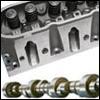
I can't see how a 224/224 cam could have PTV clearance problems with an unmilled head, even if it was not degreed. If it was that far off it would have to run very poorly.
Degreed or not, check the valve drop to see how they fare, and check the PTV clearance with a degree wheel, dial indicator and checking springs.
Degreed or not, check the valve drop to see how they fare, and check the PTV clearance with a degree wheel, dial indicator and checking springs.