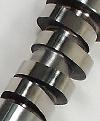



How to "Match" VE's for a new Cam

Thread Starter
TECH Enthusiast
iTrader: (42)
Joined: Mar 2006
Posts: 725
Likes: 0
From: Gettysburg, PA
 How to "Match" VE's for a new Cam
 I had another thread in here about installing a cam and after a discussion with another member I had a few questions that went un-answered. I had orginally asked about how to install the cam (dot-to-dot, advanced or retarded) and I was answered with this:
That answered my question but gave me a few more on how the cam works (which I figured no-one would answer in that thread about how to install a cam) so I made this one. Anyways here is what I posted back and am still wondering about:
Originally Posted by brad8266
More advance will give you better low end power at the expense of some top end power. Retarding the cam will give you top end at the expense of low end. I would degree it so that your valve overlap is centered over piston TDC. Example:
Dot to Dot: IVO:2 degrees BTDC and EVC:2 degrees ADTC means that overlap is centered over TDC. Total overlap is 4 degrees.
1 degree retard- IVO: 1 degree BTDC EVC:3 degrees ATDC means that overlap is more biased to the exhaust. Still 4 degrees overlap.
1 degree advance- IVO: 3 degree BTDC EVC:1 degrees ATDC means that overlap is more biased to the intake. Still 4 degrees overlap.
You can use the DCR calculator and play with your degree numbers(ICl) to see what ICL will make you overlap as close to centered over TDC.
Dot to Dot: IVO:2 degrees BTDC and EVC:2 degrees ADTC means that overlap is centered over TDC. Total overlap is 4 degrees.
1 degree retard- IVO: 1 degree BTDC EVC:3 degrees ATDC means that overlap is more biased to the exhaust. Still 4 degrees overlap.
1 degree advance- IVO: 3 degree BTDC EVC:1 degrees ATDC means that overlap is more biased to the intake. Still 4 degrees overlap.
You can use the DCR calculator and play with your degree numbers(ICl) to see what ICL will make you overlap as close to centered over TDC.
Originally Posted by LS1IMPULSE
So if i understand correctly the ICL is the degrees you advance or retard the cam from dot-to-dot and it looks like you included the +2 ground into the cam for the VE's correct?
So then what is the difference between grinding the advance/retard into the cam and doing it by not installing dot to dot?
Also do you maybe know were I could find an article that will explain how all the VE effect everything, and I noticed that some of the big guys on here talk about"matching there VE's", but what do you match them to? Maybe the other mods they have, like a free-flowing exhaust you would want more exhaust duration or lift? Or if you have a set of ported heads with a great high CFM flowing intake you want more itake duration/lift. And what would it be better to add duration or lift since they both pretty much effect how long the valve is open what would be the difference in 232 duration .600 lift -and- 228 duration .630 lift (or whatever would allow the valve to stay open just as long as the first scenario)
So then what is the difference between grinding the advance/retard into the cam and doing it by not installing dot to dot?
Also do you maybe know were I could find an article that will explain how all the VE effect everything, and I noticed that some of the big guys on here talk about"matching there VE's", but what do you match them to? Maybe the other mods they have, like a free-flowing exhaust you would want more exhaust duration or lift? Or if you have a set of ported heads with a great high CFM flowing intake you want more itake duration/lift. And what would it be better to add duration or lift since they both pretty much effect how long the valve is open what would be the difference in 232 duration .600 lift -and- 228 duration .630 lift (or whatever would allow the valve to stay open just as long as the first scenario)
Originally Posted by Dan_the_C5_Man
Let me take a stab here;
VE = Volumetric Efficiency
What this refers to tables in the PCM describing what the flow through the motor is predicted to be from intake to exhaust for any given RPM and throttle position.
VE = Volumetric Efficiency
What this refers to tables in the PCM describing what the flow through the motor is predicted to be from intake to exhaust for any given RPM and throttle position.
To answer one of the questions, to the best of my knowledge there is no difference between advancing the cam with an adjustable timing chain and having the advance ground in. Some people actually end up changing the advance/retard with the adjustable timing chain if the cam is ground with too much/too little advance. It's possible to order a cam with a +2 but end up getting a +3.5. In that case you can compinsate for this with the adjustable timing chain.
I'd bet most of the time when you see people saying "matching VE's" they're talking about to their application. Example...There isn't much point in buying a cam with 645 lift on the intake if your cylinder heads run out of breathe at around 600 lift. It would probaby work fine, but it's not an optimized setup. To fully take advantage of the high lift LSK lobes, you should *in my opinion* have high flowing cylinder heads.
Last edited by Xtnct00WS6; Mar 8, 2007 at 11:35 PM.
Thread Starter
TECH Enthusiast
iTrader: (42)
Joined: Mar 2006
Posts: 725
Likes: 0
From: Gettysburg, PA
I'm reffering to VE's in terms on Valve Events caused by the cam not SD and MAF systems.
Im not looking for advice on a cam either I'm just trying to learn how the valve events effect effect the way the car will perform...For example, I saw Patrick G looking over a cam the other day and he said the overlap was exhaust biased, which I cant remeber what that caused in terms of the way the power was distributed but this is the type of thing I am tying to figure out...how all the different valve events effect everything.
Im not looking for advice on a cam either I'm just trying to learn how the valve events effect effect the way the car will perform...For example, I saw Patrick G looking over a cam the other day and he said the overlap was exhaust biased, which I cant remeber what that caused in terms of the way the power was distributed but this is the type of thing I am tying to figure out...how all the different valve events effect everything.
Thread Starter
TECH Enthusiast
iTrader: (42)
Joined: Mar 2006
Posts: 725
Likes: 0
From: Gettysburg, PA
Originally Posted by Xtnct00WS6
He's referring to valve events.
To answer one of the questions, to the best of my knowledge there is no difference between advancing the cam with an adjustable timing chain and having the advance ground in. Some people actually end up changing the advance/retard with the adjustable timing chain if the cam is ground with too much/too little advance. You can order a cam with a +2 but end up getting a +3.5 so you can compinsate for this with the adjustable timing chain.
To answer one of the questions, to the best of my knowledge there is no difference between advancing the cam with an adjustable timing chain and having the advance ground in. Some people actually end up changing the advance/retard with the adjustable timing chain if the cam is ground with too much/too little advance. You can order a cam with a +2 but end up getting a +3.5 so you can compinsate for this with the adjustable timing chain.
If you want to know if a cam is intake/exhaust biased you can take a cam like this for example: 230/236
236-230= 6
6/4=1.5 (result / 4 = number of degrees biased)
So this would be 1.5 degrees intake biased since it's the smaller of the two numbers. Someone please correct me if I'm wrong. It's pretty close to my equation above. I'm not sure what happens when you advance or retard the cam though. Maybe someone will chime in with that answer.
236-230= 6
6/4=1.5 (result / 4 = number of degrees biased)
So this would be 1.5 degrees intake biased since it's the smaller of the two numbers. Someone please correct me if I'm wrong. It's pretty close to my equation above. I'm not sure what happens when you advance or retard the cam though. Maybe someone will chime in with that answer.
Thread Starter
TECH Enthusiast
iTrader: (42)
Joined: Mar 2006
Posts: 725
Likes: 0
From: Gettysburg, PA
I can't remember if I am right but I beleive Patrick said the biases can be determined from IVO - EVC
So for a 230/236 .598/.598 112 +2
IVO - 7 BTDC
IVC - 43 ABDC
EVO - 50 BBDC
EVC 2 ATDC
9 Degrees overlap
So if I am rigth this cam would have a 5 degree intake bias (im guessing intake since the most overlap is BTDC)
But what about the world of other VE, how do THEY effect how the car drives.
So for a 230/236 .598/.598 112 +2
IVO - 7 BTDC
IVC - 43 ABDC
EVO - 50 BBDC
EVC 2 ATDC
9 Degrees overlap
So if I am rigth this cam would have a 5 degree intake bias (im guessing intake since the most overlap is BTDC)
But what about the world of other VE, how do THEY effect how the car drives.
Trending Topics
Originally Posted by LS1IMPULSE
I can't remember if I am right but I beleive Patrick said the biases can be determined from IVO - EVC
So for a 230/236 .598/.598 112 +2
IVO - 7 BTDC
IVC - 43 ABDC
EVO - 50 BBDC
EVC 2 ATDC
9 Degrees overlap
So if I am rigth this cam would have a 5 degree intake bias (im guessing intake since the most overlap is BTDC)
But what about the world of other VE, how do THEY effect how the car drives.
So for a 230/236 .598/.598 112 +2
IVO - 7 BTDC
IVC - 43 ABDC
EVO - 50 BBDC
EVC 2 ATDC
9 Degrees overlap
So if I am rigth this cam would have a 5 degree intake bias (im guessing intake since the most overlap is BTDC)
But what about the world of other VE, how do THEY effect how the car drives.
IVO: 5 BTDC
IVC: 45 ABDC
EVO: 52 BBDC
EVC: 4 ATDC
This cam has its overlap biased 1/2 degree to the exhaust side of TDC.
Here's a better illustration. Same cam, but different advances:
230/236 112LSA +4
IVO: 7 BTDC
IVC: 43 ABDC
EVO: 54 BBDC
EVC: 2 ATDC
This cam has its overlap biased 2.5 degrees to the exhaust side of TDC. This means it will be strong down low, but run out of breath faster after its power peak.
230/236 112LSA +0
IVO: 3 BTDC
IVC: 47 ABDC
EVO: 50 BBDC
EVC: 6 ATDC
This cam has its overlap biased 1.5 degrees to the intake side of TDC. This means it will pull harder and longer after its power peak.
__________________

2013 Corvette Grand Sport A6 LME forged 416, Greg Good ported TFS 255 LS3 heads, 222/242 .629"/.604" 121LSA Pat G blower cam, ARH 1 7/8" headers, ESC Novi 1500 Supercharger w/8 rib direct drive conversion, 747rwhp/709rwtq on 93 octane, 801rwhp/735rwtq on race fuel, 10.1 @ 147.25mph 1/4 mile, 174.7mph Half Mile.
2016 Corvette Z51 M7 Magnuson Heartbeat 2300 supercharger, TSP LT headers, Pat G tuned, 667rwhp, 662rwtq, 191mph TX Mile.
2009.5 Pontiac G8 GT 6.0L, A6, AFR 230v2 heads. 506rwhp/442rwtq. 11.413 @ 121.29mph 1/4 mile, 168.7mph TX Mile
2000 Pewter Ram Air Trans Am M6 heads/cam 508 rwhp/445 rwtq SAE, 183.092 TX Mile
2022 Cadillac Escalade 6.2L A10 S&B CAI, Corsa catback.
2023 Corvette 3LT Z51 soon to be modified.
Custom LSX tuning in person or via email press here.
2013 Corvette Grand Sport A6 LME forged 416, Greg Good ported TFS 255 LS3 heads, 222/242 .629"/.604" 121LSA Pat G blower cam, ARH 1 7/8" headers, ESC Novi 1500 Supercharger w/8 rib direct drive conversion, 747rwhp/709rwtq on 93 octane, 801rwhp/735rwtq on race fuel, 10.1 @ 147.25mph 1/4 mile, 174.7mph Half Mile.
2016 Corvette Z51 M7 Magnuson Heartbeat 2300 supercharger, TSP LT headers, Pat G tuned, 667rwhp, 662rwtq, 191mph TX Mile.
2009.5 Pontiac G8 GT 6.0L, A6, AFR 230v2 heads. 506rwhp/442rwtq. 11.413 @ 121.29mph 1/4 mile, 168.7mph TX Mile
2000 Pewter Ram Air Trans Am M6 heads/cam 508 rwhp/445 rwtq SAE, 183.092 TX Mile
2022 Cadillac Escalade 6.2L A10 S&B CAI, Corsa catback.
2023 Corvette 3LT Z51 soon to be modified.
Custom LSX tuning in person or via email press here.
LS1 Tech Stories
The Best V8 Stories One Small Block at Time

Retro Modern Bandit Pontiac Trans AM Comes With Burt Reynolds' Autograph
Verdad Gallardo
Top 10 Greatest Cadillac V Series Performance Models Ever, Ranked
Pouria Savadkouei
Top 10 Most Powerful Chevy Trucks Ever Made!

Hennessey's New Supercharged Silverado ZR2 Has 700 HP
Verdad Gallardo
Coachbuilt N2A Anteros Is an LS2-Powered C6 Corvette In Italian Clothes
Verdad Gallardo
Awesome K5 Blazer Restomod Comes With C7 Corvette Power
Verdad Gallardo
10 Camaros You Should Never Buy

10 LS Engine Myths That Refuse to Die
Verdad Gallardo
Five Reasons the Camaro Was the Most Pivotal Player in the Pony Car Wars 2.0
Brett Foote Thread Starter
TECH Enthusiast
iTrader: (42)
Joined: Mar 2006
Posts: 725
Likes: 0
From: Gettysburg, PA
So it looks like IVO - EVC /2 will give you your bias with a negative number being the intake and a positive the exhaust? Do you know of any write-ups that will explain how all the other VE affect the cars perfromance?
And what about this question from the original post:
And what would it be better to add duration or lift since they both pretty much effect how long the valve is open what would be the difference in 232 duration .600 lift -and- 228 duration .630 lift (or whatever would allow the valve to stay open just as long as the first scenario)
also which calculator are you using to get VE's? The one I have must be wrong.
thank you for posting!
And what about this question from the original post:
And what would it be better to add duration or lift since they both pretty much effect how long the valve is open what would be the difference in 232 duration .600 lift -and- 228 duration .630 lift (or whatever would allow the valve to stay open just as long as the first scenario)
also which calculator are you using to get VE's? The one I have must be wrong.
thank you for posting!

Originally Posted by Xtnct00WS6
If you want to know if a cam is intake/exhaust biased you can take a cam like this for example: 230/236
236-230= 6
6/4=1.5 (result / 4 = number of degrees biased)
So this would be 1.5 degrees intake biased since it's the smaller of the two numbers. Someone please correct me if I'm wrong. It's pretty close to my equation above. I'm not sure what happens when you advance or retard the cam though. Maybe someone will chime in with that answer.
236-230= 6
6/4=1.5 (result / 4 = number of degrees biased)
So this would be 1.5 degrees intake biased since it's the smaller of the two numbers. Someone please correct me if I'm wrong. It's pretty close to my equation above. I'm not sure what happens when you advance or retard the cam though. Maybe someone will chime in with that answer.
Originally Posted by brad8266
Wrong. He is referring to overlap bias.
Originally Posted by Xtnct00WS6
I'm pretty sure it's correct in terms of a rule of thumb to see if a cam is intake or exhaust biased. If it's not correct, do you know what it is?

Originally Posted by Xtnct00WS6
I'm pretty sure it's correct in terms of a rule of thumb to see if a cam is intake or exhaust biased. If it's not correct, do you know what it is?
Originally Posted by LS1IMPULSE
what would it be better to add duration or lift since they both pretty much effect how long the valve is open what would be the difference in 232 duration .600 lift -and- 228 duration .630 lift (or whatever would allow the valve to stay open just as long as the first scenario)
also which calculator are you using to get VE's? The one I have must be wrong.
also which calculator are you using to get VE's? The one I have must be wrong.
Another way to compare cams is duration at .200 lift. .006 and .050 are industry yardsticks that allow general comparison of the profiles, but .200 lift figures can vary greatly between cams that on the surface appear similar. Two cams that have similar seat and .050 durations and similar LSA and ICL should also operate in much the same way. More agressive lobes have more duration at .200 and offer the potential to flow more air. Generally to keep valve acceleration under control, higher lift is also necessary.
The DCR calculator in my signature will also give VE's. Also, read up on the cam guide link there.
Thread Starter
TECH Enthusiast
iTrader: (42)
Joined: Mar 2006
Posts: 725
Likes: 0
From: Gettysburg, PA
thanks for the new calculator, but I this this link for the cams is a little more informative http://www.compcams.com/Community/A...?ID=-2026144213 but ive only made it to like page 5 so far.
Originally Posted by LS1IMPULSE
thanks for the new calculator, but I this this link for the cams is a little more informative http://www.compcams.com/Community/A...?ID=-2026144213 but ive only made it to like page 5 so far.

Try this: http://www.compcams.com/Community/Ar...ID=-2026144213
Last edited by Xtnct00WS6; Mar 11, 2007 at 01:00 PM.
Thread Starter
TECH Enthusiast
iTrader: (42)
Joined: Mar 2006
Posts: 725
Likes: 0
From: Gettysburg, PA
ls1tech is changing the address im putting in so copy paste these two parts togather in the url bar:
http://www.compcams.com/Community/Articles
/Details.asp?ID=-2026144213
http://www.compcams.com/Community/Articles
/Details.asp?ID=-2026144213
I've seen that article before, and posted it in the Advanced Tech Forum.
Cam Design Theory from David Vizard
After reading it, I more or less applied its theory to a cam I had been looking into, and seemed to fit rather well. See that thread to see what tech's better contributors had to say.
Cam Design Theory from David Vizard
After reading it, I more or less applied its theory to a cam I had been looking into, and seemed to fit rather well. See that thread to see what tech's better contributors had to say.