


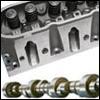



Cam Design Theory from David Vizard
 Cam Design Theory from David Vizard
 Apologies in advance for the long post, but I found this rather interesting. Rather than hijack the camshafts... semester 2... thread, I thought I'd start a new one here. Thanks to RYAN02SS for the link.
Be the Camshaft Expert from Popular Hot Rodding
After reading the article, it seems in contrast with the popular theory around here that you select the valve events to perform in the operating range you wish, thus leaving the LSA and overlap as a 'byproduct' of those events. I've noticed the trend to better street performance (higher DCR) through tighter LSA grinds, but what are your opinions on starting from LSA as stated, then arriving at the duration based on application?

346 ci (43.25 ci per cyl) with a 2.02 valve = 21.41 ci per inch of valve diameter. Based on the graph above, regardless of the operation range, 108 LSA would yield the best results.

After selecting the overlap desired, for my example here, a street performance cam, a range of 50* - 75* overlap should give the best results. Based on the formula above, I get a range as follows:
[(50/2)+108]*2 = 266 degrees, trend towards regular street cam
[(75/2)+108]*2 = 291 degrees, trend towards street/strip cam
In the middle of that range, 62.5 degrees overlap demands a duration of 278.5. To acheive this with a traditional split of 4 degrees, I'd want advertised durations of approximately 276/280.
So, what do you guys think?
Be the Camshaft Expert from Popular Hot Rodding
After reading the article, it seems in contrast with the popular theory around here that you select the valve events to perform in the operating range you wish, thus leaving the LSA and overlap as a 'byproduct' of those events. I've noticed the trend to better street performance (higher DCR) through tighter LSA grinds, but what are your opinions on starting from LSA as stated, then arriving at the duration based on application?
346 ci (43.25 ci per cyl) with a 2.02 valve = 21.41 ci per inch of valve diameter. Based on the graph above, regardless of the operation range, 108 LSA would yield the best results.
To arrive at the duration when the overlap and LCA are known, we take the overlap, divide by 2, add it to the LCA, then double it. That's the duration needed to satisfy the overlap and lca requirements.
[(50/2)+108]*2 = 266 degrees, trend towards regular street cam
[(75/2)+108]*2 = 291 degrees, trend towards street/strip cam
In the middle of that range, 62.5 degrees overlap demands a duration of 278.5. To acheive this with a traditional split of 4 degrees, I'd want advertised durations of approximately 276/280.
Code:
	                        0.006	0.050	0.200
Intake Duration - ID 	        277	228	153	Comp LSK 2127
Exhaust Duration - ED 	        281	232	156	Comp LSK 2128
Lobe Center Angle - LCA 	108	108	108
Intake Centerline - ICL 	108	108	108

Intake Valve opens - IVO	30.5	6	-31.5	BTDC (- indicates ATDC)
Intake Valve closes - IVC	66.5	42	4.5	ABDC
Exhaust Valve Opens - EVO	68.5	44	6	BBDC
Exhaust Valve Closes - EVC	32.5	8	-30	ATDC (- indicates BTDC)
Exhaust Centerline - ECL	108	108	108
Overlap 	                 63	14	-61.5	degrees
Dave is not a dummy, and even though a lot of his testing was done on flat tappet 23° headed, carb motors it still applies. Problem is different motors like different things and LS motors do like things a little differently. One of the flaws of just sticking with advertised specs is that it will leave you all over the map, you could change the lobe series and drop down to a low of 215° @ .050"..... and for god sakes stop trying to pick a "traditional" split... the split changes with so many variables it's just crazy to think there is a set amount. There is a range but not a set number.
All in all my personal though is you will never get good camshaft knowledge reading a forum. If that is the case then why do guys with 400+ cube motors stick with the 242/248 cam when it's not to hard to destroy that cam in low to midrange TQ by 20 ft lbs and make the same peak numbers? (BTDT) There are just way to many variables that come into play that simple formulas can't find.
I would say that what vizzard puts in that article is a focus on other parts of the cam that are important to look at as well, namely overlap. Overlap, IVC, ICL, durations, lift, lobe area are ALL important. I have yet to see one thread on this forum intellgently talking about lift ever.... and nobody has a clue as to why.
I think what that article comes down to is the LSA connection to valve diameter and cubes.... I don't get that connection exactly. I've backtracked into cams I know work awesome and it fits and other times not at all. I've had motors of the same family fall on both sides of that line. So it's not an exact science but it's much closer than throwing a 112 LSA on everything.
P.S. I like your sig, from the quotes (Thanks BTW) to the TRex thread.
Bret
All in all my personal though is you will never get good camshaft knowledge reading a forum. If that is the case then why do guys with 400+ cube motors stick with the 242/248 cam when it's not to hard to destroy that cam in low to midrange TQ by 20 ft lbs and make the same peak numbers? (BTDT) There are just way to many variables that come into play that simple formulas can't find.
I would say that what vizzard puts in that article is a focus on other parts of the cam that are important to look at as well, namely overlap. Overlap, IVC, ICL, durations, lift, lobe area are ALL important. I have yet to see one thread on this forum intellgently talking about lift ever.... and nobody has a clue as to why.
I think what that article comes down to is the LSA connection to valve diameter and cubes.... I don't get that connection exactly. I've backtracked into cams I know work awesome and it fits and other times not at all. I've had motors of the same family fall on both sides of that line. So it's not an exact science but it's much closer than throwing a 112 LSA on everything.
P.S. I like your sig, from the quotes (Thanks BTW) to the TRex thread.
Bret
I guess my desire for a "traditional split" does deserve more explanation.
1) I figure I will be exhaust limited in an F-body, as duals the exit at the bumper are hardly cost effective, and the room for a zero-loss exhaust system seems hard to come by on this chassis. I refuse to run dumped duals ahead of the rear axle, its just to damn noisy inside the vehicle. I'll also probably run cats for sound attenuation and to keep the noxious fumes at bay.
2) At this point, I'm still pretty well sold on the consistant results acheived by AFR 205 heads on these cars, and their I/E ratio seems to still flavor a 4 degree exhaust split.
3) I think a 228/228 may give better low and mid range response, but considering the two points above, and that I'm not daily driving this setup, I would err with more exhaust duration.
As for lift, my thought is this: more lift = more dwell time at a range where the head is flowing more. I see that Vizard also supports that with a different arguement, stating that efficiency increases as 1/4 the valve diameter is approached at .500" and above, and shrouding becomes less of a concern. I'm not sure what the duration at .500" is on the LSK lobes selected, but I'm certain is has to be much, much more than the Extreme RPM lobes which peak at .534 and .539 at these advertised durations.
But I digress, as these points are more self-serving than they are on topic.
1) I figure I will be exhaust limited in an F-body, as duals the exit at the bumper are hardly cost effective, and the room for a zero-loss exhaust system seems hard to come by on this chassis. I refuse to run dumped duals ahead of the rear axle, its just to damn noisy inside the vehicle. I'll also probably run cats for sound attenuation and to keep the noxious fumes at bay.
2) At this point, I'm still pretty well sold on the consistant results acheived by AFR 205 heads on these cars, and their I/E ratio seems to still flavor a 4 degree exhaust split.
3) I think a 228/228 may give better low and mid range response, but considering the two points above, and that I'm not daily driving this setup, I would err with more exhaust duration.
As for lift, my thought is this: more lift = more dwell time at a range where the head is flowing more. I see that Vizard also supports that with a different arguement, stating that efficiency increases as 1/4 the valve diameter is approached at .500" and above, and shrouding becomes less of a concern. I'm not sure what the duration at .500" is on the LSK lobes selected, but I'm certain is has to be much, much more than the Extreme RPM lobes which peak at .534 and .539 at these advertised durations.
But I digress, as these points are more self-serving than they are on topic.
I have several observations:
First David Vizard has done a lot of excellent original and objective research over the years on automotive performance. I would really like to see an author/researcher of his caliber revisit subjects like cylinder head design and improvement, induction systems, computer controlled fuel injection and ignition systems. I would like to see this done with modern day pushrod designs like the LSX series and the new Chrysler Hemi engines.
Second, the late John Lingenfelter wrote an excellent book on modifying Gen I and II small block engines that emphasizes many of the recurring themes expressed in recent months on this forum about smaller being better and being realistic. My synopsis of John's book in this area is that the would be hot rodder needs to be brutally honest with himself about how the vehicle will be driven and the budget available to achieve reasonable goals.
Third, as someone who is older than most of the forum members at 57, I'm seeing the maturation of a number of participants in this forum regarding what they really want out of a vehicle. Just like a high-strung race horse, a car that is set up to produce 700 plus horsepower isn't very useful for transportation. Most folks really can't afford a track only vehicle with a trailer and tow vehicle plus a true daily driver and make the mortgage payment on the house.
Now, I've gone a bit afield from the thread topic of cam selection based on duration category versus intended use and the character of a cam selected by lobe separation guidelines. I apologize for this diversion . . . but it's a small apology, because I don't think that these comments are very off-topic considering hammertime's signature line quotes and SStrokerAce's comments about the quotes.
Steve
First David Vizard has done a lot of excellent original and objective research over the years on automotive performance. I would really like to see an author/researcher of his caliber revisit subjects like cylinder head design and improvement, induction systems, computer controlled fuel injection and ignition systems. I would like to see this done with modern day pushrod designs like the LSX series and the new Chrysler Hemi engines.
Second, the late John Lingenfelter wrote an excellent book on modifying Gen I and II small block engines that emphasizes many of the recurring themes expressed in recent months on this forum about smaller being better and being realistic. My synopsis of John's book in this area is that the would be hot rodder needs to be brutally honest with himself about how the vehicle will be driven and the budget available to achieve reasonable goals.
Third, as someone who is older than most of the forum members at 57, I'm seeing the maturation of a number of participants in this forum regarding what they really want out of a vehicle. Just like a high-strung race horse, a car that is set up to produce 700 plus horsepower isn't very useful for transportation. Most folks really can't afford a track only vehicle with a trailer and tow vehicle plus a true daily driver and make the mortgage payment on the house.
Now, I've gone a bit afield from the thread topic of cam selection based on duration category versus intended use and the character of a cam selected by lobe separation guidelines. I apologize for this diversion . . . but it's a small apology, because I don't think that these comments are very off-topic considering hammertime's signature line quotes and SStrokerAce's comments about the quotes.
Steve
Last edited by Steve Bryant; Feb 3, 2007 at 03:13 PM. Reason: Improved readability
Ok how about this to make some guys think.... when you start running a restrive exhaust either due to the header/manifold design, cats or just the plumbing why do you think the motor wants more time to hold the exhaust valve open, and when would that be happening? Intuitively we all think it WANTS more but that's not always the case.... sometimes it depends on how much intake duration is there and the RPM range you are working in.
I agree with Steve on his point of tamer cams, and more drivable setups. There has been way too much emphisis on selling products in terms of rwhp numbers and cam design. Higher the peaks the better, or the lower the ET times the better in race prepped cars. That scene plays out to the 20 year old guys who can live with a street car that drives like that, older guys want something tamer and easier to drive with LOTS of TQ. Doing that might take less or more exhaust duration split that normal, depends on the RPM range, application and intake duration.
Bret
I agree with Steve on his point of tamer cams, and more drivable setups. There has been way too much emphisis on selling products in terms of rwhp numbers and cam design. Higher the peaks the better, or the lower the ET times the better in race prepped cars. That scene plays out to the 20 year old guys who can live with a street car that drives like that, older guys want something tamer and easier to drive with LOTS of TQ. Doing that might take less or more exhaust duration split that normal, depends on the RPM range, application and intake duration.
Bret
You need to base your cam on head flow,DRC/SCR,valve diameter and exhaust design/backpressure and where you want peak hp to be
Get your head flow or head flow thru the intake mainfold for optimum resaults
Select a lift 20-25% above peak head flow and get the quickest opening ramp on the intake but aggressive opening ramps,high valve pressure and lift shortens the valvetrain life
Get your head flow or head flow thru the intake mainfold for optimum resaults
Select a lift 20-25% above peak head flow and get the quickest opening ramp on the intake but aggressive opening ramps,high valve pressure and lift shortens the valvetrain life

TECH Regular
Joined: Nov 2006
Posts: 444
Likes: 0
From: Westampton, NJ
how having cats on the car isnt so bad on the stock cam, but how restrictive and limiting are the cats on a car with a larger cam? what would you look for in a cam if you have catted long tubes and say a side exit exhaust which is free flowing? im sure you'll see gains from any cam but im just wondering what i should be looking for in a cam longer exhaust duration? higher LSA's no overlap? just wondering
Trending Topics
Originally Posted by SStrokerAce
Ok how about this to make some guys think.... when you start running a restrive exhaust either due to the header/manifold design, cats or just the plumbing why do you think the motor wants more time to hold the exhaust valve open, and when would that be happening? Intuitively we all think it WANTS more but that's not always the case.... sometimes it depends on how much intake duration is there and the RPM range you are working in.
Bret
Bret
further more, could you actually use the restrictive exhaust to your advatange, abeit limited?
LS1 Tech Stories
The Best V8 Stories One Small Block at Time

Topdon ONE vs. Artidiag 800 BT2: Which is the Diagnostic Tablet For You?
Pouria Savadkouei
Gas Monkey Built a 6-Wheel Ferrari Testarossa With a Corvette LT4 Engine
Verdad Gallardo
7 Most Reliable High-Performance Engines GM Has Ever Built
Verdad Gallardo
Amazing '71 Camaro Restomod Is Modern Muscle Car Under the Skin
Verdad Gallardo
6 Common C5 Corvette Failures and What's Involved In Repairing Them
Pouria Savadkouei
Retro Modern Bandit Pontiac Trans AM Comes With Burt Reynolds' Autograph
Verdad Gallardo
Top 10 Greatest Cadillac V Series Performance Models Ever, Ranked
Pouria Savadkouei
Top 10 Most Powerful Chevy Trucks Ever Made!

Hennessey's New Supercharged Silverado ZR2 Has 700 HP
Verdad Gallardo


Originally Posted by Wnts2Go10O
not to answer a question with a question but, is it safe to say a motor like that, any motor, would want a smaller cam that still takes advantage of what flow/velocity there is? basically using both flow and velocity as equally as possible.
further more, could you actually use the restrictive exhaust to your advatange, abeit limited?
further more, could you actually use the restrictive exhaust to your advatange, abeit limited?
No real way to use resticitive exhaust to your advantage unless you have the overlap all screwed up or were working on better emissions.
Any motor reguardless of the exhaust situation wants a set duration for a RPM level. Saying that's the only thing you are changing is exhaust and cam. The different exhausts will like different things if they are radically different, like stock manifolds or shortie headers or LT's, then cats or no-cats.
Restrictive exhausts depending on their RPM range can really hate overlap, so you have to watch out for that.
Bret


Originally Posted by racer7088
The LSA stuff is nonsense. Dave's chart would have Pro Stock running 104 LSA!
I would say it's more like the opposite of that chart in reality.
I would say it's more like the opposite of that chart in reality.

Remember his "30 degree technology" deal he was so proud of?
Smart guy, but sometimes way off in left field.

TECH Resident
Joined: Dec 2004
Posts: 845
Likes: 0
From: K-W, Ontario
It would be nice if all engine parameters were this linear!
That formula puts me at a 107 lobe center. Not very friendly for a
street, or street/strip motor under 6500 RPM.
I'd have to drop some duration, and rocker ratio to reduce overlap.
To restore the required valve lift and "A.U.T.C." on a flat tappet cam
would need some tricky lobe ramps and profiles (better suited for a roller
I'm sure).
Does the article mention if this guideline is specific to a certain motor/generation?
That formula puts me at a 107 lobe center. Not very friendly for a
street, or street/strip motor under 6500 RPM.
I'd have to drop some duration, and rocker ratio to reduce overlap.
To restore the required valve lift and "A.U.T.C." on a flat tappet cam
would need some tricky lobe ramps and profiles (better suited for a roller
I'm sure).
Does the article mention if this guideline is specific to a certain motor/generation?

Guys remember Dave had to take his dick out first before he stepped on it. There has been a lot of times that he didn't!
The low lift flow and 30° seats were not winners but some of his stuff is.
Bret
The low lift flow and 30° seats were not winners but some of his stuff is.
Bret

I think that little graphic and the cam advice with it,
may not really comprehend the aggressive lobe profiles
that the LS1 crowd likes to use. This aspect lets you
have more effective duration at less real overlap, ja?
may not really comprehend the aggressive lobe profiles
that the LS1 crowd likes to use. This aspect lets you
have more effective duration at less real overlap, ja?

TECH Fanatic
Joined: Jun 2002
Posts: 1,979
Likes: 3
From: Upstate NY
Originally Posted by Adrenaline_Z
It would be nice if all engine parameters were this linear!
That formula puts me at a 107 lobe center. Not very friendly for a
street, or street/strip motor under 6500 RPM.
I'd have to drop some duration, and rocker ratio to reduce overlap.
To restore the required valve lift and "A.U.T.C." on a flat tappet cam
would need some tricky lobe ramps and profiles (better suited for a roller
I'm sure).
Does the article mention if this guideline is specific to a certain motor/generation?
That formula puts me at a 107 lobe center. Not very friendly for a
street, or street/strip motor under 6500 RPM.
I'd have to drop some duration, and rocker ratio to reduce overlap.
To restore the required valve lift and "A.U.T.C." on a flat tappet cam
would need some tricky lobe ramps and profiles (better suited for a roller
I'm sure).
Does the article mention if this guideline is specific to a certain motor/generation?
I guess that says there is more than one way to skin a feline...or design a cam. Results count. Here's the results:
http://www.popularhotrodding.com/tec...der_heads.html

TECH Addict

Joined: Jul 2002
Posts: 2,261
Likes: 0
Originally Posted by SStrokerAce
Guys remember Dave had to take his dick out first before he stepped on it. There has been a lot of times that he didn't!
The low lift flow and 30° seats were not winners but some of his stuff is.
Bret
The low lift flow and 30° seats were not winners but some of his stuff is.
Bret
Bret - hehehe....................................touche!
