






Pulled the head to fix a broken header bolt and was surprised.

Yes, those measurements in the pic are accurate  I measured countless times. The valve on the left is a 2.02 Ferrea though. The one on the right is a LS2 2.00 valve. With most aftermarket valves that I know of, you can count on the valve sticking down into the combustion chamber .040 more. A valve job can help PTV clearance, but won't have much to do with the valve margin. Even lapping the valve won't take out .040.
I measured countless times. The valve on the left is a 2.02 Ferrea though. The one on the right is a LS2 2.00 valve. With most aftermarket valves that I know of, you can count on the valve sticking down into the combustion chamber .040 more. A valve job can help PTV clearance, but won't have much to do with the valve margin. Even lapping the valve won't take out .040.
Originally Posted by The Alchemist
I don't plan on milling the heads any more, unless they come back being only slightly milled (<0.020) and my chambers are above 64 cc. I'm simply considering what gasket thickness to order, I was thinking 0.040, but 0.045 might be a safer bet.
And yes, larger valves would also serve to reduce clearance.

TECH Senior Member
Joined: Mar 2004
Posts: 14,620
Likes: 17
From: BFE
Originally Posted by Xtnct00WS6
With bigger valves and milling, even a TR224 can have problems with clearance. Especially a 2.05 intake valve.
As information, my setup consists of a .045 gasket, 243's milled .010, 2.02 and 1.57 valves, and a TR 224 114. I'm right within spec. I measured almost exactly .080 clearance on the intake. Apparently I can add about .015 since I measured with a checking spring, but that's still close.
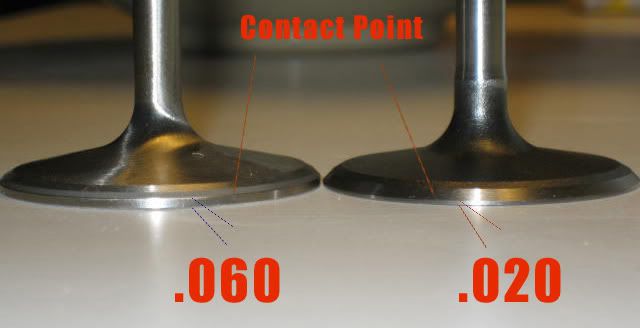
A 2.05 valve will eat up clearance with not only the diameter, but the margin too. The margin for those that don't know is the part that hangs down into the combustion chamber below where the valves hit the seat. Here's a good example between a stock valve and an aftermarket one with a big margin. The stock valve is on the right by the way.
As information, my setup consists of a .045 gasket, 243's milled .010, 2.02 and 1.57 valves, and a TR 224 114. I'm right within spec. I measured almost exactly .080 clearance on the intake. Apparently I can add about .015 since I measured with a checking spring, but that's still close.
A 2.05 valve will eat up clearance with not only the diameter, but the margin too. The margin for those that don't know is the part that hangs down into the combustion chamber below where the valves hit the seat. Here's a good example between a stock valve and an aftermarket one with a big margin. The stock valve is on the right by the way.

Thread Starter
Joined: Nov 2001
Posts: 10,813
Likes: 15
From: Doylestown PA
Originally Posted by PREDATOR-Z
The one on the left is a Ferrea valve, they are notorious for eating ~.040 Vs stock.
I'm starting to lean towards throwing a stock gasket back on and calling it a day.
Originally Posted by The Alchemist
I'm starting to lean towards throwing a stock gasket back on and calling it a day.
This link is from another thread on PTV clearance, and the poster describes the process a bit, along with a photo.
A stock gasket increases your quench volume, which both lowers compression (or leaves some on the table) and increases the possibilty of detonation because the mixture in the chamber isn't as active without the tight quench.
Originally Posted by The Alchemist
So what aftermarket vavles do most people use?
I'm starting to lean towards throwing a stock gasket back on and calling it a day.
I'm starting to lean towards throwing a stock gasket back on and calling it a day.
Ben T.
Thread Starter
Joined: Nov 2001
Posts: 10,813
Likes: 15
From: Doylestown PA
Well, I'm tempted to do a complete top end refresh with this. I'm already putting in head studs as well as header studs. I'm thinking that replacing the lifters is probably good insurance at this point too. Supposedly those new Cadilaac CTS-V racing lifters are the way to go with agressive ramp rate cams, and what's another $230 when I already have the heads off.
I'm going to put up a post in the eastern section and see if anyone local has flycutted their pistons and is willing to lend a helping hand for a couple bucks and beer on tap.
Then I can throw on a cometic 0.040" gasket, bump up the compression ratio, cut down my quench and live happily ever after.
I'm going to put up a post in the eastern section and see if anyone local has flycutted their pistons and is willing to lend a helping hand for a couple bucks and beer on tap.
Then I can throw on a cometic 0.040" gasket, bump up the compression ratio, cut down my quench and live happily ever after.
LS1 Tech Stories
The Best V8 Stories One Small Block at Time

6 Common C5 Corvette Failures and What's Involved In Repairing Them
Pouria Savadkouei
Retro Modern Bandit Pontiac Trans AM Comes With Burt Reynolds' Autograph
Verdad Gallardo
Top 10 Greatest Cadillac V Series Performance Models Ever, Ranked
Pouria Savadkouei
Top 10 Most Powerful Chevy Trucks Ever Made!

Hennessey's New Supercharged Silverado ZR2 Has 700 HP
Verdad Gallardo
Coachbuilt N2A Anteros Is an LS2-Powered C6 Corvette In Italian Clothes
Verdad Gallardo
Awesome K5 Blazer Restomod Comes With C7 Corvette Power
Verdad Gallardo
10 Camaros You Should Never Buy

10 LS Engine Myths That Refuse to Die
Verdad Gallardo Thread Starter
Joined: Nov 2001
Posts: 10,813
Likes: 15
From: Doylestown PA
I just had an epiphany this morning......
When I had broke my valve spring (the manley's) 4 years ago, I went about changing them by using the top-dead-center method and a spring compressor. This quite possibly could be the reason I have those small eyebrowes in the pistons. I may have nothing to worry about at all. This is another reason why I'm going to measure PtoV clearance before doing anything.
This whole time I thought that the eyebrowes were caused by valve contact, but it most likely was done while changing the valvesprings. Another reason that I don't think the valves contacted while running was that I'm still using stock pushrods and they are all straight as an arrow. I would think that if the valve hit the piston, I'd have at least one slightly bent pushrod, and they are all fine.
When I had broke my valve spring (the manley's) 4 years ago, I went about changing them by using the top-dead-center method and a spring compressor. This quite possibly could be the reason I have those small eyebrowes in the pistons. I may have nothing to worry about at all. This is another reason why I'm going to measure PtoV clearance before doing anything.
This whole time I thought that the eyebrowes were caused by valve contact, but it most likely was done while changing the valvesprings. Another reason that I don't think the valves contacted while running was that I'm still using stock pushrods and they are all straight as an arrow. I would think that if the valve hit the piston, I'd have at least one slightly bent pushrod, and they are all fine.

Thread Starter
Joined: Nov 2001
Posts: 10,813
Likes: 15
From: Doylestown PA
Well, I got the head back from the machine shop today. It was $111 to tap the first bolt hole after it was welded, and then helicoil all five bolt holes. I thought that was pretty good.
I measured my valves, and surprise.... they are 2.02, 1.55, so that gets me a little more room than if I had the 2.05 valves. I began to clean up the head and the top of the pistons as well. Talk about carbon build up. I bet there is at least 1cc of volume off the top of the piston in carbon buildup (okay, maybe not 1cc, but it was close to 0.010 thick if not more in some spots).
I'm so tempted just to order a set of 0.045 cometics and take the risk, but I'll clay it first to make sure I'm okay.
I measured my valves, and surprise.... they are 2.02, 1.55, so that gets me a little more room than if I had the 2.05 valves. I began to clean up the head and the top of the pistons as well. Talk about carbon build up. I bet there is at least 1cc of volume off the top of the piston in carbon buildup (okay, maybe not 1cc, but it was close to 0.010 thick if not more in some spots).
I'm so tempted just to order a set of 0.045 cometics and take the risk, but I'll clay it first to make sure I'm okay.

Thread Starter
Joined: Nov 2001
Posts: 10,813
Likes: 15
From: Doylestown PA
My only guess about the carbon buildup around the eyebrow but not actually on it; the build up is from oil seaping in past the intake rocker arm bolt because I didn't have thread sealant on them when I installed them. So as the intake vavle opens, the oil is hitting the top of the piston, coating it nicely, but gets swirled away from the valve, hence the eyebrow not getting coated. That's my theory at least. All of this will be a mute point once I check PtoV this weekend with clay on the #1 piston.
Anyone know off hand the bolt size for the crank? Is it 24mm?
Anyone know off hand the bolt size for the crank? Is it 24mm?
Thread Starter
Joined: Nov 2001
Posts: 10,813
Likes: 15
From: Doylestown PA
Well, after measuring my heads, and a stock set of 853's, I found out that my heads were milled roughly 0.036" which bumps up my compression to about 10.9:1 using the stock 0.053 graphite gaskets. I wanted to run a 0.040 gasket to cut down my quench, but that's not going to happen at this point in time. I'm going to play it safe and order a set of 0.051" cometics and call it a day. It's only 0,02 closer than what I had on it, but I don't feel comfortable going any closer. Hell, if I can find them, I'll just order another set of the graphite 0.053 gaskets and be happy with knowing that I'm safe.

Thread Starter
Joined: Nov 2001
Posts: 10,813
Likes: 15
From: Doylestown PA
Originally Posted by PREDATOR-Z
Run stock gasket, do not decrease any more. GM MLS if you ask me.
Thread Starter
Joined: Nov 2001
Posts: 10,813
Likes: 15
From: Doylestown PA
Well, I decided to live life safely and ordered a set of GM MLS gaskets which depending on who you talk to are from 0.060" to 0.055" compressed thickness. This should keep me safe and shouldn't hurt performance too much, if at all.
