








Cam Overlap: Finding the "Sweet Spot"
Thread Starter
TECH Enthusiast
iTrader: (1)
Joined: Dec 2005
Posts: 549
Likes: 0
From: Denver International Airport, Colorado USA
 Cam Overlap: Finding the "Sweet Spot"
 Looking for practical advice, and expertise for those who may have tested various cams.
I have read all the Stickies, all of the Camshaft Discussions, and searched quite a number of responses prior to posting the question. So any positive advice would be greatly appreciated.
Cam Overlap as it relates to power from 2500-6300 rpm. What amount is "ideal" for producing power "under the curve" in the LS1 346 Engine?
How much is "too much"?
My current cam setup is 228/232 110+2 XE-R lobes. (IVC 42, DCR 8.5).
Overlap: 10
Considering a 230/234 108+0 XE-R (IVC 43, DCR 8.45).
Overlap: 16
My question is for both theoretical and practical application. I do like the more aggressive lope from additional overlap, want to keep the DCR high, raise IVC to 43 and install the cam straight up.
Anybody had any firsthand experience and willing to share their opinions?
Thank You..WeathermanShawn..
I have read all the Stickies, all of the Camshaft Discussions, and searched quite a number of responses prior to posting the question. So any positive advice would be greatly appreciated.
Cam Overlap as it relates to power from 2500-6300 rpm. What amount is "ideal" for producing power "under the curve" in the LS1 346 Engine?
How much is "too much"?
My current cam setup is 228/232 110+2 XE-R lobes. (IVC 42, DCR 8.5).
Overlap: 10
Considering a 230/234 108+0 XE-R (IVC 43, DCR 8.45).
Overlap: 16
My question is for both theoretical and practical application. I do like the more aggressive lope from additional overlap, want to keep the DCR high, raise IVC to 43 and install the cam straight up.
Anybody had any firsthand experience and willing to share their opinions?
Thank You..WeathermanShawn..

TECH Senior Member
Joined: Mar 2004
Posts: 14,620
Likes: 17
From: BFE
0.050
230
234
108
108
7>IVO
43>IVC
45>EVO
9>EVC
108>ECL
16* Overlap
0.050
228
232
110
108
6>IVO
42>IVC
48>EVO
4>EVC
112>ECL
10*Overlap
So comparing the 2:
230/234 will peak about 100 rpm later
It is intake biased so it will carry further after peak
45 IVC will result in awsome midrange trq
16* overlap is gonna be really thumpy, a bit of a bitch to tune
Now that is on paper, but in reality the real grind will variate on that but will be real close, also these comments are assumed on a XE-R lobe, different lobes will react a bit different
If it fits without flycut, that would be an improvement over the other cam.
230
234
108
108
7>IVO
43>IVC
45>EVO
9>EVC
108>ECL
16* Overlap
0.050
228
232
110
108
6>IVO
42>IVC
48>EVO
4>EVC
112>ECL
10*Overlap
So comparing the 2:
230/234 will peak about 100 rpm later
It is intake biased so it will carry further after peak
45 IVC will result in awsome midrange trq
16* overlap is gonna be really thumpy, a bit of a bitch to tune
Now that is on paper, but in reality the real grind will variate on that but will be real close, also these comments are assumed on a XE-R lobe, different lobes will react a bit different
If it fits without flycut, that would be an improvement over the other cam.
Intake and exaust biased has to do with the lobe centerline and its relation to TDC. You move the centerline to the intake side by advancing and exaust side by retarding. With that said, it's all determined by the cam.
Trending Topics
LS1 Tech Stories
The Best V8 Stories One Small Block at Time

Gas Monkey Built a 6-Wheel Ferrari Testarossa With a Corvette LT4 Engine
Verdad Gallardo
7 Most Reliable High-Performance Engines GM Has Ever Built
Verdad Gallardo
Amazing '71 Camaro Restomod Is Modern Muscle Car Under the Skin
Verdad Gallardo
6 Common C5 Corvette Failures and What's Involved In Repairing Them
Pouria Savadkouei
Retro Modern Bandit Pontiac Trans AM Comes With Burt Reynolds' Autograph
Verdad Gallardo
Top 10 Greatest Cadillac V Series Performance Models Ever, Ranked
Pouria Savadkouei
Top 10 Most Powerful Chevy Trucks Ever Made!

Hennessey's New Supercharged Silverado ZR2 Has 700 HP
Verdad Gallardo
Coachbuilt N2A Anteros Is an LS2-Powered C6 Corvette In Italian Clothes
Verdad Gallardo
TECH Enthusiast
Joined: May 2007
Posts: 538
Likes: 0
TECH Fanatic
Joined: Oct 2007
Posts: 1,129
Likes: 0
From: Ventura County, California
In my experience autos can run more overlap than manuals seem to like. I ran a 256/263 .639/.639 on a 106 lobe it idled pretty ruff and had around 13" of vacuum at idle. It pulled hard in the mid range but seemed a little dead on the top end. I ran that cam to 7200 rpm.
My 270/284 .660/.690 on a 114 lobe idled better than the 106 lobe even though it was a lot bigger and it was night and day difference on the n20.
I was running a th400 with a 4,500 stall, 13-1 377.
My 270/284 .660/.690 on a 114 lobe idled better than the 106 lobe even though it was a lot bigger and it was night and day difference on the n20.
I was running a th400 with a 4,500 stall, 13-1 377.
Bad6as, look at the LSA and the ICL. A 112 LSA/112 ICL is 0* or "straight up. Meaning the ICL is at 0* when the piston reaches TDC. Changing the ICL to 110 will make the cam 2* advanced, meaning the cams ICL will be 2 degree's intake biased. Changing it to 114 will make it 2 degrees exaust biased.


Actually, advancing the cam will bias the overlap toward the exhaust side of TDC. For high rpm use, you want to have your overlap centered over TDC or biased to the intake side of TDC. This is why Pro Stock motors run such big exhaust duration compared to the intakes...they bias the overlap to the intake side of TDC and enhance breathing at an extended rpm range.
For overlap in a 346, I've found diminishing returns past 15 degrees of overlap at .050". Once you exceed that, your gain in power does not keep up with the loss in street manners. Sure you'll make more power with 25 degrees of overlap, but the 10 rwhp gain (over a similar cam with 15 degrees of overlap) is not usually worth the loss of street manners. For a race car it's worth it. For a street car, usually not. In fact, for drivers who want decent street manners, I like to see overlap around 6 degrees at .050". That's a point that's still pretty easy to tune, yet will make a solid gain over a 0 overlap cam.
For overlap in a 346, I've found diminishing returns past 15 degrees of overlap at .050". Once you exceed that, your gain in power does not keep up with the loss in street manners. Sure you'll make more power with 25 degrees of overlap, but the 10 rwhp gain (over a similar cam with 15 degrees of overlap) is not usually worth the loss of street manners. For a race car it's worth it. For a street car, usually not. In fact, for drivers who want decent street manners, I like to see overlap around 6 degrees at .050". That's a point that's still pretty easy to tune, yet will make a solid gain over a 0 overlap cam.
__________________
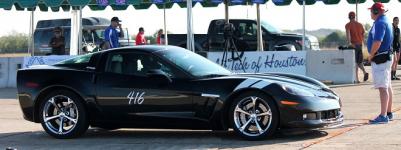
2013 Corvette Grand Sport A6 LME forged 416, Greg Good ported TFS 255 LS3 heads, 222/242 .629"/.604" 121LSA Pat G blower cam, ARH 1 7/8" headers, ESC Novi 1500 Supercharger w/8 rib direct drive conversion, 747rwhp/709rwtq on 93 octane, 801rwhp/735rwtq on race fuel, 10.1 @ 147.25mph 1/4 mile, 174.7mph Half Mile.
2016 Corvette Z51 M7 Magnuson Heartbeat 2300 supercharger, TSP LT headers, Pat G tuned, 667rwhp, 662rwtq, 191mph TX Mile.
2009.5 Pontiac G8 GT 6.0L, A6, AFR 230v2 heads. 506rwhp/442rwtq. 11.413 @ 121.29mph 1/4 mile, 168.7mph TX Mile
2000 Pewter Ram Air Trans Am M6 heads/cam 508 rwhp/445 rwtq SAE, 183.092 TX Mile
2022 Cadillac Escalade 6.2L A10 S&B CAI, Corsa catback.
2023 Corvette 3LT Z51 soon to be modified.
Custom LSX tuning in person or via email press here.
2013 Corvette Grand Sport A6 LME forged 416, Greg Good ported TFS 255 LS3 heads, 222/242 .629"/.604" 121LSA Pat G blower cam, ARH 1 7/8" headers, ESC Novi 1500 Supercharger w/8 rib direct drive conversion, 747rwhp/709rwtq on 93 octane, 801rwhp/735rwtq on race fuel, 10.1 @ 147.25mph 1/4 mile, 174.7mph Half Mile.
2016 Corvette Z51 M7 Magnuson Heartbeat 2300 supercharger, TSP LT headers, Pat G tuned, 667rwhp, 662rwtq, 191mph TX Mile.
2009.5 Pontiac G8 GT 6.0L, A6, AFR 230v2 heads. 506rwhp/442rwtq. 11.413 @ 121.29mph 1/4 mile, 168.7mph TX Mile
2000 Pewter Ram Air Trans Am M6 heads/cam 508 rwhp/445 rwtq SAE, 183.092 TX Mile
2022 Cadillac Escalade 6.2L A10 S&B CAI, Corsa catback.
2023 Corvette 3LT Z51 soon to be modified.
Custom LSX tuning in person or via email press here.

For overlap in a 346, I've found diminishing returns past 15 degrees of overlap at .050". Once you exceed that, your gain in power does not keep up with the loss in street manners. Sure you'll make more power with 25 degrees of overlap, but the 10 rwhp gain (over a similar cam with 15 degrees of overlap) is not usually worth the loss of street manners. For a race car it's worth it. For a street car, usually not. In fact, for drivers who want decent street manners, I like to see overlap around 6 degrees at .050". That's a point that's still pretty easy to tune, yet will make a solid gain over a 0 overlap cam.
Originally Posted by chrismorales75
In my experience autos can run more overlap than manuals seem to like
I was running a th400 with a 4,500 stall, 13-1 377.
I was running a th400 with a 4,500 stall, 13-1 377.
Not to be inflamatory, but the cams specs you've thrown into the discussion are so much larger than what the original poster proposed, its an apples-oranges comparison.
Originally Posted by chrismorales75
I ran a 256/263 .639/.639 on a 106 lobe it idled pretty ruff and had around 13" of vacuum at idle.
My 270/284 .660/.690 on a 114 lobe idled better than the 106 lobe even though it was a lot bigger
My 270/284 .660/.690 on a 114 lobe idled better than the 106 lobe even though it was a lot bigger
Yes, I had it backwards, it's been a while. Advancing the cam will make your RPM's fall off earlier, but they will start earlier as well. If you would like the cam to rev higher, you would want to run the cam straight up, but this will delay were the cam starts making power. In a nut shell, you keep the same power band, but you can shift it around the rpm range with the advance. Depending on the set up, it may or may not help/hurt. That's why they make adjustable timing chains.
Advancing the cam will make your RPM's fall off earlier, but they will start earlier as well. If you would like the cam to rev higher, you would want to run the cam straight up, but this will delay were the cam starts making power. In a nut shell, you keep the same power band, but you can shift it around the rpm range with the advance. Depending on the set up, it may or may not help/hurt. That's why they make adjustable timing chains. Patrick-Do you think the diminishing returns past 15* is due to insufficient exhaust? I see a lot of people running the huge cams but only running the hooker/jethott/flowtech/pacesetter design, with a horrible y-pipe. In comparison to Kooks/QTP/ARH and a better y-pipe and i-pipe.