





Weird OEM valve cover ?

Thread Starter
TECH Apprentice
Joined: Apr 2007
Posts: 369
Likes: 0
From: Clarksville
 Weird OEM valve cover ?
 Long story short I needed a stock valve cover for the passenger side. I ordered one from OEMparts.com and got it in today. Thing is I think its missing a peice. If your looking at your passenger side valve cover from the front of the car it has a tube for a hose to connect to your TB. And at the rear of the cover there is another tube back there for another hose that goes behind the engine. Well on my nice new replacement its missing that rear tube that would connect to a hose that runs behind the engine? So I call the place I ordered it from and the guy tells me its not supposed to be there and to block off the hose....Is this guy full of it? He read me the instructions out of GM service manual he says but it just sounds crazy to me. Any ideas?
that guy doesnt know what hes talkin about, different years have different fittings and u just got one for the wrong year. i put a new ls6 in my car recently but i had to reuse my old valve covers because the covers for the 04 ls6 were like the one you got and was missing certain fittings
Don't block that off unless you plan on running a new style pcv system. The front hole you are referring to is the "fresh air" tube. Their is vacuum on it when your motor is running and it takes air from the tb pushes it down into the valve cover in the front. From there, it goes around the back of the motor into a y adapter. One part of the y goes to the back of the drivers side valve cover and the vacuum that is created it heads back over to the y adapter. From the y adapter it runs back up the passenger side of the motor through the pcv valve and then into the intake manifold. Thus you have PCV...
Basically he didn't know what he was talking about.
Basically he didn't know what he was talking about.
Thread Starter
TECH Apprentice
Joined: Apr 2007
Posts: 369
Likes: 0
From: Clarksville
Its a shot in the dark but I think I might go by the stealership tommarow and see if they will accept this cover for a new correct one. I mean its a OEM part just from a dealer in another state.
Trending Topics
Thread Starter
TECH Apprentice
Joined: Apr 2007
Posts: 369
Likes: 0
From: Clarksville
So I just got back from the dealership and the guy at the parts counter looked it up and I read it with my own eyes! It says when installing new valve cover block off rear hose on passenger side! Im going back in about an hour to clarify with one of the techs. Also the part numbers are the same when he looked up a passenger side valve cover it has the same number as the one I have without the rear connector?
LS1 Tech Stories
The Best V8 Stories One Small Block at Time

Gas Monkey Built a 6-Wheel Ferrari Testarossa With a Corvette LT4 Engine
Verdad Gallardo
7 Most Reliable High-Performance Engines GM Has Ever Built
Verdad Gallardo
Amazing '71 Camaro Restomod Is Modern Muscle Car Under the Skin
Verdad Gallardo
6 Common C5 Corvette Failures and What's Involved In Repairing Them
Pouria Savadkouei
Retro Modern Bandit Pontiac Trans AM Comes With Burt Reynolds' Autograph
Verdad Gallardo
Top 10 Greatest Cadillac V Series Performance Models Ever, Ranked
Pouria Savadkouei
Top 10 Most Powerful Chevy Trucks Ever Made!

Hennessey's New Supercharged Silverado ZR2 Has 700 HP
Verdad Gallardo
Coachbuilt N2A Anteros Is an LS2-Powered C6 Corvette In Italian Clothes
Verdad Gallardo To me that just makes no sense. So you are sucking fresh air from the TB into the cover only to be blocked off on the outlet side? Wouldn't that build pressure in the crankcase?
Thread Starter
TECH Apprentice
Joined: Apr 2007
Posts: 369
Likes: 0
From: Clarksville
I know its weird.... Im about to go back here in a few mins to talk to a tech to see what he has to say. (not expecting much) But if he comes up with the same answer of just block the hose off im wondering if i can have a machine shop weld a tube on the back of the cover just like the one on the car now has?
Thread Starter
TECH Apprentice
Joined: Apr 2007
Posts: 369
Likes: 0
From: Clarksville
Update- I just got back from talking to a tech at GM he said the passenger side cover i have is a new updated version. So I asked him about how the pressure is supposed to escape without that hose in the back. He explained to me that the pressure would dissapte through the crank case and I would feel no difference in the car. So I guess I have 3 options.
1. After 3 different techs gave me the same answer use the new cover and plug the hose.
2. Get a machine shop to remove the tube from the old cover and weld it to the new cover.
3. Use the new cover and get a breather like the ones that plug into the oil filler neck or a catch can with a breather?
Im gonna have to do something because the cover thats on the car now has 3 small cracks around the oil filler neck and it just a matter of time before it lets go. So whats up guys what should I do here?
1. After 3 different techs gave me the same answer use the new cover and plug the hose.
2. Get a machine shop to remove the tube from the old cover and weld it to the new cover.
3. Use the new cover and get a breather like the ones that plug into the oil filler neck or a catch can with a breather?
Im gonna have to do something because the cover thats on the car now has 3 small cracks around the oil filler neck and it just a matter of time before it lets go. So whats up guys what should I do here?
Last edited by tennz28; Mar 7, 2008 at 07:39 PM.
Thread Starter
TECH Apprentice
Joined: Apr 2007
Posts: 369
Likes: 0
From: Clarksville
Not to beat this horse anymore but......I went to one of those ask a tech web sites where they have ASE certified techs to answer car questions and this is what he said.
"Hello, I am pretty sure you have been given the right info from your tech. the orginal valve cover has a port for the pcv hose that runs over to the left valve cover. the replacement valve cover does not have this port. but dont worry the engine will still vent pressure thru the left valve cover and pcv."
At first I was thinking these people are crazy but sofar every person ive asked has given the same answer???????
"Hello, I am pretty sure you have been given the right info from your tech. the orginal valve cover has a port for the pcv hose that runs over to the left valve cover. the replacement valve cover does not have this port. but dont worry the engine will still vent pressure thru the left valve cover and pcv."
At first I was thinking these people are crazy but sofar every person ive asked has given the same answer???????

Don't block that off unless you plan on running a new style pcv system. The front hole you are referring to is the "fresh air" tube. Their is vacuum on it when your motor is running and it takes air from the tb pushes it down into the valve cover in the front. From there, it goes around the back of the motor into a y adapter. One part of the y goes to the back of the drivers side valve cover and the vacuum that is created it heads back over to the y adapter. From the y adapter it runs back up the passenger side of the motor through the pcv valve and then into the intake manifold. Thus you have PCV...
Basically he didn't know what he was talking about.
Basically he didn't know what he was talking about.
As Connexion2005 explained, a proper PCV system needs a fresh air source to "flush" the moisture, harmful corrosive vapors, un-burn't fuel, and combustion gasses from blow by (even a perfectly sealed ring set will allow some blowby past....just not much). Now the crankcase pressure built up is released as long as the system is not disabled (plugged off), but you need a vacuum source to draw those vapors out at idle & low RPM. This comes from the intake manifold on a NA motor, and can come from the induction in front of the turbos/supercharger (as pressure is built up in the intake & will pressure back through where it should have been sucking) . This vacuum source needs a device to meter or limit the amount of vacuum so the PCV valve is used on the early GenIII & a fixed orfice in the valley cover on the later GenIII & GenIV. If the drivers side fitting is capped off then there is not a full even flow through the entire crankcase & internal engine in general. It will still pull from the pass side , but does not give the fresh air a complete route through the crankcase. The fresh air in the OEM setup is drawn from the front fitting on the throttle body so it is filtered by the main air filter. (Never have an unfiltered line open to the crank case EVER...your motor will loose 1/2 or more of its life due to all the dust/dirt/sand/moisture/ and who knows what else into the crankcase and slowly grind the internal parts to death) So, idealy you want a vac source that is metered or controlled
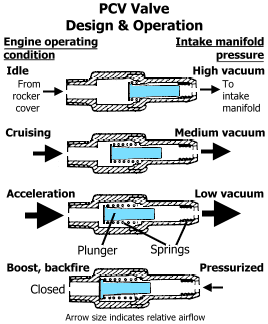
and them a good functioning catch can to seperate, trap, and condense the vapors as well as the oil mist that most cans trap (the bigger the better), an equal outlet setup to draw the vapors & gasses out, (either the valve covers in the rear or as in the later GenIII's, the valley cover) and a filtered frsh air source that can be the stock OEM tube to the TB frnt, or a filtered breather.
Here are more pics & info from another thread that addresses a very ALARMING modification that some one is doing all over the place & is drawing dirt & dust directly into the internal engine:
Heres the problem with hoses hanging near the ground & plugging your vacuum source. When at speed, one hose will develop negative pressure, and the other positive as the hose has a venturi effect when air is moving past it. What happens then is you are sucking up dirt, sand, water, etc. directly into your valve cover & into the motor internals. I suspect they have no filter on them, correct? Also, if you are not pulling metered vacuum at idle & low RPM's the harmfull vapors that are in your crankcase cannot be pulled totally out...only pressure vents so all the unburnt fuel, caustic gasses from blow-by, & moisture will re-condense in your crankcase after the motor cools & contaminate the oil as well as corode internal parts (look at the links in another thread on bearings & see the damage just the unfiltered dust causes). A proper PCV system needs a fresh air source that is filtered, (on the stock OEM setup it is drawn from in front of the throttle body & the main air filer cleans the air pulled) and a vacum source that is metered & valved, such as the PCV valve on a LS1 or the fixed orfice & baffle system in the vally cover of the LS6 & LS2/3/7 design. The problem with the OEM systems on our vettes is it allows oil vapors to be pulled into the intake & robs power & contributes to detonation. The only proper way to correct this w/out sacrificing your engine to premature wear (I have seen motor come in that look like dirt was poured right into the crankcase & no internal part not showing advanced wear & failure from the hoses dangling unfiltered to the ground. Those that have this setup just have to look closly at your oil the next time you change it to see how dark it now comes out compared to when you had the stock system in place) is to modify the system to remove as much of the oil & harmful vapors from the PCV lines before the mist is pulled into the intake. So the most effective mod for NA motors is to add the proper catch can system AND a PCV valve inline to control the amount of vacum pulled & prevent back-flow of the vapors.
The catch can must be of a material that disipates heat effectively, and that eliminates plastic. Auminum or steel are the 2 best. 2nd, the can must be baffeled in such a way as it disperses the vapors to make contact with as much of the cooler outer surface of the can to allow the vapors & oil to condense into droplets that are collected in the bottom of the can. Now 2 forms of oil come through the system....a mist from the fast movong internals in the engine which is pretty easy to trap, and the vapors from the high heat which need the cooler surface area to condense.
So the can has to be large enough to be effective & most I see in use are far to small, allthough there are several good ones on the market. Then the outlet of the can must be located as far up & away from the inlet to prevent vapors from being pulled through before having a chance to cool & condense. You then need a PCV valve to control the amount of vacuum.


(this setup uses a perforated down tube to disperse the vapors as completly as possible for contact on the cooler surface & is a 1 qt capacity)

If you have a stroker, big cube build, or run at extended high RPMs you should also add the filtered breather as some have mentioned above (easiest is as an oil fill cap mod) and this will allow a good volume of filtered fresh air in at low RPMs and allow venting of crancase pressure at high RPMs. On a FI application it gets just a little more complicated but the design is very similar.
Shown below is on a Magnacharger application.


So what you have accomplished is a near total elimination of any oil getting into the intake, proper ventalation & breathing, and not subjecting your babies motor to a slow horrible premature death from unfiltered ventalation.
Hope this helps, anyone wanting any clarification dont hesitate to contact be.:thumbsup:
Last edited by TLewis4095; Mar 7, 2008 at 08:56 PM.

I had to do the same thing on my valve covers, just pop the old tube out with a phillips screwdriver and hammer from inside the valve cover. Its not welded in its pressed in be patient and take your time it will come out. Then on your new valve cover you will need to drill a 3/8 inch hole on the side of the valve cover not on the top. Theres a boss on the side of the valve cover that you will see. Thats where to drill the new hole. Start out with a smaller 1/8 inch bit, then with a 3/8 inch bit and my check for fitness. You may need to wollow the hole out some to get it to fit. Not real hard to do. Good Luck
