







More fun from the previous owner..
 More fun from the previous owner..
 So I found this today from the previous owner. Anybody know why somebody would drill a hole in the throttle body? Seems like all it would do is make tuning hard. So I'm looking for a new one I guess, my intake is a fast 92mm so I'm thinking a 92mm TB also. I keep seeing some that say cable driven and some that don't, and i thought all TB's were cable driven. Can anybody educate me on this? Thanks guys.
people do that dumb **** because they think it helps the car idle better or some ****. it even says to do it on ls1howto.com when you change your cam. any tuner worth a **** will not tell you to drill a hole in your tb.
I think yall have been misinformed on the drilling of the throttlebody blade.When allan futral was tuning my car he drilled a hole in my blade . He's a very credible tuner.I believe it helps with idling.idk
Trending Topics

TECH Apprentice
Joined: Jan 2002
Posts: 366
Likes: 0
From: Gilbert, AZ
Depends on the cam. If the cam is big enough the IAC won't be able to feed enough air to keep the motor running. Drilling a hole maybe necessary with big enough cams. Most of the time it isn't needed.
LS1 Tech Stories
The Best V8 Stories One Small Block at Time

Gas Monkey Built a 6-Wheel Ferrari Testarossa With a Corvette LT4 Engine
Verdad Gallardo
7 Most Reliable High-Performance Engines GM Has Ever Built
Verdad Gallardo
Amazing '71 Camaro Restomod Is Modern Muscle Car Under the Skin
Verdad Gallardo
6 Common C5 Corvette Failures and What's Involved In Repairing Them
Pouria Savadkouei
Retro Modern Bandit Pontiac Trans AM Comes With Burt Reynolds' Autograph
Verdad Gallardo
Top 10 Greatest Cadillac V Series Performance Models Ever, Ranked
Pouria Savadkouei
Top 10 Most Powerful Chevy Trucks Ever Made!

Hennessey's New Supercharged Silverado ZR2 Has 700 HP
Verdad Gallardo
Coachbuilt N2A Anteros Is an LS2-Powered C6 Corvette In Italian Clothes
Verdad Gallardo

Many T/B's come with a hole in them from the factory. Also some T/B's tend to whistle when the throttle blade is opened too much. I personally drilled a small hole in my T/B and tuning is no more difficult.

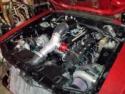


So I found this today from the previous owner. Anybody know why somebody would drill a hole in the throttle body? Seems like all it would do is make tuning hard. So I'm looking for a new one I guess, my intake is a fast 92mm so I'm thinking a 92mm TB also. I keep seeing some that say cable driven and some that don't, and i thought all TB's were cable driven. Can anybody educate me on this? Thanks guys.
you drill a hole in the TB because it allows in more air for a big cam and allows you to retain off idle thottle transition airflow...
basically, you keep your low TPS % throttle movement which allows you to keep a good off idle throttle response
when you open the TB blade more, you change the relationship of how much air goes in per each 1% of TPS movement...
you effectively change the area of a circle making tuning much harder to get a nice throttle transition at low TPS values...which usually leads to people having a "dead spot" inbetween idle and part throttle.
as you move your throttle, 1% at a time get progressively bigger and bigger as you open it...
1% movement at 3% is a smaller slice than a 1% movement at 30%
think of a crescent shaped moon slice of the TB...
its exponential as it opens...you have to understand area of a circle and a tangent to get the relationship
people who dont understand that relationship, are not tuners and do not understand how the airflow going into your TB actually reacts...
it becomes especially useful to drill a hole on a DBW TB as sometimes they can correct quite far and that 1% step is not small enough to control idle properly...making you rely more heavily on spark, and in the end it cintributes to an unstable idle or a car that dies once in a while for no apparrent reason when coming to a stop.
knowing how far to drill is the key...
you have to know where the stock cam sits...does it sit at 7%? 4%
on a TB with an IAC...you want it to sit around 40~60 IAC counts at hot idle...so you get the car warm, drill the tb until your IAC comes back down to that range...and then you are good to go...
I can make some pretty radical cams idle perfect just by drilling a TB hole
it also solves a lot of issues people have with Bucking at low throttle low rpm cruising..again...because of how the PCM corrects the airflow needed...
if you dont have that hole in the TB, you wont be able to correct the bucking with the throttle cracker/follower tables...and many times, the cracker and follower are responsible for bucking and surging.
just looked at my ported tb and it has a hole in it. Dont remember it being there when i sent it in. oh well car is tuned by Ryne@CMS who is a forum sponsor and it runs great so i think you are ok OP.