






breathers, PCV bypass etc...
 breathers, PCV bypass etc...
 The LS2 valley cover has a breather tube in the front that normally vents to the intake manifold.
I would like to completely vent the spaces under the valley cover, and the valve covers/pcv into a open breather connected to a slop tank rather than back into the manifold.
Here are my questions:
Is there a negative effect of just having the space under the valve covers and valley cover open to atmospheric (open slop tank)? Is there an ideal positive or negative pressure in these 2 chambers.
Does this air inside these chambers, contribute to combustion tuning? Will I suffer from affecting the AFR if I bypass the intake manifold?
Please explain this to me.
Thanks,
J
I would like to completely vent the spaces under the valley cover, and the valve covers/pcv into a open breather connected to a slop tank rather than back into the manifold.
Here are my questions:
Is there a negative effect of just having the space under the valve covers and valley cover open to atmospheric (open slop tank)? Is there an ideal positive or negative pressure in these 2 chambers.
Does this air inside these chambers, contribute to combustion tuning? Will I suffer from affecting the AFR if I bypass the intake manifold?
Please explain this to me.
Thanks,
J
Anyone....hello...
Actually lets tackle it one by one.
If I vent the valve covers to air, other than polluting the environment with unburned gases and oil droplets, will this negatively affect my fuel mapping or other combustion formulas??
Does adding this combustion gas back into the intake manifold make the car run richer or leaner?
Next. The valley cover has a vent--can I vent this to air too?
Actually lets tackle it one by one.
If I vent the valve covers to air, other than polluting the environment with unburned gases and oil droplets, will this negatively affect my fuel mapping or other combustion formulas??
Does adding this combustion gas back into the intake manifold make the car run richer or leaner?
Next. The valley cover has a vent--can I vent this to air too?
Having tried most every idea since 2000 here is the best that I have found to date:
Block of all the valve cover vents.
Block off the valley cover vent.
Buy a catch can drill out the top and put a breather filter on its top.
Run one line out of the can to the port behind the throttle body, restricted it about 1/8".
Put a large ~1/2, or better -12 hole fitting in the filler cap and run a large diameter line to high on the side of the catch can.
This will keep the system vented to atmosphere yet keep a very light vacuum in the can to keep it from huffing.

Block of all the valve cover vents.
Block off the valley cover vent.
Buy a catch can drill out the top and put a breather filter on its top.
Run one line out of the can to the port behind the throttle body, restricted it about 1/8".
Put a large ~1/2, or better -12 hole fitting in the filler cap and run a large diameter line to high on the side of the catch can.
This will keep the system vented to atmosphere yet keep a very light vacuum in the can to keep it from huffing.
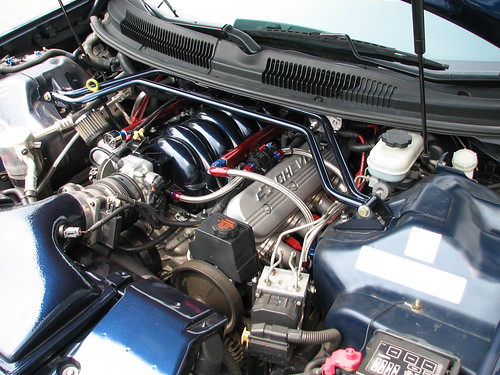

This is what I have been doing with mine for the last 30,000 + miles ... seems to be working fine ...

LS6 valley cover and LS6 PVC and a breather in the passenger side valve cover... the GMPP valve covers have no other holes besides the one the breather is in.
Don't take this wrongly, but you are only venting the right side cylinder head, correct. What about the other side with the plugged pcv, and under the valley cover, do the gases just build up underneath? Where do they go?
Why have your intake manifold open to air at all-- isn't that a vacuum leak? Measure your engine vacuum with the tube open and clamped, see if it makes a difference.
My plan was to run a tube from the valley cover into the front right side valve cover vent tube. Connect the left PCV and rear right valve cover vent to a T-tube going to a slop can. Plug all my manifold ports, except the one to the brake booster.
I've searched on other sites and there is often mention of "metered air" having to return thru the intake from the PCV, or otherwise affecting AFR.
The only thing bothering me is this "metered air" business which I don't understand.
Why have your intake manifold open to air at all-- isn't that a vacuum leak? Measure your engine vacuum with the tube open and clamped, see if it makes a difference.
My plan was to run a tube from the valley cover into the front right side valve cover vent tube. Connect the left PCV and rear right valve cover vent to a T-tube going to a slop can. Plug all my manifold ports, except the one to the brake booster.
I've searched on other sites and there is often mention of "metered air" having to return thru the intake from the PCV, or otherwise affecting AFR.
The only thing bothering me is this "metered air" business which I don't understand.
Originally Posted by See5
Having tried most every idea since 2000 here is the best that I have found to date:
Block of all the valve cover vents.
Block off the valley cover vent.
Buy a catch can drill out the top and put a breather filter on its top.
Run one line out of the can to the port behind the throttle body, restricted it about 1/8".
Put a large ~1/2, or better -12 hole fitting in the filler cap and run a large diameter line to high on the side of the catch can.
This will keep the system vented to atmosphere yet keep a very light vacuum in the can to keep it from huffing.
Block of all the valve cover vents.
Block off the valley cover vent.
Buy a catch can drill out the top and put a breather filter on its top.
Run one line out of the can to the port behind the throttle body, restricted it about 1/8".
Put a large ~1/2, or better -12 hole fitting in the filler cap and run a large diameter line to high on the side of the catch can.
This will keep the system vented to atmosphere yet keep a very light vacuum in the can to keep it from huffing.
for my 408 i did this
ls6 valley cover to passenger side port
capped off the ports on intake
capped off the rear port on valve cover
and 2 breathers one on each cover
no way to get oil into intake
the valley now vents to valve cover which vents to atmosphere
driverside vents thru breather
ls6 valley cover to passenger side port
capped off the ports on intake
capped off the rear port on valve cover
and 2 breathers one on each cover
no way to get oil into intake
the valley now vents to valve cover which vents to atmosphere
driverside vents thru breather
Originally Posted by jtl12419
Don't take this wrongly, but you are only venting the right side cylinder head, correct. What about the other side with the plugged pcv, and under the valley cover, do the gases just build up underneath? Where do they go?
Why have your intake manifold open to air at all-- isn't that a vacuum leak? Measure your engine vacuum with the tube open and clamped, see if it makes a difference.
My plan was to run a tube from the valley cover into the front right side valve cover vent tube. Connect the left PCV and rear right valve cover vent to a T-tube going to a slop can. Plug all my manifold ports, except the one to the brake booster.
I've searched on other sites and there is often mention of "metered air" having to return thru the intake from the PCV, or otherwise affecting AFR.
The only thing bothering me is this "metered air" business which I don't understand.
Why have your intake manifold open to air at all-- isn't that a vacuum leak? Measure your engine vacuum with the tube open and clamped, see if it makes a difference.
My plan was to run a tube from the valley cover into the front right side valve cover vent tube. Connect the left PCV and rear right valve cover vent to a T-tube going to a slop can. Plug all my manifold ports, except the one to the brake booster.
I've searched on other sites and there is often mention of "metered air" having to return thru the intake from the PCV, or otherwise affecting AFR.
The only thing bothering me is this "metered air" business which I don't understand.
- For 50 years there was no PCV just vent built into filler cap on valve cover.
- Since mid 70s manufacturers have tried to PCVs implement a legal CLOSED system. The PCV system should keep pressure out of the block and prevent condensation.
- Since 97 LSs have had at least a dozen different PCV iterations trying to balance the system while NOT sucking oil into the intake. Sorry, they all suck.
- Due to vast oil return ports there is no differential pressure within the block. I have measured vac with and without the small line to can and it is negligible, much higher than with stock system, so high in fact, it sets PCM codes which have to be tuned out.
- The system I use is a copy of a NASCAR sytem without the $$$ vacuum pump and without the check valve under the top vent.
- The CF "unmetered" air bloggers are referring to the air that does not go thru MAF or TB, however the vacuum bleed on my system is filtered 1/8" line which is tiny % compared to volume of air that goes thru 90mm TB. That small amount of air is in fact measured, "tuned for" because it is combustion air measured by AFR ratio in tune.
- You can easily run without the line from tank to intake manifold but the system will huff or steam from vent/breather which smells bad in the car and makes a mess. Key to the system is the large diameter line from cap to can which is low velocity therefore does not atomize oil like the smaller diameter hose lines.
Is it worth it? Up to you.
Trending Topics
Originally Posted by See5
Well, here goes:
Is it worth it? Up to you.
- For 50 years there was no PCV just vent built into filler cap on valve cover.
- Since mid 70s manufacturers have tried to PCVs implement a legal CLOSED system. The PCV system should keep pressure out of the block and prevent condensation.
- Since 97 LSs have had at least a dozen different PCV iterations trying to balance the system while NOT sucking oil into the intake. Sorry, they all suck.
- Due to vast oil return ports there is no differential pressure within the block. I have measured vac with and without the small line to can and it is negligible, much higher than with stock system, so high in fact, it sets PCM codes which have to be tuned out.
- The system I use is a copy of a NASCAR sytem without the $$$ vacuum pump and without the check valve under the top vent.
- The CF "unmetered" air bloggers are referring to the air that does not go thru MAF or TB, however the vacuum bleed on my system is filtered 1/8" line which is tiny % compared to volume of air that goes thru 90mm TB. That small amount of air is in fact measured, "tuned for" because it is combustion air measured by AFR ratio in tune.
- You can easily run without the line from tank to intake manifold but the system will huff or steam from vent/breather which smells bad in the car and makes a mess. Key to the system is the large diameter line from cap to can which is low velocity therefore does not atomize oil like the smaller diameter hose lines.
Is it worth it? Up to you.
LS1 Tech Stories
The Best V8 Stories One Small Block at Time

Topdon ONE vs. Artidiag 800 BT2: Which is the Diagnostic Tablet For You?
Pouria Savadkouei
Gas Monkey Built a 6-Wheel Ferrari Testarossa With a Corvette LT4 Engine
Verdad Gallardo
7 Most Reliable High-Performance Engines GM Has Ever Built
Verdad Gallardo
Amazing '71 Camaro Restomod Is Modern Muscle Car Under the Skin
Verdad Gallardo
6 Common C5 Corvette Failures and What's Involved In Repairing Them
Pouria Savadkouei
Retro Modern Bandit Pontiac Trans AM Comes With Burt Reynolds' Autograph
Verdad Gallardo
Top 10 Greatest Cadillac V Series Performance Models Ever, Ranked
Pouria Savadkouei
Top 10 Most Powerful Chevy Trucks Ever Made!

Hennessey's New Supercharged Silverado ZR2 Has 700 HP
Verdad Gallardo
Originally Posted by phildo
Will your set-up work for forced induction?
Last edited by See5; Apr 13, 2007 at 09:43 AM.

Originally Posted by WP01
Has anyone got a pic of the Z06 system,or diagram showing the dry sump breather hook up ???
If you look at the photos in my above post (#4) you will see the LS6 valley cover with the LS6 PVC connecting the valley cover to the throttle body.


Originally Posted by slt200mph
If you look at the photos in my above post (#4) you will see the LS6 valley cover with the LS6 PVC connecting the valley cover to the throttle body.


Here is what I did, and it works fine :
http://www.mainstreamtopics.com/~scr...TP%20heads.JPG
Cap all the pcv stuff off on the valvecovers, on the intake, including teh small line that runs from the passenger side to the TB.
No need to vent every valvecover/etc, you can run a single vent from either valvecover, or the valley cover.... they're all connected in some way.
I ran the line into the side of my amw can I used to run with the stock PCV, and just slugged a little autozone filter on the top of it. No oil fumes really make it out of the filter, you can smell it a little bit but the can catches anything that would be heavy enough to oil up the filter.
http://www.mainstreamtopics.com/~scr...TP%20heads.JPG
Cap all the pcv stuff off on the valvecovers, on the intake, including teh small line that runs from the passenger side to the TB.
No need to vent every valvecover/etc, you can run a single vent from either valvecover, or the valley cover.... they're all connected in some way.
I ran the line into the side of my amw can I used to run with the stock PCV, and just slugged a little autozone filter on the top of it. No oil fumes really make it out of the filter, you can smell it a little bit but the can catches anything that would be heavy enough to oil up the filter.



I am thinking about tapping a Fitting into the back of the Valley Cover Plate, making a Baffle on the under side so nothing comes out, and running a line off of that toward the back of the Engine, maybe into a Breather Filter, I don't know yet. It might not need one if it's setup like that. Sounds like a good idea..I am going to mess with it tomorrow.
Good explanation, thanks. Good tips too on the huffing.
How does your bottle mount to the side of the engine like that?
How does your bottle mount to the side of the engine like that?
Originally Posted by See5
Well, here goes:
Is it worth it? Up to you.
- For 50 years there was no PCV just vent built into filler cap on valve cover.
- Since mid 70s manufacturers have tried to PCVs implement a legal CLOSED system. The PCV system should keep pressure out of the block and prevent condensation.
- Since 97 LSs have had at least a dozen different PCV iterations trying to balance the system while NOT sucking oil into the intake. Sorry, they all suck.
- Due to vast oil return ports there is no differential pressure within the block. I have measured vac with and without the small line to can and it is negligible, much higher than with stock system, so high in fact, it sets PCM codes which have to be tuned out.
- The system I use is a copy of a NASCAR sytem without the $$$ vacuum pump and without the check valve under the top vent.
- The CF "unmetered" air bloggers are referring to the air that does not go thru MAF or TB, however the vacuum bleed on my system is filtered 1/8" line which is tiny % compared to volume of air that goes thru 90mm TB. That small amount of air is in fact measured, "tuned for" because it is combustion air measured by AFR ratio in tune.
- You can easily run without the line from tank to intake manifold but the system will huff or steam from vent/breather which smells bad in the car and makes a mess. Key to the system is the large diameter line from cap to can which is low velocity therefore does not atomize oil like the smaller diameter hose lines.
Is it worth it? Up to you.
Originally Posted by jtl12419
Good explanation, thanks. Good tips too on the huffing.
How does your bottle mount to the side of the engine like that?
How does your bottle mount to the side of the engine like that?
Lemme give an update.. because what I had on my car in the above link did not work fine, there was still too much crankcase pressure (keep in mind I am running a 13 to 1 loosly built 402 that was built for alot of nitrous, etc so the blowby is higher then a stock motor, on a stock motor the setup I had would have been fine) so we found a solution. What I did was took the back pcv hookup on the drivers side, ran a hose from that around to the passenger's side and hooked it up on the back pcv hookup. This allows the pressure from the 2 valvecovers to be equeal. Next I took a line from the ls2/ls6 valley cover, ran it to the small hookup on the front of passenger's side valvecover, therefore equealing the pressure in the valley cover with the valvecovers. I now have a Metco breather in place of the oil fill cap.. and have no more problems. Yes it huffs steam and whatnot out, as long as I keep the metco breather's filter clean, it doesn't get all over the place.
I needed to have alot more venting then most due to having a high compression, high spinning loosly built motor. This setup would work probably for any car really, but after experimenting around, it's what I ended up with. Another way would be to hook up a can and remotely mount it like above, either with a large line, or a couple smaller lines... either would probably work.
I needed to have alot more venting then most due to having a high compression, high spinning loosly built motor. This setup would work probably for any car really, but after experimenting around, it's what I ended up with. Another way would be to hook up a can and remotely mount it like above, either with a large line, or a couple smaller lines... either would probably work.
I have the GMPP valve covers like SLT does and this is what I was planning on doing. Drill a hole in the back of each of the valvecovers and T them together into a larger diameter line Run that line to a Catch-can and run a line from the catch can to to the Intake. The catchcan would have a breather in it. Does this sound like it would work. Motor details in sig. It is being built to be wound out to ~7200 peak.
Originally Posted by Stang's Bane
I have the GMPP valve covers like SLT does and this is what I was planning on doing. Drill a hole in the back of each of the valvecovers and T them together into a larger diameter line Run that line to a Catch-can and run a line from the catch can to to the Intake. The catchcan would have a breather in it. Does this sound like it would work. Motor details in sig. It is being built to be wound out to ~7200 peak.
I just found these and am going to start using them>
http://www.ovalcraft.com/catalog/ind...5a85afbfcad914