
Help! LS2/L92 falls down at 6100 rpm on Dyno


Runner length determines about 99% of your peak. TPI cars have about whopping 17" runner and thats why they peak about 4500-4700. As you increase displacement you will also lower your peak as the manifold will have an even harder time keeping up. Do not be afraid of the carb intake it is extremely nice and 100% better than the ls1 carb intake.

On The Tree
Joined: Dec 2006
Posts: 126
Likes: 0
From: Indianapolis, IN
Runner length determines about 99% of your peak. TPI cars have about whopping 17" runner and thats why they peak about 4500-4700. As you increase displacement you will also lower your peak as the manifold will have an even harder time keeping up. Do not be afraid of the carb intake it is extremely nice and 100% better than the ls1 carb intake.
It still doesn't change the runner length. Do you think porting will be effective?
Last edited by Navy David SS; Nov 29, 2007 at 07:21 AM.


I don't think the RPM the L76/LS3 is designed to peak at is as relevant here as the fact that they're simply not able to flow enough air to support 400 some cubes. I haven't seen this problem yet on stock-displacement 6.0s or 6.2s, but it's been seen on more than a few 400+ cube motors.
On The Tree
Joined: Dec 2006
Posts: 126
Likes: 0
From: Indianapolis, IN
At 416 cubes, my engine peaks around 6000 RPM, just like the LS-3 did. I really do think that our intake is the bottleneck.
So back to my question concerning the L76 intake:
Do you think that porting the L76 intake will be effective? It still doesn't change the runner length.
Last edited by cybernco; Dec 3, 2007 at 06:59 PM.

On The Tree
Joined: Apr 2004
Posts: 157
Likes: 0
From: Brampton, Ontario
Carb intake> L76. Thats why it fell on its face.
Manifold GMp/n 25534416, $369.95 (when I bought mine) from scoggin-dickey
Gasket Fel-pro P/n 1222-3 (.060"), or 1222-2 (.040), $21.45, scoggin-dickey
edelbrock neck, carbplate-90mm TB front, pn 3850, $152, jegs
also need a vacuum fitting for the brake booster (pretty much anywhere, 90* NPT-barb) , and spacers for the fuel rails (thats on you) and after market rails.
But not having breathing problems is priceless.
Manifold GMp/n 25534416, $369.95 (when I bought mine) from scoggin-dickey
Gasket Fel-pro P/n 1222-3 (.060"), or 1222-2 (.040), $21.45, scoggin-dickey
edelbrock neck, carbplate-90mm TB front, pn 3850, $152, jegs
also need a vacuum fitting for the brake booster (pretty much anywhere, 90* NPT-barb) , and spacers for the fuel rails (thats on you) and after market rails.
But not having breathing problems is priceless.
What are the disadvantages of this kind of setup? Just wondering if it has that much better flow, why don't we see more of them?

Teching In
Joined: Feb 2007
Posts: 42
Likes: 0
And its cheaper than a FAST, even with all the other BS.
Ive got one of the new edelbrock cast Al elbows on order, if/when jegs gets it to me, ill post dimensions and flow. Im thinking thats the best bet.
The reason you dont see more of them is stupidity, and availability. These are relatively new parts, compared to the LS family's 10 year age. GMPP makes three, LS1/2/6, LS7, L92/L76/LS3. Im pretty sure edelbrock only has a LS1/2/6 version at this time, but i think they have both single and dual plane versions (GMPP are all single plane). They pop up mainly on FI cars, those guys understand airflow. Most NA guys seem to ignore the air flow, and focus on their cam lobes and head flow. According to Comp's Camquest soft ware, a max flow single plane is worth ~100 hp over their own FAST90, everything else being equal. Heres a post i made o that effect on another forum:
So I finally had time to sit down and get some of my engine's specs to work.
the results, 644.2 HP @6500/ 593.5ftlbs @5000. Thats with the biggest cam the program allows me, whish is still way smaller than my actual cam. It is also with the unported flow numbers on my L92's (my tests, which is lower than GM's published numbers).
So thats pretty close to what I ran on the engine simulator in class. Which meets my 750 N/A HP goal.
The funny thing is when i throw a 100 shot of giggle juice at it. 753.9 hp @ 6500/776.2 ftlb @ 1000. WTF? a 150 shot is 808/1066. Im pretty sure thats a bit off.
the cam the program reccomends is 238/240 .605/.609 112 LSA
my actual cam is ~ 25x/26x .62x/.62x 110LSA+4
and using the fast (@ 1170 cfm) instead of my single plane (@7000 cfm) drops it to 535.2/462.9 N/A. thats ~100hp/tq lost. Time to ditch those plastic manifolds, fellas.
the results, 644.2 HP @6500/ 593.5ftlbs @5000. Thats with the biggest cam the program allows me, whish is still way smaller than my actual cam. It is also with the unported flow numbers on my L92's (my tests, which is lower than GM's published numbers).
So thats pretty close to what I ran on the engine simulator in class. Which meets my 750 N/A HP goal.
The funny thing is when i throw a 100 shot of giggle juice at it. 753.9 hp @ 6500/776.2 ftlb @ 1000. WTF? a 150 shot is 808/1066. Im pretty sure thats a bit off.
the cam the program reccomends is 238/240 .605/.609 112 LSA
my actual cam is ~ 25x/26x .62x/.62x 110LSA+4
and using the fast (@ 1170 cfm) instead of my single plane (@7000 cfm) drops it to 535.2/462.9 N/A. thats ~100hp/tq lost. Time to ditch those plastic manifolds, fellas.
Last edited by KonnietheGoat; Nov 28, 2007 at 04:26 PM.
Teching In
Joined: Feb 2007
Posts: 42
Likes: 0
No, I came to this conclusion other ways (math, observation, etc), but Im backing it up with data from a program as well.
Nobody in their right mind thinks that our long runner plastic intakes can properly feed a high RPM, moderate cube motor as well as a short runner carb style intake can.
And while I dont trust the 100 HP figure that the software spit out, I do feel it is a significant gain (30-40 HP) over the FAST.
The pulsing effect of a short runner is much better for a high RPM engine (over 6k), plain and simple.
Nobody in their right mind thinks that our long runner plastic intakes can properly feed a high RPM, moderate cube motor as well as a short runner carb style intake can.
And while I dont trust the 100 HP figure that the software spit out, I do feel it is a significant gain (30-40 HP) over the FAST.
The pulsing effect of a short runner is much better for a high RPM engine (over 6k), plain and simple.
GMPP has a new victor type alum. sorry i dont have the Part no but its in the new GMPP cat. Its lower than victor jr so no cowl or hood probs.
Im currently doin this setup:
60lb, elbow, 300 shot direct port, 100 shot 2nd on a plate.
JT- get that cam into the .615s & ^ w/ springs. The l92 really needs it flowing out of the box @ 330cfms. The AF should be tweaked a little as well.
Stupid things we sometimes miss= TQ Mgt.
Im currently doin this setup:
60lb, elbow, 300 shot direct port, 100 shot 2nd on a plate.
JT- get that cam into the .615s & ^ w/ springs. The l92 really needs it flowing out of the box @ 330cfms. The AF should be tweaked a little as well.
Stupid things we sometimes miss= TQ Mgt.


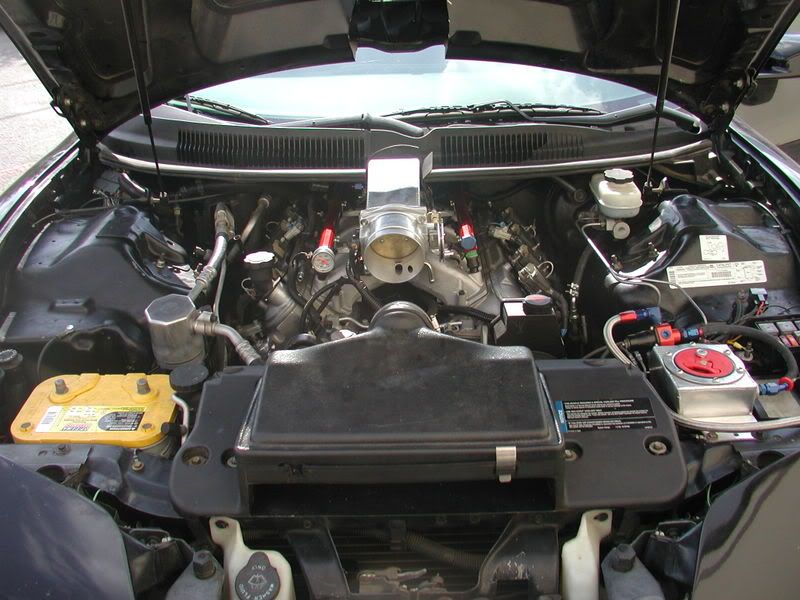

Combo, combo, combo. Its all about the way the intake/heads/cam/engine work together. These rec-port heads might have AWESOME flow numbers, but some of these guys have no business running them. Not to mention, the guys that DO have the engines to take advantage of them are kind of the pioneers at this moment, there isnt much real world information on them compared to the cathedral port heads.
I say good luck and make sure to post the results so I can copy the setup on my 454 build.
I say good luck and make sure to post the results so I can copy the setup on my 454 build.
Teching In
Joined: Feb 2007
Posts: 42
Likes: 0
Good point. The main reason they turn up on less than ideal motors is cost. And a 364 does not need this kind of air flow unless you run high RPMs. But then it gets saddled with a crippling L76 intake. I find it funny, but hey, not my car.
It is new territory. Ive done all my own R&D on these heads, and cut a perfectly good one to bits. And when I get my 427 done, you'll have all sorts of data to use on your 454 build.
It is new territory. Ive done all my own R&D on these heads, and cut a perfectly good one to bits. And when I get my 427 done, you'll have all sorts of data to use on your 454 build.