


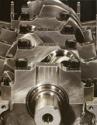



500+ ci LSx

You don't want to have to turn more RPM. A wise man once said, "RPM stands for Ruins Peoples' Motors". Guys in NHRA Pro Stock, F1, and NASCAR all have displacement limits (ie limiting TQ) so they only have RPM to increase as a way on increasing HP. As you increase the RPM range, it places greater loads, not just on the bottom end, but on the valvetrain too at an exponential rate. It's usually better to increase the displacement (hence the motivation behind the 500ci LS2) than to increase RPM to make power.
Displacement will always be limited, or else people would be buiilding 2000ci motors.
My 421 (4.125" stroke) has seen 8500rpm in the burnout box and at the traps and I can still drive it to and from the track.
 I'm not saying its the greatest thing in the world but if it makes power up there USE IT!
 Displacement will always be limited, or else people would be buiilding 2000ci motors.
My 421 (4.125" stroke) has seen 8500rpm in the burnout box and at the traps and I can still drive it to and from the track. I'm not saying its the greatest thing in the world but if it makes power up there USE IT!
My 421 (4.125" stroke) has seen 8500rpm in the burnout box and at the traps and I can still drive it to and from the track.
I'm not saying its the greatest thing in the world but if it makes power up there USE IT!
Thread Starter
Joined: Mar 2007
Posts: 3,280
Likes: 49
From: Hampstead, NC
heres an 1100 ci engine, turn up your speakers the idle sounds like a train. http://www.youtube.com/watch?v=rt5uSx3eFYU
I just got assigned a project in my Internal Combustion Engines class to design some part of an engine (connecting rods, crank, piston etc.) using finite element analysis and other design software. I am going to try to do an LSx with various bore sizes from 4.0 to 4.25 and see the differences in stresses in the block and get some real answers to this question. The project isnt due for a couple months, but as I go along I'll post pictures of what I find. I know GM used FEA when designing the block, it would be pretty cool if I could get their model so I'm more accurate but I doubt they would give it to me.
I need to go plant a money tree out back so I can just build a 515 and see how it turns out...
I just got assigned a project in my Internal Combustion Engines class to design some part of an engine (connecting rods, crank, piston etc.) using finite element analysis and other design software. I am going to try to do an LSx with various bore sizes from 4.0 to 4.25 and see the differences in stresses in the block and get some real answers to this question. The project isnt due for a couple months, but as I go along I'll post pictures of what I find. I know GM used FEA when designing the block, it would be pretty cool if I could get their model so I'm more accurate but I doubt they would give it to me.
I need to go plant a money tree out back so I can just build a 515 and see how it turns out...
See if you can get ahold of Ken Carduccio, he has alot fo FEA info on the LS7 block. Have a little bit of info here but not much
Build it as big as you can. THen turn it as hard as you can and be reliable for what your doing. Thats the easy answer
Build it as big as you can. THen turn it as hard as you can and be reliable for what your doing. Thats the easy answer
Nobody has mentioned piston speed with these long 4.5" strokes. Builders like Katech told me long ago they won't build anything with longer than a 4" stroke because of piston speed. They may have said 4.1", but I'm pretty sure from memory they said 4".
Is that a problem with a longer 4.5" stroke?
Is that a problem with a longer 4.5" stroke?
LS1 Tech Stories
The Best V8 Stories One Small Block at Time

6 Common C5 Corvette Failures and What's Involved In Repairing Them
Pouria Savadkouei
Retro Modern Bandit Pontiac Trans AM Comes With Burt Reynolds' Autograph
Verdad Gallardo
Top 10 Greatest Cadillac V Series Performance Models Ever, Ranked
Pouria Savadkouei
Top 10 Most Powerful Chevy Trucks Ever Made!

Hennessey's New Supercharged Silverado ZR2 Has 700 HP
Verdad Gallardo
Coachbuilt N2A Anteros Is an LS2-Powered C6 Corvette In Italian Clothes
Verdad Gallardo
Awesome K5 Blazer Restomod Comes With C7 Corvette Power
Verdad Gallardo
10 Camaros You Should Never Buy

10 LS Engine Myths That Refuse to Die
Verdad Gallardo For comparison, Powerboat BBC engines run 4.5" strokes quiet frequently. They're usually accompanied by something is the vicinity of a 6.500" rod, but they can make in excess of 1200bhp, turn over 6000RPM, and run at WOT for hours at a time. Rebuilds are usually required after 300-600hrs. IHRA Pro Stock is another area where long strokes achieve crazy RPM.
Probably not. At least not the way ERL has set it all up in this LS2. It would make sense that a longer rod would help the reliability in alleviating piston side loading, but you are gonna need some extra sleeve length to run that stroke anyways, forcing a longer rod to be used.
For comparison, Powerboat BBC engines run 4.5" strokes quiet frequently. They're usually accompanied by something is the vicinity of a 6.500" rod, but they can make in excess of 1200bhp, turn over 6000RPM, and run at WOT for hours at a time. Rebuilds are usually required after 300-600hrs. IHRA Pro Stock is another area where long strokes achieve crazy RPM.
For comparison, Powerboat BBC engines run 4.5" strokes quiet frequently. They're usually accompanied by something is the vicinity of a 6.500" rod, but they can make in excess of 1200bhp, turn over 6000RPM, and run at WOT for hours at a time. Rebuilds are usually required after 300-600hrs. IHRA Pro Stock is another area where long strokes achieve crazy RPM.
How much is that complete engine?
I mean, jeez, I've been trying figure out what I want to build in the next month or so....turbo engine, sc'ed engine, BBC or a big cube LSX with spray. Is this 500ci ERL engine just WAY more than anything like that?

TECH Regular
Joined: Feb 2006
Posts: 437
Likes: 2
From: Cleveland
ERL does shortblocks and complete engines for people. Just give them a call and report back to the rest of us. As for piston speed, there are plenty of threads about pistons speed...and I've contributed to 1/2 of them. It's not an issue...there is no preset insurmountable limit. Oh the Humanity!!!!, can't we just replace the "piston speed" threads with "valve float and valvespring issues" threads?
Is ERL building these engines for customers with the cash?
How much is that complete engine?
I mean, jeez, I've been trying figure out what I want to build in the next month or so....turbo engine, sc'ed engine, BBC or a big cube LSX with spray. Is this 500ci ERL engine just WAY more than anything like that?
How much is that complete engine?
I mean, jeez, I've been trying figure out what I want to build in the next month or so....turbo engine, sc'ed engine, BBC or a big cube LSX with spray. Is this 500ci ERL engine just WAY more than anything like that?
I like the BBC better, for many reasons, but a 500ci LS2 is one way to be different.
I mean in terms of "oh no, I have a large stroke, its going to come apart the first time it sees 8000 rpm" More swept volume, more head needed of course
Obviously have to be able to feed that cylinder well, no matter how big it is. Just saying I wouldnt be too worried about piston speed in and of itself in a drag or street engine that sees normal duty. Road race 500 miles at WOT you may make a case for it, not my area of interest. This is of course assuming the guy that screws together the engine isnt dumber than the aluminum/steel the engine parts are made of... which isnt often the case.
Big crank like that rod/cam concerns, keeping crank flexing under control, oil control issues due to stupidness with the piston relative to the cylinder like Nutter was talking about, those are the kinds fo things I see happening. Havent seen a piston fly off or anything from too much piston speed, usually its because someone forgot to put the rod bolts all the way in
Valvetrain/physical fitment is limiting factor in drag race and street engines, there are heads out that can feed them, not "piston speed" ERL block and 4.5 crank would be pretty tight fit
Obviously have to be able to feed that cylinder well, no matter how big it is. Just saying I wouldnt be too worried about piston speed in and of itself in a drag or street engine that sees normal duty. Road race 500 miles at WOT you may make a case for it, not my area of interest. This is of course assuming the guy that screws together the engine isnt dumber than the aluminum/steel the engine parts are made of... which isnt often the case.
Big crank like that rod/cam concerns, keeping crank flexing under control, oil control issues due to stupidness with the piston relative to the cylinder like Nutter was talking about, those are the kinds fo things I see happening. Havent seen a piston fly off or anything from too much piston speed, usually its because someone forgot to put the rod bolts all the way in
Valvetrain/physical fitment is limiting factor in drag race and street engines, there are heads out that can feed them, not "piston speed" ERL block and 4.5 crank would be pretty tight fit
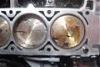
Here is a link to that SAM engine:
http://www.samracing.com/500ciLS2.html
What they dont say in print but is obvious by the dyno info as well as the video is that its on a HUGE hit of nitrous.
Also, with a 4.500" crank and a 6.800" rod insdie of a stock deck height block, I cant image that thing has a long life expectancy. Just my opinion.
http://www.samracing.com/500ciLS2.html
What they dont say in print but is obvious by the dyno info as well as the video is that its on a HUGE hit of nitrous.
Also, with a 4.500" crank and a 6.800" rod insdie of a stock deck height block, I cant image that thing has a long life expectancy. Just my opinion.
I have the magazine at home with that car. It made 717 to the wheels and is using a rather small cam for a 500 ci motor. They made more power with it than they did with a bigger cam. It uses a 1" deck plate to allow the longer stroke and also uses spacers to mount the intake manifold to the intake runners on the heads. Heres the PDF article from the magazine.
http://www.samracing.com/pdf/CamaroPerformersJune08.pdf
I have the magazine at home with that car. It made 717 to the wheels and is using a rather small cam for a 500 ci motor. They made more power with it than they did with a bigger cam. It uses a 1" deck plate to allow the longer stroke and also uses spacers to mount the intake manifold to the intake runners on the heads. Heres the PDF article from the magazine.
http://www.samracing.com/pdf/CamaroPerformersJune08.pdf
http://www.samracing.com/pdf/CamaroPerformersJune08.pdf
I mean in terms of "oh no, I have a large stroke, its going to come apart the first time it sees 8000 rpm" More swept volume, more head needed of course
Obviously have to be able to feed that cylinder well, no matter how big it is. Just saying I wouldnt be too worried about piston speed in and of itself in a drag or street engine that sees normal duty. Road race 500 miles at WOT you may make a case for it, not my area of interest. This is of course assuming the guy that screws together the engine isnt dumber than the aluminum/steel the engine parts are made of... which isnt often the case.
Big crank like that rod/cam concerns, keeping crank flexing under control, oil control issues due to stupidness with the piston relative to the cylinder like Nutter was talking about, those are the kinds fo things I see happening. Havent seen a piston fly off or anything from too much piston speed, usually its because someone forgot to put the rod bolts all the way in
Valvetrain/physical fitment is limiting factor in drag race and street engines, there are heads out that can feed them, not "piston speed" ERL block and 4.5 crank would be pretty tight fit
Obviously have to be able to feed that cylinder well, no matter how big it is. Just saying I wouldnt be too worried about piston speed in and of itself in a drag or street engine that sees normal duty. Road race 500 miles at WOT you may make a case for it, not my area of interest. This is of course assuming the guy that screws together the engine isnt dumber than the aluminum/steel the engine parts are made of... which isnt often the case.
Big crank like that rod/cam concerns, keeping crank flexing under control, oil control issues due to stupidness with the piston relative to the cylinder like Nutter was talking about, those are the kinds fo things I see happening. Havent seen a piston fly off or anything from too much piston speed, usually its because someone forgot to put the rod bolts all the way in
Valvetrain/physical fitment is limiting factor in drag race and street engines, there are heads out that can feed them, not "piston speed" ERL block and 4.5 crank would be pretty tight fit
99% of the time, off the shelf parts are used and are really over-engineered anyways. It's the engines pushing the ragged edge (NASCAR. Pro Stock, etc) that should be concerned.
IMHO, piston speed/acceleration is a factor that needs to be looked at as well as piston weight. It has an effect on compression and inertial loads that the rotating/reciprocating parts are subjected to. It may not cause a piston to come flying off the rod, but it could have an effect on the big end distortion.
99% of the time, off the shelf parts are used and are really over-engineered anyways. It's the engines pushing the ragged edge (NASCAR. Pro Stock, etc) that should be concerned.
99% of the time, off the shelf parts are used and are really over-engineered anyways. It's the engines pushing the ragged edge (NASCAR. Pro Stock, etc) that should be concerned.
No.

I thought high piston speed stressed the rod bearings from starting the downward stroke as the pistons momentum is being stopped and pulled downward with it. I thought that kind of caused the rod bearings to get "crushed". Kind of like detonation, where the rod is still going upward but the pre-ignition is trying to push that piston downward before it should, "crushing" or stressing the rod bearing.
No.
No.
No way 'cause my LS2 head /cam put 508 to the ground. The LSx 454 puts down 640 on average so 500 ci should follow suit with 700+ to the ground.
Last edited by lynmup; Feb 4, 2009 at 10:43 AM.