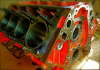
LS7 Engine Failure

TECH Fanatic
iTrader: (1)
Joined: Oct 2002
Posts: 1,851
Likes: 0
From: Elmhurst, IL (Chicago Suburb)

Sorry to hear about the owner's if this car misfortune that is very frustrating. 
I see there still has not been any disclosure regrading what brand name piston this was (can you kindy tell us or is it that important to you not to disclose same)?
Best of luck on the final outcome!
I see there still has not been any disclosure regrading what brand name piston this was (can you kindy tell us or is it that important to you not to disclose same)?
Best of luck on the final outcome!

Thread Starter
Teching In
Joined: Feb 2010
Posts: 41
Likes: 1
Sorry to hear about the owner's if this car misfortune that is very frustrating.
I see there still has not been any disclosure regrading what brand name piston this was (can you kindy tell us or is it that important to you not to disclose same)?
Best of luck on the final outcome!
I see there still has not been any disclosure regrading what brand name piston this was (can you kindy tell us or is it that important to you not to disclose same)?
Best of luck on the final outcome!

TECH Resident


Joined: Apr 2008
Posts: 838
Likes: 12
From: Right here, right now!
The piston is a Katech unit out of a street attack engine. From what I understand the piston has been sent back to Katech to be evaluated. I am still trying to get some of the information requested; Rockwell tests, fuel & spark tables, etc. I am going to try and stop by the engine builder later in the week and get some more information.
Thread Starter
Teching In
Joined: Feb 2010
Posts: 41
Likes: 1
If there was no mechanical force put on the cylinder wall as in a dropped valve, the sleeve and block wall broke due to detonation in that particular cylinder. I usually see this in cylinder 7 with 5 being the next to crack. I had one a couple of weeks ago (blower motor) with a cracked cylinder 2 which was rather unusual.
That block can be welded and put back into service. Don't junk it, it will be much better than new with Darton Seal Tight dry liners installed. I have been repairing two to three LS7 blocks a month on average. Another leaving here tomorrow.
Steve
That block can be welded and put back into service. Don't junk it, it will be much better than new with Darton Seal Tight dry liners installed. I have been repairing two to three LS7 blocks a month on average. Another leaving here tomorrow.
Steve
Thread Starter
Teching In
Joined: Feb 2010
Posts: 41
Likes: 1
I am such a moron for not getting pictures of the underside of the piston. If I recall the underside did not reflect the valve reliefs at all, but was rather smooth between the wrist pin bores.
Pistons were evaluated by engineering and no signs of detonation or overheating were found. The forging has a material on the underside to compensate for both intake and exhaust valve pockets. Crown thickness is consistent throughout the piston. It was determined that the failure was caused by the piston exceeding it's recommended replacement interval in race conditions. Our bogey for replacing pistons in an endurance road race application is 30 hours. These pistons had 40 hours. After the 24 hours of Le Mans, one of the items on the rebuild list is new pistons.
Those are 2618 pistons.
Those are 2618 pistons.
Last edited by Katech_Jason; Feb 17, 2010 at 10:04 AM.
LS1 Tech Stories
The Best V8 Stories One Small Block at Time

Topdon ONE vs. Artidiag 800 BT2: Which is the Diagnostic Tablet For You?
Pouria Savadkouei
Gas Monkey Built a 6-Wheel Ferrari Testarossa With a Corvette LT4 Engine
Verdad Gallardo
7 Most Reliable High-Performance Engines GM Has Ever Built
Verdad Gallardo
Amazing '71 Camaro Restomod Is Modern Muscle Car Under the Skin
Verdad Gallardo
6 Common C5 Corvette Failures and What's Involved In Repairing Them
Pouria Savadkouei
Retro Modern Bandit Pontiac Trans AM Comes With Burt Reynolds' Autograph
Verdad Gallardo
Top 10 Greatest Cadillac V Series Performance Models Ever, Ranked
Pouria Savadkouei
Top 10 Most Powerful Chevy Trucks Ever Made!

Hennessey's New Supercharged Silverado ZR2 Has 700 HP
Verdad Gallardo
Staging Lane
Joined: Jan 2006
Posts: 69
Likes: 0
From: New York
Jason,
I'm curious what constitutes endurance race use. I assume the parameters are full throttle at rpms cycling from torque peak to HP peak?
I'm asking because my track car has forged pistons in it, and I'd like to know when I need to pull them out for replacement. For a motor seeing some street and track use, should you just keep track of total hours on track, or should there also be an add in factor for mild street use?
TIA.
I'm curious what constitutes endurance race use. I assume the parameters are full throttle at rpms cycling from torque peak to HP peak?
I'm asking because my track car has forged pistons in it, and I'd like to know when I need to pull them out for replacement. For a motor seeing some street and track use, should you just keep track of total hours on track, or should there also be an add in factor for mild street use?
TIA.
Thread Starter
Teching In
Joined: Feb 2010
Posts: 41
Likes: 1
Pistons were evaluated by engineering and no signs of detonation or overheating were found. The forging has a material on the underside to compensate for both intake and exhaust valve pockets. Crown thickness is consistent throughout the piston. It was determined that the failure was caused by the piston exceeding it's recommended replacement interval in race conditions. Our bogey for replacing pistons in an endurance road race application is 30 hours. These pistons had 40 hours. After the 24 hours of Le Mans, one of the items on the rebuild list is new pistons.
Those are 2618 pistons.
Those are 2618 pistons.
Jason,
I'm curious what constitutes endurance race use. I assume the parameters are full throttle at rpms cycling from torque peak to HP peak?
I'm asking because my track car has forged pistons in it, and I'd like to know when I need to pull them out for replacement. For a motor seeing some street and track use, should you just keep track of total hours on track, or should there also be an add in factor for mild street use?
TIA.
I'm curious what constitutes endurance race use. I assume the parameters are full throttle at rpms cycling from torque peak to HP peak?
I'm asking because my track car has forged pistons in it, and I'd like to know when I need to pull them out for replacement. For a motor seeing some street and track use, should you just keep track of total hours on track, or should there also be an add in factor for mild street use?
TIA.
Even that is debatable. It all depends on duty cycle and you would need datalogging to compare. Even the same car/same engine would have different wear characteristics with different drivers. An amateur track day enthusiast is going to wear out an engine a lot more slowly than if you put Johnny O'Connell in the driver's seat.
You pretty much need to just keep track of the track miles (or hours). A 24 hour race is like 100,000 or more street miles, so it is not as significant.
Thanks Jason for clearing that up. I noticed on your Ultra Attack LS7 thread, you made a point to state that your forged pistons are durability tested at WOT for 422 hours. In a real world environment I guess that equals 30 hours? Would the addition of piston squirters extend your "bogey" on piston replacement or should one expect to refresh one of your engines every 30 hours of track use?
-Horsepower (550 in that durability test versus 622 noted here)
-Duty cycle
-Heat
-Calibration
-Fuel
-Knock monitoring
Piston squirters will definitely reduce heat and reduce that portion of the equation. However the 30 hour bogey for endurance racing pistons doesn't change. Those engines also have piston squirters. It's a risk vs. reward situation. The pistons may last much longer, but is it worth it to find out exactly how long?