


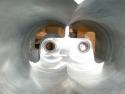




Pics of LSA Heads.

Thread Starter
LS1Tech Sponsor
iTrader: (14)
Joined: Feb 2009
Posts: 2,262
Likes: 2
From: Lubbock, TX

Gm uses them like this. GM does not cnc this head in any fashion.
Is the wing that is refered to, the small bump at the base of the valve guide boss? From what I've been able to gather these are supposed to flow the same as an ls9 head. Is that bump all that reduces the flow from the stock l92 intake flow numbers?
Kory
Kory
Yes, the deck is a little thicker and they are stronger overall because they are rotocast to eliminate porosity during the pour and they are T356-T6 aluminum. Valves are 2.165, 1.59 and they also have a "wing" in the intake port to help atomize fuel.
LS1 Tech Stories
The Best V8 Stories One Small Block at Time

6 Common C5 Corvette Failures and What's Involved In Repairing Them
Pouria Savadkouei
Retro Modern Bandit Pontiac Trans AM Comes With Burt Reynolds' Autograph
Verdad Gallardo
Top 10 Greatest Cadillac V Series Performance Models Ever, Ranked
Pouria Savadkouei
Top 10 Most Powerful Chevy Trucks Ever Made!

Hennessey's New Supercharged Silverado ZR2 Has 700 HP
Verdad Gallardo
Coachbuilt N2A Anteros Is an LS2-Powered C6 Corvette In Italian Clothes
Verdad Gallardo
Awesome K5 Blazer Restomod Comes With C7 Corvette Power
Verdad Gallardo
10 Camaros You Should Never Buy

10 LS Engine Myths That Refuse to Die
Verdad Gallardo
I'm pretty sure the combustion chamber is the same as an LS3 . I've been trying to get more info but they've been working hard dealing with the loss of John . I really need heads and misc. parts to finish my 402 build .
 Re: LSA heads
 Complete LSAs are are significantly better for boosted or HO applications for a number of reasons.
They have a stronger , more dense alloy and casting process.
They have tougher, more heat resistant valves and they have that swirl inducing wing cast into the roof of the intake ports.
The LSA engine as used in the CTSV and the new LSA powered ZL1 Camaro are both supercharged and benefit from these heads as supplied.
The low cost of the bare castings is more than offset by the final assembled cost of the heads inluding the special valves, spring retainers and rockers (rockers same as sister rectangular port offset valve LS3, L92, heads)
The concept of the LSA and LS9 heads is optimize them for boosted applications where porting is not the answer rather more forced induction pressure and better mixing.
IMO
Bruce
From GM:
Exceptional airflow
High-flow cylinder heads based on GM’s proven L92 design channel incoming air into the combustion chambers. They are made with a premium A356T6 alloy that offers excellent heat resistance, particularly in the bridge area of the cylinder head, between the intake and exhaust valves. Additionally, each head is manufactured with a roto-casting method.
Also known as spin casting, the roto-casting process involves pouring the molten alloy into a rotating mold, for a more even distribution of the material that virtually eliminates porosity – air bubbles or pockets trapped in the casting – for a stronger finished product.
For optimal combustion, the cylinder heads feature swirl-inducing wings cast into the intake ports, improving the mixture motion of the pressurized air/fuel charge. The gatekeepers of the heads’ combustion chambers are large-diameter, 2.16-inch (55 mm) intake valves and 1.59-inch (40.4 mm) exhaust valves. The intake valves are made of steel and feature thick heads. Unique, four-layer steel head gaskets are used between the heads and cylinder block.
The LSA’s valves are actuated by a hydraulic roller-type camshaft that delivers a relatively low 0.480-inch (12.2 mm) lift on both the intake and exhaust sides. The low lift – relative to the engine’s high horsepower and torque – and low overlap foster a smoother idle and excellent low-rpm driving characteristics. The wider efficiency band of the Eaton supercharger enabled the use of the low-lift cam to achieve the engine’s performance targets.
They have a stronger , more dense alloy and casting process.
They have tougher, more heat resistant valves and they have that swirl inducing wing cast into the roof of the intake ports.
The LSA engine as used in the CTSV and the new LSA powered ZL1 Camaro are both supercharged and benefit from these heads as supplied.
The low cost of the bare castings is more than offset by the final assembled cost of the heads inluding the special valves, spring retainers and rockers (rockers same as sister rectangular port offset valve LS3, L92, heads)
The concept of the LSA and LS9 heads is optimize them for boosted applications where porting is not the answer rather more forced induction pressure and better mixing.
IMO
Bruce
From GM:
Exceptional airflow
High-flow cylinder heads based on GM’s proven L92 design channel incoming air into the combustion chambers. They are made with a premium A356T6 alloy that offers excellent heat resistance, particularly in the bridge area of the cylinder head, between the intake and exhaust valves. Additionally, each head is manufactured with a roto-casting method.
Also known as spin casting, the roto-casting process involves pouring the molten alloy into a rotating mold, for a more even distribution of the material that virtually eliminates porosity – air bubbles or pockets trapped in the casting – for a stronger finished product.
For optimal combustion, the cylinder heads feature swirl-inducing wings cast into the intake ports, improving the mixture motion of the pressurized air/fuel charge. The gatekeepers of the heads’ combustion chambers are large-diameter, 2.16-inch (55 mm) intake valves and 1.59-inch (40.4 mm) exhaust valves. The intake valves are made of steel and feature thick heads. Unique, four-layer steel head gaskets are used between the heads and cylinder block.
The LSA’s valves are actuated by a hydraulic roller-type camshaft that delivers a relatively low 0.480-inch (12.2 mm) lift on both the intake and exhaust sides. The low lift – relative to the engine’s high horsepower and torque – and low overlap foster a smoother idle and excellent low-rpm driving characteristics. The wider efficiency band of the Eaton supercharger enabled the use of the low-lift cam to achieve the engine’s performance targets.
Last edited by See5; Feb 27, 2011 at 09:23 AM.
