







LS2 427 having issues...HELP

what all gets caped off. driver valve cover back of intake ?? therer alot of place that would need caped. TB? vallycover?
All of where the PCV lines ran. so there are a few plugs on the valve covers, on on the passenger side of the TB, and you shouldn't have one on the Valley cover if its a standard LS1 cover. the LS6 cover moved the ports from the valve covers to the valley cover. I believe thats it.
What I did, when I had stock valve covers on my car, was run a metco breather, and all the other lines capped off (actually I ran a hose connecting both valve covers, just for the sake of doing so...
I later put a set of aftermarket covers on, with those I ran a -10 line around the back from the drivers side to the passenger's side to a T fitting, then ran a -10 line down to a moroso vented catch can, much like what's used with a vacuum pump.
I had absolutely no oil smell at that point. The line and can gave the oil and other mositure enough time to collect and it was low enough (mounted on my motor plate) so that it would collect there.
Worked out great. I used to keep a piece of foam around the filter, and clean the filter/replace the foam on a regular basis. No smell at all, no oil residue anywhere.
I later put a set of aftermarket covers on, with those I ran a -10 line around the back from the drivers side to the passenger's side to a T fitting, then ran a -10 line down to a moroso vented catch can, much like what's used with a vacuum pump.
I had absolutely no oil smell at that point. The line and can gave the oil and other mositure enough time to collect and it was low enough (mounted on my motor plate) so that it would collect there.
Worked out great. I used to keep a piece of foam around the filter, and clean the filter/replace the foam on a regular basis. No smell at all, no oil residue anywhere.
Well I talked to the guy that took a look at my heads said they tested fine no leaks guides are fine and he's putting new valve seals in even tho they didnt look bad. Thats good news but bad news b/c Im back at square one.
How would oil pool on the backside of the valves? but yet everything check out on the heads.? anyone?
How would oil pool on the backside of the valves? but yet everything check out on the heads.? anyone?

Launching!
Joined: Jan 2010
Posts: 283
Likes: 0
From: N. Va
As far as PCV....don't remove it unless the car is a race car only constantly seeing HIGH rpms and having it's oil changed CONSTANTLY!!!!
If it's a car you drive on the street or only change the oil every 3k miles as normal....you NEED pcv! All these guys can say otherwise but I've seen the sludge and junk it'll do to your motor if you don't run it! Now I went with Mike Norris's catch can and I love it! It's slim and fits great.
The important thing to know about PCV is you need fresh air going into your passenger valve cover from the TB and bad air being sucked out of the driver side valve cover going to the pcv valve and then a catch can and then the vaccum port on the intake manifold. The PCV valve is a $3 part that i'll change at every oil change. I put mine right at the port on the driver valve cover...then ran fuel line around to the catch can...then to the intake manifold. If you have a front and rear port on your passenger side valve cover...you can block off the rear or T it into the driver side....i'd just block the rear one off though.
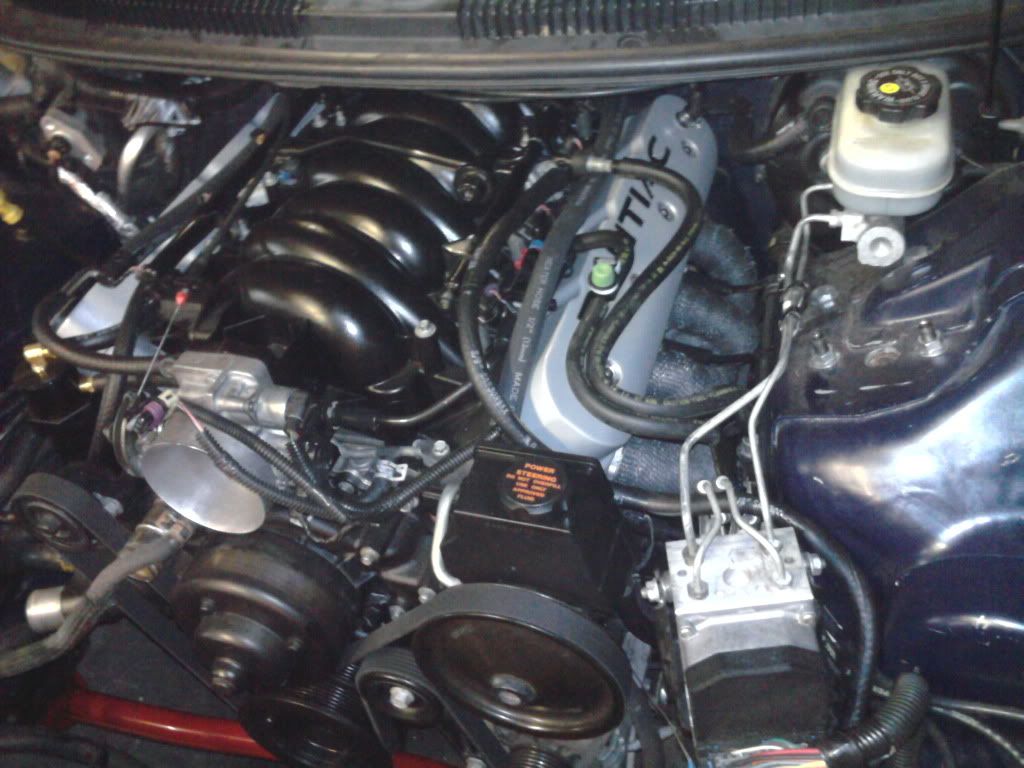
Here's a pic of my catch can. My vacuum port is at the rear of the driver side valve cover, goes behind the intake manifold and then runs up beside the injectors to the catch can top port. The catch can side port goes to the intake manifold vaccum port. You can have Mike Norris put AN fittings on instead of the brass to dress it up even more.
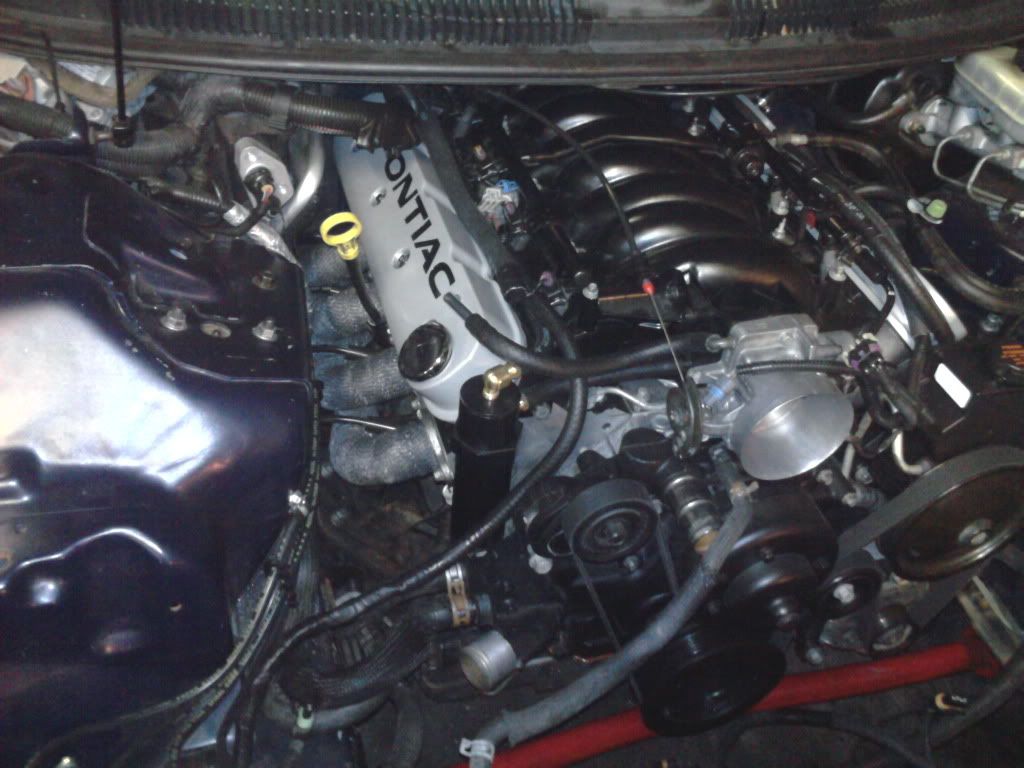
Here you see the vacuum rear port on the driver sidewith the pcv valve (it's there...trust me..haha) and the fuel line hose clamped to it...
If it's a car you drive on the street or only change the oil every 3k miles as normal....you NEED pcv! All these guys can say otherwise but I've seen the sludge and junk it'll do to your motor if you don't run it! Now I went with Mike Norris's catch can and I love it! It's slim and fits great.
The important thing to know about PCV is you need fresh air going into your passenger valve cover from the TB and bad air being sucked out of the driver side valve cover going to the pcv valve and then a catch can and then the vaccum port on the intake manifold. The PCV valve is a $3 part that i'll change at every oil change. I put mine right at the port on the driver valve cover...then ran fuel line around to the catch can...then to the intake manifold. If you have a front and rear port on your passenger side valve cover...you can block off the rear or T it into the driver side....i'd just block the rear one off though.
Here's a pic of my catch can. My vacuum port is at the rear of the driver side valve cover, goes behind the intake manifold and then runs up beside the injectors to the catch can top port. The catch can side port goes to the intake manifold vaccum port. You can have Mike Norris put AN fittings on instead of the brass to dress it up even more.
Here you see the vacuum rear port on the driver sidewith the pcv valve (it's there...trust me..haha) and the fuel line hose clamped to it...
I just recently helped tear down a truck 6 litre motor, that had the pcv on it just like the factory sets it up, and in 97447 miles, it had more crap built up in it then you even want to imagine. And I know the original owner, he kept up with the oil every 3500 miles...
That PCV isn't going to stop an engine from geting sludged up, and taking it off isn't going to make it happen any more OR less.
You can listed to the Tlewis/rev extreme BS all you want about catch cans and the need for a PCV system. It's crap.
The PCV went on cars back when emissions laws went into effect, and it was to stop oil from getting on the road out of engines, and to try to decrease the overall smog of cars, true fact.
You pull that PCV off, and if you start the car and drive it for a good 15 to 20 min before you change the oil every time, you will have all the contamination in the oil that you're draining out, and you will not have buildup problems inside the engine. Draining the oil when the engine is cold, and all the stuff has had time to seperate out of the oil and collect on the tops of the engine, will cause buildup in ANY engine.
I've been around engines that are getting torn down for near 20 years now, and I have seen plenty, both before and after smog equipment, and all that nonsense. Believe me, if the maintenance is done, and done right, the engine will look clean inside.
Change the oil like a nut every 500 miles, if you're doing it with the engine cold, it's not going to get the contaminents out.
Vent the crankcase, PCV it, vacuum pump it, doesn't matter, if you change the oil while it's cold, you will never get everything out of the engine. Do it while the engine oil is hot and the engine is up to temp, and you won't get the buildup.
Oh, and 98, that header wrap you have on your headers, why is that on there? I hope you didn't buy into the "it will make more power" stories about that stuff, and I hope that they aren't stainless headers, because the heat you're holding in will make them brittle. And if you're doing that to cover a rusty set of mild steel headers, it will cause them to rust out FASTER, becuase now the moisture can get wicked into the fabric and get held right against the tubes... making them deteriorate even faster....
Just thought I'd throw that one out there too... since that's another urban legend that is supposedly a "good idea". ONLY time that stuff has any value is if you're trying to stop stuff from getting burnt from the heat... which I can't imagine on a standard n/a setup f body would be an issue. Turbo guys do it, to try to keep the under hood temps down and help prevent wires and whatnot from failing, they are the only ones that really stand to benefit from it.
That PCV isn't going to stop an engine from geting sludged up, and taking it off isn't going to make it happen any more OR less.
You can listed to the Tlewis/rev extreme BS all you want about catch cans and the need for a PCV system. It's crap.
The PCV went on cars back when emissions laws went into effect, and it was to stop oil from getting on the road out of engines, and to try to decrease the overall smog of cars, true fact.
You pull that PCV off, and if you start the car and drive it for a good 15 to 20 min before you change the oil every time, you will have all the contamination in the oil that you're draining out, and you will not have buildup problems inside the engine. Draining the oil when the engine is cold, and all the stuff has had time to seperate out of the oil and collect on the tops of the engine, will cause buildup in ANY engine.
I've been around engines that are getting torn down for near 20 years now, and I have seen plenty, both before and after smog equipment, and all that nonsense. Believe me, if the maintenance is done, and done right, the engine will look clean inside.
Change the oil like a nut every 500 miles, if you're doing it with the engine cold, it's not going to get the contaminents out.
Vent the crankcase, PCV it, vacuum pump it, doesn't matter, if you change the oil while it's cold, you will never get everything out of the engine. Do it while the engine oil is hot and the engine is up to temp, and you won't get the buildup.
Oh, and 98, that header wrap you have on your headers, why is that on there? I hope you didn't buy into the "it will make more power" stories about that stuff, and I hope that they aren't stainless headers, because the heat you're holding in will make them brittle. And if you're doing that to cover a rusty set of mild steel headers, it will cause them to rust out FASTER, becuase now the moisture can get wicked into the fabric and get held right against the tubes... making them deteriorate even faster....
Just thought I'd throw that one out there too... since that's another urban legend that is supposedly a "good idea". ONLY time that stuff has any value is if you're trying to stop stuff from getting burnt from the heat... which I can't imagine on a standard n/a setup f body would be an issue. Turbo guys do it, to try to keep the under hood temps down and help prevent wires and whatnot from failing, they are the only ones that really stand to benefit from it.
Last edited by JL ws-6; May 11, 2011 at 04:43 PM.
LS1 Tech Stories
The Best V8 Stories One Small Block at Time

Topdon ONE vs. Artidiag 800 BT2: Which is the Diagnostic Tablet For You?
Pouria Savadkouei
Gas Monkey Built a 6-Wheel Ferrari Testarossa With a Corvette LT4 Engine
Verdad Gallardo
7 Most Reliable High-Performance Engines GM Has Ever Built
Verdad Gallardo
Amazing '71 Camaro Restomod Is Modern Muscle Car Under the Skin
Verdad Gallardo
6 Common C5 Corvette Failures and What's Involved In Repairing Them
Pouria Savadkouei
Retro Modern Bandit Pontiac Trans AM Comes With Burt Reynolds' Autograph
Verdad Gallardo
Top 10 Greatest Cadillac V Series Performance Models Ever, Ranked
Pouria Savadkouei
Top 10 Most Powerful Chevy Trucks Ever Made!

Hennessey's New Supercharged Silverado ZR2 Has 700 HP
Verdad Gallardo Launching!
Joined: Jan 2010
Posts: 283
Likes: 0
From: N. Va
If u change oil every 500 miles with oil at temp...then yeah I'll agree with ya....you def have more years on me working on motors so I'll always respect that....I'm just explaining what I've seen happen with motors that didn't have the pcv and changed oil every 3-4k miles
As far as the headers...wrapping them gives me more power just like a GT-R sticker! Haha...I got those headers for free from a friend. They were rusty on the outside the I spent a lot of time restoring...but even after I restored and ceramic coated them, they still looked like crap....so I wrapped them just to make them look better...no other reason. They'll hold me over until I can afford some Kooks stainless headers.
Don't be so quick to judge...not everyone on here with a different opinion is an idiot.
As far as the headers...wrapping them gives me more power just like a GT-R sticker! Haha...I got those headers for free from a friend. They were rusty on the outside the I spent a lot of time restoring...but even after I restored and ceramic coated them, they still looked like crap....so I wrapped them just to make them look better...no other reason. They'll hold me over until I can afford some Kooks stainless headers.
Don't be so quick to judge...not everyone on here with a different opinion is an idiot.

For those changing oil every 3000 miles religiously, you may want to check this out and see for yourself if its really doing anything good or if you are just throwing $$$ away. I would NEVER go as far as they did with waiting to change oil but finding out that engine wear is occurring more with fresh oil seems VERY interesting to me...enjoy http://neptune.spacebears.com/cars/stories/mobil1.html
side note:
I would assume this is for mostly DD driving tho as seeing redline all the time like with a race car would prob change the results IMO but regardless, good info.
http://neptune.spacebears.com/cars/stories/mobil1.htmlside note:
I would assume this is for mostly DD driving tho as seeing redline all the time like with a race car would prob change the results IMO but regardless, good info.
If u change oil every 500 miles with oil at temp...then yeah I'll agree with ya....you def have more years on me working on motors so I'll always respect that....I'm just explaining what I've seen happen with motors that didn't have the pcv and changed oil every 3-4k miles
As far as the headers...wrapping them gives me more power just like a GT-R sticker! Haha...I got those headers for free from a friend. They were rusty on the outside the I spent a lot of time restoring...but even after I restored and ceramic coated them, they still looked like crap....so I wrapped them just to make them look better...no other reason. They'll hold me over until I can afford some Kooks stainless headers.
Don't be so quick to judge...not everyone on here with a different opinion is an idiot.
As far as the headers...wrapping them gives me more power just like a GT-R sticker! Haha...I got those headers for free from a friend. They were rusty on the outside the I spent a lot of time restoring...but even after I restored and ceramic coated them, they still looked like crap....so I wrapped them just to make them look better...no other reason. They'll hold me over until I can afford some Kooks stainless headers.
Don't be so quick to judge...not everyone on here with a different opinion is an idiot.
I figured that the wrap was to hide the rust. I know about it... becuase I've done it.... in the same situation, I couldn't afford stainless headers at the time. Granted that was back in the mid 90's ant they weren't available like they are now..... but the time frame is irrevelant.
Oil is usually good for more then 3000 miles, today's oils are alot better then they were 20 years ago by far. But, I still adhere to the 3000 miles, because I usually ditch the pcv on these cars, and it does it's job, collecting teh contaminents taht don't just steam out the breather system.
Fwiw, my old race engine I changed the oil on that, every trip to the track. Think about that, every trip. And it only got raced. Oil would generally come out the color it went in, but I did it to make sure that if something started to come apart, I'd see it as I was draining the oil into a coffee filter.... which I did every time, so that if there were any bigger particles, I would catch them.
Overkill, absolutely. No pcv on that bad boy, and every time I took a valve cover off to check the springs, it looked like the engine had never even been run. But, that was to be expected.
I did just help someone change valve springs not too long ago that went about 25K without the PCV. He had a catch can on the car for a while and the intake, when that came off at an intake swap roughly 25K ago...was full of oil. He had a BIG one on there too, not sure what brand, looked about the size of a 1/2 gallon of milk
 Intake was still full of oil.
We ditched the PCV when the intake was swapped, and when the valve springs got done the inside of that motor was as clean as any I have seen with 80K on it. Honestly I would have never known it had that many miles on it.
He keeps the oil in the car for 3 months, and that's it. Doesn't matter if it's 500 miles or 2500. NEVER over 3000. It's overkill I am aware, but if you keep up on the maintenance, there's no adverse effects to removing the pcv. Only downside, is no oil in the intake, as if that's a bad thing.
Last edited by JL ws-6; May 12, 2011 at 06:16 AM.
PCV, No PCV, catchcan ?? I know it is all personal pref or what you beleive but what seems to be the norm. My car is not a DD nor a race car only. I makes me no diff wether I have a pcv no pcv or a catchcan. i simply dont want oil in my intake nor on the back side of my valves?
Then don't run any lines from the crankcase to the intake. That stops all the oil from getting to the back side of the valves... unless the valve seals are leaking.
98, I used castrol 20-50 in my 402. Next motor will use rotella 15-40.
98, I used castrol 20-50 in my 402. Next motor will use rotella 15-40.
Just had new seals put in. what lines am I looking for that are from the crankcase to the intake

Launching!
Joined: Jan 2010
Posts: 283
Likes: 0
From: N. Va
that will work...I've seen systems run that way or I've seen them run where both catch cans run the dirty side just as double insurance no oil gets in the intake. not necessary to run clean air through a catch can as your air goes through the air filter in the lid already, but if that's how your would like to run it by all means! It'll still work great.

your problem is likely the street driving with the long stroke. Performance pistons are tappered so that they can grow in the bore under extreme load. When that 4.1 stroke brings that piston down out of the bore and you are just cruising around, that piston is rocking like a **** and the skirts are beating up the cylinder walls. When he pulled the heads off, with the pistons at the bottom, he will likely see the straight up/down lines in the bore. That's how you eat some oil in these long stroke setups. Also, scrap the PCV and just change the oil when it starts looking dirty. I run a vented catch can to my valve covers
The vented catch can is what I ran off my valve covers.... oil changes were so often I never let the oil even get to the point it "looked dirty"
Long stroke is an oil consumption problem waiting to happen with these engines, 4 inch stroke is really about as long as you can go without the use of one of the tall deck blocks, if you want to prevent the issues associated with longer stroke.
4 inch stroke in a tall deck block would probably behave like a stock engine with how far the piston could be up in the bore all the time. Make for a very reliable setup that would likly be happy for a long time, rebuild interval's would be pretty long.
Long stroke is an oil consumption problem waiting to happen with these engines, 4 inch stroke is really about as long as you can go without the use of one of the tall deck blocks, if you want to prevent the issues associated with longer stroke.
4 inch stroke in a tall deck block would probably behave like a stock engine with how far the piston could be up in the bore all the time. Make for a very reliable setup that would likly be happy for a long time, rebuild interval's would be pretty long.
