


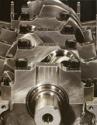




Is this oky: Piston Above Block Deck by 0.035"

Thread Starter
TECH Regular
Joined: Dec 2003
Posts: 486
Likes: 0
From: Cherry Hill, New Jersey State
 Is this oky: Piston Above Block Deck by 0.035"
 Is there a certain limit value for piston above the block deck at TDC.
I'm calculating a Stroker combination, I found the piston will be above the block deck by 0.035", is this within the acceptable limit?
With this clearance, the quench Will be 0.018"!!!
It can be solved with a connecting rod center to center 6.000", but the crankshaft spec sheet say a minimum connecting rod length is 6.098".
I'm calculating a Stroker combination, I found the piston will be above the block deck by 0.035", is this within the acceptable limit?
With this clearance, the quench Will be 0.018"!!!
It can be solved with a connecting rod center to center 6.000", but the crankshaft spec sheet say a minimum connecting rod length is 6.098".
Last edited by LS6; Jun 25, 2016 at 11:31 PM.
Thread Starter
TECH Regular
Joined: Dec 2003
Posts: 486
Likes: 0
From: Cherry Hill, New Jersey State
Just for understanding
Is there any issue of angular motion or major stress on the block cylinder wall and crankshaft when going with connecting rods sized smaller length (center to center) than the one is specified by the crankshaft manufacture sheet?
For example, K1 4.250" or 4.125" stroke crankshaft, the manufacture spec.sheet specified minimum connecting rod as 6.098", and if I went with 6.000", will there be an issue on the crankshaft or on the block wall cylinder, or other that I'm not aware of?
Is there any issue of angular motion or major stress on the block cylinder wall and crankshaft when going with connecting rods sized smaller length (center to center) than the one is specified by the crankshaft manufacture sheet?
For example, K1 4.250" or 4.125" stroke crankshaft, the manufacture spec.sheet specified minimum connecting rod as 6.098", and if I went with 6.000", will there be an issue on the crankshaft or on the block wall cylinder, or other that I'm not aware of?
Just for understanding
Is there any issue of angular motion or major stress on the block cylinder wall and crankshaft when going with connecting rods sized smaller length (center to center) than the one is specified by the crankshaft manufacture sheet?
For example, K1 4.250" or 4.125" stroke crankshaft, the manufacture spec.sheet specified minimum connecting rod as 6.098", and if I went with 6.000", will there be an issue on the crankshaft or on the block wall cylinder, or other that I'm not aware of?
Is there any issue of angular motion or major stress on the block cylinder wall and crankshaft when going with connecting rods sized smaller length (center to center) than the one is specified by the crankshaft manufacture sheet?
For example, K1 4.250" or 4.125" stroke crankshaft, the manufacture spec.sheet specified minimum connecting rod as 6.098", and if I went with 6.000", will there be an issue on the crankshaft or on the block wall cylinder, or other that I'm not aware of?

Staging Lane
Joined: Jan 2012
Posts: 61
Likes: 0
Just for understanding
Is there any issue of angular motion or major stress on the block cylinder wall and crankshaft when going with connecting rods sized smaller length (center to center) than the one is specified by the crankshaft manufacture sheet?
For example, K1 4.250" or 4.125" stroke crankshaft, the manufacture spec.sheet specified minimum connecting rod as 6.098", and if I went with 6.000", will there be an issue on the crankshaft or on the block wall cylinder, or other that I'm not aware of?
Is there any issue of angular motion or major stress on the block cylinder wall and crankshaft when going with connecting rods sized smaller length (center to center) than the one is specified by the crankshaft manufacture sheet?
For example, K1 4.250" or 4.125" stroke crankshaft, the manufacture spec.sheet specified minimum connecting rod as 6.098", and if I went with 6.000", will there be an issue on the crankshaft or on the block wall cylinder, or other that I'm not aware of?
Trending Topics
LS1 Tech Stories
The Best V8 Stories One Small Block at Time

6 Common C5 Corvette Failures and What's Involved In Repairing Them
Pouria Savadkouei
Retro Modern Bandit Pontiac Trans AM Comes With Burt Reynolds' Autograph
Verdad Gallardo
Top 10 Greatest Cadillac V Series Performance Models Ever, Ranked
Pouria Savadkouei
Top 10 Most Powerful Chevy Trucks Ever Made!

Hennessey's New Supercharged Silverado ZR2 Has 700 HP
Verdad Gallardo
Coachbuilt N2A Anteros Is an LS2-Powered C6 Corvette In Italian Clothes
Verdad Gallardo
Awesome K5 Blazer Restomod Comes With C7 Corvette Power
Verdad Gallardo
10 Camaros You Should Never Buy

10 LS Engine Myths That Refuse to Die
Verdad Gallardo
On The Tree
Joined: May 2012
Posts: 106
Likes: 1
Most likely the piston will hit the heads with that amount of quench. Had .030" quench setups hit the heads, the pistons do rock in the bore, forged pistons have more wall clearance than cast pistons. While that does sound bad its not catastrophic but should be avoided.
Basically the ideas of what is ok for quench with a cast piston is different than a forged piston.
The piston should be at 0 deck, with a steel rod. Look at how the OEM's are, LS factory engines are .006 above the deck.
Another option would be to cut the tops of the pistons in a lathe, which isn't difficult. Any of the piston companies could do that to an existing piston, or a machine shop or Rebco.
Bottom line, order the correct piston with the appropriate compression height.
Basically the ideas of what is ok for quench with a cast piston is different than a forged piston.
The piston should be at 0 deck, with a steel rod. Look at how the OEM's are, LS factory engines are .006 above the deck.
Another option would be to cut the tops of the pistons in a lathe, which isn't difficult. Any of the piston companies could do that to an existing piston, or a machine shop or Rebco.
Bottom line, order the correct piston with the appropriate compression height.
Last edited by Fraser588; Jun 28, 2016 at 01:03 PM.

Launching!
Joined: Dec 2014
Posts: 215
Likes: 1
Most likely the piston will hit the heads with that amount of quench. Had .030" quench setups hit the heads, the pistons do rock in the bore, forged pistons have more wall clearance than cast pistons. While that does sound bad its not catastrophic but should be avoided.
Basically the ideas of what is ok for quench with a cast piston is different than a forged piston.
The piston should be at 0 deck, with a steel rod. Look at how the OEM's are, LS factory engines are .006 above the deck.
Another option would be to cut the tops of the pistons in a lathe, which isn't difficult. Any of the piston companies could do that to an existing piston, or a machine shop or Rebco.
Bottom line, order the correct piston with the appropriate compression height.
Basically the ideas of what is ok for quench with a cast piston is different than a forged piston.
The piston should be at 0 deck, with a steel rod. Look at how the OEM's are, LS factory engines are .006 above the deck.
Another option would be to cut the tops of the pistons in a lathe, which isn't difficult. Any of the piston companies could do that to an existing piston, or a machine shop or Rebco.
Bottom line, order the correct piston with the appropriate compression height.
Cheers,
Mark.
On The Tree
Joined: May 2012
Posts: 106
Likes: 1
I would run .040" (or more) quench with forged aluminum 2618 type pistons. Specially if its a 4.125"+ bore size boosted motor with .005-or .006" wall clearance. If you had a naturally aspirated engine with less clearance, 4032 pistons, or cast, .030" or .032" quench could be optimal.
This isn't something I read in a book or magazine, this is from tearing down a motor and seeing the chamber imprint on the piston.
One spec doesn't work for all engines.
This isn't something I read in a book or magazine, this is from tearing down a motor and seeing the chamber imprint on the piston.
One spec doesn't work for all engines.

Is there a certain limit value for piston above the block deck at TDC.
I'm calculating a Stroker combination, I found the piston will be above the block deck by 0.035", is this within the acceptable limit?
With this clearance, the quench Will be 0.018"!!!
It can be solved with a connecting rod center to center 6.000", but the crankshaft spec sheet say a minimum connecting rod length is 6.098".
I'm calculating a Stroker combination, I found the piston will be above the block deck by 0.035", is this within the acceptable limit?
With this clearance, the quench Will be 0.018"!!!
It can be solved with a connecting rod center to center 6.000", but the crankshaft spec sheet say a minimum connecting rod length is 6.098".
If you have a virgin deck and are going to run a much thicker head gasket you will need to mock up your intake to ensure it will still fit.
A min rod length # means anything shorter than that will hit the counterweight. So unless your having counterweights machined and spending a small fortune on heavy metal for balancing I would reconsider or have a special crank made
Launching!
Joined: Dec 2014
Posts: 215
Likes: 1
I would run .040" (or more) quench with forged aluminum 2618 type pistons. Specially if its a 4.125"+ bore size boosted motor with .005-or .006" wall clearance. If you had a naturally aspirated engine with less clearance, 4032 pistons, or cast, .030" or .032" quench could be optimal.
This isn't something I read in a book or magazine, this is from tearing down a motor and seeing the chamber imprint on the piston.
One spec doesn't work for all engines.
This isn't something I read in a book or magazine, this is from tearing down a motor and seeing the chamber imprint on the piston.
One spec doesn't work for all engines.
Launching!
Joined: Dec 2014
Posts: 215
Likes: 1
We are also not revving these engines much above 7,000 RPM.
Cheers,
Mark.