


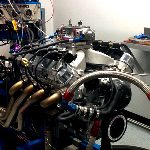




406 lsx vs 408 lsx

Speed that's a generalization(of what I read a long time ago) that was used for a sbc with the same stroke etc..., only a cam change. Engine made x amount 6 degrees in duration were added and it picked up around 20 at the crank it did lose some Tq *add some comp. Old old old Hot Rod mag. 383 gen 1 style chevy with Brodix heads 11:5 comp. Maybe 10:5 compression very old read. Still got the old mag along with around 300 others LOL.
I'm waiting for Lance. We seen 6000 rpm and it's the same for more $. Let us now see what happens with RPM. Big bore heads flow 400 and small bores flow around 360 to 390 depending on CSA and heads used.
I'm waiting for Lance. We seen 6000 rpm and it's the same for more $. Let us now see what happens with RPM. Big bore heads flow 400 and small bores flow around 360 to 390 depending on CSA and heads used.

Banned
Joined: Apr 2017
Posts: 948
Likes: 1
You may be right. I gave Comp cams and Westech dyno the benifit of a doubt for a cam swap and trying to get mid 10"s with a 150 hot shot on a 383.
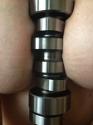
Speed you being the cam guy you are what type of cam am I asking or looking at. It has a more plateau or flatter type lobe to keep the valve open longer to have more area under the curve to maximize airflow. I've found this one lobe I've never seen before. It's under Comp cams DIX cam profile: The DIX series is similar to the RX but with substantially more area under the curve.. I don't know which has more area under the curve , vs cam profiles such as the Comp UBR or HXL line of cams. I'll call tomorrow hoping you could save me the time. Didn't mean to get off base just I'd like to know which has more of what I'm looking for.
Speed you being the cam guy you are what type of cam am I asking or looking at. It has a more plateau or flatter type lobe to keep the valve open longer to have more area under the curve to maximize airflow. I've found this one lobe I've never seen before. It's under Comp cams DIX cam profile: The DIX series is similar to the RX but with substantially more area under the curve.. I don't know which has more area under the curve , vs cam profiles such as the Comp UBR or HXL line of cams. I'll call tomorrow hoping you could save me the time. Didn't mean to get off base just I'd like to know which has more of what I'm looking for.
Who mentioned anything about reving to 8500 RPMs or .800" lift?
Where did that come from?
KW
Banned
Joined: Apr 2017
Posts: 948
Likes: 1
KW we did see what happens @ 6k and it's about even. Why not ask for 7000 to 8k (also maximize the high flow of the big bore heads) we have the low level 6k rpm limit. The bigger bore should do so much better as they have said which didn't go as one may have thought. Why not ask to see? The bigger bore does this and that with around the same CID. The kittty 6k rpm is known so let's go on the deeper end of the pool.... to see what happens.(Oh it rev's well let's See) Just for the sake of RPM to see and know. I know for a fact no one here who would buy a cam with that much duration and lift. Just a cost less test to see what happens. The cam lobes asked about above are just from reading and that was my own personal ?
Last edited by Patron; Aug 10, 2017 at 09:02 AM.
IMO, this is pretty similar discussion to a 3.9" bore x 4" stroke 383 vs a 4.125" bore x 3.622" stroke 388.
I'm really curious to see how 98_ws6_m6's 383 he's building with a mamo top end will compare with Big Hammer's 388. Both of those are very well built motors - not like its a bad 383 and a tremendous 388
I'm really curious to see how 98_ws6_m6's 383 he's building with a mamo top end will compare with Big Hammer's 388. Both of those are very well built motors - not like its a bad 383 and a tremendous 388
At what point is too much too much? I ask because I'm in conversations with engine builders on how big to go.
4.125" bore x 3.622" stroke 388 with twin 366's is all that is needed to run 8.60's at the track while being more than enough power on the street.
Would a TT 427 not be overkill on the street? I realize this is a non forced induction discussion, but curious how this thought applies when discussing forced induction setups as I know next to nothing about turbo applications.
But what if the application is twin turbo street car and not NA? How do you view the smaller cubes then? Is it still "why go TT 388 when you can go TT 427 since you are spending money on an aftermarket block"?
At what point is too much too much? I ask because I'm in conversations with engine builders on how big to go.
4.125" bore x 3.622" stroke 388 with twin 366's is all that is needed to run 8.60's at the track while being more than enough power on the street.
Would a TT 427 not be overkill on the street? I realize this is a non forced induction discussion, but curious how this thought applies when discussing forced induction setups as I know next to nothing about turbo applications.
At what point is too much too much? I ask because I'm in conversations with engine builders on how big to go.
4.125" bore x 3.622" stroke 388 with twin 366's is all that is needed to run 8.60's at the track while being more than enough power on the street.
Would a TT 427 not be overkill on the street? I realize this is a non forced induction discussion, but curious how this thought applies when discussing forced induction setups as I know next to nothing about turbo applications.
Yes, I think a twin turbo 427 might be hard to control on the street, but there again, a single larger turbo would delay the spooling and help with lower rpm control. Might even make MORE power up top vs the twins.
Switching focus to the top end power, I do think that anything that makes more power NA will make even morER power FI. Sort of like how ported heads benefit FI even more than they benefit NA. The rules don't change, just the pressure difference between the intake manifold and the cylinder.
Banned
Joined: Apr 2017
Posts: 948
Likes: 1
Pretty much what Darth said check your in box.Too much Down low Tq is not needed or wanted you'll have more than enough with FI. Pretty sure John would have said or thinking the same thing as above. Besides what he told you over the phone.
LS1 Tech Stories
The Best V8 Stories One Small Block at Time

Gas Monkey Built a 6-Wheel Ferrari Testarossa With a Corvette LT4 Engine
Verdad Gallardo
7 Most Reliable High-Performance Engines GM Has Ever Built
Verdad Gallardo
Amazing '71 Camaro Restomod Is Modern Muscle Car Under the Skin
Verdad Gallardo
6 Common C5 Corvette Failures and What's Involved In Repairing Them
Pouria Savadkouei
Retro Modern Bandit Pontiac Trans AM Comes With Burt Reynolds' Autograph
Verdad Gallardo
Top 10 Greatest Cadillac V Series Performance Models Ever, Ranked
Pouria Savadkouei
Top 10 Most Powerful Chevy Trucks Ever Made!

Hennessey's New Supercharged Silverado ZR2 Has 700 HP
Verdad Gallardo
Coachbuilt N2A Anteros Is an LS2-Powered C6 Corvette In Italian Clothes
Verdad Gallardo EAP Model Method
 Hi ALL, yes the remarks in the above stated tech are true. (COMPLETELY)
Example: "speedtrigger" = True with respect to the BASE numbers, NOT a Lobe File, that was specified !
EAP is ALLOWED to input the lobe files I use for Crower Cams orders, the Andrews file.
The Cam Doctor lobe file is also allowed input.
The use of these produce MUCH greater accuracy.
The heads are of great concern with respected flow numbers ALLOWED as input.
These first two items, if provided, are MAJOR factors in an EAP report.
NEXT, the manifold runner dimensions (BOTH) are needed inputs.
The patron request was a simple bore/stroke change report based on an OEM LS-3. (with cam upgrade)
ALL here are asked to provide their specifications AND EACH will have a custom report.
Lance
Example: "speedtrigger" = True with respect to the BASE numbers, NOT a Lobe File, that was specified !
EAP is ALLOWED to input the lobe files I use for Crower Cams orders, the Andrews file.
The Cam Doctor lobe file is also allowed input.
The use of these produce MUCH greater accuracy.
The heads are of great concern with respected flow numbers ALLOWED as input.
These first two items, if provided, are MAJOR factors in an EAP report.
NEXT, the manifold runner dimensions (BOTH) are needed inputs.
The patron request was a simple bore/stroke change report based on an OEM LS-3. (with cam upgrade)
ALL here are asked to provide their specifications AND EACH will have a custom report.
Lance
Banned
Joined: Apr 2017
Posts: 948
Likes: 1
I can provide all the info or where to find it, there just normal aftermarket intakes. And the heads used would be Mamo AFR/TFS Ls3 heads for the big bore and Factory Ls3 heads ported by FRH as we have the listed flow for both. And let's just rev it to say 7000 to 8k Lance. Let me get up and get on my home CPU and not this I phone. If someone could post the Mamo Ls3 flow chart for either. Give me a second.



My experience says what is in bold is not true as a generalization. First, I offer that this depends on the RPM. With "all other variables held constant" the longer stroke engine is going to make peak torque a little earlier. So, at that earlier RPM, the longer stroke will make more power. With that said, once the engine RPMs get above peak torque, the short stroke and better road ratio engine will perform better for sure.
My interpretation of the question is all things equal...4.030 x 4.00 vs 4.155 x 3.75" stroke.
Below peak torque yes the longer stroke engine should produce more horsepower. Peak torque should be the same or very extremely similar. Above peak torque I would expect to see the larger bore engine produce more power - and the higher the revs go the more disparity there will be.
Banned
Joined: Apr 2017
Posts: 948
Likes: 1
A CID,Super Vic intake or MSD(ported or unported) can be used with a 4500 or 102 T/b depending. Let's keep the lift in the terms of safe so .750 lift and a duration of 266 to 270 @ .050. Can the 4 inch crank have around 2 to 4 degrees in intake duration to make things = as far as RPM and the stroker eating up duration.
Factory Ls3 heads from FRH for the 4.030 bore and 4 inch crank.
2.165
.200/159
.300/237
.400/282
.500/338
.600/368
.700/388
.750/390
Ex 1.590
.200/120
.300/190
.400/225
.500/242
.600/250
.700/255
.750/257
Mamo TFS Ls3 heads to be used with a 4.155 bore and 3.75 stroke
Lift.......Int....Exh
.200....151....125
.300....236....177
.400....297....218
.500....339....239
.550....359....246
.600....378....252
.650....383....258
.700....388....261
At the end let's do Cost to build each.
Factory Ls3 heads from FRH for the 4.030 bore and 4 inch crank.
2.165
.200/159
.300/237
.400/282
.500/338
.600/368
.700/388
.750/390
Ex 1.590
.200/120
.300/190
.400/225
.500/242
.600/250
.700/255
.750/257
Mamo TFS Ls3 heads to be used with a 4.155 bore and 3.75 stroke
Lift.......Int....Exh
.200....151....125
.300....236....177
.400....297....218
.500....339....239
.550....359....246
.600....378....252
.650....383....258
.700....388....261
At the end let's do Cost to build each.
Banned
Joined: Apr 2017
Posts: 948
Likes: 1
Oh no! It's, just is what it is don't back track now in terms of Money wasted for some crank combination that cost 3k more to start. Yea that's the AH HA! If you don't get over 50 hp money Wasted. As I know a 4 in crank would not even be a ? in terms of Hp / Tq. Let's play ball Smaller crank guys.
Banned
Joined: Apr 2017
Posts: 948
Likes: 1
Don't hate the Messenger hate the game with that Short as stroke. Lance will post them and then we will all see. As of now your Higher number went in the trash @ 6k. You may as well extend the RPM to see if that helps LOL!